


TL;DR
An MVP, or minimum viable product, is the simplest version of a product that still delivers real value to real users, built to test whether an idea works before investing in the full product. It has just enough features to solve one core problem and prove one hypothesis, nothing more. Founders build an MVP to learn fast and cheaply: instead of spending months and a budget on a product nobody has validated, they ship the smallest useful version, put it in front of real users, and let actual behavior guide what to build next.
The term was coined by Frank Robinson in 2001 and popularized by Eric Ries in The Lean Startup. This guide explains exactly what an MVP is and is not, what "minimum" and "viable" really mean, the types of MVP, famous real-world examples, what it means in software and agile, and why it has become the default first step for serious startups. At MVP Development we turn validated ideas into funding-ready MVPs in 21 days, more on that at the end.
Key Takeaways
- An MVP is the simplest version of a product that still delivers real value to real users.
- It has just enough features to solve one core problem and prove one hypothesis, nothing more.
- Founders build an MVP to learn fast and cheaply before investing in the full product.
- The term was coined by Frank Robinson in 2001 and popularized by Eric Ries in The Lean Startup.
- You ship the smallest useful version, put it in front of real users, and let behavior guide what to build next.
What is an MVP? A clear definition
An MVP (minimum viable product) is a version of a new product built with the minimum set of features required to deliver real value to early users and gather validated learning about whether the idea works, with the least effort and cost.
MVP stands for Minimum Viable Product. Each word carries weight: minimum (as few features as possible), viable (it must actually work and provide value), and product (something real people use, not a mockup or a slide). Put together, an MVP is the smallest thing you can build that is still genuinely useful to a real user.
The concept comes from lean and agile thinking. The term itself was coined by Frank Robinson in 2001, but it was Eric Ries's Lean Startup and Steve Blank's customer-development work that made it the standard practice it is today. Their core insight: most startups fail not because they cannot build the product, but because they build a product nobody wants. The MVP exists to catch that failure early, while it is still cheap to fix.
A practical way to hold it in your head: an MVP is an experiment, and a working product is the apparatus. Its purpose is to answer a question, do people want this, and does our solution deliver it?, with the smallest possible build. That reframe is what separates a true MVP from "version one of the product."
What "minimum" and "viable" really mean
Most confusion about MVPs comes from misreading one of the two key words. Getting both right is the whole game.
Minimum means as few features as you can ship while still solving the core problem. It is an exercise in subtraction: you start from your full vision and cut everything that is not essential to proving the central hypothesis. Not the nice-to-haves, not the edge cases, not the polish, just the one core flow. The discipline is brutal, and it is the single hardest, most valuable part of building an MVP.
Viable means it actually works and delivers real value. This is the half founders forget. An MVP is not a broken, half-finished, or shoddy product, it is a complete solution to one narrow problem. The core flow must function reliably, because if it does not, users churn for the wrong reason and you misread a quality failure as a demand failure. Minimum scope, viable quality.
The tension between the two is the point. Push too far toward "minimum" and you ship something that does not work, which teaches you nothing true. Push too far toward "viable" and you over-build, blowing the time and budget the MVP was supposed to save. A good MVP sits exactly at the intersection: the smallest build that still does its one job well. Think of it as the most basic version that a real user would actually find useful and be willing to use, not the most basic version you can technically ship.
Why do MVPs exist? The purpose
The MVP exists to replace guessing with evidence. Every new product rests on assumptions, that people have the problem, that they want your solution, that they will pay. Building the full product to test those assumptions is the most expensive possible way to find out you were wrong. The MVP tests them for a fraction of the cost.
This is what Eric Ries calls validated learning: progress measured not in features shipped but in things proven about your customers and market. The MVP runs a tight loop, build the smallest thing, measure how real users respond, learn what to do next, then repeat. Each turn of the loop converts an assumption into knowledge.
The payoff is risk reduction. A startup that builds an MVP first either confirms the idea works (and now builds the rest with confidence and evidence to raise on) or discovers it does not (and pivots or stops before burning a year and a runway). Both outcomes are wins compared to building blind. The MVP is, in essence, the cheapest insurance a founder can buy against the most common cause of startup death: building something nobody wanted.
The lean startup and validated learning
The MVP is the centerpiece of the lean startup methodology, and that context is what makes the concept click. Lean startup, formalized by Eric Ries, argues that a startup is fundamentally an engine for learning under extreme uncertainty, and that the way to win is to discover what customers actually want as fast and cheaply as possible, rather than executing a detailed plan built on untested assumptions.
The mechanism is the build-measure-learn loop. You build the minimum thing needed to test an idea (the MVP), measure how real users respond, and learn whether your hypothesis held, then feed that learning into the next build. The goal is to move through the loop as quickly as possible, because each turn converts a guess into validated knowledge. The MVP is what makes the "build" step fast and cheap; without it, each loop would take months and cost a fortune.
This reframes what "progress" means. In a traditional plan, progress is features shipped against a roadmap. In lean startup, progress is validated learning, how much you have proven about your customers and market. An MVP that "fails" by disproving an assumption is real progress, because it stops you building the wrong thing. A beautifully built feature nobody uses is not progress, however much work it took.
Two related ideas complete the picture. Pivoting is changing direction based on what you learn, when the MVP reveals your assumption was wrong but points to a better one. Persevering is doubling down when the MVP validates the idea. The MVP exists to give you the evidence to make that call honestly, instead of escalating commitment to a plan that reality has already contradicted.
When should you build an MVP?
An MVP makes sense whenever you are building something new and uncertain, a new product, feature, or market, where the cost of being wrong is high and the demand is unproven. That covers almost every startup and most new product lines inside established companies. If you face real uncertainty about whether people want what you are about to build, an MVP is the cheapest way to resolve it.
There are a few cases where the full MVP discipline is less necessary: a well-understood product in an already-validated market, or a trivial feature with little downside. And in some regulated spaces (parts of healthcare or finance), a bare-bones version cannot credibly or legally ship, so you may need more than a minimal product to test at all, though the lighter validation methods still apply.
But these exceptions are rarer than founders think. The instinct to skip the MVP because "I just know this will work" is precisely the overconfidence the MVP exists to check. The asymmetry favors building one: an MVP that confirms demand costs you a little; skipping it and building the wrong thing costs you everything. The real question is rarely "should I build an MVP?" but "what is the lightest MVP that proves my riskiest assumption?"
What an MVP is NOT
Half of understanding the MVP is separating it from the concepts it gets confused with. These distinctions matter because conflating them is the most common reason MVPs balloon in scope or get built at the wrong time.
- An MVP is not a prototype. A prototype is a non-functional mockup used to test design and flow, often clickable but not real. An MVP is a working product real users can actually use to get value. See MVP vs prototype for the full distinction.
- An MVP is not a proof of concept (POC). A POC is an internal technical test that answers "can we build this?" An MVP answers "do people want this?", a market question, not a technical one. See MVP vs POC.
- An MVP is not a beta. A beta is a near-complete product tested for bugs before full release. An MVP comes much earlier and is far smaller, it tests the core idea, not the finished product. See MVP vs beta.
- An MVP is not version 1.0 of the full product. It is deliberately incomplete, scoped to one hypothesis. Treating it as "the first version of everything" is how scope creep kills MVPs.
- An MVP is not a low-quality product. Minimal in scope, never minimal in quality. The features it has must work.
| Concept | Question it answers | Stage |
|---|---|---|
| Proof of concept | Can we build it? | Earliest, internal |
| Prototype | How should it look and flow? | Design, non-functional |
| MVP | Do people want it? | First real product |
| Beta | Is the full product bug-free? | Near launch |
The characteristics of a good MVP
A well-built MVP shares a handful of traits. Use these as a checklist for whether what you are building is actually an MVP or something heavier wearing the name.
- Focused. It solves one core problem for one core user, not many problems for many users. One hypothesis, one flow.
- Functional. The core flow works reliably. It is viable, a real, usable product, not a mockup or a broken shell.
- Valuable. A real user gets a real benefit from it. If no one would actually use it, it is not viable.
- Minimal. It contains only the must-have features required for that core flow. Everything else is deferred.
- Measurable. It is instrumented so you can learn from real usage, activation and retention, not vanity metrics.
- Fast and cheap to build. Because it is minimal, it ships in weeks, not quarters, and costs a fraction of the full product.
The thread connecting all six is intentionality. An MVP is not what you get when you run out of time or money on a bigger build, it is a deliberate, scoped experiment designed to answer a specific question. That intent is what separates a real MVP from a half-finished product.
The types of MVP
Not every MVP is a working app. Some prove demand before any product exists at all. MVPs span a spectrum from "no real product" to "one real feature," and the right type depends on your riskiest question. Here are the common formats, covered in full in our guide to the types of MVP.
| Type | What it is | Proves |
|---|---|---|
| Landing page | A page describing the product with a signup | Interest in the promise |
| Concierge | You deliver the service manually, by hand | The solution delivers value |
| Wizard of Oz | A real-looking front end run manually behind the scenes | The experience works |
| Explainer video | A demo of the product as if it exists | Demand (Dropbox's method) |
| No-code build | A working product built without custom code | The flow, cheaply |
| Single-feature build | A real product with exactly one core flow | Usage and retention |
The guiding rule: pick the lightest type that can answer your riskiest question. If the risk is "will anyone want this?", a landing page or video beats months of code. If it is "will the core flow retain users?", you need a single-feature build. Most funding-ready MVPs are that last type, one real, working flow.
Four questions is usually enough to narrow it down. Answer them and the matching type appears, with the guide for it:
Famous minimum viable product examples
The best way to understand an MVP is to see how the biggest companies started with one. None launched a polished, full-featured product. Each shipped something small that proved demand first. Eight of the clearest are below, and we cover fifteen in full, with what each one proved, in our guide to MVP examples.
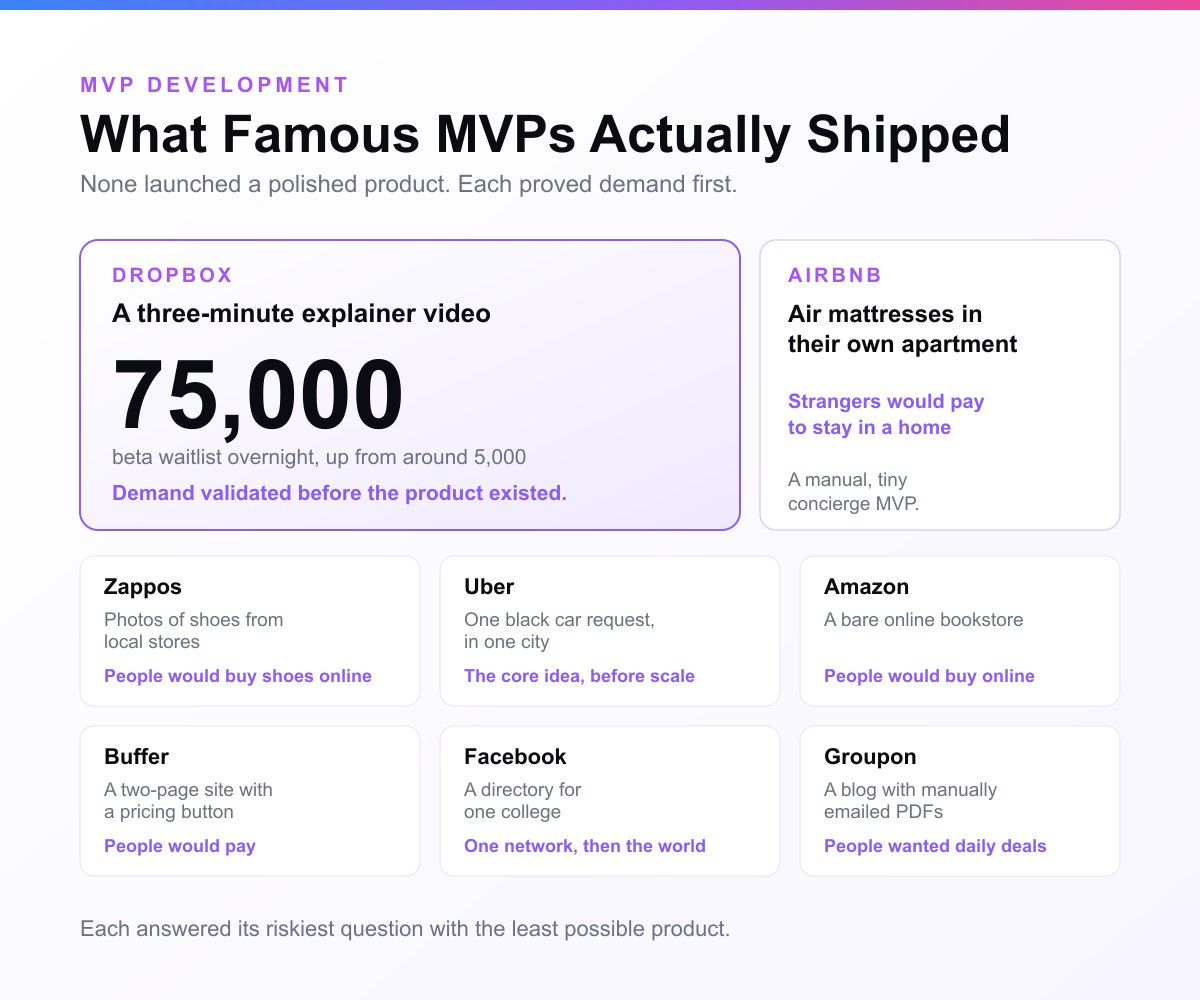
- Dropbox did not build its sync engine to test demand. Founder Drew Houston posted a three-minute explainer video showing how it would work. The beta waitlist jumped from around 5,000 to 75,000 overnight, demand validated before the product existed.
- Airbnb started when the founders rented out air mattresses in their own apartment to test whether strangers would pay to stay in someone's home. A manual, tiny concierge MVP that proved the core hypothesis before any platform was built.
- Zappos tested whether people would buy shoes online by photographing stock at local shoe stores, posting the photos, and buying from the store when an order came in. No inventory, no warehouse, just proof of demand, a classic Wizard-of-Oz MVP.
- Uber launched as a simple app (originally UberCab) that only let you request a black car in one city, San Francisco. One feature, one city, no scheduling, no pool, no food delivery. It proved the core idea before becoming a global platform.
- Amazon began as a bare online bookstore. Jeff Bezos started with books alone, the simplest possible product to test whether people would buy online, before expanding to "everything."
- Buffer validated demand with a two-page site: one describing the product, one showing pricing plans behind a button. Clicks on the paid plans, before any product existed, proved people would pay.
- Facebook launched as a simple directory for a single college, Harvard, with basic profiles and almost nothing else. One network, one feature set, before expanding school by school into a global platform.
- Groupon began as a bare WordPress blog where the founder manually emailed PDF coupons to subscribers. No platform, no automation, just enough to prove people wanted daily local deals before building the real thing.
The pattern across all of these: each answered its riskiest question with the least possible product, and none scaled until the proof was in. That is the entire discipline of the MVP.
What is an MVP in software development?
In software development, an MVP is the first working version of an application that includes only the features needed to deliver its core value and validate the concept with real users. It is the bridge between an idea and a full software product. (If you are right at the start, see the beginner's roadmap for how to turn your idea into an app.)
Practically, building a software MVP means identifying the single core workflow, signup to core value, building that flow to production quality, and deliberately excluding everything else: secondary features, admin tools, customization, and edge cases. The software MVP is real, deployed, and usable, but narrow. It is engineered to be extended later, not thrown away, which is why the tech stack and build approach matter: a good software MVP is owned, production-grade code you scale from after product-market fit.
The software MVP is where "minimum viable" gets tested hardest, because engineers can always add "just one more feature." Resisting that is the core discipline. The full sequence, from validating the idea to shipping the build, is covered in our MVP development process guide.
What is an MVP in agile?
In agile development, the MVP is the first increment of a product that delivers usable value, the smallest releasable slice you can put in front of users and learn from. Agile and the MVP fit together naturally: both are built on short cycles, real feedback, and iterating toward the right product rather than guessing it up front.
In an agile workflow, you build the MVP, release it, gather feedback, and use that feedback to prioritize the next increment, the same build-measure-learn loop the MVP is built on, expressed as sprints. The Atlassian definition of the MVP frames it this way: the MVP is the version that lets a team start the learning process as early as possible. We go deeper on this in our guide to the MVP in agile.
The key agile principle the MVP embodies is responding to change over following a plan. Rather than committing to a full feature roadmap built on assumptions, you ship the minimum, learn from reality, and let real usage shape the roadmap, which is exactly what an MVP is designed to enable.
What is an MVP in business and for startups?
For a startup, the MVP is a stage as much as an artifact, the phase where the company's entire focus is proving its core idea with a real product before scaling or raising significant capital. It sits between ideation and product-market fit, and clearing it is what unlocks the next funding round. We cover this in depth in the MVP stage of a startup.
In business terms, the MVP is a risk-management tool. It lets a company test a new product or market with minimal investment, gather real evidence, and decide whether to commit further, all before betting the budget on an unproven idea. That is as true for an established company launching a new line as it is for a two-person startup. The MVP turns a large, risky, all-at-once bet into a small, informed, sequential one.
For founders specifically, the MVP has become the price of entry to fundraising. In 2026, even pre-seed investors increasingly want to see traction, a working product with early usage, not just a pitch deck. The MVP is how you produce that proof. A deployed MVP with real users is the artifact that turns an investor conversation from "we think" into "we know."
Common misconceptions about MVPs
The MVP is one of the most misunderstood ideas in startups, and the misunderstandings are expensive. A few worth clearing up.
"An MVP is a low-quality product." The most damaging myth. Minimal refers to scope, not quality. The features an MVP has must work well; a buggy core flow teaches you nothing true, because users churn on the bug, not on the idea. Minimal scope, viable quality.
"An MVP is just the cheapest, fastest thing you can ship." Not quite, it is the smallest thing that still delivers real value. "Cheap and fast" without "valuable" produces something nobody uses, which is not viable, and therefore not an MVP.
"You only build one MVP." The MVP is the start of an iterative loop, not a one-off. You ship, learn, and iterate, often through several versions, as you converge on product-market fit.
"An MVP has to be software." No. Landing pages, explainer videos, and manual concierge services are all valid MVPs. Some of the most famous, Dropbox's video, Airbnb's air mattresses, involved little or no product code.
"Big companies don't need MVPs." Established companies use MVPs constantly to test new products and features with minimal risk. The logic of validated learning applies at any size.
"An MVP means launching something embarrassing." A common misreading of the "if you're not embarrassed by your first version, you launched too late" line. The point is to launch early to learn, not to ship something broken. An MVP should be minimal and credible, especially if investors will see it, not shoddy.
The benefits of building an MVP
The MVP has become the default first step because its benefits compound: it reduces risk (you learn whether the idea works before betting the budget), saves time and money (a scoped build ships in weeks for a fraction of the cost), produces real evidence from actual users instead of opinions, speeds up time to market, attracts investors (a working MVP with traction beats a deck), and gives you the usage data to build the right full product next. The meta-benefit underneath all of them is a shift from expensive certainty-seeking to cheap learning, which is the entire reason the practice exists.
We break down each of these in depth, with the honest trade-offs and who gains most from each, in our dedicated guide to the benefits of an MVP.
What comes after the MVP?
The MVP is the first step in a product's life, not the destination. Once it has proven the core idea, the product evolves through recognizable stages, and knowing them keeps you from staying in MVP mode too long or scaling too early.
After the MVP validates demand, many teams build toward the MLP (minimum lovable product), a version that does not just work but that users genuinely enjoy, adding the polish and delight the MVP deliberately skipped. We compare the two in MVP vs MLP. From there comes the MMP (minimum marketable product), the version with enough features and reliability to stand on its own in the market and be sold broadly, covered in MVP vs MMP.
The progression runs: prove it works (MVP), make people love it (MLP), make it sellable at scale (MMP), then build out the full product. Each stage rewards a different mindset, the MVP rewards ruthless cutting and speed; the later stages reward depth, polish, and reliability. Founders who keep "MVP-ing" after they have product-market fit stall out, never building the richer product the market now wants. Founders who try to build the full MMP before validating with an MVP burn out, over-investing in an unproven idea.
The discipline is knowing which stage you are in. The MVP's job ends the moment real users prove the idea works, your MVP stage is over, and the work shifts from proving to scaling what you validated. The MVP is where the journey starts, not where it ends.
From idea to MVP: how it actually happens
Understanding what an MVP is naturally leads to the question of how to build one. The short version: you validate, then build, then learn.
First, validate demand before building anything, confirm real people want this, using interviews, landing pages, or pre-sales. Our MVP validation guide covers the full process. Then, build the MVP: define the one core problem, cut features to a single flow, choose your build approach, and ship it to production quality, the complete walkthrough is in how to build an MVP. Finally, launch and iterate, put it in front of real users, measure activation and retention, and let the data guide what comes next.
The whole arc, validate, build, learn, is what separates founders who build the right product from those who build a product and hope. The MVP is the vehicle for that arc.
Build your MVP with a team that knows the discipline
Knowing what an MVP is and actually shipping one are different things. The hard part is the discipline, cutting to one core flow, resisting scope creep, building viable quality without over-building. That is the work of a dedicated MVP development company, and it is exactly what we do at MVP Development.
- We help you validate and scope. We pressure-test the idea and cut it to the one core flow that proves it, the hardest and most valuable part.
- We ship in 21 days. A complete, funding-ready MVP, built by senior engineers on a clear, scoped quote you approve before we start.
- It's funding-ready by default. A deployed product with a working core flow and a live URL, the artifact that turns a pre-seed conversation into a check.
- You own production-grade code. Built to scale past the MVP, not a throwaway prototype.
The honest trade-off is scope, not quality: we build the one validated flow, not ten guesses, which is what the definition of an MVP demands anyway. Explore our MVP development services or go straight to a custom MVP build.
Have an idea worth proving? Give us your idea in three sentences and we will sketch what its MVP looks like.
Related guides
Go deeper, by product type, by what makes an MVP work, and by the terms it gets confused with:
- By product type: SaaS MVP, AI MVP, and Marketplace MVP.
- Design and value: MVP UX design and the benefits of an MVP.
- MVP vs other terms: MVP vs MBI, MVP vs MMF, MVP vs pilot, and MVP vs SLC. Or see every term at once in the MVP glossary.
Frequently asked questions
What does MVP stand for?
MVP stands for Minimum Viable Product. It is the simplest version of a product that still delivers real value to users, built with just enough features to solve one core problem and test whether the idea works, before investing in the full product.
What is an MVP in simple terms?
In simple terms, an MVP is the most basic version of a product that real people can actually use and find useful. Instead of building everything at once, you build the smallest useful version, release it to real users, and learn from how they respond, so you discover whether the idea works before spending months and a budget on the full product.
What is an example of an MVP?
A classic example is Dropbox, which validated demand with a three-minute explainer video before building the product, the waitlist jumped from 5,000 to 75,000 overnight. Other famous examples include Airbnb (renting air mattresses by hand), Zappos (selling shoes by photographing local stock with no inventory), and Uber (a single app to request a black car in one city). Each proved its core idea with the smallest possible product.
Is an MVP the same as a prototype?
No. A prototype is a non-functional mockup used to test design and flow, it is not a real, usable product. An MVP is a working product that real users can actually use to get value. You often build a prototype during the design phase to catch flow problems cheaply, then build the MVP. Confusing the two leads founders to think they have validated demand when they have only tested an interface.
What makes a good MVP?
A good MVP is focused (solves one core problem for one user), functional (the core flow works reliably), valuable (real users get a real benefit), minimal (only must-have features), and measurable (instrumented so you can learn from real usage). The balance that matters most is minimal scope with viable quality, few features, but the features it has must genuinely work.
Why is it called a minimum viable product?
Because each word defines it: minimum (as few features as possible), viable (it must actually work and deliver value), and product (something real users use). The name captures the central tension, build the smallest thing that is still genuinely useful. The term was coined by Frank Robinson in 2001 and popularized by Eric Ries in The Lean Startup.
What is an MVP in software development?
In software, an MVP is the first working version of an application containing only the features needed to deliver its core value and validate the concept with real users. It is a real, deployed, usable product, but deliberately narrow, built around one core workflow and engineered to be extended later, not thrown away.
How is an MVP different from a finished product?
An MVP is deliberately incomplete, it contains only the features required to test one core hypothesis, while a finished product is feature-complete and polished for a broad market. The MVP comes first and exists to produce learning; the finished product comes after, built on the evidence the MVP gathered. Treating the MVP as a finished product is a common cause of scope creep and blown timelines.
Do startups still need an MVP in 2026?
Yes, more than ever. AI tooling has made building faster, but that has raised the bar: "we built it" no longer impresses on its own, investors and users want evidence of demand. The MVP is how you produce that evidence cheaply. Even pre-seed investors increasingly expect a working product with early traction, which is exactly what an MVP delivers.
How long does it take to build an MVP?
A well-scoped MVP with one core flow typically takes a few weeks to a few months, depending on complexity and build approach. No-code MVPs can take days to weeks; custom builds run weeks to a couple of months. A tightly scoped, senior-built MVP can ship in as little as three to four weeks. The biggest factor is scope, the more minimal the MVP, the faster it ships.
Who came up with the minimum viable product?
The term "minimum viable product" was coined by Frank Robinson in 2001. It was popularized and shaped into today's standard practice by Eric Ries in The Lean Startup and Steve Blank through his customer-development work. Their shared insight, that startups fail mostly from building things nobody wants, made the MVP a core tool for testing demand before committing to a full build.
What is the difference between an MVP and an MMP?
An MVP (minimum viable product) is the smallest product that tests whether an idea works, built to learn, not to sell broadly. An MMP (minimum marketable product) comes later: the version with enough features, polish, and reliability to stand on its own in the market and be sold to a wide audience. The MVP proves demand; the MMP captures it. Many products pass through an MLP (minimum lovable product) in between.
Is an MVP only for startups?
No. While the MVP is most associated with startups, established companies use it constantly to test new products, features, and markets with minimal risk. Any time an organization faces real uncertainty about whether people want what it is about to build, the MVP, validated learning through the smallest real product, applies. The logic scales from a two-person startup to an enterprise launching a new line.
Sources & references
This guide draws on the foundational lean-startup and product literature:
- Eric Ries, The Lean Startup, validated learning and the popularization of the MVP
- Atlassian, Minimum Viable Product, the MVP in agile product development
- Minimum Viable Product, Wikipedia, the term's origin with Frank Robinson (2001) and its evolution
- Shortform, The Original Dropbox MVP Explainer Video, the explainer-video MVP that validated demand before the product existed
Definitions reflect established lean and agile practice; the 21-day figure is based on our own data for focused, scoped builds.


