


TL;DR
The MVP stage is the first build phase of a startup's lifecycle: you ship the smallest product that delivers real value, then test it with users to prove the core idea before scaling or raising. It sits between ideation and product-market fit, after you've picked a problem, before you've proven people want the solution. Its only job is evidence. You leave the MVP stage not when the product is "done," but when real usage data tells you the idea works.
Why this matters now: in 2026, investors expect proof earlier, even pre-seed checks increasingly want traction, not just a deck. At MVP Development we get founders through the MVP stage fast: a funding-ready MVP in 3 to 4 weeks, built by senior engineers, on a clear, scoped quote you approve before we start. More on that at the end.
Key Takeaways
- The MVP stage is the first build phase of a startup's lifecycle: ship the smallest product that delivers real value, then test it with users.
- It sits between ideation and product-market fit, after you have picked a problem, before you have proven people want the solution.
- Its only job is evidence.
- You leave the MVP stage not when the product is "done," but when real usage data tells you the idea works.
- In 2026, investors expect proof earlier; even pre-seed checks increasingly want traction, not just a deck.
What is the MVP stage of a startup?
The MVP stage is the period in a startup's life when its entire focus is building and launching a minimum viable product, the most basic version of the product that still delivers value, to validate one core hypothesis with real users.
The term comes from Eric Ries's Lean Startup. An MVP isn't a half-finished product; it's a deliberate experiment. The MVP stage is the chapter of your company built around that experiment: minimal resources, one core flow, and a single question, do people actually want this?
We call it the proof stage, because that's its real output. Not features, not revenue, not headcount, evidence. Everything you do in this stage either produces proof that the idea works or proof that it doesn't, and both are wins compared to guessing.
Where the MVP stage sits in the startup lifecycle
A venture-backed startup moves through roughly seven stages. The MVP stage is the second, early, foundational, and the one everything later depends on.
| # | Stage | Goal | Where the MVP fits |
|---|---|---|---|
| 1 | Ideation | Find a problem worth solving | The setup for the MVP |
| 2 | MVP (proof stage) | Prove the idea with a real product | ← you are here |
| 3 | Investment (pre-seed/seed) | Fund the proof | The MVP unlocks the raise |
| 4 | Product-market fit | Earn retention + real demand | The MVP's payoff |
| 5 | Go-to-market | Build repeatable acquisition | After the MVP |
| 6 | Growth | Scale what works | After the MVP |
| 7 | Maturity | Optimize and expand | After the MVP |
The key relationship: the MVP stage comes before product-market fit, not after. Founders who treat the MVP as a finished product skip the learning the stage exists to produce. The MVP stage ends when PMF begins, and PMF is something users grant you, not something you declare.
Two things this guide deliberately does not repeat. The work inside the stage, discovery through launch, is the MVP development phases, covered step by step in the process guide. The document that schedules that work against a date is the MVP roadmap. This page is about the stage itself: what it is for, how long it lasts, how you know you have cleared it, and what comes after.
What happens during the MVP stage
The MVP stage has one job and a short list of activities that serve it:
- Build the smallest product that tests the hypothesis. One core flow, not ten features. If you want a structured way to plan and sequence this, that's exactly what an MVP roadmap is for.
- Get it in front of real users fast. The clock matters, most MVPs ship in weeks, not months. See how long it takes to build an MVP for the phase-by-phase timeline.
- Instrument and measure. Pick one metric that proves or disproves the idea, and watch it.
- Keep the burn low. The MVP stage is about learning per dollar, not spending. For the numbers, see what an MVP costs.
Notice what's not on the list: scaling, hiring a big team, paid acquisition, polishing the UI. Those belong to later stages. Doing them in the MVP stage is the most common way founders burn runway before they've earned the right to spend it.
The 5 types of MVP (and when to use each)
Not every MVP is a working product. The leanest founders often prove the idea before writing much code. These are the five classic MVP formats, from lightest to heaviest:
| MVP type | What it is | Best when | Effort |
|---|---|---|---|
| Landing page / smoke test | A page describing the product with a signup or pre-order button | You're testing demand for something you haven't built | Hours to days |
| Explainer video | A short demo of the product as if it already exists | The product is hard to convey in text | Days |
| Concierge | You deliver the service manually, by hand, to real customers | You need deep early feedback and the flow is service-like | Days to weeks |
| Wizard of Oz | A front-end that looks automated but is run by humans behind the scenes | You want a real user experience before building the engine | Days to weeks |
| Single-feature build | A real, working product with exactly one core flow | You've validated demand and need usage and retention data | Weeks |
The rule: pick the lightest MVP that can answer your riskiest question. If the risk is "will anyone want this?", a landing page or video beats months of code. If the risk is "will the core flow work and retain users?", you need the single-feature build. Most funding-ready MVPs are that last row, one real flow, deployed.
MVP stage metrics that matter
The MVP stage runs on evidence, and evidence means metrics. Track these, and ignore the vanity numbers that feel good but prove nothing:
| Metric | What it tells you | Healthy signal |
|---|---|---|
| Activation rate | Do new users reach the core value? | 30%+ complete the core action |
| 90-day retention | Do they keep coming back? | Above ~40% |
| DAU/MAU ratio | How sticky is the product? | Near 20%+ |
| The 40% test | Would users be "very disappointed" without it? | 40%+ say yes |
| LTV:CAC | Would growth compound or bleed? | 3:1 or better |
| Qualitative feedback | Why the numbers move | Specific, repeated pain points |
Activation and retention are the two that matter most in the MVP stage, they tell you whether the core idea actually delivers value. Vanity metrics (total signups, page views, social followers) measure curiosity, not value. A thousand signups with 5% retention is a clearer "no" than a hundred signups with 50% retention is a "yes."
The MVP stage and startup funding
The MVP stage maps tightly onto the earliest funding rounds. Knowing which is which keeps you from pitching the wrong story to the wrong investor. The bar is highest with American investors, and MVP development for US startups covers what they expect a product to look like at this stage.
| Funding stage | Typical raise | What it funds | What investors expect to see |
|---|---|---|---|
| Pre-seed | $50k to $500k | Build the MVP, form the core team | A basic MVP or prototype, a waitlist, or design partners |
| Seed | $1M to $4M (18 to 24 months) | Turn the MVP into a marketable product, win first customers | A working MVP + early traction, a credible path to PMF |
| Series A | $10M to $15M | Scale a product that has PMF | Proof of product-market fit and real revenue |
A few things this makes clear:
- Pre-seed is the MVP stage's native funding round. Pre-seed money exists to build the MVP and hire the first few people, nothing more.
- Seed is the bridge out of the MVP stage. By seed you should have a working MVP and be chasing product-market fit, not still deciding what to build.
- Series A is past the MVP stage entirely. It's the hardest jump in the funding journey precisely because investors stop betting on potential and start demanding proof of PMF and revenue.
In 2026 the bar moved earlier: investors increasingly want early validation or first revenue even at pre-seed. The faster and cheaper you clear the MVP stage, the stronger your hand when you raise, and knowing exactly what investors evaluate in an MVP is what turns a working product into a funded one.
How long does the MVP stage last?
Two clocks run here, and founders conflate them. The first is the build: shipping the MVP itself, typically a few weeks to a few months depending on scope, the full breakdown is in our MVP timeline guide. The second is the stage: the build plus the months of real-world learning that follow, which usually runs until your seed round or until the PMF signals below show up.
For most startups the MVP stage as a whole lasts 6 to 18 months, short build, longer learning. The goal isn't to make it last; it's to get the answer and move on.
How real startups cleared the MVP stage
The most valuable startups didn't start with polished products. They started with scrappy MVPs that proved demand first, often before the real product existed. Three of the clearest are below; for the full set, see our guide to MVP examples.
Dropbox, the explainer video. Before building the full sync engine, Drew Houston posted a 3-minute demo video showing how Dropbox would work. The beta waitlist jumped from around 5,000 to 75,000 overnight. He validated demand for a product that barely existed, a textbook smoke-test MVP.
Airbnb, air mattresses. In 2007 the founders rented out air mattresses in their own apartment to test one question: would strangers pay to stay in someone's home? It was a concierge MVP, manual, tiny, and just enough to prove the core hypothesis before any platform existed.
Zappos, photos from the shoe store. Nick Swinmurn tested whether people would buy shoes online by photographing stock at local stores, posting the photos, and buying from the store when an order came in. A Wizard-of-Oz MVP: real transactions, no inventory, no warehouse, pure proof of demand.
The pattern across all three: each cleared the MVP stage by answering its riskiest question with the least possible product. None scaled until the proof was in, which is the entire discipline of the stage.
How to know you've outgrown the MVP stage
You leave the MVP stage when users, not your roadmap, tell you the idea works. The signals that you've reached product-market fit and graduated the proof stage:
- The 40% test. If 40%+ of users say they'd be "very disappointed" without your product (Sean Ellis's benchmark), you have PMF.
- Retention holds. 90-day retention above ~40%, and a DAU/MAU ratio near 20%, mean people keep coming back.
- Growth turns organic. Word-of-mouth and referrals start doing the acquisition work you used to do by hand.
- Selling gets easier. Shorter sales cycles and less need to educate buyers, the market already feels the problem.
- The unit economics work. An LTV:CAC ratio of at least 3:1 means growth would compound, not bleed.
Hit these and the MVP stage is over, your job shifts from proving to scaling. Miss them after a fair test, and the honest move is to iterate the MVP or pivot, not to raise and scale a thing the data hasn't validated.
What comes after the MVP stage
The MVP proved people want the thing. Everything you do once it's live, iterating, pivoting, or scaling, is the post-MVP stage, and it's where most of the real work happens. The next stage is often called the MMP (Minimum Marketable Product): making the product sellable, with enough polish, reliability, and features that it stands on its own in the market. After that comes go-to-market and growth.
The mental shift is the hard part. The MVP stage rewards speed and ruthless cutting; the stages after it reward depth, reliability, and scale. Founders who keep "MVP-ing" after PMF stall out; founders who try to scale before PMF burn out. Knowing which stage you're in is the whole game.
The stages after MVP, and what each one is called
Five acronyms describe the same journey, which is why the vocabulary confuses people. They are not competing methodologies. Each one answers the same question a different way: minimum in what sense?
| Stage | Minimum what | The bar it has to clear |
|---|---|---|
| MMP | Minimum Marketable Product | Enough value that you can charge for it and it stands on its own in the market |
| MLP | Minimum Lovable Product | People love it rather than merely tolerate it |
| MDP | Minimum Delightful Product | People enjoy using it, not just finish the task |
| MAP | Minimum Awesome Product | It survives a category where three competitors already do the same thing |
| MMF | Minimum Marketable Feature | Not a whole product: one feature with standalone market value |
In practice the order is simpler than the list makes it look. The MVP proves someone wants it. The MMP is the next real milestone, because it is the first version you can sell. MLP, MDP and MAP are three versions of one argument, that "it works" is no longer a high enough bar, and they matter most in crowded categories where a competitor is one tap away. MMF is a different unit altogether: once the product exists, it is how you size each thing you ship next.
The section above names the destination. This is the map: once your MVP is live and producing data, you are choosing between three paths, and the choice is the whole point of having built a minimal product first.
The three post-MVP paths
Once the data is in, you are choosing between three paths (plus the honest fourth option of stopping).
Path 1: Iterate (persevere)
If the signals are promising but not yet conclusive, retention is forming, some users clearly love it, you persevere: keep the direction and improve. You run the loop again, sharpening the core flow for the users who already value it, fixing what blocks activation, and deepening what drives retention. Most post-MVP time is spent here, iterating toward product-market fit one turn of the loop at a time (see MVP iteration). The discipline is to iterate toward a signal, not to polish aimlessly.
Path 2: Pivot
If the data says the current direction is not working, no segment retains, the core assumption was wrong, you pivot: change a major element (the user, the problem, the solution, or the model) while keeping what you learned. A pivot is not failure; it is the loop doing its job. The MVP exists precisely so you can change course cheaply, before you have sunk years into the wrong idea. The "iterate vs pivot" call, persevere or change, is the central post-MVP decision: see our full guide to pivot or persevere.
Path 3: Scale
If the signals are strong, retention has flattened, growth is increasingly organic, the 40% test passes, you have likely reached product-market fit, and the job changes from finding fit to scaling it. This is where you harden the product, invest in growth, and turn a validated MVP into a production-grade system that can handle real demand, which is exactly what our scale your MVP work handles (see how to scale an MVP). The critical rule: earn this path before you take it. Scaling before fit is the classic way startups burn out.
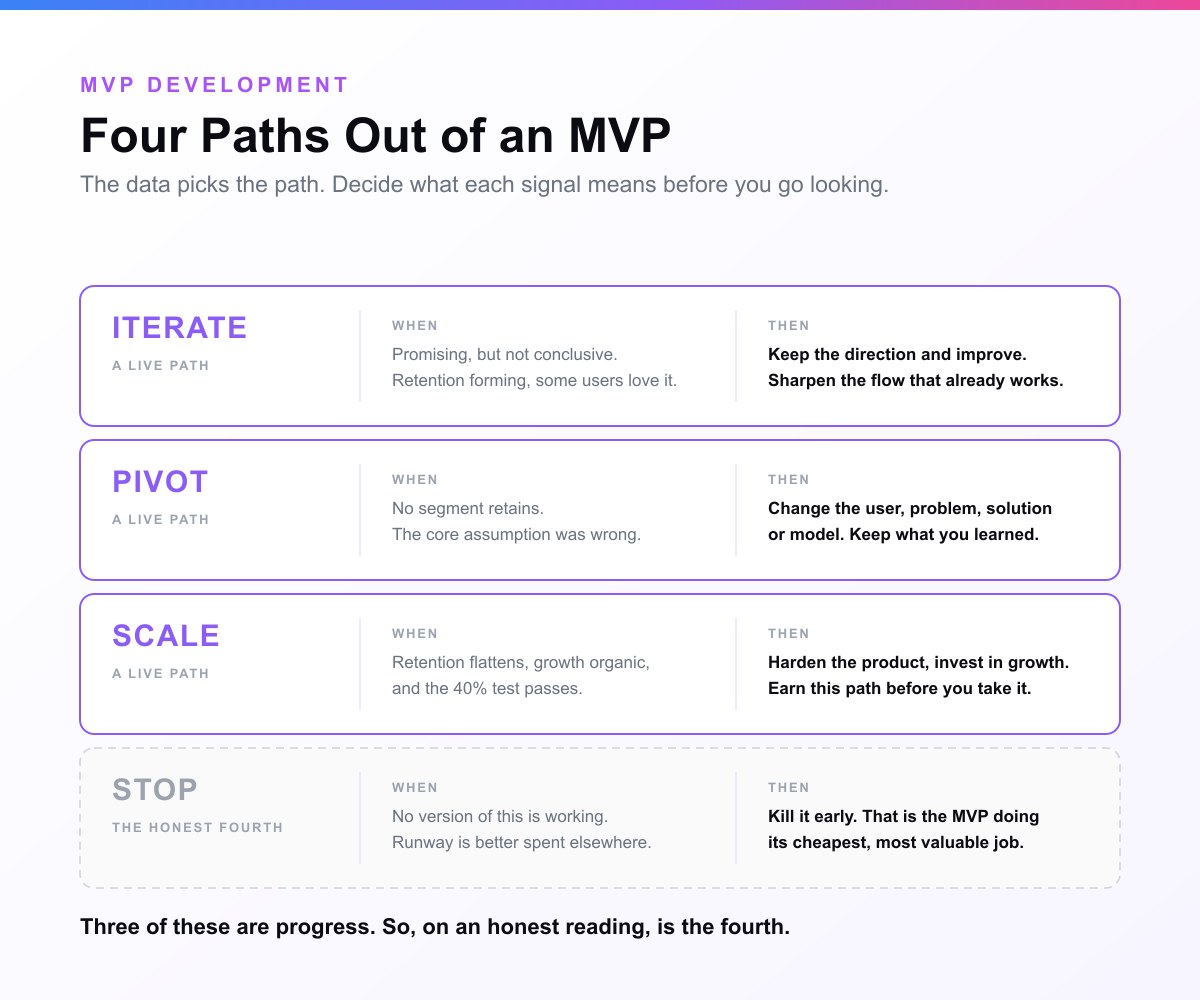
The fourth option: stop
Sometimes the honest read is that no version of this is working and the runway is better spent elsewhere. Killing a validated-as-dead idea early is not a failure of the MVP, it is the MVP succeeding at its cheapest, most valuable job: saving you from a much larger, later loss.
How to know which path you are on
The path is chosen by the data, not by hope. The signals to read:
- Retention. Do cohorts keep coming back, and does the curve flatten? Flattening retention is the strongest sign you are on the iterate-toward-fit or scale path. A curve decaying to zero points to pivot.
- The 40% test. Would users be "very disappointed" without the product? Climbing toward 40%+ says persevere and sharpen; stuck low says reconsider.
- Activation. Are new users reaching the core value? If not, that is an iterate problem (fix onboarding/the flow) before any bigger decision.
- Where growth comes from. Increasingly organic and referral growth is a fit signal that can justify scaling; all-paid, non-retaining growth is not.
These are the same signals covered in depth in MVP metrics and product-market fit. The post-MVP skill is committing, in advance, to what each signal means you will do, so you act on evidence rather than rationalize whatever you already wanted to do.
What to build next, post-MVP
Whatever path you are on, "what to build next" should be driven by the data, not by the backlog you parked during scoping. A useful sequence:
- Fix what blocks the core flow first. If activation is leaking, nothing else matters yet. Patch the path to value before adding anything.
- Pull from the "out of scope" list deliberately. The features you scoped out are now candidates, but re-prioritize them against real usage data, not the original guesses. Some you thought were essential will turn out not to be.
- Build toward the fit signal, not feature-completeness. Add only what moves retention or activation for the users who already value the product.
- Sequence it as a roadmap. Turn the chosen path into a plan with the same discipline as the first build, see the MVP roadmap.
The trap is reverting to "build the whole product now" mode the moment the MVP gets traction. Post-MVP is still lean: small, evidence-led increments, not a sudden return to building everything.
Common post-MVP mistakes
- Treating the MVP as done. Shipping and losing momentum, instead of running the next turn of the loop. The MVP was turn one.
- Scaling before fit. The most expensive post-MVP error, pouring money into growth and hiring before retention proves the value is real.
- Iterating without direction. Endlessly tweaking with no signal to aim at, "busy" is not "progress." Iterate toward a specific metric.
- Refusing to pivot. Clinging to the original idea when the data clearly says change. The loop only works if you act on it.
- Building the parked backlog blindly. Reaching for the pre-launch feature list instead of re-prioritizing against what real users actually do.
- Dropping the discipline. Abandoning scope and measurement once there is traction, which lets scope creep and vanity metrics back in.
MVP stage mistakes founders make
1. Overstaying the stage. Polishing the MVP forever instead of shipping, learning, and moving. The MVP stage is a doorway, not a room to live in.
2. Scaling too early. Hiring a team and buying ads before PMF. Spending like a growth-stage company while you're still a proof-stage one is the fastest way to die.
3. Building past the MVP. Adding features the stage doesn't need. Every feature beyond the core flow is runway spent on a question you haven't earned the right to ask yet.
4. Chasing vanity metrics. Celebrating signups instead of retention. Signups measure curiosity; retention measures value. Only one tells you the stage is over.
5. Raising on the wrong story. Pitching Series A growth metrics at the MVP stage, or pre-seed potential when investors now want traction. Match the narrative to the stage you're actually in.
6. Skipping the stage entirely. Building the "full product" and launching without validation. That's not ambition; it's an expensive way to discover nobody wanted it.
An MVP stage checklist
Use this to know when you're truly in the MVP stage, and when you've earned the right to leave it.
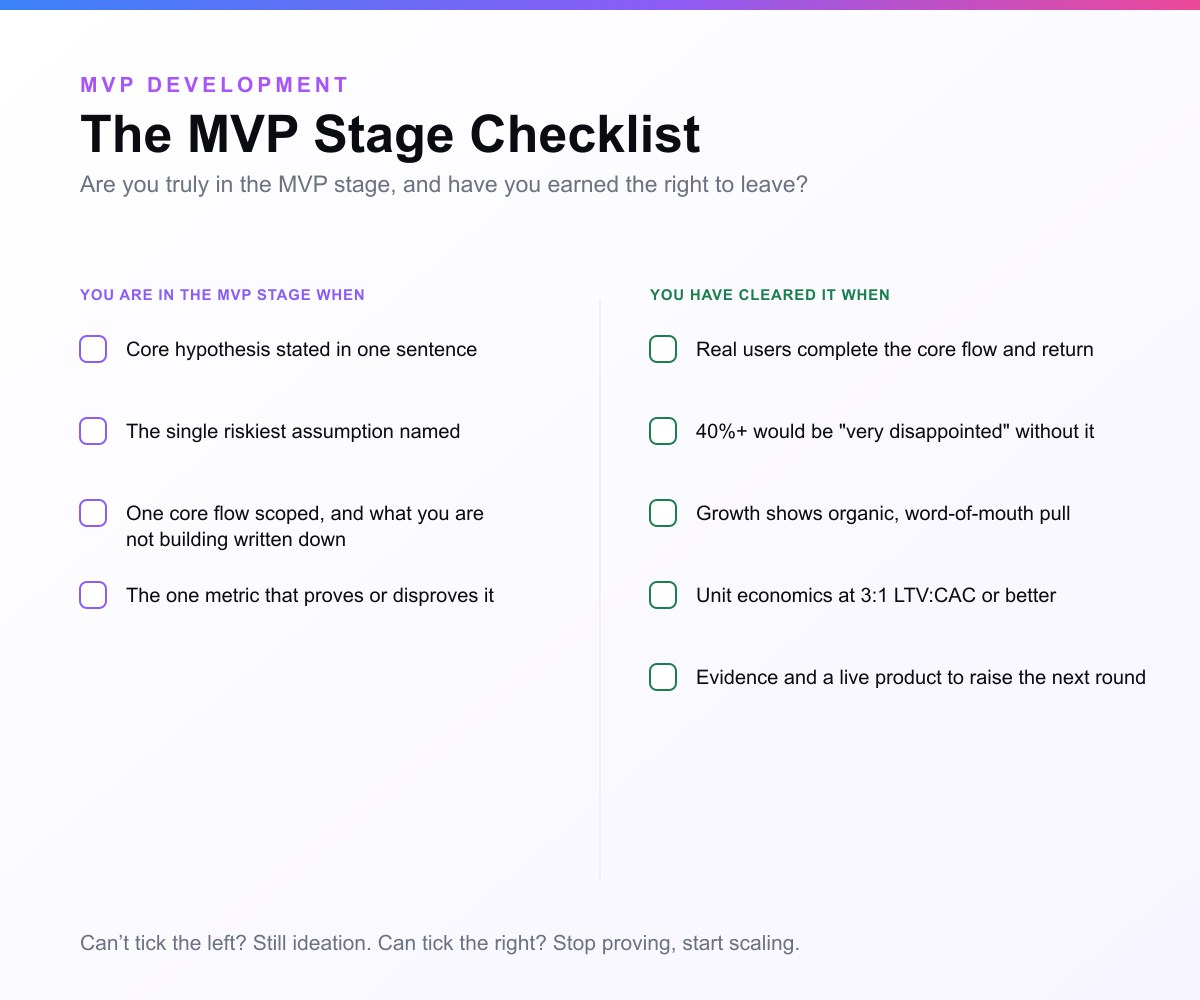
You're ready to enter the MVP stage when:
- You can state your core hypothesis in one sentence.
- You've named the single riskiest assumption to test.
- You've scoped one core flow, and written down what you're not building.
- You know the one metric that will prove or disprove the idea.
You've cleared the MVP stage when:
- Real users complete the core flow and come back (retention holds).
- 40%+ would be "very disappointed" without the product.
- Growth shows organic, word-of-mouth pull.
- Unit economics point to 3:1 LTV:CAC or better.
- You have the evidence, and the live product, to raise your next round.
If you can't tick the entry boxes, you're still in ideation. If you can tick the exit boxes, stop proving and start scaling.
The fast track through the MVP stage (the MVP Development method)
The MVP stage is a race to evidence, so the faster and cheaper you clear it, the more runway and momentum you keep. That's the whole point of how we work at MVP Development, a dedicated MVP development partner for the earliest stage: a complete, funding-ready MVP in 3 to 4 weeks, built by senior engineers with AI-accelerated tooling, on a clear, scoped quote you approve before we start.
Why it fits the MVP stage so well:
- It's scoped to the stage's actual job. One core flow, built to production standard, exactly the proof the stage exists to produce, and exactly what a pre-seed investor wants to see.
- It protects runway. A scoped, upfront quote means you spend on learning, not on a months-long build or a team you can't yet justify.
- It's funding-ready by default. A deployed product with working auth, a real core flow, and a live URL, the artifact that turns a pre-seed conversation into a check.
- It's senior-built, so it scales past the stage. Owned, production-grade code you expand from after PMF, not a throwaway you rewrite.
The honest trade-off is scope, not quality: our engagement buys the one flow that proves your idea, not ten features, which is what the MVP stage should be anyway. You get through the proof stage in 28 days instead of two quarters.
Ready to clear the MVP stage? Tell us which stage you are really at and we will say what to build now, and what to refuse to build.
How long the MVP stage actually lasts
The stage does not end when the product ships. It ends when the next round closes, and that gap is the part nobody budgets for.
Carta’s Peter Walker reported in February 2025 that in a normal year, something like 25 to 30% of startups that raised a seed round would graduate to a Series A within 24 months. For companies that raised seed in 2022, only about 17% made it in the first two years.
Carta’s Kevin Dowd reported in September 2025 that the median gap between a seed round and a Series A reached 616 days in Q2 2025, a little more than 20 months.
Read those two together carefully, because they count different things. The 17% is a cohort graduation rate: of the companies that raised seed in 2022, that share had reached a Series A two years later. The 616 days is a median across the Series A rounds that actually closed in Q2 2025, whenever those companies raised seed. So: most seed companies do not reach a Series A within two years, and among those that reach one at all, the typical wait is a little over twenty months.
The building is not the long part
Across 17 articles stating how long an MVP takes to build, MVP Development found a median claimed range of 8 to 12 weeks, with the fastest claim at 1 week and the slowest at 26. Read 23 September 2026, from the same 30-article corpus as the cost study.
Those are different clocks and the difference is the useful bit. Two or three months is time to a working product. 616 days is time to the next cheque. Shipping faster does not shorten Carta’s number, because what happens in between is traction, not code.
The practical consequence for a founder at this stage: the runway that matters is the one after launch, not the one before it. A build that eats the budget leaves nothing for the twenty months that decide whether there is a Series A at all.
What these figures are not
The build-time figure counts what articles claim, not what was measured on delivered projects, and the claims run from 1 week to 26. Treat it as a map of the advice rather than of delivery. The Carta figures are not ours and are linked to their sources; we are relaying them, not claiming them.
Worth knowing if you go looking: the 616-day figure circulates elsewhere as 774 days, 2.2 years and 28 months. The 774 traces to an older Carta report; we could not trace the 28 months to any Carta page at all. The number above is from Carta’s Q2 2025 report, published September 2025, and it is the one Carta publishes today.
How to cite these figures
The build-time count is ours and free to quote with attribution. The Carta figures belong to Carta and should be cited to them.
Across 17 articles stating how long an MVP takes to build, MVP Development found a median claimed range of 8 to 12 weeks (read 23 September 2026). https://mvpdevelopment.company/blog/mvp-stage-of-a-startup
Sources: Carta, graduation rate from seed to Series A, Peter Walker, 5 February 2025. Carta, the new state of Series A fundraising, Kevin Dowd, 19 September 2025.
Related guides
- What Is an MVP?: the minimum viable product, explained
- How to Build an MVP: the full step-by-step process
- MVP Validation: validate demand before you build
- MVP Metrics: how to measure whether your MVP works
- Benefits of an MVP: why building one first pays off
- How investors evaluate an MVP: what makes an MVP fundable
Frequently asked questions
What is the MVP stage of a startup?
The MVP stage is the first build phase of a startup's lifecycle, when the company's focus is shipping a minimum viable product, the smallest version that delivers value, to validate its core idea with real users. It sits between ideation and product-market fit, and its purpose is to produce evidence that the idea works before the startup scales or raises significant capital.
Where does the MVP stage fit in the startup stages?
It's the second of roughly seven stages: ideation, MVP, investment, product-market fit, go-to-market, growth, and maturity. The MVP stage comes right after you've identified a problem and right before product-market fit, it's the bridge from idea to proof.
What funding stage is the MVP?
The MVP stage maps to pre-seed funding ($50k to $500k), which exists specifically to build the MVP and form the core team. By the seed round ($1M to $4M) you should have a working MVP and be chasing product-market fit. Series A comes after the MVP stage and requires proof of PMF and real revenue.
How long does the MVP stage last?
The MVP build itself usually takes a few weeks to a few months, but the MVP stage as a whole, build plus real-world learning, typically runs 6 to 18 months, ending at your seed round or when product-market-fit signals appear. The aim is to get the answer quickly, not to make the stage last.
How do you know when the MVP stage is over?
When users signal product-market fit: 40%+ would be "very disappointed" without your product, 90-day retention holds above ~40%, growth turns organic, sales cycles shorten, and LTV:CAC reaches at least 3:1. At that point your job shifts from proving the idea to scaling it.
What comes after the MVP stage?
Usually the MMP, Minimum Marketable Product, where you make the validated product polished and sellable, followed by go-to-market and growth. The mindset shifts from speed and cutting to depth, reliability, and scale.
Is the MVP stage the same as pre-seed?
They overlap but aren't identical. Pre-seed is a funding round; the MVP stage is a phase of company-building. Most startups are in the MVP stage during pre-seed and the early part of seed, pre-seed money funds the MVP stage, and exiting the MVP stage (reaching PMF) is what unlocks a strong seed or Series A.
What are the types of MVP?
The five classic MVP types are the landing-page/smoke test, the explainer video, the concierge MVP (you deliver the service by hand), the Wizard of Oz (a manual back-end behind an automated-looking front-end), and the single-feature build. Pick the lightest type that can answer your riskiest question, a landing page tests demand; a single-feature build tests retention.
What metrics matter in the MVP stage?
Activation rate (do users reach the core value), 90-day retention (do they come back), the DAU/MAU ratio, the Sean Ellis 40% "very disappointed" test, and LTV:CAC. Activation and retention matter most, they prove the idea delivers real value. Ignore vanity metrics like total signups, page views, and social followers.
What is post-MVP?
Post-MVP is the stage that begins once your MVP is live and real user data starts coming in, the "what happens next" period after launch. The MVP answered whether people want the product; post-MVP is everything you do with that answer. Rather than a fixed phase, it is a decision point that repeats: data comes in, you read it, and you choose to iterate (keep improving), pivot (change direction), or scale (grow a proven fit). Treating the MVP as turn one of an ongoing loop, not a finished deliverable, is the key to the post-MVP stage.
What comes after an MVP?
After an MVP you enter the post-MVP stage and choose one of three paths based on the data: iterate (persevere and keep improving toward product-market fit), pivot (change a major element, the user, problem, solution, or model, because the current direction is not working), or scale (invest in growth and harden the product once you have proven fit). A fourth, honest option is to stop if no version is working. The right path is decided by signals like retention, activation, and the 40% test, not by hope.
What should you do right after launching your MVP?
First, read the data honestly against the success metric you set before launch, do not celebrate, observe. Talk to the users who engaged most, especially any who would be "very disappointed" without the product, because they tell you what is working. Fix anything blocking activation (users reaching the core value) before adding features. Then decide your path: iterate, pivot, or scale. The mistake is treating launch as the finish line and losing momentum; launch is the start of the learning, not the end of the work.
When should you scale after an MVP?
Only after you have genuine product-market-fit signals: retention that flattens to a stable plateau, growth that is increasingly organic rather than all paid, and roughly 40% or more of users saying they would be "very disappointed" without the product. Scaling before those signals are real, hiring, paid acquisition, building the full product, is the most common and expensive post-MVP mistake, because it pours money into something not yet proven. Find fit first, then scale; that sequencing is what keeps you from running out of runway.
Is launching the MVP the end of the process?
No, it is closer to the beginning. The MVP exists to generate learning, and learning only starts when real users touch the product. The build was the cheap part; the post-MVP loop, reading signals and iterating, pivoting, or scaling, is where you discover whether you have a business. Teams that treat launch as the finish line stall; teams that treat it as the first turn of the build-measure-learn loop keep moving toward product-market fit.
Sources & references
This guide draws on venture-stage frameworks and current investor expectations:
- CRV, The MVP Stage of a Startup, what investors expect before Series A
- Latitud, The 7 Stages of a Startup, the full ideation-to-maturity lifecycle
- OpenVC, Startup Funding Stages, pre-seed, seed, and Series A milestones
- Shortform, The Original Dropbox MVP Explainer Video, the smoke-test MVP that took the waitlist from 5,000 to 75,000
- Eric Ries, The Lean Startup, the origin of the MVP concept
- Y Combinator, Startup Library: iterating toward product-market fit after launch
- Atlassian, Minimum Viable Product: the MVP as the start of learning, not the end
- Sean Ellis, the PMF Survey: the 40% test that signals when to scale
Funding ranges and PMF benchmarks reflect Q2 2026 market practice; the 3 to 4 week figure comes from our delivery data on lean, one-flow builds.


