


TL;DR
A proof of concept (POC) asks "can we build this?" An MVP asks "do people want this?" A POC is a small, usually internal, often throwaway experiment that proves a technical idea is feasible. An MVP is the smallest real product you put in front of users to prove there is demand. One de-risks the technology, the other de-risks the market.
They are not competing options, they are different stages. When an idea carries real technical uncertainty, a POC comes first to confirm it can be done, and only then does an MVP test whether anyone wants it. Most ideas do not need a POC at all, because the technology is already proven, and jump straight to the MVP. This guide covers the full MVP vs POC comparison: what each is, how they differ, where a prototype fits between them, and which you actually need.
Key Takeaways
- A proof of concept (POC) asks "can we build this?"; an MVP asks "do people want this?"
- A POC is a small, usually internal, often throwaway experiment that proves technical feasibility.
- An MVP is the smallest real product you put in front of users to prove there is demand.
- Most ideas skip the POC, because the technology is already proven, and go straight to the MVP.
MVP vs POC: the difference that matters most
If you remember one thing, make it this: a POC and an MVP answer two completely different questions.
A proof of concept answers a technical question: is this idea even possible to build with the approach we have in mind? It exists to remove engineering risk before you invest in a full build. The audience is internal, the output is often rough or throwaway, and success means "yes, this can work."
An MVP answers a market question: do real people want this enough to use it, pay for it, or sign up? It exists to remove market risk. The audience is real users, the output is a genuinely usable product, and success means evidence of demand.
So the two are sequential, not interchangeable. A POC tells you the thing can be built. An MVP tells you the thing is worth building. Confusing them is one of the most expensive mistakes an early team can make, because you end up testing the wrong kind of risk.
What is a proof of concept (POC)?
A proof of concept is a small experiment whose only job is to verify that a specific idea or technical approach is feasible. It is the answer to "before we sink months into this, can we confirm the hard part actually works?"
POCs are most common when an idea depends on something genuinely uncertain: a new algorithm, an integration nobody has tried, a performance target that may not be reachable, or a novel use of a technology. The team builds the smallest thing that settles the question, shows it to internal stakeholders, and uses the result to decide whether to proceed.
Key characteristics of a POC:
- Purpose: prove technical feasibility, not market demand.
- Audience: internal, the team and decision-makers, not customers.
- Scope: as narrow as possible, just the risky part, with everything else faked or ignored.
- Quality: often rough and throwaway. POC code is rarely meant to ship.
- Outcome: a yes or no on feasibility, and an understanding of how hard the real build will be.
A POC is deliberately not a product. It might have no interface, no real data, and no polish. It exists to answer one question and then, frequently, to be discarded. That throwaway nature is a feature, not a flaw: the value was the learning, not the code.
What is an MVP?
An MVP, or minimum viable product, is the smallest version of your product that lets real users do the core job your idea promises, so you can learn whether the market actually wants it. The concept was popularized by Eric Ries in The Lean Startup as the fastest way to start learning from real customers.
Unlike a POC, an MVP is a real, usable product. It is missing most features, but the ones it has work, and a real user can complete the core flow end to end. It goes to actual customers, and its success is measured in their behavior: sign-ups, activations, payments, retention.
Key characteristics of an MVP:
- Purpose: prove market demand and viability, not technical feasibility.
- Audience: real users and customers.
- Scope: the single core flow that proves the riskiest market assumption.
- Quality: genuinely usable and production-grade, even if minimal.
- Outcome: validated learning about whether people want the product, and a foundation you can build on.
The MVP is kept and grown, not thrown away. It is the first version of the product itself, the seed of everything that comes after. For a fuller treatment, see our guide to the types of MVP and the MVP development process.
MVP vs POC: side-by-side comparison
Here is the whole comparison in one view.
| Dimension | Proof of concept (POC) | Minimum viable product (MVP) |
|---|---|---|
| Core question | Can we build it? | Do people want it? |
| Tests | Technical feasibility | Market demand and viability |
| Audience | Internal team and stakeholders | Real users and customers |
| What you build | A narrow technical experiment | A usable, minimal product |
| Functionality | Just the risky part, rest faked | The full core flow, end to end |
| Quality | Rough, often throwaway | Production-grade, kept and grown |
| Success looks like | "Yes, this is feasible" | Evidence of real demand |
| Lifespan | Discarded after the question is answered | The foundation of the product |
| Comes | First, only if there is technical risk | After feasibility is known |
The comparison categories that matter
The table is the summary. These are the categories worth understanding in depth, because each one is a place teams get MVP and POC mixed up.
Purpose. A POC reduces technical risk; an MVP reduces market risk. If you are unsure whether something can be built, that is a POC question. If you are unsure whether anyone wants it, that is an MVP question. Naming which risk you are actually facing tells you which one to build.
The question answered. "Can we?" versus "Should we?" A POC that succeeds proves the idea is possible. An MVP that succeeds proves the idea is wanted. A feasible idea nobody wants is still a failure, which is why a POC alone never tells you to proceed.
Audience. This is the cleanest tell. A POC is shown internally, to engineers and decision-makers. An MVP is put in front of real, external users. The moment you are showing something to customers to gauge demand, you are in MVP territory, not POC.
What gets built. A POC builds only the uncertain part and fakes or skips everything else. An MVP builds the complete core flow, even if narrow, because a user has to be able to actually complete the job.
Quality and lifespan. POC code is usually rough and thrown away once it has answered its question. MVP code is the real product, built to be kept, extended, and eventually scaled. Treating MVP code as throwaway, or trying to ship POC code as a product, both cause expensive problems.
Cost and time. A POC is small and fast because it is narrow and internal. An MVP is a real build, larger than a POC but still tightly scoped, and a well-run one ships in about 3-4 weeks. We break the numbers down in our guide on how much it costs to build an MVP.
How to test each one: the metrics that matter
Because a POC and an MVP answer different questions, you judge them with different metrics, and using the wrong scorecard is a quiet way to reach the wrong conclusion.
For a POC, success is a technical threshold defined before you start. If the question is accuracy, you set a target and measure against it. If it is performance, you set a latency or throughput number and test it under realistic conditions. If it is integration, success is simply that the two systems exchange data reliably. The result is close to binary: the approach either clears the bar or it does not, and either answer is useful. A POC that "fails" has saved you months.
For an MVP, success is about real user behavior, not technical numbers. The metrics are things like sign-ups, activation rate (how many users complete the core action), conversion to paid, and retention. Crucially, you define the one number that matters most before launch, so you are not tempted to cherry-pick a flattering metric afterward. An MVP with a beautiful interface and nobody completing the core action has failed, however good it looks.
The trap is judging an MVP by POC-style measures ("the code works, the demo runs") or a POC by MVP-style measures ("people liked the idea"). The POC question is feasibility; the MVP question is demand. Keep the two scorecards separate.
Where the prototype fits: POC vs prototype vs MVP
POC and MVP are often discussed alongside a third thing, the prototype, and the three form a natural sequence. They are easy to confuse because all three are "early," but each tests a different kind of risk.
- Proof of concept tests technical risk: can it be built?
- Prototype tests design and usability risk: is the flow clear and does the experience make sense? A prototype is typically a clickable mockup with no real functionality behind it.
- MVP tests market risk: do real people want it and will they use or pay for it?
In sequence, that is feasibility, then usability, then demand. A technically risky, design-heavy product might run all three: a POC to prove the hard technology, a prototype to refine the experience, then an MVP to test the market. Most products skip the POC entirely, because the technology is already proven, and many move straight from a quick prototype to an MVP. For the design side of this, see our MVP vs prototype comparison.
The full stage map: where POC, prototype, MVP, beta, and pilot fit
POC and MVP are two points on a longer path from idea to scaled product, and seeing the whole map makes the differences click.
- Proof of concept comes first, only when there is technical risk. Question: can it be built? Audience: internal.
- Prototype refines the design and flow. Question: is the experience clear and usable? Audience: a few test users.
- MVP tests the market with a real, minimal product. Question: do people want it? Audience: real early adopters.
- Beta is a more complete product released to a wider group to shake out bugs before general availability. Question: is it ready and stable? Audience: a larger user group.
- Pilot runs the product in a real, controlled deployment, often with a specific customer. Question: does it deliver in the real world? Audience: a real customer or segment.
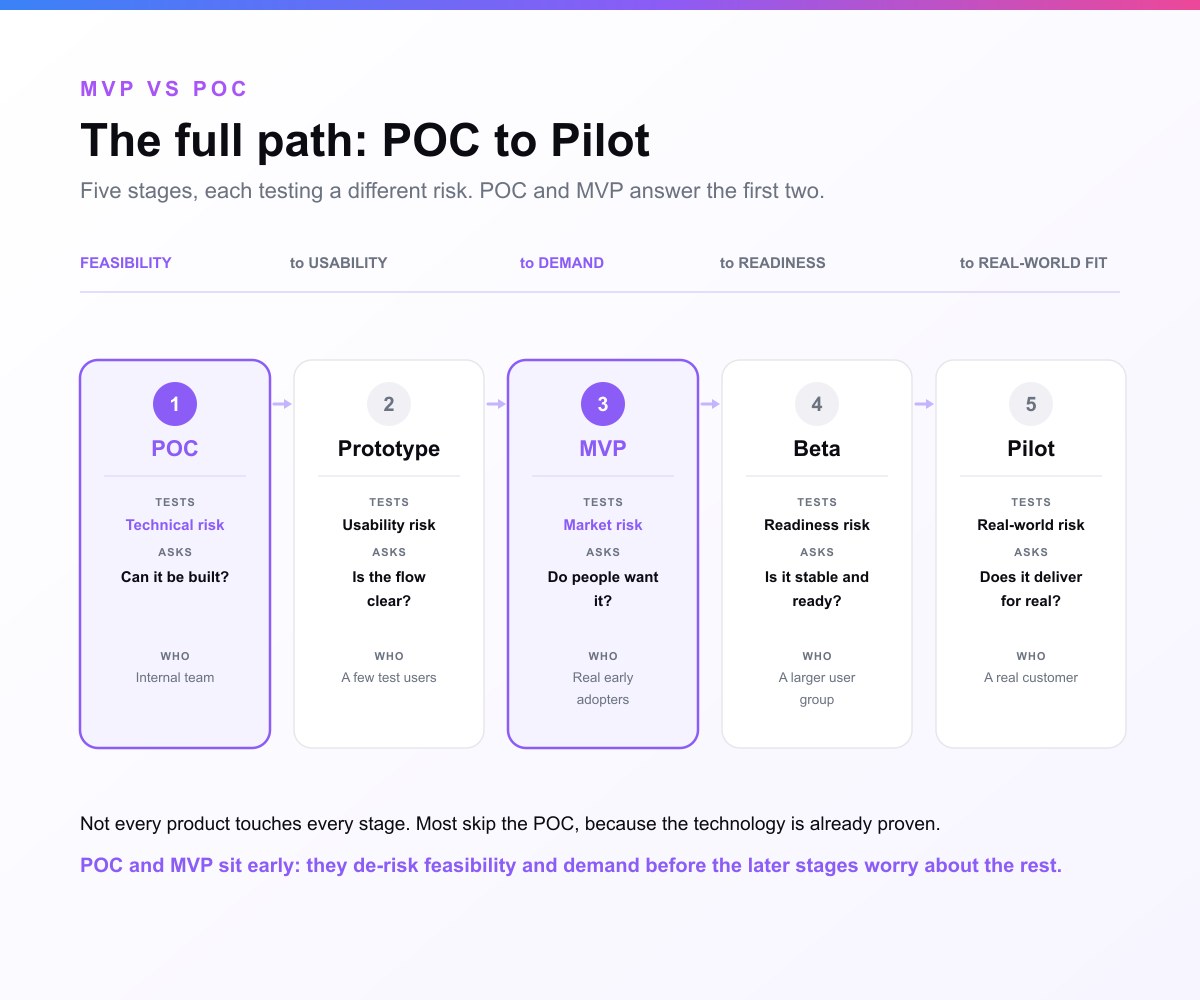
Not every product touches every stage. A simple product might go prototype, then MVP, then straight to growth. A technically novel, enterprise-grade product might run all five. The point of the map is that POC and MVP sit early and answer the two foundational risks, feasibility and demand, before the later stages worry about readiness and real-world fit. For the stages on the other side of the MVP, see our comparisons on MVP vs beta and MVP vs pilot.
From POC to MVP: what carries over
A common assumption is that a successful POC becomes the MVP. Usually it does not, and expecting it to causes trouble.
What carries over from a POC is the learning and the validated approach, not the code. The POC proved that the risky technical method works, so the MVP build can proceed with confidence and a known plan for the hard part. That is enormously valuable, because the biggest engineering unknown has been removed before the real build starts.
What rarely carries over is the code itself. POC code is written to answer a question fast, not to be maintainable, secure, or user-facing. Trying to graft a real product onto a throwaway POC tends to cost more than rebuilding the proven approach cleanly. The right mental model is that the POC produces a recipe, and the MVP cooks the dish properly using it.
So a healthy flow is: run the POC, confirm feasibility, throw away the POC code, and build the MVP fresh on the validated approach. You keep the knowledge and discard the scaffolding.
Which should you build first?
If your idea has real technical risk, the POC comes first, then the MVP. If it does not, you skip straight to the MVP. The deciding question is simple: are you more unsure whether it can be built, or whether anyone wants it?
- If the bigger unknown is technical ("we are not sure this is even possible"), de-risk that first with a POC. There is no point testing demand for something you cannot build.
- If the bigger unknown is the market ("we know we can build it, but will anyone use it?"), go straight to the MVP. Most ideas live here, because they use proven technology in a new combination.
The expensive error is doing it backwards: spending months on a full MVP for a technically risky idea that turns out not to be buildable, or running an elaborate POC for an idea whose only real risk was whether customers cared. Match the experiment to the risk you actually face.
When to build a POC (and when not to)
Build a POC when:
- Your idea depends on something technically uncertain: a novel algorithm, an unproven integration, a hard performance or scale requirement, or a new use of a technology.
- The cost of discovering infeasibility late would be severe.
- You need to convince technical stakeholders or investors that the hard part is solvable before committing to a build.
Skip the POC when:
- The technology is well understood and the build is routine, which is true for most web and mobile products.
- Your real uncertainty is about demand, not feasibility. In that case a POC answers a question you were not actually worried about.
- You are tempted to use a POC as a stand-in for talking to users. It cannot test demand, so it will not.
When to build an MVP (and when not to)
Build an MVP when:
- You are confident the product can be built and your real question is whether the market wants it.
- You want validated learning from real users rather than internal opinion.
- You are ready to put a usable product in front of customers and measure their behavior.
Hold off on the MVP when:
- A serious technical risk is still unresolved. Confirm feasibility with a POC first, or you may build a polished MVP of something that cannot actually work at scale.
- You have not defined the core flow or the one assumption you are testing. An MVP without a clear hypothesis is just a small product with no way to read the result.
Common mistakes founders make
The same handful of errors come up again and again with POCs and MVPs.
- Showing a POC to customers as if it were a product. A POC is internal and rough. Putting it in front of users to "test demand" tests nothing except their patience.
- Trying to ship POC code as the MVP. Throwaway code is throwaway for a reason. Building a real product on it usually costs more than starting clean on the proven approach.
- Building a full MVP when the real risk was technical. Months of product work for something that turns out not to be feasible is the most expensive version of this mistake.
- Running a POC when the technology was never in doubt. This wastes time de-risking something that was already safe, while the real question, demand, goes untested.
- Treating "POC" and "MVP" as the same thing. They answer different questions. Using the words interchangeably leads to building the wrong artifact for the risk you face.
Why POC and MVP get confused
If the difference is this clear, why do so many teams mix them up? Three reasons.
First, both are "early and small," so they look similar from the outside: neither is a finished product, both are cheaper than a full build, and both happen before launch. That surface resemblance hides the fact that they test different risks.
Second, the words get used loosely. Plenty of teams call any rough early build a "POC" or any first version an "MVP" without meaning the precise thing, so the terms blur in everyday conversation.
Third, and most importantly, founders often have not separated their risks. If you have not asked "is my bigger unknown whether this can be built, or whether anyone wants it," then POC and MVP feel like the same fuzzy instinct to "build something small first." The moment you name the specific risk, the right tool becomes obvious and the confusion disappears.
The expensive misconception: a POC is not a cheap MVP
The single most damaging belief in this area is that a POC is just a smaller, cheaper MVP. It is not. They are different tools for different jobs.
A POC is cheaper precisely because it skips everything that makes a product a product: the usable interface, the real data, the security, the polish, the end-to-end flow. Strip those away and you have something that can answer a feasibility question but cannot tell you anything about demand. Hand that to a customer and you learn nothing useful, because they are reacting to a broken half-thing, not your actual idea.
If your goal is to learn whether people want your product, the cheap option is not a POC, it is a tightly scoped MVP, or even a lighter validation approach like a landing page or concierge test from the types of MVP. Use a POC for feasibility and an MVP for demand, and do not ask either one to do the other's job.
A concrete example
Imagine a founder who wants to build an AI assistant that reads commercial contracts and flags risky clauses for small law firms. The idea carries two very different risks.
The technical risk is real: can a model actually extract and classify clauses accurately enough to be useful? That is a POC question. The team builds a narrow proof of concept, no interface, just a script that runs a sample of contracts through a model and measures accuracy against a lawyer's review. The POC succeeds: accuracy is high enough. The hard technical question is answered, and the throwaway script is set aside.
Now the market risk takes over: will small law firms actually adopt and pay for this? That is an MVP question. The team builds an MVP, a real, usable web app where a lawyer can upload a contract, see flagged clauses, and act on them, with clean, secure, production-grade code, in a tight scope. They put it in front of ten firms and watch what they do.
Notice the sequence. The POC proved it could be built and was discarded. The MVP, built fresh on that validated approach, tested whether anyone wanted it and became the foundation of the product. Run in the other order, the team might have built a beautiful MVP of something the model could not actually do, or never built anything because they were too unsure to start.
More examples: POCs and MVPs in practice
A few quick scenarios make the line between them concrete.
POC scenarios, where the question is feasibility:
- A team wants to match users in real time across thousands of data points and is not sure the matching can run fast enough. A POC builds just the matching engine and measures latency under load.
- A product depends on integrating with a legacy hospital records system nobody on the team has touched. A POC proves data can be read and written reliably before anything else is built.
- A startup bets on a machine-learning model hitting a quality bar. A POC runs sample data through the model and checks the output against experts.
MVP scenarios, where the question is demand:
- Dropbox tested demand with a simple explainer video before building the hard syncing technology, a lightweight way to confirm people wanted it.
- Zappos started by listing shoes online and buying them from local stores when orders came in, proving people would buy shoes online before building any inventory system.
- A SaaS founder ships a single working workflow to ten companies and watches whether they adopt it and pay.
Notice the pattern: the POC examples are internal and technical, and the MVP examples are external and about behavior. Same idea, two different risks, two different tests.
How we approach POCs and MVPs
When founders come to us, the first thing we do is name the risk. If the idea uses proven technology, which most do, there is no reason to spend time on a POC, and we go straight to scoping the MVP. If there is a genuine technical unknown, we run a quick, narrow proof of concept first to confirm the hard part works, then build the real MVP on that validated approach.
Either way, the MVP itself is built to be kept: production-grade, fully owned code, scoped to the core flow, and shipped in about 3-4 weeks. We do not hand over throwaway POC scaffolding dressed up as a product, because that is exactly the trap this comparison warns against. The POC, when it is needed, de-risks the technology. The MVP de-risks the market and becomes the thing you grow. When a POC is the honest answer, that is our proof of concept development engagement: one question, a pass mark agreed up front, and the numbers in writing inside two to four weeks.
A quick decision checklist
Run your idea through these to know which you need.
- Is there a real chance this cannot be built with our approach? If yes, start with a POC.
- Is the technology proven and the main unknown whether people want it? If yes, go straight to an MVP.
- Am I about to show this to customers? Then it should be an MVP, not a POC.
- Am I trying to convince my team or investors the hard part is solvable? That is a POC.
- Do I want to keep and grow what I build (MVP), or throw it away once it answers a question (POC)?
Related guides
- What Is an MVP?: a clear definition of the minimum viable product
- How to Build an MVP: the step-by-step founder's playbook
- MVP Examples: 15 Famous MVPs: how the biggest startups validated with an MVP
Frequently asked questions
What is the difference between a POC and an MVP?
A proof of concept tests whether an idea can be built; an MVP tests whether people want it. A POC is a narrow, usually internal, often throwaway technical experiment that proves feasibility. An MVP is a real, usable product put in front of customers to prove demand. One de-risks the technology, the other de-risks the market.
Does a POC come before an MVP?
When an idea has real technical risk, yes: the POC confirms the hard part is feasible before you invest in building a product. When the technology is already proven, which is the case for most products, you skip the POC and go straight to the MVP. The POC only earns its place when you genuinely do not know whether the thing can be built.
Is a POC the same as a prototype?
No. A POC tests technical feasibility (can it be built?), while a prototype tests design and usability (is the flow clear and usable?). A prototype is usually a clickable mockup with no real functionality, aimed at refining the experience. A POC is usually rough, internal code aimed at proving the technology. They sit at different points in the sequence: POC, then prototype, then MVP.
Can a POC become an MVP?
Rarely, and trying to force it usually backfires. What carries over from a POC is the validated approach and the learning, not the code. POC code is written to answer a question fast, not to be secure, maintainable, or user-facing. The healthy path is to keep the proven approach, discard the POC code, and build the MVP cleanly on top of that knowledge.
Do I always need a POC before building an MVP?
No. Most products use well-understood technology, so there is nothing to prove and a POC would just delay you. You only need a POC when your idea depends on something genuinely uncertain, such as a novel algorithm, an unproven integration, or a hard performance requirement. If your real question is "will anyone want this," skip the POC and build the MVP.
How long does a POC take compared to an MVP?
A POC is usually much faster because it is narrow and internal: it builds only the risky part and fakes the rest, so it can take days to a couple of weeks. An MVP is a real, usable product and takes longer, though a tightly scoped one still ships in about 3-4 weeks. The POC is an experiment; the MVP is the first version of the product.
Who is a POC for, versus an MVP?
A POC is for an internal audience: the engineering team and the decision-makers or investors who need confidence that the idea is technically feasible. An MVP is for an external audience: real users and customers whose behavior tells you whether there is demand. If you are showing something to customers, it should be an MVP, not a POC.
Is building a POC a waste of money?
Only if you build one when the technology was never in doubt. When there is real technical risk, a POC is the opposite of waste: it is cheap insurance against pouring months into a product that cannot actually be built. The waste comes from mismatching the tool to the risk, either skipping a needed POC or running an unnecessary one while the real question goes untested.
POC, prototype, or MVP: which do I need?
Match the artifact to your biggest unknown. If you are unsure it can be built, you need a POC. If you are unsure the experience is clear and usable, you need a prototype. If you are unsure anyone wants it, you need an MVP. Many products only need the MVP, because the technology and the basic flow are already well understood and the only real risk is demand.
If you want a partner who names the real risk first and then builds a production-grade MVP you fully own, that is what we do. Custom MVP development at MVP Development runs a quick proof of concept only when the technology truly needs it, then ships your investor-ready MVP in 3-4 weeks. Ask us whether you actually need that proof of concept and we will answer before you spend on one.
Sources & references
- TechMagic, PoC vs prototype vs MVP: a comparison of the three stages
- UXPin, prototype vs MVP vs proof of concept: the design-side view of the same split
- Eric Ries, The Lean Startup: the validated-learning framework behind the MVP


