


TL;DR
Turning an idea into an app comes down to four steps: (1) sharpen the idea into one problem for one specific person, (2) check that people actually want it before you build anything, (3) build the smallest working version that solves the core problem, this small first version is called a Minimum Viable Product, or MVP, and (4) launch it to real users and improve from what they do. You do not need to know how to code, and you do not need $50,000 to start.
The single most important lesson: build small first. Most first-time founders want to build the full, polished app with every feature. That is the fastest way to spend a lot of money and time on something nobody wanted. The smart move is to build the smallest version that proves people want it, learn, and grow from there. This guide walks through all four steps in plain language, shows you the realistic ways to actually get it built, what it costs, and how to protect your idea along the way.
Key Takeaways
- Turning an idea into an app comes down to four steps: sharpen the idea, check that people want it, build the smallest working version (the MVP), and launch to real users.
- You do not need to know how to code, and you do not need $50,000 to start.
- The most important lesson: build small first.
- Building the full, polished app with every feature is the fastest way to spend a lot on something nobody wanted.
- Build the smallest version that proves people want it, learn, and grow from there.
So you have an app idea. Here is the honest roadmap.
If you have an idea and no technical background, the process can feel like a black box: who do you ask, where do you start, how much does it cost, and how do you avoid getting ripped off? Here is the whole journey at a glance, so it stops feeling like a mystery: If your first instinct is to sell the idea rather than build it, read how to sell an app idea first; the honest answer is why this roadmap exists.
- Sharpen the idea: get crystal clear on the one problem and who it is for.
- Validate it: cheaply check that real people want it, before spending on building.
- Build the smallest version (your MVP): using no-code tools, a developer, or a specialist team.
- Launch and improve: get it to real users and let their behaviour guide what comes next.
The rest of this guide takes each step in turn. None of them require you to write code.
Step 1: Sharpen the idea
Before anything gets built, get brutally clear on two things, written in one sentence each:
- The problem: what specific pain does your app remove? "Helps people do X faster/cheaper/easier."
- The person: who exactly feels that pain? Not "everyone", one specific type of user.
Then do the hardest and most valuable thing: find the one core thing your app must do. Most ideas come bundled with ten features. Your first version should do one of them, the one that delivers the main value. Everything else waits. This single act of cutting down is what keeps your project cheap, fast, and focused, and it is the skill that separates founders who ship from founders who stall. (We go deep on this in how to scope an MVP.)
Step 2: Check that people actually want it (before you build)
Here is the mistake that sinks most first-time founders: they spend months and thousands of dollars building the app, launch it, and discover nobody wanted it. The data backs this up, a lack of real market demand is one of the top reasons startups fail.
So before you build, validate cheaply. You can test whether people want your idea without writing a line of code:
- Talk to 10 to 20 real potential users. Not friends and family, actual people with the problem. Do they have the pain? How do they solve it today? Would they pay?
- Put up a simple landing page describing the app and a "sign up for early access" button. If people give you their email, that is real interest. If nobody does, better to know now.
- Do it manually first. If your app connects two people or delivers a service, try doing it by hand for a few users before automating it.
This step costs almost nothing and saves you the most expensive mistake in the whole process. For the full playbook, see MVP validation.
Step 3: Build the smallest working version (your MVP)
Once you know people want it, you build, but you build small. Instead of the full app, you build the minimum version that solves the core problem well enough for real people to use. This has a name: a Minimum Viable Product, or MVP.
Why build an MVP instead of the whole thing? Three reasons:
- It is far cheaper and faster. A focused first version can be built in weeks, not the many months a full app takes.
- You learn what is actually true. Real users show you what they use and what they ignore, so you build the right next features instead of guessing.
- It reduces risk. If the idea needs to change (it often does), you have not sunk your whole budget into the wrong thing.
An MVP is not a low-quality app. It is a focused one: it does the one core thing reliably and well, and leaves everything else for later. That is the version you build first. (For the full step-by-step, see how to build an MVP.)
How you can actually build it (4 ways, no coding required by you)
This is the question the roadmap usually leaves out: who builds it? As a non-technical founder, you have four realistic options. Before you talk to any of them, write the one-page brief in how to explain an app idea to a developer; it is what turns the first conversation into a scope and a quote.
| Option | Rough cost | Best when | The catch |
|---|---|---|---|
| No-code / AI app builders | Free to low monthly fees | Your idea is fairly standard and you want to build it yourself | Hits a ceiling on complex or custom features; you do the work |
| Hire a freelancer (Upwork, etc.) | Hundreds to low thousands | Simple project, tight budget, you can manage the work | Quality varies wildly; you must spec and manage it carefully |
| Hire an app development company / studio | Higher, but production-grade | You want it built right the first time, to a real standard | Costs more; you need to pick a good one (watch for red flags) |
| Find a technical co-founder | Equity, not cash | It is a long-term, deeply technical company | Slow to find, and you give up a large share of the business |
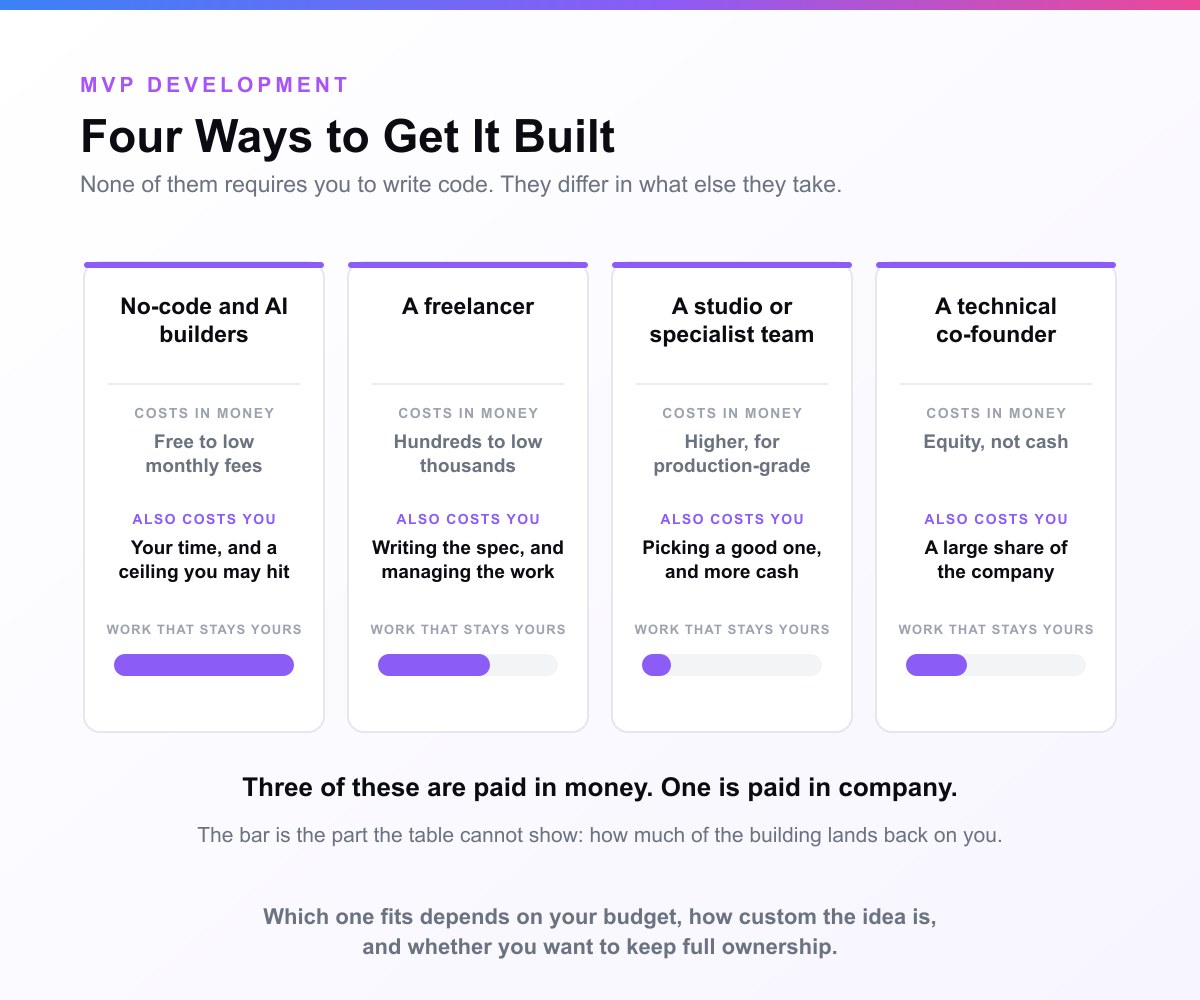
A few honest notes:
- No-code and AI tools have made it genuinely possible to build a simple app yourself. Great for validating fast; be aware you may outgrow the platform. See no-code MVP.
- Freelancers can be great or terrible. If you go this route, write a very clear spec with screen-by-screen descriptions, because developers build exactly what you describe and nothing more.
- A specialist team is the route when you want the first version built to a real, launchable standard without learning to code or babysitting freelancers. This is exactly what we do at MVP Development, and specifically for non-technical founders: we make the technical calls for you (the stack, the architecture, the security), build the one core flow, and hand you a live app you fully own, so your only job is the idea and the users, not managing engineers. It costs more than a freelancer, but you get production-grade code and a team whose job is to keep your scope tight so you actually ship.
- A co-founder is a big commitment, you are giving away part of the company, so it is rarely the right first move. (See do you need a technical co-founder?)
Which fits depends on your budget, how custom your idea is, and whether you want to keep full ownership. For the full comparison of the paths, see MVP for non-technical founders.
Step 4: Launch and improve
Once your MVP works, get it in front of real users, even a small group, and watch what they actually do:
- Launch to your early group (the people from Step 2 are perfect). You do not need a huge launch; you need real usage.
- Watch behaviour, not just opinions. What do people actually use? Where do they get stuck? What do they ask for?
- Improve in small steps. Add the next feature real usage is telling you to add, not the one you assumed. Repeat.
This loop, build a little, learn, improve, is the entire engine of a successful app. The MVP was never the finish line; it is the first turn of the wheel.
What does it cost to turn an idea into an app?
The honest answer is "it depends on how you build it," but rough 2026 ranges for a first version (not the full, finished app):
- No-code / do-it-yourself: from almost nothing to low monthly tool fees.
- A freelancer: typically hundreds to a few thousand dollars for something simple.
- A specialist team or studio: commonly $15,000 to $80,000 depending on complexity, for a production-grade MVP.
The number that matters is not the total, it is how much you spend before you know people want it. Keep Step 2 cheap, keep the first build focused, and you avoid the classic mistake of spending $50,000 before validating. For a detailed breakdown, see how much it costs to build an MVP.
How to protect your app idea (the honest truth)
First-time founders often worry most about someone stealing the idea. Here is the reality: ideas are cheap; execution is everything. Investors and developers hear hundreds of ideas; almost nobody wants to stop their own life to steal yours, because the value is in building and growing it, which is the hard part. (For the full playbook, including owning your code and when an NDA actually matters, see how to protect your app idea.)
That said, a few sensible steps:
- You do not need an NDA to talk about your idea generally. Sharing the concept to get feedback is how you validate it, and most serious people will not sign an NDA just to hear a pitch.
- Use an NDA for the specifics if you are handing over detailed plans to a developer or agency you are about to hire. It is normal and reasonable at that point.
- Focus your energy on executing faster and better, not on secrecy. The founder who ships and learns beats the one who guards an idea and never builds.
The one mistake to avoid
If you take one thing from this guide: do not build the whole app before checking anyone wants it. The most expensive, most common failure is spending your entire budget and months of time on a full, feature-rich app, only to launch to silence. Validate cheaply, build the smallest real version, and grow from evidence. Small-first is not the timid path; it is the smart one.
Where to go from here
If you would rather not learn to code or manage freelancers, and you want that small first version built properly, that is exactly what we do. We take founders from idea to a funding-ready MVP in 3 to 4 weeks: we help you cut to the one core flow, agree a fixed price you approve before any work starts, and build it with real accounts, payments, and a live app you own, no technical work required on your side. You walk away with a real app in users' hands, and a team that keeps the scope honest so you ship and learn instead of building forever. If you have an idea and want it made, walk us through the app in your head and we will plan the first version worth shipping.
Common mistakes founders make
- Building everything before validating anything. The single most expensive error.
- Trying to build the full, polished app first. Start with the one core thing; add the rest from real feedback.
- Over-worrying about idea theft. Spend that energy executing faster instead.
- Picking a builder on price alone. The cheapest freelancer often costs the most in rework; match the builder to how serious and custom your app is.
- Treating launch as the finish line. The first version is where the real learning starts, not where it ends.
Related guides
- What is an MVP?: the concept behind "build small first," explained simply
- MVP for non-technical founders: the four build paths in depth
- How to build an MVP: the full step-by-step build process
- No-code MVP: building your first version without a developer
- How much does it cost to build an MVP?: the detailed cost breakdown
Frequently asked questions
How do I turn my idea into an app?
Turn your idea into an app in four steps: sharpen it into one clear problem for one specific user; validate cheaply that real people want it (by talking to potential users or putting up a simple landing page) before building anything; build the smallest working version that solves the core problem, which is called an MVP, using no-code tools, a freelancer, or a specialist team; then launch it to real users and improve based on what they actually do. The key is to build small first rather than trying to build the full app up front.
Can I make an app if I have no coding experience?
Yes. You have several ways to get an app built without writing code yourself: no-code and AI app builders let you create simpler apps by describing or dragging and dropping; you can hire a freelancer or an app development studio to build it for you; or you can bring on a technical co-founder for a long-term, deeply technical product. Your job as a non-technical founder is not to code, it is to define the idea clearly, validate demand, choose the right build path, and manage the process. Those are learnable, non-technical skills.
How much does it cost to turn an idea into an app?
It depends on how you build it. Doing it yourself with no-code tools can cost almost nothing beyond monthly fees; a freelancer might charge hundreds to a few thousand dollars for something simple; and a specialist team building a production-grade first version (an MVP) commonly costs $15,000 to $80,000 depending on complexity. The most important cost discipline is to spend as little as possible before you have validated that people want the app, then keep the first build focused on one core flow.
Do I need a developer to build my app?
Not necessarily. For a simple app, no-code and AI app builders can let you build it yourself. For anything custom, complex, or intended to be production-grade, you will need someone technical, either a freelancer, an app development studio, or eventually a technical co-founder or hire. Many non-technical founders validate their idea with a no-code version first, then bring in a specialist team to build the real MVP. You do not need to become a developer; you need to choose the right build path and manage it well.
Can I sell my app idea?
Realistically, no, or at least not for meaningful money. Ideas on their own are considered cheap in the startup world, because the value is created by executing the idea, building the product, finding users, and growing it. Companies and investors are not in the business of buying raw ideas. If you believe in your idea, the way to make it valuable is to build a first version and show real people using it. That evidence, not the idea itself, is what has worth.
How do I protect my app idea from being stolen?
Focus less on secrecy than most first-time founders expect. You do not need an NDA to discuss your idea generally, and sharing it to get feedback is a necessary part of validating it. Use an NDA only when you are handing over detailed specifications to a developer or agency you are hiring, where it is normal and reasonable. The strongest protection is execution: the founder who builds, launches, and learns quickly is far ahead of anyone who might hear the concept, because turning an idea into a real, growing product is the genuinely hard part.
Sources & references
This guide draws on established lean-startup and product practice for taking an idea to a first product.
- Eric Ries, The Lean Startup: validated learning and the minimum viable product
- Y Combinator, Startup Library: building a first version and talking to users early
- Atlassian, Minimum Viable Product: scoping the smallest valuable version
This article is general educational guidance for turning a software idea into a first product.


