


TL;DR
The MVP development process is the repeatable path from a raw idea to a working product in front of real users, run in six phases: discovery and validation, scoping and prioritization, design, build, test, and launch and iterate. Each phase has a clear goal, a concrete output, and a way it commonly goes wrong.
The point of having a process at all is speed without chaos. A defined process is what lets a tightly scoped MVP ship in about 3-4 weeks instead of drifting for months, because every phase ends in a decision rather than a debate. This guide walks through all six phases, how long each takes, who runs them, the mistakes that derail teams, and how the whole thing compresses into a few focused weeks.
Key Takeaways
- The MVP development process is the repeatable path from a raw idea to a working product in front of real users.
- It runs in six phases: discovery and validation, scoping and prioritization, design, build, test, and launch and iterate.
- Each phase has a clear goal, a concrete output, and a way it commonly goes wrong.
- The point of a process is speed without chaos: every phase ends in a decision rather than a debate.
- A defined process is what lets a tightly scoped MVP ship in about 3-4 weeks instead of drifting for months.
What is the MVP development process?
An MVP, or minimum viable product, is the smallest version of your product that lets real users do the one job your idea promises, so you can learn whether anyone actually wants it. The MVP development process is the sequence of phases you move through to build that first version deliberately, instead of guessing your way forward.
It is not the same as building a full product. A full product process optimizes for completeness and scale. The MVP process optimizes for learning: the goal is to answer the single most important question about your idea as quickly and cheaply as possible, then use what you learn to decide what to build next.
Run well, the process is a series of small, reversible commitments. You validate before you scope, scope before you design, design before you build, and build before you scale. Each phase narrows the uncertainty, so by launch you are not betting everything on one untested assumption. That is the whole reason a process beats simply opening a code editor and starting.
One distinction before the phases. The process is the work, in order. The document that puts that work on a calendar with owners and exit gates is the MVP roadmap, and it has its own guide. Where all of this sits in a company’s life, between idea and product-market fit, is the MVP stage of a startup. This page stays on the phases.
Why a defined process matters
Most failed MVPs do not fail because the team could not write code. They fail because the team built the wrong thing, built too much of it, or took so long that the runway ran out before they learned anything. A defined process is the cheapest insurance against all three.
A clear process gives you three things. It gives you focus, because each phase forces a decision about what is in and what is out. It gives you speed, because nobody is waiting on an unclear next step. And it gives you evidence, because every phase produces an output you can point to: a validated problem, a locked scope, a working build, real usage data.
The alternative, which is what most first-time founders default to, is to skip straight to building. It feels faster for about two weeks. Then scope creep, rework, and "wait, who is this actually for" set in, and the project slows to a crawl. The process is what keeps the fast start from turning into a slow middle.
How the MVP process differs from building a full product
It is worth being clear about what the MVP process is not, because applying full-product habits to an MVP is one of the most common ways to lose months.
A full product is built for completeness: every feature a market expects, polished, scaled, and supported. Its process optimizes for coverage and reliability, and it makes sense to plan it thoroughly up front, because the requirements are largely known.
An MVP is built for learning. Its process optimizes for the speed at which you can answer one question, so it deliberately leaves things out: secondary features, rare edge cases, scale you do not have yet, polish the core flow has not earned. Where a full-product process asks "what does this need to do," the MVP process asks "what is the smallest thing that proves people want this."
That difference changes every phase. Discovery is narrower, scoping is more ruthless, design is lighter, the build targets one flow, testing protects the core rather than chasing zero defects, and launch is the start of iteration rather than a finished release. Treat the MVP process like a small full-product process and you inherit all of the cost and timeline of the big version with none of the speed that makes an MVP worth doing. The two are not rivals: the MVP process comes first and produces the evidence, and the full-product process comes later, once you know what is worth scaling.
The process runs in six phases, in order. Here is the whole pipeline before we walk through each one:
Phase 1: Discovery and validation
Goal: confirm there is a real problem worth solving before you build anything.
Discovery is where you turn a hunch into a testable hypothesis. The work here is mostly conversation and research, not code. You talk to the people who have the problem, study how they solve it today, and name the single riskiest assumption your idea depends on.
The key activities in this phase:
- Customer interviews. Talk to ten to twenty people in your target market. You are listening for the problem in their words, not pitching your solution.
- Market and competitor research. Understand who else solves this, how, and where they fall short.
- Define the core problem and user. One sentence each. If you cannot, you are not ready to build.
- Name the riskiest assumption. The one belief that, if wrong, sinks the whole idea. That is what the MVP exists to test.
- Pick the one success metric. The single number that will tell you the idea is working: sign-ups, paid conversions, repeat usage.
The output of this phase is a short, sharp problem statement: who the user is, what job they are trying to do, why current options fail them, and the one metric you will watch. Sometimes the cheapest validation happens right here, before any real build, with a landing page, a concierge test, or a fake-door experiment. Those are covered in our guide to the types of MVP.
The common mistake: two opposite failures live here. The first is skipping validation entirely and building on a founder hunch. The second is over-researching, running interview after interview without ever shipping anything to test. Discovery should be measured in days, not months.
Phase 2: Scoping and feature prioritization
Goal: cut the idea down to the single core flow and lock what is in version one.
This is the phase that most determines whether the MVP stays minimal. You start with everything the product could eventually do and ruthlessly narrow it to the one flow that proves the riskiest assumption. Every feature you add here is a week you add to the timeline, so the discipline is to say no.
The key activities:
- List every candidate feature, then prioritize. Frameworks like MoSCoW (must have, should have, could have, will not have) or RICE (reach, impact, confidence, effort) keep the decision honest instead of emotional.
- Define the core user journey. Map the path from a user arriving to the one job being done. Anything off that path is a candidate to cut.
- Lock the scope. Write it down and agree it. A scope that is open to change every week is a project that never ships.
- Choose the stack. Pick proven, boring technology that the team knows and that will not need a rewrite the moment you grow.
- Produce a lightweight spec and a roadmap. Enough to build from, not a 60-page document nobody reads.
The output is a locked, prioritized feature list, the core user flow, a simple spec, and a realistic plan. This is also where a fixed scope and timeline get agreed, which is what makes a delivery date a commitment rather than a hope. For how to turn the scope into a sequenced plan, see our guide on how to build an MVP roadmap.
The common mistake: scope creep. The "while we are at it, let us also add" instinct is how a four-week MVP becomes a four-month one. Protect the core flow and park everything else in a clearly labeled "later" list.
Phase 3: UX and UI design
Goal: design the core flow so it is usable, before a line of production code is written.
Design in the MVP process is not about pixel-perfect polish. It is about making sure the one core flow is clear and that the team is building the right screens. Designing before building is far cheaper than discovering a flawed flow halfway through development.
The key activities:
- Wireframes and user flows. Low-fidelity sketches of every screen on the core path.
- A clickable prototype. Something you can put in front of a few users to catch confusing flows before they cost engineering time.
- The essentials of a design system. Consistent components, type, and spacing, so the build is fast and the product does not look like five different apps.
- A quick usability check. Watch a handful of people try the prototype. Fix what trips them up.
The output is a set of wireframes, the key screens designed to a level the team can build from, and a validated flow. The design should be clean and credible, but it does not need to be award-winning. An MVP earns its polish after it has earned its users.
The common mistake: over-designing. Founders sometimes spend weeks perfecting visuals for a flow nobody has used yet. The opposite mistake is skipping design entirely and letting engineers improvise the UX, which usually produces a product that works but confuses people.
Phase 4: Build and development sprints
Goal: build the core flow in short, iterative sprints, with working software at the end of each.
This is the phase people picture when they think of MVP development, but by now most of the risky decisions are already made. (For how the build phase runs for American startups specifically, see MVP development in the USA.) Good scoping and design make the build the most predictable phase, not the most chaotic. The work runs in short sprints, usually one to two weeks, each ending in a demo of working software.
The key activities:
- Set up the foundation. Repository, environments, continuous integration, and deployment, so shipping is routine from day one.
- Build front end and back end against the locked scope. Core flow first, edge cases second.
- Integrate the essentials. Authentication, payments if you charge, and the handful of third-party services the core flow needs.
- Demo weekly. Every sprint ends with something you can click, not a status update. Demos are how scope creep and misunderstandings get caught early.
- Keep code quality honest. Reviews and basic tests, because the MVP you are building is the foundation you will scale, not a throwaway.
The output is working software that grows each sprint until the core flow is complete. The discipline here is to build the happy path first and resist gold-plating. A feature that is not on the core flow is a feature that can wait.
The common mistake: building everything at once with no demos, then discovering at the end that the pieces do not fit or the flow is wrong. Weekly demos and a build-the-happy-path-first rule prevent it.
Phase 5: Testing and QA
Goal: make sure the product works and is secure before real users and investors see it.
Testing is not a phase you bolt on at the end so much as a discipline that runs alongside the build, with a focused pass before launch. The aim is not zero bugs, which is impossible, but no broken core flow and no obvious security holes.
The key activities:
- Functional testing. Does the core flow work, end to end, every time?
- Edge cases and error handling. What happens when a user does the unexpected, or a payment fails?
- Security basics. Authentication, data protection, input validation, and the common vulnerabilities, because investors and enterprise buyers check.
- Performance and load. Will it hold up when your launch brings a spike of users at once?
- User acceptance testing. A final check that the product does what the scope promised.
The output is a tested, stable build with the known bugs triaged and the launch-blockers fixed. The standard is not perfection, it is "the core flow never breaks and nothing is unsafe."
The common mistake: skipping QA to hit a date, then launching something that falls over in front of the first real users. The other frequent miss is treating security as a later problem, which is exactly the thing that sinks a fundraise during technical diligence.
Phase 6: Launch and iterate
Goal: ship to real users, measure what they do, and turn that into the next iteration.
Launch is not the finish line. It is the moment the MVP starts doing its actual job, which is generating evidence. The first version going live is the beginning of the learning loop, not the end of the project.
The key activities:
- Deploy to production. Ideally to a small, controlled group of real users first.
- Onboard your first users. Watch them use it. The gap between what they say and what they do is where the insight lives.
- Instrument analytics. Track the one success metric and the core-flow funnel, so you are deciding on evidence, not opinion.
- Gather feedback and prioritize. Collect what users tell you and what the data shows, then decide the next iteration.
- Iterate. Ship improvements, kill features nobody uses, double down on what works.
The output is a live product, a working feedback and analytics loop, and a prioritized backlog for version two. From here the process loops: you are back to a smaller version of discovery and scoping, now armed with real usage data instead of guesses.
The common mistake: treating launch as the end. The MVP that ships and is never iterated on learns nothing. The whole point of the minimal first version is to start the loop quickly and run it often.
The MVP development process at a glance
Here is the full process in one view, with the rough share of a tightly scoped timeline each phase takes.
| Phase | Goal | Key output | Typical share of timeline |
|---|---|---|---|
| 1. Discovery & validation | Confirm the problem is real | Problem statement, success metric | A few days |
| 2. Scoping & prioritization | Lock the core flow | Scoped feature list, spec, roadmap | A few days |
| 3. UX & UI design | Make the flow usable | Wireframes, prototype, key screens | 3 to 5 days |
| 4. Build (sprints) | Ship the core flow | Working software, the MVP | The bulk of the time |
| 5. Testing & QA | Make it work and stay safe | Tested, stable build | Runs alongside, plus a final pass |
| 6. Launch & iterate | Get evidence from real users | Live product, analytics, v2 backlog | Ongoing after launch |
Two phases tend to surprise first-time founders: discovery and scoping take less calendar time than people expect but carry the most leverage, and the build, while it is the bulk of the hours, is the most predictable phase when the earlier ones were done well.
The process in action: a worked example
To make the phases concrete, walk through a simple example: a founder wants to build a tool that lets independent music teachers schedule and bill their students.
In discovery, they interview fifteen teachers and learn the real pain is not scheduling, which calendars already handle, but chasing late payments. The riskiest assumption becomes "teachers will pay for a tool that automates billing," and the success metric is how many connect a payment method.
In scoping, the long wish list (lesson notes, video, a marketplace, reviews) is cut to one core flow: a teacher adds students, sets a rate, and sends an automatic invoice. Everything else goes on the later list.
In design, three screens are wireframed and prototyped, adding a student, setting the rate, and the invoice view, and a few teachers click through it so the flow can be adjusted.
In the build, the team ships those screens across two sprints, wiring in authentication and Stripe for payments, with a demo each week.
In testing, they confirm invoices send correctly, payments succeed and fail gracefully, and the data is secure.
At launch, ten real teachers start using it. Within two weeks the data shows most connect a payment method but few touch the schedule, so the next iteration doubles down on billing and drops scheduling. That is the whole process in miniature: a narrow bet, validated cheaply, shipped fast, and sharpened by real usage.
Agile or waterfall: which fits the MVP process?
The MVP development process is almost always run with an agile, iterative approach rather than a waterfall one, and the reason is the nature of an MVP itself.
Waterfall plans the entire product up front and builds it in one long sequence, ending in a single big release. That works when the requirements are fully known and unlikely to change, which is the opposite of an MVP. With an MVP you expect to learn and change direction, so committing to a complete plan up front is a bet against the very thing you are trying to do.
Agile breaks the work into short sprints, each producing something usable, with regular demos and the freedom to re-prioritize. For an MVP, that fit is natural: you build the core flow first, demo weekly, and let real feedback shape what comes next. You do not need heavyweight Scrum ceremony for a small MVP team, but you do need the core agile habits: small increments, frequent demos, and a backlog you re-order based on evidence.
The practical version for most MVPs is lightweight and lean: short sprints, a weekly demo, a single prioritized backlog, and a bias toward shipping the smallest useful thing and learning from it.
Who runs the MVP development process?
The same six phases apply no matter who builds your MVP, but who runs them changes the speed, cost, and quality dramatically. There are four common paths.
- An in-house team. Full control, but you spend months and significant salary hiring senior engineers before the process can even start. It fits best after you have funding and product-market fit, rarely before.
- Freelancers. Flexible and affordable for a well-defined piece, but for a whole MVP the process tends to fragment: no one owns the architecture, quality varies, and you carry the project management yourself.
- No-code tools. The fastest, cheapest path when your product fits the template, and a great way to run the early phases. The wall arrives when the core flow needs something the platform cannot do, which our guide on the no-code MVP covers in detail.
- A specialist MVP studio. A senior team that runs the entire process on a fixed scope and timeline, with the security work built in and full code ownership at the end, without the overhead of hiring. It fits the founder who wants a real, owned product in weeks rather than quarters.
There is no universally right answer. Pre-validation and tight on budget points toward no-code or a lean approach. A complex or regulated product, or a funded team that needs to move now, points toward a studio or, eventually, in-house.
Who does what: the roles in the process
A small MVP team wears several hats, but the process still depends on a handful of distinct roles being covered, whether by four people or by one studio team.
- The founder or product owner owns the decisions: the problem, the user, the priorities, and the scope. This is the one role that cannot be outsourced, because it is the source of truth for what the product is for.
- A product strategist runs discovery and scoping: the interviews, the prioritization, and turning the idea into a buildable plan.
- A designer owns the flow and the screens, turning the locked scope into wireframes and a prototype the team can build from.
- Engineers build the core flow in sprints, handle the integrations, and keep the code a foundation rather than a throwaway.
- QA, often shared by the engineers on a small team, protects the core flow and the security basics before launch.
On a lean MVP, one person may cover several of these, and that is fine, as long as every role is consciously covered rather than accidentally skipped. The role that most often gets dropped, and hurts most when it does, is the product owner: when nobody clearly owns priorities, scope creep fills the vacuum. A studio supplies the strategist, designer, engineers, and QA as one team, but you, the founder, always keep the product-owner seat. For a deeper look at the roles, the right team size, and how to assemble one, see our full guide to the MVP development team.
How long the MVP development process takes
A tightly scoped MVP runs through the full process in about 3-4 weeks. That surprises people who assume building software means months, so it is worth seeing where the time actually goes.
Discovery and scoping together take only a handful of days when they are run with discipline, because they are decisions, not deliverables. Design runs three to five days for a focused flow. The build is the bulk of the time, two to three weeks for a tight scope, with testing running alongside it and a final QA pass before launch. Launch itself is a day or two.
Heavier products run longer. A regulated build in fintech or healthtech, a marketplace with two sides to balance, or a product with several deep integrations all add time, and an honest team tells you that up front during scoping rather than discovering it halfway through. For the full breakdown, see our guide on how long it takes to build an MVP, and for what it costs, how much it costs to build an MVP.
Common mistakes that derail the process
Most MVP projects that go off the rails do so in predictable ways. Watch for these.
- Skipping validation. Building on a hunch and discovering at launch that nobody wanted it. Phase one exists to prevent this.
- Scope creep. The single most common killer. Every "while we are at it" feature pushes the date and dilutes the core flow.
- Over-designing. Polishing visuals for a flow no user has touched yet. Validate the flow, then make it beautiful.
- Building for scale too early. Architecting for ten million users you do not have yet, instead of shipping for the first hundred.
- No analytics at launch. Shipping blind, with no way to see what users actually do, so iteration becomes guesswork.
- Skipping QA and security. Hitting a date by shipping something fragile or unsafe, then paying for it in front of users or investors.
- Treating launch as the finish line. The MVP that never iterates learns nothing and was barely worth building.
- Choosing the wrong build method. Forcing a complex product onto no-code, or hiring a full team to validate a hunch.
Almost every one of these traces back to a weak earlier phase. Strong discovery and scoping prevent most of the damage downstream.
How we compress the process into 21 days
The process above can take months or it can take weeks, and the difference is almost never the amount of code. It is how the process is run. Here is how a focused, senior team compresses the same six phases into a few weeks without cutting the parts that matter.
- Senior people, no ramp time. A team that has run this process many times does not relearn it on your budget.
- Scope locked in discovery. The biggest time sink in MVP projects is indecision. Locking the core flow early removes it.
- Phases run in parallel where they safely can. Design and infrastructure setup, for example, do not have to wait for each other.
- Modern frameworks, automation, and AI. The same output that used to take months now takes days when the tooling does the repetitive work.
- Weekly demos, not status decks. You see working software every week, which keeps scope honest and surprises out.
- Full handover at the end. You own all of the code, infrastructure, and documentation, so the MVP is a foundation you can build on, not a black box.
That is the entire reason a clear process matters: it is what makes "3-4 weeks to a fundable MVP" a commitment instead of a marketing line.
A pre-build checklist
Before you start the build phase, you should be able to check every one of these.
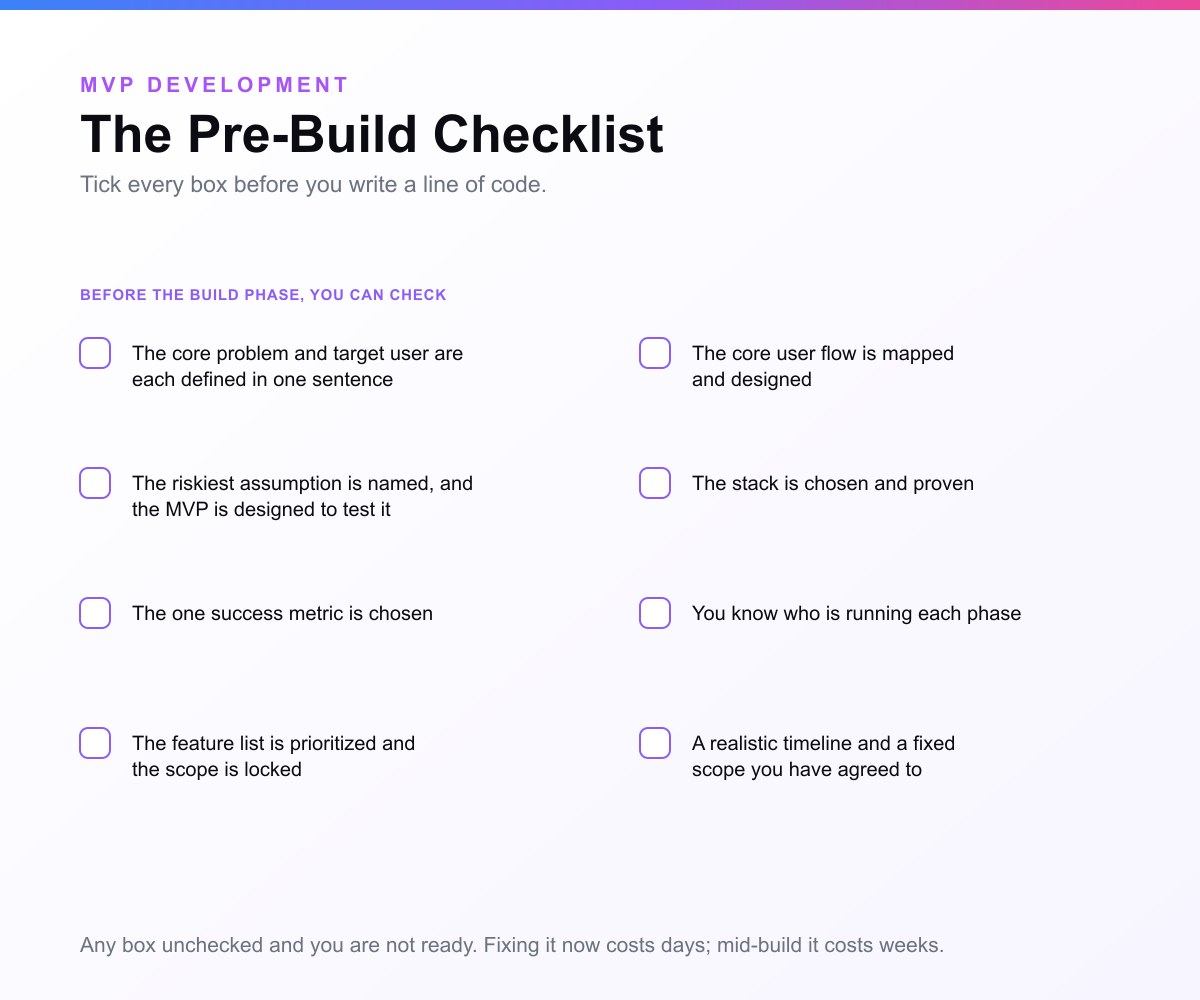
- The core problem and target user are each defined in one sentence.
- The riskiest assumption is named, and the MVP is designed to test it.
- The one success metric is chosen.
- The feature list is prioritized and the scope is locked.
- The core user flow is mapped and designed.
- The stack is chosen and proven.
- You know who is running each phase.
- You have a realistic timeline and a fixed scope you have agreed to.
If any box is unchecked, you are not ready to build yet. Going back to fix it now costs days. Discovering it mid-build costs weeks.
Related guides
- What Is an MVP?: the minimum viable product, explained
- How to Build an MVP: the full step-by-step process
- MVP Validation: validate demand before you build
- MVP Metrics: how to measure whether your MVP works
- MVP UX Design: designing the core flow before you build
- MVP Testing: how to test an MVP without slowing it down
Frequently Asked Questions
What is the MVP development process?
The MVP development process is the structured path from idea to a working first product, run in six phases: discovery and validation, scoping and prioritization, design, build, testing, and launch and iterate. Each phase has a clear goal and output, and the whole process is designed to maximize learning while minimizing wasted time and money.
What are the stages of MVP development?
There are six core stages: discovery and validation (confirm the problem), scoping and prioritization (lock the core flow), UX and UI design (make the flow usable), build (ship the core flow in sprints), testing and QA (make it work and stay safe), and launch and iterate (get evidence from real users and improve). Testing usually runs alongside the build rather than strictly after it.
How long does the MVP development process take?
A tightly scoped MVP moves through the full process in about 3-4 weeks. Discovery and scoping take a few days each, design three to five days, and the build two to three weeks with testing alongside. Heavily regulated products, marketplaces, or builds with many integrations run longer, which a good team flags during scoping.
How much does the MVP development process cost?
It depends on scope, team, and complexity, and the honest answer is that a fixed, scoped quote agreed before any work starts is what keeps it predictable. The process itself does not have to be expensive: validation and scoping cost mostly time, and a disciplined build keeps engineering hours focused on the core flow. Our cost guide breaks the numbers down in detail.
What comes first in the MVP development process?
Discovery and validation come first, always. Before any design or code, you confirm that the problem is real and worth solving, define your user and your one success metric, and name the riskiest assumption the MVP needs to test. Skipping straight to building is the most common and most expensive process mistake.
Do I need a technical co-founder to run the MVP process?
No. Many non-technical founders run the process successfully by partnering with an MVP studio or, for early validation, using no-code tools. What you do need is ownership of the product decisions, the problem, the user, and the priorities, which is exactly the part a technical partner cannot do for you.
Should an MVP use agile or waterfall?
Agile, in almost every case. An MVP exists to learn and change direction, which is the opposite of what waterfall is built for. A lightweight agile approach with short sprints, weekly demos, and a re-prioritized backlog fits the MVP process naturally and keeps you shipping and learning rather than planning everything up front.
What is the most common mistake in the MVP process?
Scope creep. The steady accretion of "while we are at it" features is what turns a four-week MVP into a four-month one and dilutes the core flow that the product is supposed to test. The fix is to lock the scope during the scoping phase and park every non-essential idea in a clearly labeled later list.
What happens after the MVP launches?
Launch starts the learning loop rather than ending the project. You onboard real users, measure the one success metric and the core-flow funnel, gather feedback, and use the evidence to prioritize the next iteration. The MVP process then loops, with each round informed by real usage data instead of guesses, until you reach product-market fit and shift toward scaling.
Should I run the process with no-code or custom development?
If you are pre-validation, non-technical, or on a tight budget, no-code can run the early phases fast and cheap. If your core is technically complex, you are in a regulated field, or you have validated demand and need to scale, custom development is the stronger foundation. Many founders validate with no-code, then rebuild the core on custom code once the idea is proven.
How do I keep the MVP development process on schedule?
Three habits keep the process on track. First, lock the scope during the scoping phase and route every new idea to a later list instead of into the current build. Second, demo working software every week, so misunderstandings and creep surface in days rather than at the end. Third, protect the core flow above all else: when something has to give, cut a secondary feature, never the timeline or the quality of the one flow that proves your idea. Most schedule slips trace back to a scope that was never truly locked, so that is where to hold the line.
If you want a senior team to run this entire process for you and hand over a production-grade product you fully own, that is exactly what we do. Custom MVP development at MVP Development takes your idea through all six phases and ships an investor-ready MVP in 21 days. Ask us to run this process against your idea and we will do it live on a scoping call.
Sources & references
- Atlassian, Agile: agile delivery practices this sits inside
- Y Combinator Library: founder guidance on building and launching early


