


TL;DR
The most valuable companies in the world started with scrappy MVPs that proved demand before the real product existed, Airbnb rented air mattresses, Dropbox shipped a video, Zappos photographed shoes in local stores, and Uber launched one feature in one city. None of them began with a polished, full-featured product. Each shipped the smallest thing that could answer its riskiest question, and only scaled once the proof was in.
This guide collects 15 famous MVP examples, grouped by the type of MVP each one used, with the story, the result, and the lesson you can apply to your own build. Read them as a pattern library: every one is a different way to learn whether people want your product without building the whole thing first. At MVP Development we help founders run the same play, validate, then ship a funding-ready MVP in 3 to 4 weeks. More on that at the end.
Key Takeaways
- The most valuable companies started with scrappy MVPs that proved demand before the real product existed.
- Airbnb rented air mattresses, Dropbox shipped a video, Zappos photographed shoes in local stores, and Uber launched one feature in one city.
- None began with a polished, full-featured product.
- Each shipped the smallest thing that could answer its riskiest question, and only scaled once the proof was in.
- Read them as a pattern library: different ways to learn whether people want your product without building the whole thing.
What makes these MVP examples worth studying
Before the list, the thing to notice across all 15: each founder identified the single riskiest assumption behind their idea, and built the cheapest possible test for that, nothing more. For Airbnb it was "will strangers pay to stay in a stranger's home?" For Dropbox it was "do people even want frictionless sync?" The MVP was never the product; it was the experiment.
That is what separates a real minimum viable product from "version one." These companies did not build small because they lacked ambition; they built small because building small is how you learn fastest and cheapest. As you read, watch for the pattern: riskiest question first, smallest test that answers it, scale only after the answer comes back yes.
One more thing to notice: the examples span a huge range, software and hardware, marketplaces and media, 2007 and 2022, yet the method never changes. That is the real reason they are worth studying. You are not looking for an idea to copy; you are looking at a repeatable process that works regardless of what you are building or when. The companies are famous, but the transferable asset is the discipline underneath them, and that discipline is exactly what you can apply to your own idea this week.
The anatomy of a great MVP example
Before the list, it is worth naming the structure every example below shares, because it is the structure you want to copy. A great MVP has four parts.
1. A single riskiest assumption. The founders named the one belief that, if wrong, would kill the idea. Airbnb's was "strangers will pay to stay in a stranger's home." Dropbox's was "people want frictionless sync enough to switch." Everything else was set aside.
2. The cheapest possible test of it. They built the smallest thing that could break that assumption, a video, a landing page, a manual service, one feature in one city. Not the product. The experiment.
3. A real behavior as the signal. None relied on opinions or surveys. They measured what people did: waitlist signups (Dropbox), completed bookings (Airbnb), real purchases (Zappos), pre-orders (Pebble). Behavior, not enthusiasm.
4. Scale only after the yes. Each stayed deliberately small until the evidence came back positive, then expanded from proof rather than hope. The discipline to not scale prematurely is as important as the test itself.
As you read the 15 examples, map each one to these four parts. You will see the same skeleton under every story, regardless of industry, era, or MVP type, and that skeleton is exactly what you will build for your own idea. The companies differ wildly; the method is identical.
The explainer-video MVPs
Some products are hard to convey in text, so the founders demonstrated them in a video as if they already existed, and measured the response. A landing page with a video is one of the lightest MVPs there is.
1. Dropbox. In 2008, before building the notoriously hard sync engine, founder Drew Houston posted a three-minute explainer video showing how Dropbox would work, narrated with in-jokes for the tech crowd he posted it to. The beta waitlist jumped from around 5,000 to 75,000 overnight. He validated overwhelming demand for a product that barely existed yet. Lesson: when the product is hard to explain or expensive to build, a video can be the MVP. (Full story: our Dropbox MVP case study.)
2. Dollar Shave Club. In 2012, the company launched with essentially one asset: a single, deadpan-funny explainer video ("Our Blades Are F***ing Great"). It went viral, drove tens of thousands of signups in 48 hours, and proved demand for a subscription razor service before the operation was built to scale. Lesson: a sharp video can simultaneously be your MVP and your launch, demand first, logistics second.
The concierge MVPs
In a concierge MVP, the founders deliver the service manually, by hand, to real customers, learning exactly what people value before automating anything.
3. Airbnb. In 2007, Brian Chesky and Joe Gebbia couldn't make rent, so during a design conference that had sold out the city's hotels, they put air mattresses on their apartment floor and offered "Air Bed & Breakfast" to attendees. Three guests paid. It was tiny and entirely manual, but it answered the one question that mattered: would strangers pay to stay in a stranger's home? Lesson: do things that don't scale to get your first proof. (Full story: our Airbnb MVP case study.)
4. Stripe. When Patrick and John Collison started Stripe (first called /dev/payments) in 2010, their MVP onboarding was famously hands-on, the "Collison installation": when someone showed interest, the founders would not email a signup link, they would take the person's laptop and set up the integration on the spot, sometimes writing the code themselves. Lesson: manually removing every ounce of friction for your first users teaches you what the product must eventually automate.
5. Product Hunt. In 2013, Ryan Hoover did not build a website. He started Product Hunt as a simple email list using a group-digest tool, curating and sharing cool new products with a small community over email. Within weeks it had an engaged audience, which proved the demand before a single line of the actual site was written. Lesson: build the audience with a manual MVP before building the product.
The Wizard-of-Oz MVPs
A Wizard-of-Oz MVP looks fully automated to the user, but humans run everything behind the curtain, so you validate the experience before building the engine.
6. Zappos. In 1999, Nick Swinmurn wanted to test whether people would buy shoes online. Instead of building warehouses and inventory, he went to local shoe stores, photographed their stock, posted the photos on a basic website, and when an order came in, he bought the shoes from the store and shipped them himself. Real transactions, zero inventory, pure proof of demand. Lesson: fake the back end entirely; only the customer's experience has to be real. (Full story: our Zappos MVP case study.)
The landing-page and fake-door MVPs
A landing page tests interest in the promise; a fake-door test, like a pricing page for a product that doesn't exist, tests willingness to pay.
7. Buffer. In 2010, Joel Gascoigne validated Buffer with a two-step MVP. First, a simple landing page explaining the product with an email signup, to test interest. When that converted, he added a second page behind a "Plans and Pricing" button, listing paid tiers for a product that did not yet exist. Clicks on the paid plans validated not just demand but willingness to pay specific prices. Lesson: validate price, not just interest, they are different questions. (Full story: our Buffer MVP case study.)
The single-feature MVPs
A single-feature MVP is a real, working product stripped to exactly one core flow, often in one market, before any expansion.
8. Uber. When it launched in 2009 as UberCab, the app did one thing in one city: let you request a black car in San Francisco. No scheduling, no carpooling, no food delivery, no nationwide rollout, just push a button, get a car. It proved the core experience before becoming a global platform. Lesson: one feature, one market, prove the core before you expand. (Full story: our Uber MVP case study.)
9. Amazon. Jeff Bezos launched Amazon in 1994 as a bare online bookstore. He chose books deliberately: a huge catalog, easy to ship, and a clear use case to test whether people would buy online at all. Only after proving that did "the everything store" expand category by category. Lesson: start in one narrow niche that tests the core behavior, then expand from proof. (Full story: our Amazon MVP case study.)
10. Facebook. In 2004, "TheFacebook" launched for Harvard students only, with little more than profiles and a network. It deliberately served one small, contained market before rolling out school by school. Dominating a tiny network first proved the model and created the density that made expansion work. Lesson: win a small market completely before going wide.
11. Instagram. Instagram began as a cluttered check-in app called Burbn. The founders noticed users only really loved one feature, photo sharing with filters, so they stripped everything else away and relaunched as a single-feature photo app. It hit a million users in months. Lesson: cut to the one feature people actually love, even if it means killing the rest. (Full story: our Instagram MVP case study.)
12. Spotify. When Spotify started in 2006, it focused obsessively on one thing: instant, near-zero-latency music streaming, the experience that made it feel better than piracy. It launched as an invite-only closed beta to a small group to prove both the technology and the demand before opening up. Lesson: nail one core experience so well it changes user behavior, then scale access. (Full story: our Spotify MVP case study.)
13. Twitter. Twitter began in 2006 as "twttr," an internal side project at Odeo, a podcasting company looking for its next idea. It was a minimal SMS-based tool for posting short status updates to a group. The stripped-down simplicity was the point, and the experiment outgrew its parent company. Lesson: a tiny side project testing one simple behavior can become the main event.
The manual / piecemeal MVPs
A piecemeal MVP stitches together existing tools and manual work instead of custom code, often the fastest way to launch something real.
14. Groupon. Groupon started as a pivot from a failing site called The Point. The first version was a bare WordPress blog where the team manually posted a daily deal and emailed PDF coupons they generated by hand to subscribers. No platform, no automation, just enough to prove people wanted daily local deals before any real product was built. Lesson: a blog and manual effort can validate a billion-dollar idea, no code required, echoing the no-code MVP approach.
The crowdfunding MVPs
A crowdfunding MVP validates demand and raises build capital in the same motion, ideal for physical products.
15. Pebble. In 2012, the Pebble smartwatch used Kickstarter as its MVP. Rather than build inventory on a guess, the team put up a campaign with a demo and pre-orders. Backers pre-purchased over $10 million worth of watches from roughly 68,000 people, proving demand and funding production at once. Lesson: for hardware, pre-selling validates the market and pays for the build simultaneously.
Modern MVP examples (2020s)
MVPs are not a relic of the early 2010s, the biggest recent products used the same playbook.
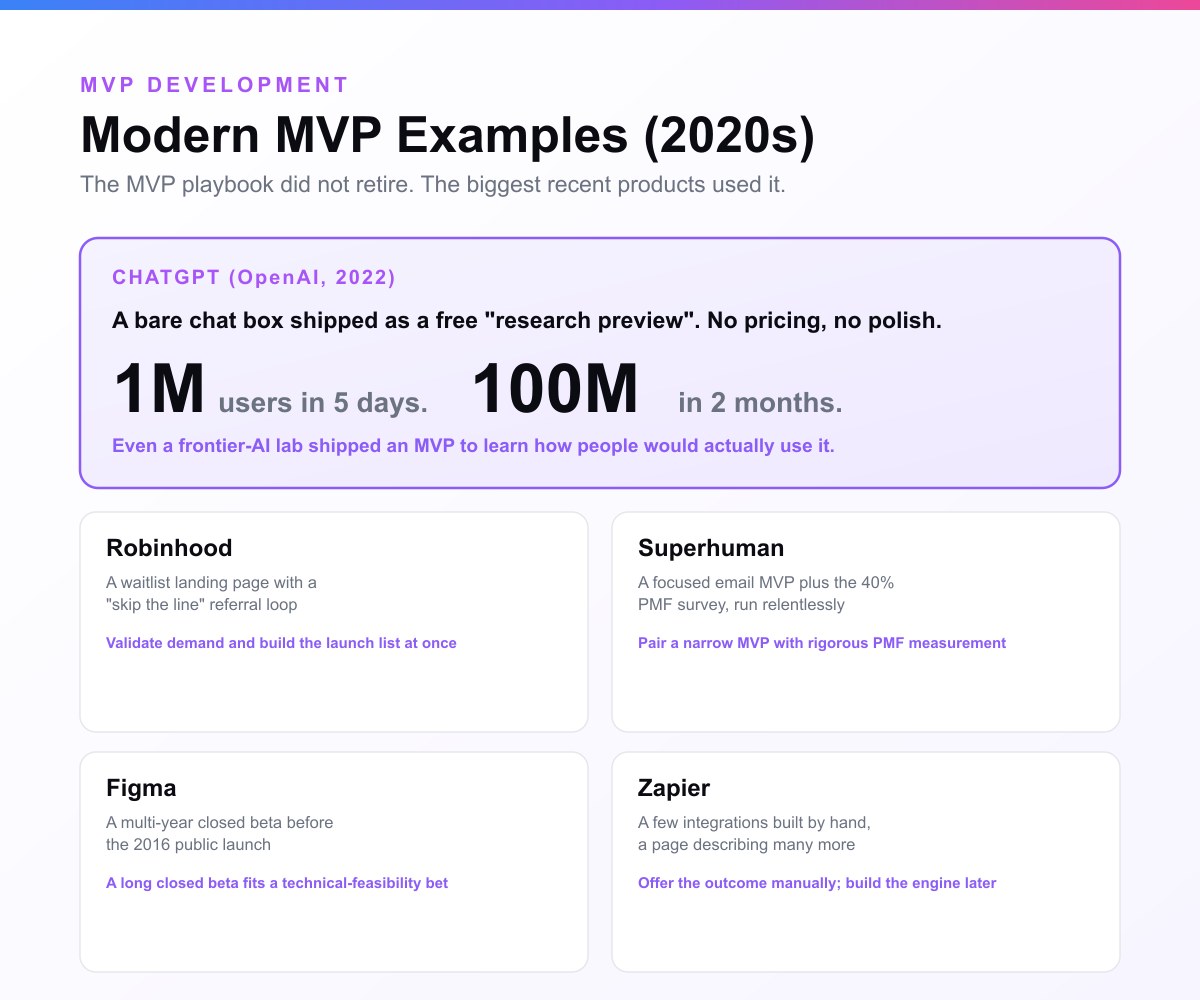
ChatGPT (OpenAI, 2022). OpenAI launched ChatGPT as a deliberately minimal, free "research preview", a bare chat box, no pricing, no polish, explicitly framed as an experiment to see how people would use conversational AI. It reached one million users in five days and an estimated 100 million in two months, the fastest consumer adoption on record. Even a frontier-AI lab shipped an MVP to learn. Lesson: ship a minimal preview to discover how people actually use something new, before building the product around it.
Robinhood. Before launching its commission-free trading app, Robinhood put up a landing page with a waitlist and a viral "skip the line" referral mechanic, refer friends, move up the queue. Nearly a million people joined before the product shipped, validating demand and building a launch audience at the same time. Lesson: a waitlist landing page validates demand and builds your launch list at once.
Superhuman. Rahul Vohra built Superhuman's email MVP around measurement: he ran Sean Ellis's 40% "very disappointed" product-market-fit survey relentlessly, and onboarded every early user with a personal, concierge-style session. He refused to scale until the PMF score was high enough. Lesson: pair a focused MVP with rigorous PMF measurement and hands-on onboarding.
Figma. Figma ran a multi-year closed beta before its 2016 public launch, validating its hard technical bet, full design tools running in a browser, with a small group of real designers before opening the doors. Lesson: a long, closed beta is the right MVP when the riskiest assumption is technical feasibility.
Zapier. The founders started by manually building a handful of app integrations and a bare landing page describing many more, taking on integration requests by hand before automating them. They validated that people wanted no-code automation before building the platform to deliver it. Lesson: offer the outcome manually first; build the engine once demand is proven.
What the MVP examples teach: the patterns
Across all 15, a few patterns repeat, and they are the real lessons to carry into your own build.
- Riskiest question first. Each founder found the single assumption most likely to kill the idea and tested that, will strangers pay (Airbnb), do people want this enough (Dropbox), will they pay this price (Buffer).
- Action over opinion. None relied on surveys or "would you use this?" They measured behavior, signups, pre-orders, real transactions.
- Manual before automated. Airbnb, Zappos, Stripe, Groupon, and Product Hunt all ran manually first. They bought insight with effort before spending it on engineering.
- One thing, done well. Uber, Amazon, Facebook, Instagram, and Spotify each launched a single core flow or market, not a feature buffet.
- Scale only after proof. Every one of them stayed small until the evidence came back yes, then expanded from a position of knowledge.
How much these MVPs cost (vs. the full product)
The reason these examples matter is the asymmetry between what the MVP cost and what building the full product first would have cost.
Zappos cost a few hours and the price of some shoes, bought one pair at a time, against the millions a real e-commerce warehouse operation needs. Dropbox's MVP was a screen-recorded video, against the years of engineering its sync infrastructure required. Buffer's was two web pages. Airbnb's was three air mattresses. In every case, the founders spent almost nothing to answer the single question the full build would otherwise have bet everything on.
That is the entire economic argument for an MVP. The full product, built on a wrong idea, costs the whole budget and a year of runway. The MVP costs a video, a landing page, or a weekend of manual work, and if the answer comes back no, you have lost almost nothing. Given what a real MVP build costs and how long it takes, the validation step is the cheapest, highest-leverage money a founder will ever spend.
The lesson is not "spend nothing." It is "spend the minimum required to learn, before you spend the maximum required to build."
Match the example to your own MVP
The fastest way to use this list is to find the example closest to your situation and borrow its method. This table maps each type of MVP to its examples and when to use it.
| MVP type | Examples here | Use when |
|---|---|---|
| Explainer video | Dropbox, Dollar Shave Club | The product is hard to convey in text |
| Concierge | Airbnb, Stripe, Product Hunt | You need deep early feedback, service-like flow |
| Wizard of Oz | Zappos | The experience must feel real, the engine is costly |
| Landing page / fake door | Buffer | Testing interest and willingness to pay |
| Single feature | Uber, Amazon, Facebook, Instagram, Spotify, Twitter | You've validated demand and need usage data |
| Piecemeal / no-code | Groupon | You can stitch existing tools to launch fast |
| Crowdfunding | Pebble | A physical product that benefits from pre-sales |
Once you have picked your approach, the next steps are the same for everyone: validate the demand with the lightest test that fits, then build the MVP, one core flow, instrumented to measure whether it works.
The one mistake none of these founders made
For all their differences, the 15 founders shared one discipline: none of them built the full product before proving it. That sounds obvious, but it is the exact mistake that kills most startups, and avoiding it is the entire point of an MVP.
It would have been easy for Drew Houston to spend a year building Dropbox's sync engine before knowing anyone wanted it. Easy for the Airbnb founders to build a booking platform before learning whether strangers would share homes. Easy for Nick Swinmurn to lease a warehouse before confirming people would buy shoes online. Each resisted, and tested the riskiest assumption with something they could build in days.
The corollary is just as important: none of them scaled prematurely either. Uber stayed in one city. Facebook stayed at one school. Amazon sold only books. They expanded only after the evidence justified it, treating early restraint as a feature, not a limitation. Premature scaling, hiring, spending, and building ahead of proof, is the most common way well-funded startups die, and these companies are famous precisely because they avoided it.
The takeaway for your own build: the goal is not to build as much as possible as fast as possible. It is to learn as much as possible for as little as possible, then scale what the evidence supports. Every example here is a master class in that single discipline, the product ideas were diverse, but the restraint was universal.
MVP examples by industry
The same patterns recur across industries, and the example closest to your market is often the most useful to copy.
- SaaS: Dropbox, Buffer, and Superhuman validated software products with videos, landing pages, and concierge onboarding before scaling. See SaaS MVP development.
- Marketplaces: Airbnb and Uber both started hyper-local and manual, proving one side of the market and one city before expanding. See marketplace MVP development.
- Fintech: Stripe (hands-on onboarding) and Robinhood (a waitlist) validated trust and demand before building regulated infrastructure. See fintech MVP development.
- AI products: ChatGPT shipped as a minimal research preview to learn how people would use it, the modern blueprint for an AI MVP.
- Consumer & mobile: Instagram and Spotify each nailed a single core experience, photos, instant streaming, before adding anything else. See mobile app MVP development.
- Hardware: Pebble used crowdfunding to validate and fund a physical product, the standard play when you cannot ship a cheap digital test.
Whatever your industry, the move is the same: find the example that matches your riskiest assumption and borrow its method.
How to apply these MVP examples to your idea
Reading the examples is only useful if you turn them into a test for your own idea. Here is how to translate them into action, in four steps.
- Name your riskiest assumption. Write the one belief that, if wrong, kills your idea, as a single falsifiable sentence. This is what every founder above did first, before choosing any tactic.
- Find the closest example. Scan the list for the company whose riskiest question most resembles yours. Unsure anyone wants it? You are Dropbox or Buffer. Unsure your solution delivers value? You are Airbnb or Stripe. Unsure they will pay? You are Buffer's pricing page or Pebble.
- Copy its test, not its product. Borrow the method, a video, a landing page, a manual concierge service, one feature, scaled to your idea. The goal is the cheapest experiment that can break your assumption, exactly as theirs did.
- Measure the behavior they measured. Decide your pass/fail signal in advance, signups, pre-orders, repeat usage, real transactions, and read the action, not opinions. Then build, iterate, or drop based on the result.
This is the bridge from inspiration to execution. The full method is in our guides to validating an MVP and building one, but the shortcut is right here: pick the example that matches your risk, and run their play on your idea.
Turn your idea into the next MVP example
Every company on this list started where you are: an idea and a riskiest assumption. What they did next, test it small, prove it, then build, is exactly the play we run at MVP Development.
- We help you pick the right play. We match your riskiest question to the lightest validation method, the same logic behind every example above.
- Then we build fast. A complete, funding-ready MVP in 3 to 4 weeks, built by senior engineers on a scoped quote you approve up front, the one core flow your validation proved people want.
- It's funding-ready by default. A deployed product with a working core flow and a live URL, the artifact that turns a pre-seed conversation into a check.
- You own production-grade code. Built to scale past the MVP, the way Uber, Amazon, and the rest scaled from their first version.
The honest trade-off is scope, not quality: we build the one validated flow, not ten guesses, exactly what these examples teach. Explore our MVP development services or go straight to a custom MVP build.
Ready to build your MVP? Point at the example closest to your idea and we will scope your version of it.
Myths these MVP examples bust
Seen together, the examples puncture the most common misconceptions about MVPs.
"An MVP is a low-quality product." Zappos shipped real shoes; Airbnb hosted real guests; Uber summoned real cars. Every successful MVP delivered genuine value, it was minimal in scope, never in quality. A broken product would have produced a false negative.
"An MVP has to be software." Dropbox and Dollar Shave Club used videos. Airbnb, Zappos, and Stripe used manual human effort. Groupon used a blog and PDFs. Some of the most famous MVPs contained little or no product code at all.
"You only build one MVP." Instagram began as Burbn, a cluttered check-in app, and became an MVP for photo sharing only after a pivot. The MVP is the start of an iterative loop, not a single shot.
"Big, serious companies don't need MVPs." OpenAI, the most-watched AI lab in the world, shipped ChatGPT as a minimal "research preview." The logic of validated learning applies at every scale.
"An MVP means launching something embarrassing." None of these were embarrassing, they were minimal but credible. Buffer's pricing page looked real; Uber's app worked. The point is to launch early to learn, not to ship something broken.
The throughline: an MVP is a deliberate, intelligent experiment, not a cut corner. That is why these scrappy first versions became some of the most valuable companies on earth.
Related guides
- Explainer Video MVP: how to run the method Dropbox made famous
- Types of MVP: the 8 approaches behind these famous starts
- The Airbnb MVP, Dropbox MVP, and Zappos MVP: the deep-dive case studies
- How to Build an MVP: turn the inspiration into a build plan
- MVP Validation: prove demand the way these companies did
Frequently asked questions
What is an example of an MVP?
A classic example is Dropbox, which validated demand with a three-minute explainer video before building the product, its waitlist jumped from 5,000 to 75,000 overnight. Other famous examples include Airbnb (renting air mattresses by hand), Zappos (selling shoes by photographing local stock with no inventory), Uber (a single app to request a car in one city), and Buffer (a landing page with a pricing button to test willingness to pay). Each proved its core idea with the smallest possible product.
What are the most famous MVP examples?
The most cited MVP examples are Airbnb, Dropbox, Zappos, Uber, Amazon, Facebook, Buffer, Groupon, Instagram, Spotify, Stripe, Twitter, Product Hunt, Dollar Shave Club, and Pebble. They span every MVP type, from explainer videos and concierge services to single-feature builds and crowdfunding campaigns, but share one trait: each started with the smallest possible test of demand before building the full product.
What was Airbnb's MVP?
Airbnb's MVP was a concierge test in 2007: the founders put air mattresses on their San Francisco apartment floor and offered "Air Bed & Breakfast" to attendees of a design conference that had sold out local hotels. Three guests paid to stay. It was entirely manual and tiny, but it answered the core question, would strangers pay to stay in a stranger's home, before any platform existed.
What was Dropbox's MVP?
Dropbox's MVP was a three-minute explainer video. Before building the technically difficult file-sync engine, founder Drew Houston made a video demonstrating how Dropbox would work and posted it to a tech-savvy audience. The beta waitlist grew from around 5,000 to 75,000 people overnight, validating massive demand for a product that did not yet exist. It is the textbook example of a video-as-MVP.
What do all successful MVP examples have in common?
They each identified the single riskiest assumption behind the idea and built the cheapest possible test for it, then measured real behavior (signups, pre-orders, transactions) rather than asking for opinions. They tended to run manually before automating, focused on one core flow or market, and scaled only after the evidence proved demand. The MVP was always an experiment, not a small version of the finished product.
Can a video or landing page really be an MVP?
Yes. An MVP does not have to be software, it is the smallest thing that tests your riskiest assumption. Dropbox and Dollar Shave Club used videos; Buffer used a landing page; Airbnb and Zappos used manual services. If a video or page can answer "do people want this?" without building the product, it is a perfectly valid, and very efficient, MVP.
How can I apply these MVP examples to my own startup?
Find the example closest to your situation and borrow its method. Identify your riskiest assumption, then pick the lightest test that fits: a video or landing page if the risk is demand, a concierge or Wizard-of-Oz approach if you need to prove the solution delivers value, pre-sales if the risk is willingness to pay. Validate first, then build the one core flow your test proved people want.
Were these MVPs low-quality products?
No, and that is the key lesson. Minimal refers to scope, not quality. Each example did one thing, but did it well enough to deliver real value: Zappos shipped real shoes, Airbnb hosted real guests, Uber summoned real cars. The MVPs were narrow, not shoddy. A broken product would have produced a false negative, killing a good idea on a bad experience.
What is the best MVP example to learn from?
It depends on your riskiest assumption. If you are unsure anyone wants your product, Dropbox's explainer video and Buffer's landing page are the models. If you need to prove your solution actually delivers value, Airbnb's and Stripe's concierge approaches fit. If you are validating willingness to pay, Buffer's pricing page or Pebble's crowdfunding campaign are the templates. Match the example to the question you most need answered.
Are MVPs still relevant in 2026?
Yes, more than ever. ChatGPT, Robinhood, Superhuman, and Figma all used MVPs in the modern era, and AI tooling has made building faster, which raises the bar: shipping is no longer impressive on its own, evidence of demand is. The MVP is how you produce that evidence cheaply, and investors increasingly expect it even at pre-seed.
What's the difference between an MVP and a prototype in these examples?
In these examples, the MVPs were things real users actually used to get value, Zappos shipped real shoes, Uber summoned real cars. A prototype, by contrast, is a non-functional mockup used to test design and flow, not a real product. Most of these famous examples skipped straight to a minimal but real product or service, because their riskiest question was about demand, which only real behavior can answer.
How many MVP examples should I study before building?
A handful is enough, focus on the two or three closest to your own situation rather than memorizing all fifteen. The goal is not trivia; it is to extract the method: which riskiest assumption they tested, what the cheapest test was, and which behavior they measured. Pick the examples that match your industry and your riskiest question, then copy the approach, not the specifics.
Did famous companies fail by skipping the MVP?
Many, though survivors are better documented than failures. The startup graveyard is full of companies that built polished, full-featured products for markets that did not exist, the exact failure the MVP prevents. Even well-funded efforts are often cited as cases where validating real demand before scaling production and marketing might have changed the outcome. The lesson of the successful examples is the same lesson inverted: prove demand small before you build big.
What's the smallest MVP example on this list?
Dropbox's and Dollar Shave Club's video MVPs and Buffer's landing-page MVP are about as small as it gets, no product was built at all, just a demonstration or a page, yet each produced decisive demand signals. They prove the most important point in this guide: an MVP can be tiny, even product-less, and still answer the one question that matters, before a line of code is written.
Can a small startup use the same MVP methods as these companies?
Absolutely, and that is the point. When Airbnb, Dropbox, and Zappos ran these MVPs, they were tiny, unfunded, and unknown, exactly where most founders start. The methods, a video, a landing page, a manual service, one feature, require almost no money or team. A solo founder with a weekend and a small budget can run the same play these now-giant companies used at the very beginning. The MVP is, if anything, more important for a small startup, because you have less runway to waste on the wrong thing.
Sources & references
This guide draws on widely documented startup histories and lean-startup practice:
- Eric Ries, The Lean Startup, the MVP concept and validated learning behind these examples
- Shortform, The Original Dropbox MVP Explainer Video, the video that took Dropbox's waitlist from 5,000 to 75,000
- First Round Review, founder accounts of early-stage product and growth experiments
- Minimum Viable Product, Wikipedia, the concept's origin and documented company examples
Company histories reflect widely reported accounts; the 3 to 4 week range reflects our delivery data for tightly scoped, single-flow builds.


