


TL;DR
The core difference in MVP vs MMP: an MVP (minimum viable product) is the smallest thing you can build to test whether the market wants your idea, while an MMP (minimum marketable product) is the smallest product with enough value that you can actually sell it. An MVP optimizes for learning with the least effort. An MMP optimizes for time-to-market with the least scope that still earns money. They sound alike because both contain the word "minimum," but one is an experiment to reduce uncertainty and the other is a launchable, marketable product.
Short version: if you still need proof that anyone wants this, you need an MVP. If demand is already proven and you are deciding the smallest set of features worth launching to a paying market, you are defining an MMP. The MVP comes first and answers "should this exist." The MMP comes next and answers "what is the leanest thing worth selling." At MVP Development we ship a funding-ready MVP in 3 to 4 weeks on a clear, scoped quote you approve before we start, so you reach real demand evidence before you ever scope an MMP. More on the order below.
Key Takeaways
- An MVP is the smallest thing you build to test whether the market wants your idea.
- An MMP (minimum marketable product) is the smallest product with enough value that you can actually sell it.
- An MVP optimizes for learning; an MMP optimizes for time-to-market with the least scope that still earns money.
- The MVP comes first and answers "should this exist"; the MMP answers "what is the leanest thing worth selling."
MVP vs MMP: the difference that matters most
Strip away the shared word "minimum" and the two ideas pull in different directions. An MVP is built to learn. Its job is to reduce the biggest uncertainty, usually "does anyone actually want this," using the smallest possible build. An MMP is built to sell. Its job is to get a genuinely marketable product into customers' hands as fast as possible, by shipping the smallest feature set that the market will still pay for.
That single difference, learning versus marketability, drives everything else. An MVP can be deliberately incomplete, rough, even partly manual behind the scenes, because its only obligation is to produce honest evidence. An MMP cannot be rough in the same way: it has to stand on its own as a product a customer would choose and pay for, even if it does far less than your eventual vision.
Founders blur the two constantly, and the blur is expensive in both directions. Treat your MVP like an MMP and you over-build a polished, "sellable" product before proving anyone wants it. Treat your MMP like an MVP and you launch something too thin to actually win customers, then read the weak sales as a demand problem when it is really a marketability problem.
What is an MVP?
An MVP (minimum viable product) is the smallest version of your product that is genuinely functional and built to test a hypothesis: usually whether real people want what you are making enough to use it and pay. It does one core thing to a real standard, ships to actual users, and exists to generate validated learning with the least time and effort.
The defining trait of an MVP is that something important is still unproven, most often demand. You are not optimizing a known winner, you are running an experiment. That is why an MVP can be narrow, unpolished, or even held together manually behind the curtain without failing at its job. Its job is learning, not launching. The MVP sits at a specific point in a company's life, after the idea is shaped and before scaling begins, which we cover in depth in our guide to the MVP stage of a startup.
An MVP can take many forms, from a concierge service to a fake-door test to a single-feature app, depending on the cheapest honest way to test the riskiest assumption. We map the full set in our breakdown of the types of MVP. The common thread is that every MVP is chosen to maximize what you learn per dollar and per week spent.
What is an MMP?
An MMP (minimum marketable product) is the version of your product with the smallest feature set that still solves the customer's problem well enough to be sold and marketed successfully. Where the MVP minimizes effort to learn, the MMP minimizes scope to launch: it is the leanest product you can take to market that customers will actually choose, adopt, and pay for at scale.
The defining trait of an MMP is that the product concept is already validated. You are no longer asking whether people want it. You have evidence they do, and now you are deciding the smallest, fastest, most focused product worth putting on the market. As product strategist Roman Pichler frames it, the minimum viable product and the minimal marketable product serve different goals: the MVP reduces risk and waste while you learn, while the marketable product captures the smallest feature set that meets customer needs so you can launch without over-building.
The MMP is a discipline against feature bloat at launch. Left unchecked, teams pile features into a first release "to be safe," delaying the launch and muddying the value. The MMP forces the opposite question: what is the least we can ship that the market will genuinely pay for? A minimum marketable product is about getting to market faster with a focused, sellable offering rather than a maximal one.
MVP vs MMP: side-by-side comparison
Here is the full MVP vs MMP comparison across the categories that actually drive the decision.
| Category | MVP | MMP |
|---|---|---|
| What it is | The smallest build that tests an idea | The smallest product you can sell |
| Primary goal | Validated learning, reduce uncertainty | Time-to-market, capture revenue leanly |
| Core question | "Do people actually want this?" | "What is the least we can ship and still sell?" |
| What it optimizes | Effort spent per lesson learned | Scope shipped per dollar earned |
| Stage | Early: before product-market fit | Later: after demand is validated |
| Demand status | Unproven, being tested | Already validated |
| Completeness | Minimal, sometimes partly manual | Complete enough to be genuinely marketable |
| Polish | Rough is acceptable | Must be market-ready and sellable |
| Audience | A few early adopters | Your real target market |
| Success looks like | A clear yes or no on the hypothesis | Customers buying the lean product |
| Primary metrics | Activation, retention, willingness to pay | Revenue, adoption, conversion, time-to-market |
| Risk it reduces | "Will the market want this at all?" | "Can we launch and sell without over-building?" |
The table is the fast answer. The sections below unpack the categories where founders most often place themselves at the wrong stage.
The 6 comparison categories that matter
1. Goal: learning vs marketability
This is the category everything else flows from. An MVP exists to learn. Its yardstick is how much uncertainty it removes per unit of effort, and a "failed" MVP that proves nobody wants the product is a success, because it saved you from building the wrong thing. An MMP exists to sell. Its yardstick is whether the lean product wins customers in the real market without you over-building.
The trap is judging an MVP by MMP standards. If you grade a learning experiment on its revenue or its polish, you will keep adding scope until it stops being an MVP at all, spending months making something "sellable" before you have earned the right to sell anything.
2. Stage: validation vs launch
The MVP comes first, when demand is the open question. The MMP comes later, once demand is proven and the question shifts to "what is the leanest thing worth launching to a paying market." An MMP assumes the answer to the MVP's question. That is why building an MMP before an MVP is a quiet bet that your idea is right, made before any user has confirmed it.
Think of it as a sequence: validate with the MVP, then define the MMP as the smallest marketable expression of the now-validated idea, then grow toward the full product. Our MVP roadmap guide lays out how the early build evolves into later releases.
3. Completeness: experiment vs sellable product
An MVP can be radically incomplete and still do its job. Some of the most effective MVPs are barely "products" at all: a concierge service run by hand, a fake-door button that measures clicks, a landing page that takes pre-orders. None of those is marketable, and none needs to be, because the goal is evidence.
An MMP is held to a higher bar: it must be complete enough that a customer in your target market would choose it and pay for it. It can do far less than your eventual vision, but the slice it does deliver has to be a coherent, sellable product, not a stub. This is the line that separates the two: an MVP can be a clever experiment, an MMP must be a real, marketable product.
4. Audience: early adopters vs the target market
An MVP goes to a small group of early adopters: people who tolerate rough edges in exchange for solving a real problem early, and whose behavior is the signal you are reading. You are not trying to please the mainstream, you are trying to learn from the willing.
An MMP goes to your actual target market: mainstream customers who have normal expectations and will judge the product as a product, not as an experiment. Early adopters forgive a rough MVP; the broader market that an MMP targets does not. The audience shifts because the question shifts, from "will anyone use this" to "will our real customers buy this."
5. The metrics you actually track
An MVP and an MMP succeed or fail on different numbers, and using the wrong scorecard wastes the exercise.
MVP metrics are about validated learning:
- Activation: do new users reach the core value at all?
- Retention: do they come back after the first use?
- Willingness to pay: will early adopters put money or a strong signal behind it?
- Evidence quality: did the test actually answer the question you asked?
MMP metrics are about marketability and revenue:
- Conversion and sales: are target customers actually buying?
- Adoption rate: is the lean product spreading in the real market?
- Time-to-market: did the minimal scope get you live faster than a full build?
- Unit economics: does each sale work financially at the lean scope?
The difference is the whole point. MVP numbers tell you whether a business should exist. MMP numbers tell you whether the leanest sellable version of it does work in the market.
6. The risk each one retires
An MVP retires market risk: the chance that you build something nobody wants. It is the cheapest insurance against the single most common cause of startup failure, building for months and launching to silence.
An MMP retires execution and scope risk at launch: the chance that you either over-build (shipping a bloated first release that takes too long and dilutes the value) or under-build (shipping something too thin to be marketable). The MMP is how you launch lean without launching weak. Both stages exist because they remove different risks at different moments.
Where the MVP and MMP sit in the timeline
The clearest way to keep them straight is to place them in order. The common sequence runs: shape the idea, build an MVP to validate demand, iterate toward product-market fit, define the MMP as the smallest marketable product worth launching, ship it to your target market, then grow toward the full product.
| Stage | What it is | Question it answers | Audience |
|---|---|---|---|
| MVP | Smallest build to test the idea | "Do people want it?" | A few early adopters |
| MMP | Smallest sellable, marketable product | "What is the least worth launching?" | The real target market |
| Full product | The maturing, feature-rich offering | "How do we win and scale?" | The whole market |
Skipping straight to an MMP is the classic mistake: it assumes demand instead of proving it. Skipping the MMP and launching a maximal product is the opposite mistake: shipping everything, slowly, when a leaner release would have reached the market sooner and taught you what to build next. Each stage earns the right to the next.
MMP, MMF, MMR, and MLP: the related terms
The "minimum marketable" family has a few cousins that get used loosely. Knowing them keeps the MVP vs MMP conversation precise.
| Term | Stands for | What it means |
|---|---|---|
| MVP | Minimum Viable Product | The least you build to learn whether the idea is wanted |
| MMP | Minimum Marketable Product | The smallest product complete enough to sell and market |
| MMF | Minimum Marketable Feature | The smallest single feature that delivers marketable value |
| MMR | Minimum Marketable Release | The smallest release worth shipping to market, often a bundle of MMFs |
| MLP | Minimum Lovable Product | A lean product scoped not just to be usable, but to delight |
The relationships are simple once laid out. An MMP is often assembled from one or more minimum marketable features. A minimum marketable release is the shippable package of those features. And the minimum lovable product is a reaction to thin MVPs and MMPs: it argues that even the leanest launch should be something customers love, not merely tolerate. All of them share the MMP's premise, that demand is validated and the question is now what to launch, which is exactly what separates the whole family from the MVP.
How real products moved from MVP to MMP
The distinction is easiest to see when one company runs both stages in order.
Dropbox validated with an MVP, then shipped an MMP. Before building the full product, Drew Houston released a short demo video showing how seamless file sync would feel. That was a pure MVP move: a demand test, not a sellable product, and the waitlist reportedly jumped from around 5,000 to 75,000 overnight. Only after that signal did Dropbox build its minimum marketable product: a real, installable sync tool that did one thing, kept a folder in sync across devices, well enough that mainstream users would adopt and pay. The video proved demand; the lean sync product was the marketable launch.
Buffer tested demand and willingness to pay before building the MMP. Founder Joel Gascoigne started with a deliberately two-step landing-page MVP. The first page described the product and a "Plans and Pricing" button; clicking it revealed the product was not built yet and simply collected an email. When enough people clicked through, he added a second page with real price tiers, to test not just interest but willingness to pay at a specific price. Only once those signals were in did Buffer build its minimum marketable product: a single, sellable scheduling tool that did one thing, queue and post social updates, well enough that customers would pay a monthly fee. The landing pages were the MVP that proved demand; the lean paid scheduler was the MMP that captured it.
Many SaaS tools follow the same arc. A founder runs a landing-page or concierge MVP to confirm people will pay for, say, automated scheduling. Once that is proven, the MMP is not "every scheduling feature imaginable," it is the single core workflow, polished enough to sell, shipped fast. Extra features (team calendars, analytics, integrations) come later, once the lean marketable product has customers and revenue pointing the way.
The pattern is the article in one sentence: the MVP answers "is this worth building," and the MMP answers "what is the smallest version worth selling." Run them in that order and each does its job.
How to scope an MMP without bloating it
Once demand is proven, the hard part of an MMP is rarely deciding what to add. It is deciding what to leave out. The MMP fails when teams treat "minimum" as a formality and quietly rebuild the full product under a leaner name. Here is a repeatable way to land on the smallest scope that is still genuinely marketable.
- Name the one job the product is hired to do. Write a single sentence describing the core outcome a customer pays for. Everything that does not directly serve that job becomes a candidate to cut.
- List every feature you think the launch "needs." Get the whole wish list on paper, including the ones that feel too obvious to question. You cannot cut what you have not made visible.
- Score each feature against one blunt test: would a target customer refuse to buy without it? Not "would it be nicer with it," but "would the sale actually fail." Most features quietly fail this test, and that is exactly the point.
- Keep only the refuse-to-buy features. That set, and only that set, is your MMP candidate. It should feel uncomfortably lean. If it feels comfortable and complete, you have almost certainly kept too much.
- Sequence everything else as post-launch work. The cut features are not gone, they are queued. Each becomes a minimum marketable feature you ship later, once the lean product has paying customers telling you which one matters most.
- Pressure-test for marketability, not completeness. The final question is not "is this finished," it is "would our real target market choose and pay for this slice over the alternatives." If yes, you have an MMP. If you are only confident a generous early adopter would tolerate it, you are still describing an MVP.
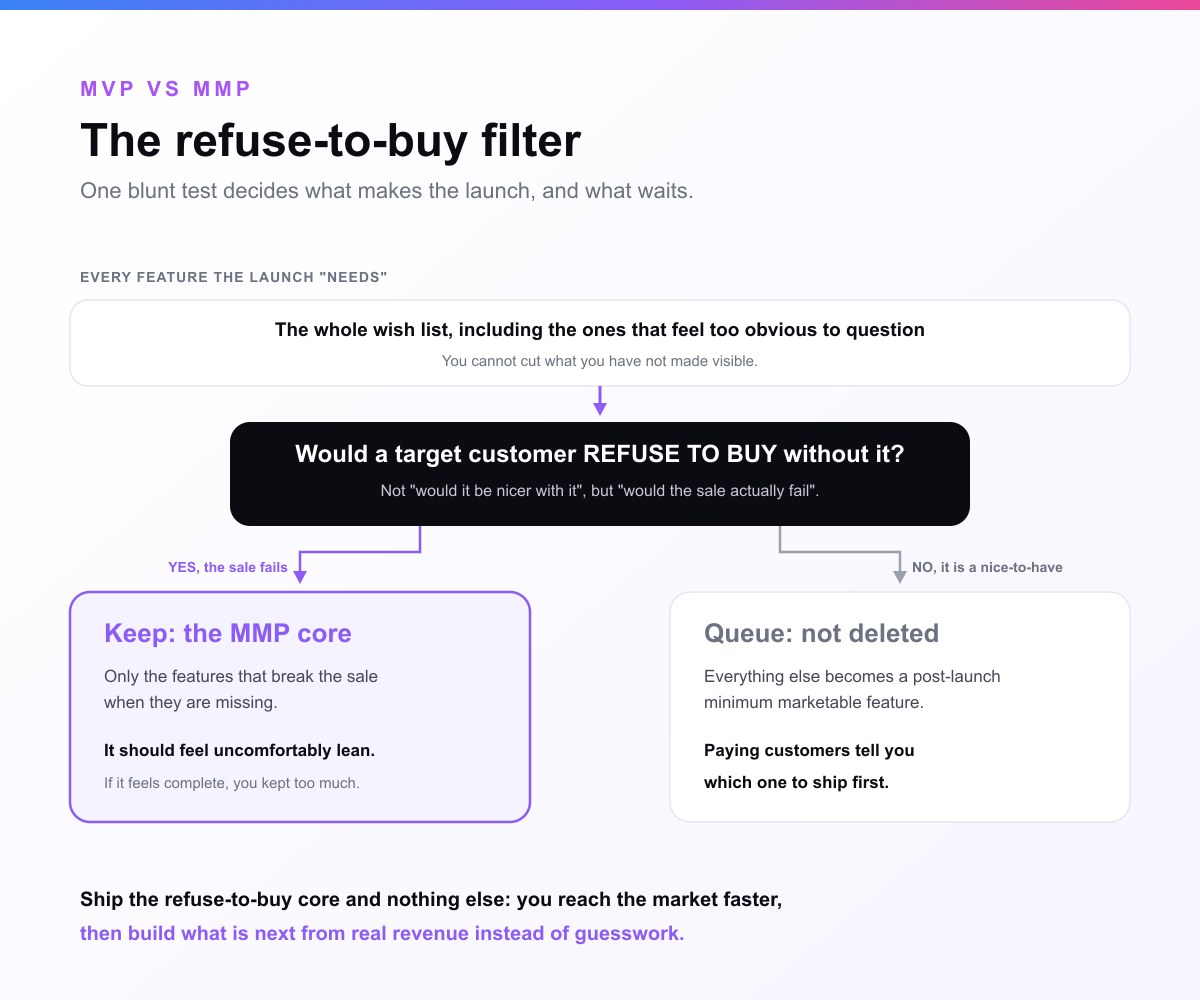
The discipline is the deliverable. An MMP that ships the refuse-to-buy core and nothing else reaches the market faster, then tells you what to build next from real revenue instead of guesswork. It also sidesteps the most common launch failure: a bloated first release that took twice as long to ship and still missed the feature customers actually cared about.
How an MVP earns the right to an MMP
Because the entire argument of MVP vs MMP rests on order, the moment of transition deserves its own attention. Scoping an MMP too early is just an MMP-flavored version of the same guess an unvalidated MVP makes. The signal to move on is not a calendar date or a feeling of momentum. It is evidence that the demand question is genuinely closed.
Four signals, taken together, tell you the MVP has done its job:
- Retention holds, it does not just spike. A launch bump means little if users leave right after. What you want is a retention curve that flattens into a stable base of people who keep returning to the core value. Flat-and-positive beats high-and-falling every time.
- Willingness to pay is real, not polite. Early adopters putting money down, or a strong and repeated equivalent signal, is the clearest proof you have. Verbal enthusiasm is not willingness to pay. A credit card is.
- Demand pulls instead of being pushed. When users start asking for the product, referring others, or building workarounds because they want the outcome badly enough, demand is pulling you forward. If every bit of usage requires you to push, the question is still open.
- The use case is repeatable. The same kind of customer, hiring the product for the same job, triggered by the same situation. A handful of unrelated one-off wins is not a validated market, it is noise that feels like signal.
A simple way to read where you stand:
| Signal | Stay in the MVP | Scope the MMP |
|---|---|---|
| Retention | Spikes, then decays | Flattens into a stable, returning base |
| Willingness to pay | Praise, "I'd totally use this" | Actual payments or a strong paid-intent signal |
| Demand direction | You push every use | Users pull: requests, referrals, workarounds |
| Use case | Scattered, one-off wins | Repeatable: same customer, same job, same trigger |
| Your open question | "Does anyone want this?" | "What is the least we can sell?" |
When most of the right-hand column is true, the remaining risk has shifted from demand to scope, and scope risk is precisely what the MMP exists to retire. Until then, more MVP iteration is the higher-value move, even when it feels less like progress than "building the real product" would.
The investment difference between an MVP and an MMP
The two stages also ask for different levels of investment, and confusing them is how budgets get burned in the wrong place. An MVP is deliberately cheap and fast, because its entire purpose is to buy a lesson at the lowest possible price. A tightly scoped MVP can ship in around 3 to 4 weeks precisely because it tests one core thing rather than launching a finished product. Spending heavily to make an MVP feel polished defeats it: you are paying launch prices for an experiment whose premise is still unproven.
An MMP costs more, and it should. It has to be a coherent, sellable product, which means real reliability, the polish paying customers expect, billing, and basic support, even at a minimal feature set. The lever that keeps an MMP affordable is not cutting quality, it is cutting scope: shipping the marketable core and nothing else. General guidance on what actually drives these numbers, from scope to team to platform, is in our guide to how much it costs to build an MVP, and the same forces push an MMP's cost upward as marketability raises the bar.
The practical takeaway is simple: do not spend MMP money on an MVP, and do not try to fund a real MMP on an MVP budget. Match the investment to the question. Cheap and fast to learn whether the thing should exist; more deliberate, but still disciplined and lean, to launch the smallest version actually worth selling.
Which one do you actually need?
The decision is not about which is "better." It is about which question you most need answered next.
- You need an MVP if demand is unproven. You do not yet know whether real users will adopt and pay, and your next job is to find out with the smallest real test that can answer it. Most early founders are here, even when they are already talking about features and launch.
- You need to define an MMP if demand is proven and you are deciding what to launch. Early adopters have shown they want it, and your next job is to scope the smallest marketable product, the leanest set of features your target market will actually buy, so you reach the market fast without over-building.
A useful gut check: ask what would change your mind about the product right now. If the honest answer is "seeing whether anyone actually wants it," you need an MVP, no matter how launch-ready the plan feels. If the answer is "seeing whether our lean version sells in the real market," you are scoping an MMP.
When to build an MVP (and when not to)
Build an MVP when:
- Your biggest open question is whether the market wants and will pay for the product.
- You need real usage data to raise money, decide whether to continue, or shape what to build next.
- You can define a single core flow or experiment worth putting in front of early adopters.
Move past the MVP when:
- Early adopters have clearly validated demand and retention.
- The remaining risk has shifted from "do they want it" to "what is the leanest thing worth launching," which is the signal to scope an MMP.
When to scope an MMP (and when not to)
Scope an MMP when:
- Demand is validated and you are deciding what to take to the broader market.
- You are tempted to cram features into the first release and need discipline to ship the smallest marketable version instead.
- Time-to-market matters and a leaner launch beats a maximal one.
Hold off on an MMP when:
- You have not proven anyone wants the product. Build and learn from an MVP first.
- You are still discovering the core value. That is MVP iteration, not MMP scoping, and it is one of the MVP development challenges that sinks teams who rush to launch.
Common mistakes founders make
1. Building an MMP before an MVP. Scoping a "lean sellable product" before proving demand assumes the idea is right. If the market does not want it, a beautifully marketable launch changes nothing. Validate first.
2. Judging an MVP by MMP standards. Grading a learning experiment on revenue or polish pushes you to keep adding scope until it is no longer minimal, and no longer fast.
3. Over-stuffing the MMP. The whole point of a minimum marketable product is restraint. Piling in "just in case" features delays the launch and blurs the value. Ship the smallest marketable slice, then expand from real demand.
4. Shipping an MMP that is too thin. The opposite error: cutting so deep that the launch is not actually marketable. An MMP is minimal and sellable. If your target market would not choose it, it is not an MMP yet.
A concrete example
Imagine a founder building an app that auto-generates product descriptions for online sellers.
- The MVP tests demand with the least build. It might be a concierge version where the team writes descriptions by hand behind a simple form, or a single-feature app that generates one real description, with payment if you are charging. A small group of early adopters uses it, and you learn the only thing that matters at this stage: do sellers come back and pay? Demand is the question.
- The MMP comes after demand is proven. It is the smallest marketable version: a real, self-serve product that connects a store, generates and publishes descriptions in bulk, and bills customers, polished enough that mainstream sellers will choose it over alternatives. It deliberately leaves out the long tail (multi-language, advanced templates, deep analytics) until the lean marketable product has traction. Marketability is the question.
Each step answers a different risk in a different order. A founder who has not proven demand should be building the MVP, not scoping an MMP, no matter how clear the launch vision feels.
The MVP Development take
In our experience, most founders who describe their plan as "building the MMP" are actually still at the MVP stage, because demand is not yet proven. The MMP framing feels productive, since it sounds like shipping a real, sellable product, but it quietly skips the question that decides whether the product should exist at all. A polished, marketable launch of something nobody wants is the most expensive way to learn you guessed wrong.
That is why our default is to take founders straight to a real, narrow MVP: a single core flow, built to production standard, live for real early adopters, in 3 to 4 weeks on a clear, scoped quote you approve before we start. You get the one thing that actually de-risks the business, evidence of real demand, plus a deployed product you can put in front of investors. Once that evidence is in, scoping the MMP becomes a much easier, much safer decision, because you are choosing the leanest marketable version of something you now know people want.
There is no conflict between the two, only an order. The MVP earns the right to define an MMP. The MMP turns validated demand into the leanest product worth launching. Run them in sequence and each does its job. Collapse them, and you either over-build before you have proof or launch a product too thin to win. We help founders place themselves honestly on that timeline, then build whatever the current stage actually calls for. If you want a deeper picture of the surrounding stages, our comparisons of MVP vs prototype and MVP vs beta map the steps before and after.
Not sure whether you need an MVP or an MMP? Ask us how thin your first paid release can be and we will draw that line with you.
Related guides
- What Is an MVP?: a clear definition of the minimum viable product
- How to Build an MVP: the step-by-step founder's playbook
- MVP Examples: 15 Famous MVPs: how the biggest startups validated with an MVP
- Post-MVP: what comes after launch: where the MMP fits in iterate, pivot, or scale
Frequently asked questions
What is the difference between an MVP and an MMP?
An MVP (minimum viable product) is the smallest build you create to test whether the market wants your idea, optimized for learning with the least effort. An MMP (minimum marketable product) is the smallest product complete enough to sell and market successfully, optimized for getting to market fast without over-building. In short, an MVP validates demand and comes first; an MMP defines the leanest sellable product and comes later.
Is an MMP the same as an MVP?
No. They share the word "minimum" but serve different goals. An MVP is an experiment built to reduce uncertainty, and it can be rough or even partly manual. An MMP is a real, marketable product that customers in your target market would choose and pay for. If demand is still unproven, you need an MVP, not an MMP.
Which comes first, the MVP or the MMP?
The MVP comes first. You build an MVP to validate demand, iterate toward product-market fit, and only then scope an MMP as the smallest marketable product worth launching. An MMP assumes the demand question is already answered, which is exactly the MVP's job.
What does MMP stand for?
MMP stands for minimum marketable product: the version of your product with the smallest feature set that still solves the customer's problem well enough to be sold and marketed. The emphasis is on marketability and time-to-market, shipping the leanest product the market will actually buy, rather than a maximal first release.
Can an MVP become an MMP?
Indirectly. The learning from an MVP informs the MMP, and the MVP's code may even evolve into it, but the MVP itself is not an MMP. At the MVP stage demand is unproven and the build is intentionally minimal and experimental. The MMP is the later, sellable product you scope once that demand is confirmed.
What is the difference between an MMP and an MMF?
An MMP (minimum marketable product) is a complete, sellable product with the smallest viable feature set. An MMF (minimum marketable feature) is the smallest single feature that delivers marketable value on its own. An MMP is often assembled from one or more MMFs, and a bundle of MMFs shipped together is sometimes called a minimum marketable release (MMR).
Is an MMP the same as a minimum lovable product?
Not quite. An MMP is the smallest product that is marketable and sellable. A minimum lovable product (MLP) goes a step further and argues the lean launch should also delight customers, not merely satisfy them. The MLP is partly a reaction to thin MVPs and MMPs. Both assume demand is validated, which is what separates them from the MVP.
Does an MMP need to be profitable?
Not necessarily on day one, but it does need to be genuinely sellable: a product your target market will choose and pay for. The MMP's discipline is shipping the smallest marketable scope so you reach the market faster and can then improve unit economics. Profitability is a goal you work toward; marketability is the bar the MMP must clear to launch.
How long does it take to build an MVP before an MMP?
A tightly scoped MVP can ship in around 3 to 4 weeks, because it tests one core thing rather than launching a full product. Scoping and building an MMP usually takes longer, since it must be a complete, marketable product, though keeping it genuinely minimal is what controls that timeline. We break the build estimate down in our guide to how long it takes to build an MVP.
How do I know my MVP is ready to become an MMP?
Look for four signals together: retention that flattens into a stable, returning base rather than spiking and fading; real willingness to pay instead of verbal praise; demand that pulls (requests, referrals, workarounds) rather than usage you constantly have to push; and a repeatable use case where the same kind of customer hires the product for the same job. When most of those hold, the open risk has moved from "does anyone want this" to "what is the least we can sell," which is the cue to scope the MMP.
How do you keep an MMP from turning into a full product?
Score every proposed feature against one test: would a target customer refuse to buy without it? Keep only the features that break the sale when missing, and queue the rest as post-launch minimum marketable features. A well-scoped MMP should feel uncomfortably lean. If the scope feels comfortable and complete, you have most likely rebuilt the full product and given up the time-to-market advantage that makes an MMP worth doing in the first place.
Does an MMP cost more than an MVP?
Usually, yes. An MVP is built to learn at the lowest possible price and can ship in around 3 to 4 weeks because it tests one core thing. An MMP has to be a genuinely sellable product, with the reliability, polish, and billing that paying customers expect, so it asks for more investment even at a minimal feature set. The way to keep an MMP affordable is to cut scope, not quality, shipping only the marketable core and sequencing the rest for later.
Is an MMP the same as product-market fit?
No, though they are closely related. Product-market fit is evidence that a market strongly wants your product. An MMP is a scoping decision about the smallest sellable version you take to that market. In practice you gather early fit signals from the MVP, use them to justify scoping an MMP, then strengthen and prove fit at scale as the marketable product gains adoption. Fit is a state of demand; the MMP is a product decision about what to launch.
How is MVP vs MMP different from MVP vs prototype or MVP vs beta?
A prototype comes before the MVP and is a non-functional simulation that tests design. A beta comes after the MVP and is a feature-complete product tested for stability before launch. An MMP also comes after the MVP, but it is about scope and marketability, the smallest sellable product, rather than stability. We cover the neighboring comparisons in MVP vs prototype and MVP vs beta.
Sources and references
This comparison draws on established product-management frameworks and current practice:
- Roman Pichler, Minimum Viable Product and Minimal Marketable Product the goal difference between learning and marketability
- ProductPlan, Minimum Marketable Product the smallest-sellable-product definition and time-to-market focus
- ProductPlan, Minimum Marketable Feature how MMFs relate to an MMP
- Buffer, From Idea to Paying Customers in 7 Weeks the two-step landing-page MVP and willingness-to-pay test before the paid MMP
- Wikipedia, Minimum viable product the MVP definition and validated-learning purpose
- Eric Ries, The Lean Startup the origin of the MVP and build-measure-learn
Time and delivery ranges reflect Q2 2026 practice; the 3 to 4 week figure reflects MVP Development delivery data for tightly scoped, single-flow MVP builds.


