


TL;DR
The core difference in MVP vs SLC: an MVP (minimum viable product) is the smallest, often deliberately incomplete build you ship to test an idea and learn, while an SLC (simple, lovable, complete) is a small product that is finished and genuinely good at its narrow scope, built to serve the customer from day one. An MVP optimizes for the company's learning and is allowed to be rough, even embarrassing. An SLC, a term coined by Jason Cohen and pronounced "slick," keeps the scope just as small but insists the result be simple, lovable, and complete, a real v1 rather than a broken v0.1.
Short version: if your only goal is the cheapest possible test of whether an idea is wanted, and a throwaway experiment answers it, a classic MVP is fine. If you want that same small first version to be something customers actually like, can rely on, and would pay for, build an SLC: keep it simple, make it lovable, and make sure it is complete at the one job it does. At MVP Development we ship a focused, production-standard first version in 3 to 4 weeks on a clear, scoped quote you approve before we start, built to be a complete, lovable slice rather than a half-finished test. More on when each is right below.
Key Takeaways
- An MVP is the smallest, often deliberately incomplete build you ship to test an idea and learn.
- An SLC (simple, lovable, complete) is a small product that is finished and genuinely good at its narrow scope.
- An MVP is allowed to be rough; an SLC insists the result be simple, lovable, and complete, a real v1 rather than a broken v0.1.
- Use a classic MVP for the cheapest possible test; build an SLC when you want that first version to be something customers like and would pay for.
MVP vs SLC: the difference that matters most
Both an MVP and an SLC are small first versions of a product. The difference is what you allow the smallness to do to quality. An MVP treats "minimum" and "viable" as the goal: ship the least that technically works so you can learn fast, and accept that it may be rough, partial, or unpolished. An SLC treats smallness as a scope decision, not a quality excuse: the product is simple, but within that simple scope it is lovable and complete.
That distinction comes from Jason Cohen, who argued in your customers hate MVPs, make an SLC instead that the MVP framing quietly optimizes for the wrong party. An MVP is built for the company's learning, even when that means shipping something that disappoints the people using it. An SLC is built for the customer first, on the bet that a small product people love will teach you just as much while actually earning their goodwill, their money, and their word of mouth.
His sharpest line captures the whole comparison: "An MVP that never gets additional investment is just a bad product. An SLC that never gets additional investment is a good, if modest product." The MVP only makes sense if you keep iterating it. The SLC has standalone value the day it ships. That is the difference that drives everything below.
What is an MVP?
An MVP (minimum viable product) is the leanest genuinely working version of your product, built to put a hypothesis on trial, most often whether real people will use what you are making and pay for it. It ships one core capability to a working standard for real users, and everything about it is optimized for learning per week and per dollar spent. The term comes from Eric Ries's The Lean Startup, where it serves as the fastest on-ramp to the build-measure-learn loop.
The defining trait of an MVP is that something important is still unproven, most often demand, and the build exists to remove that uncertainty. Because the priority is learning, the strict MVP framing permits a lot: narrow scope, rough edges, and features held together by hand behind the scenes. An MVP belongs to a particular moment in a company's life, once the idea has taken shape but before scaling starts; our guide to the MVP stage of a startup maps that moment in detail.
MVPs come in many shapes, a concierge service, a fake-door test, a single-feature app, chosen by whichever gives the cheapest honest read on the riskiest assumption. The full menu is laid out in our types of MVP breakdown. The common thread is that every classic MVP is chosen to maximize what you learn per dollar and per week spent, and the customer experience is secondary to that learning.
What is an SLC?
An SLC (simple, lovable, complete) is a small product that is finished and genuinely good at the one job it does, built to delight the customer from the first version rather than to serve as a throwaway experiment. Coined by Jason Cohen of A Smart Bear and pronounced "slick," it is offered as a direct replacement for the MVP. The name is the definition, and each word fixes a specific failure of the MVP mindset:
- Simple, because complex things cannot be built quickly, and you must ship quickly to learn quickly and create the right product before you run out of money and willpower. Simple is the part the SLC shares with the MVP: small scope, fast to build.
- Lovable, because, as Cohen puts it, crappy products are insulting, and you did not start a company to make crappy products. Even a tiny product can be loved, and that love overpowers the fact that it is feature-poor.
- Complete, because products are supposed to accomplish a job. Customers want a v1 of something simple, not a v0.1 of something broken. This is the pillar that most separates SLC from MVP.
The defining trait of an SLC is completeness at a small scope. A simple thing can still be whole. A paper airplane is complete; the fuselage of a jumbo jet is not, even though it is far more advanced. The SLC says: pick a job small enough that you can finish it, then finish it well, rather than shipping a fragment of a bigger job and calling the gaps "minimum."
MVP vs SLC: side-by-side comparison
Here is the full MVP vs SLC comparison across the categories that actually drive the decision.
| Category | MVP | SLC |
|---|---|---|
| Stands for | Minimum Viable Product | Simple, Lovable, Complete (say "slick") |
| What it is | The smallest, often incomplete build to test an idea | A small product that is finished and good at its scope |
| Primary goal | The company's learning | The customer's experience, with learning close behind |
| Completeness | Can be a partial v0.1 | Complete at its scope, a real v1 |
| Quality bar | Viable: it technically works | Lovable: people genuinely like using it |
| Who it serves first | You, the builder | The customer |
| Can you charge for it | Awkwardly, it is a test | Yes, it is a real product |
| If it never improves | Just a bad product | A good, if modest, product |
| How it evolves | Must be iterated or it fails | Expands in scope while customers stay happy |
| Main failure mode | Shipping junk that insults customers | Over-polishing or creeping past "simple" |
| Best when | You only need a cheap throwaway test | You want the first version to stand on its own |
The table is the fast answer. The sections below unpack the three letters of SLC and the categories where the two approaches really pull apart.
The three letters: what Simple, Lovable, and Complete each fix
The power of the SLC framing is that it names three things the MVP leaves to chance. Walking each letter shows exactly what changes.
Simple fixes scope creep, not quality
Simple is the one letter the SLC and the MVP agree on. Both keep the first version small, because small ships fast and fast learning is survival for a young company. The difference is that the MVP treats "minimum" as the whole instruction, while the SLC treats simple as a boundary on scope only, not a license to lower the bar on what is inside that scope. You do less, but what you do, you do properly.
Lovable fixes the "viable is enough" trap
"Viable" sets a floor at "it works." The SLC raises that floor to "people love it," on the argument that a merely functional product earns no loyalty and no word of mouth. This is the same instinct behind the minimum lovable product, and the two ideas overlap heavily here. Lovable does not mean more features; it means the small thing you ship feels good, looks cared-for, and respects the person using it. As Cohen frames it, the love is what overpowers the fact that the product is still small and imperfect.
Complete fixes the broken v0.1
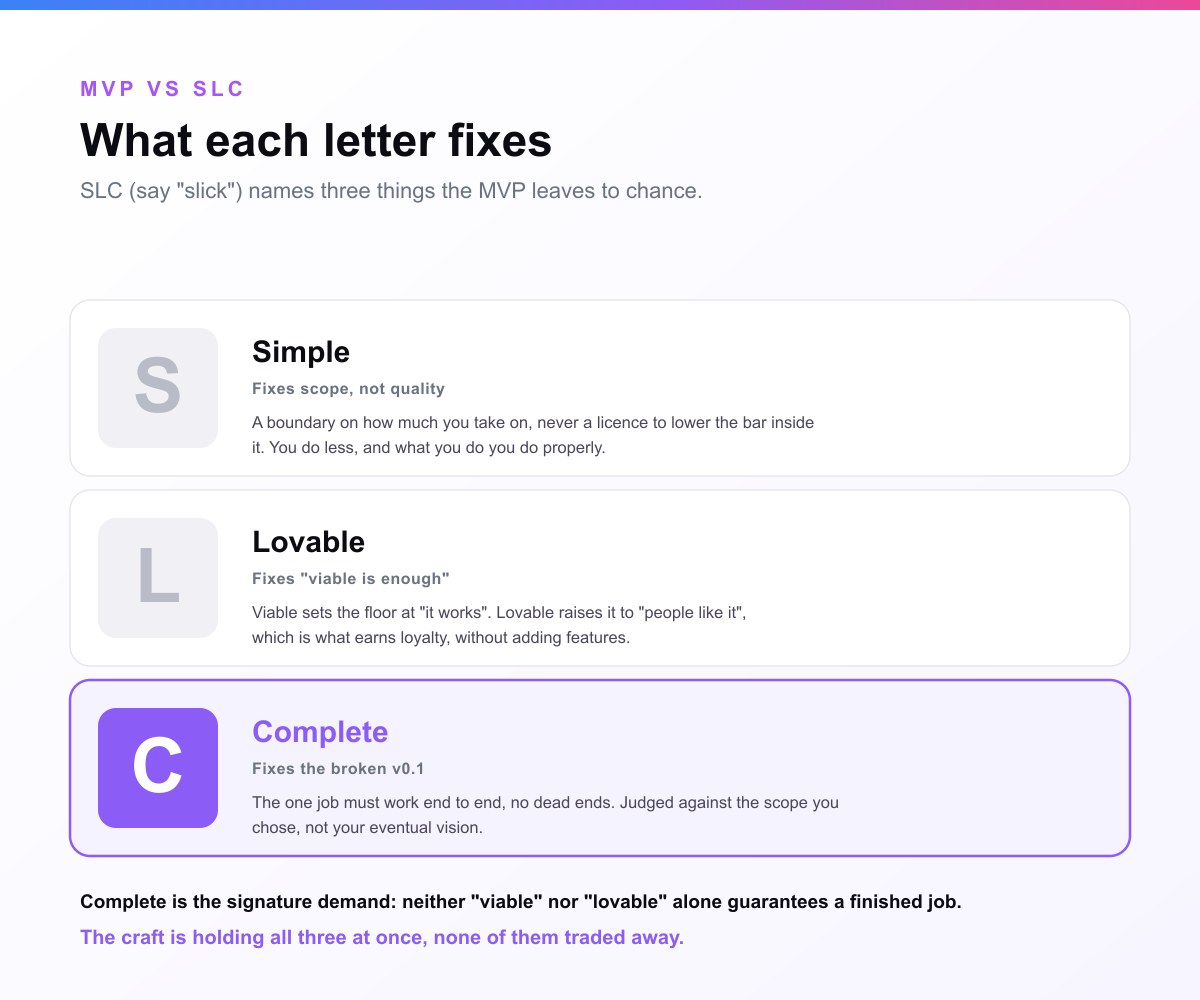
Complete is the SLC's signature contribution, the part that neither "viable" nor "lovable" alone guarantees. A product can be lovable in ambition and still ship with obvious holes: a sign-up with no way to reset a password, a checkout that forgets the cart, a core flow that dead-ends. The SLC refuses that. It says the product must accomplish its one job end to end, so the customer gets a whole experience, not a teaser. Completeness is judged against the scope you chose, not against your eventual vision. Finish the small thing.
MVP vs SLC: the comparison categories that matter
1. Goal: your learning vs the customer's experience
This is the category everything else flows from. The classic MVP optimizes for your learning and accepts that the customer may have a poor experience in exchange. The SLC optimizes for the customer's experience and treats your learning as something you still get, because a product people love generates honest, motivated feedback rather than the shrug an unfinished test earns. Both learn. Only one earns goodwill while doing it.
2. Completeness: a fragment vs a finished small thing
An MVP is permitted to be a fragment, a v0.1 with visible gaps, on the theory that you will fill them later. An SLC must be a finished v1 at its chosen scope. This is the practical heart of the difference: not how many features, but whether the features you shipped form a complete, usable whole. A founder can use the same budget to ship a broken slice of a big idea (MVP) or a complete version of a smaller idea (SLC).
3. Who it serves: builder-first vs customer-first
Cohen's critique is that the MVP is "selfish," built for the company at the customer's expense. The SLC flips the priority. That is not charity; it is strategy. In a world where users have alternatives and switch in seconds, a first impression that respects the customer is worth more than the few weeks you might save by shipping something embarrassing. Customer-first is how a small product earns the right to grow.
4. Revenue: awkward to charge for vs a real product
You can technically put a price on an MVP, but charging for an admitted experiment is uncomfortable and often unconvincing. An SLC is a real product, small but whole and likable, so charging for it is natural from day one. That matters beyond revenue: a customer who pays gives you the strongest possible signal that the value is real, which is exactly the learning the MVP was chasing in the first place.
5. Evolution: must-iterate vs stands alone
An MVP is a promise of more. If the follow-up investment never comes, you are left with, in Cohen's words, just a bad product. An SLC stands on its own: if you stopped today, you would still have a good, modest product that does its job. When you do keep going, an SLC grows by expanding scope while existing customers stay happy, rather than by patching a thing that was broken from the start. Cohen points to WhatsApp, Snapchat, and Twitter as products that began simple and complete, then expanded.
6. The risk each one creates
Every approach has a characteristic failure. The MVP's risk is shipping junk: something so minimal and unfinished that it insults customers and produces a false "nobody wants this," when the real problem was the experience. The SLC's risk runs the other way: "lovable" and "complete" can be used as excuses to polish forever or to creep past "simple" into a bloated, late release. The discipline of the SLC is holding all three letters at once, simple and lovable and complete, none of them traded away.
The skateboard test: is your first version a v1 or a v0.1?
The cleanest way to tell an MVP apart from an SLC is a test borrowed from Henrik Kniberg's well-known skateboard-to-car drawing. From a strict MVP point of view, a skateboard is a v0.1 of a car: a step on the way to the real thing, useful mainly for learning. From an SLC point of view, the skateboard is already a v1.0: it is simple, people love it, and it is complete at its job of getting you from A to B faster than walking. Same object, different bar.
Apply it to your own plan. Look at the first version you intend to ship and ask: if we never built anything after this, is it a whole, likable product, or a broken piece of a bigger one? If it is a skateboard, a complete simple thing, you are building an SLC. If it is a single car wheel, useless until the rest arrives, you are building the riskier kind of MVP, the kind that only has value if the roadmap behind it actually happens.
We dig into how that roadmap should unfold in our guide to the [MVP roadmap](/blog/mvp-roadmap).
SLC, MVP, MLP, and the rest of the family
The "build it small" world has several overlapping terms. Placing SLC among them keeps the comparison precise.
| Term | Stands for | What it emphasizes |
|---|---|---|
| MVP | Minimum Viable Product | The least you build to learn whether the idea is wanted |
| SLC | Simple, Lovable, Complete | A small product that is finished and good, customer-first |
| MLP | Minimum Lovable Product | The smallest version customers genuinely love |
| MMP | Minimum Marketable Product | The smallest version complete enough to sell and market |
| MLVP | Minimum Lovable Viable Product | A hybrid that bolts "lovable" onto the MVP |
The overlaps are real but the emphasis differs. The SLC and the MLP both reject the idea that "viable" is enough and insist on love. The SLC's distinctive addition is Complete: it is not only about emotion but about finishing the job so nothing is broken, and about being a real product rather than a test. The MMP is close to the SLC's "complete and sellable" idea but is framed around marketability and time-to-market rather than the simple-and-lovable craft of the build. Designer John Maeda grouped these together when he tracked the field's drift from MVP toward MLVP and SLC, all reactions to the same complaint: minimum and viable set the bar too low.
How real products launched simple, lovable, and complete
The SLC idea is easiest to see in products that shipped small but whole, and were loved for it.
WhatsApp launched simple and complete. Its first versions did one thing, send messages, with a clarity and reliability people immediately loved, then expanded over years into voice, video, and more. It was never a broken fragment waiting to become useful; it was a complete, simple product from the start, which is exactly the SLC pattern Cohen cites.
Twitter and Snapchat followed the same arc. Both began as simple, complete, lovable products with a tightly defined core (a short public post; a disappearing photo) and grew scope from there while keeping early users happy. None of them shipped a half-built v0.1 and asked users to tolerate it. They shipped a whole small thing and earned the right to expand.
Basecamp made completeness a philosophy. The team behind it has long argued for shipping a simple, opinionated, finished product rather than a feature-stuffed or half-baked one, charging for it from day one. That is the SLC stance in practice: less, but complete and likable, sold as a real product rather than floated as an experiment.
The pattern across all of them: a small scope, finished properly, that customers liked on contact, then grown over time. That is the difference between an SLC and an MVP that hopes to become good later.
How to build an SLC without it becoming a full product
The danger with "lovable" and "complete" is that they become excuses to keep building forever. They do not have to. The whole point of the SLC is that it is still simple. Here is a repeatable way to ship one without sliding into a bloated, late release.
- Pick a job small enough to finish. Completeness is judged against scope, so choose a scope you can actually complete in your timeline. A narrower job done whole beats a broader job left broken.
- Cut features until what remains can be both lovable and complete. Every feature you remove buys the time to finish and polish the rest. Subtraction is how an SLC stays simple while clearing the higher bar.
- Define "complete" before you build. Write down the end-to-end path the customer must be able to walk with no dead ends (sign up, do the core thing, recover from the obvious error). That list is your completeness checklist, and nothing ships until it is all true.
- Spend the saved effort on lovable, not on more scope. Once the job is complete, invest remaining time in making the core moment feel good, fast, clear, and cared-for, rather than adding a second job.
- Hold all three letters at once. If you are tempted to ship something incomplete, you have drifted toward an MVP. If you are tempted to add scope in the name of "lovable," you have drifted away from simple. The craft is keeping simple, lovable, and complete true together.
- Charge, or at least be willing to. A good test of an SLC is whether you would feel comfortable charging for it. If yes, it is probably complete and lovable enough. If the idea embarrasses you, it is still an MVP. Rushing past this is one of the MVP development challenges that traps teams.
The deliverable is a small product you are proud to put a name on, shipped on time. That is very different from a large polished product shipped late, which is what teams build when they forget the "simple" in SLC.
Which one do you actually need?
The decision is not about which acronym is trendier. It is about whether your first version needs to stand on its own.
- A classic MVP can be enough when your only goal is the cheapest possible test of a single risky assumption, when you are validating demand before committing real build effort, or when the format is inherently a throwaway (a fake-door test, a concierge run by hand). Here, learning is the entire job and a rough experiment does it. We cover those formats in types of MVP.
- You should build an SLC when the first version will be in front of real customers who have alternatives, when you want that version to earn money and goodwill rather than just data, or when a broken first impression would be unrecoverable. In most markets where users can leave in seconds, this is the safer bet.
A useful gut check: ask whether you would be comfortable charging a stranger for the first version. If the honest answer is "no, it is just a test," you are building an MVP, which is fine if learning is truly all you need. If the answer is "yes, it is small but genuinely good," you are building an SLC, and in a competitive market that is usually the stronger move.
When a classic MVP is still the right call (and when not)
Lean toward a classic MVP when:
- You only need to test one assumption as cheaply as possible, and a throwaway answers it.
- The format is inherently an experiment (fake-door, concierge, a landing page measuring intent).
- You are pre-build and deciding whether the idea deserves a real product at all.
Do not settle for a rough MVP when:
- Real customers with alternatives will judge the first version as a product.
- A poor first impression would burn trust you cannot win back.
- You want the first release to earn revenue and advocacy, not just learning.
When to build an SLC (and when not)
Build an SLC when:
- The first version ships to real users and needs to stand on its own.
- You want to charge from day one and treat early customers as customers, not test subjects.
- You can define a job small enough to finish completely inside your timeline.
Hold off on chasing a "perfect" SLC when:
- You have not confirmed the idea is wanted at all. A leaner test may answer that first, before you invest in completeness.
- "Lovable" or "complete" start pushing the release later and later. Simple is a hard constraint, not a nice-to-have.
- You are adding scope to feel more complete. Completeness comes from finishing a small job, not from doing a bigger one.
Common mistakes founders make
1. Using "MVP" as an excuse to ship junk. The most common error, and the one the SLC was invented to fix. Hiding an unfinished, unlikable product behind "it is just an MVP" insults customers and produces a false read on demand.
2. Confusing complete with feature-complete. Completeness is measured against the small scope you chose, not your full vision. An SLC is a whole skateboard, not a finished car. Adding features to feel "complete" breaks the "simple."
3. Polishing past simple in the name of lovable. The opposite error. Endless polish and creeping scope turn a fast SLC into a slow, bloated launch. Lovable is a bar to clear on a small surface, then ship.
4. Shipping a broken core flow. Leaving dead ends in the one job the product is supposed to do, a sign-up with no recovery, a checkout that loses state, is the clearest sign you built a v0.1, not an SLC.
A concrete example
Picture a founder whose app writes product descriptions automatically for online sellers.
- The classic MVP might ship the thinnest possible slice: a form that generates one description, with visible gaps (no way to edit the result, no save, no error handling), shipped mainly to see if anyone bothers. It is a v0.1, useful as a test, awkward to charge for, and a little embarrassing to show.
- The SLC keeps the scope just as small, one core job, generate and publish a great description, but finishes it: you can generate, tweak, publish, and recover from the obvious errors, the result is genuinely good, and the interface feels fast and cared-for. It is simple, lovable, and complete. A seller could pay for it today and feel they got a real product, even though it does only one thing.
Same budget, same simplicity, very different result. The MVP is a fragment that hopes to become good. The SLC is a small, finished product that is good now and can grow later, which in a crowded market is the version that actually earns customers.
The MVP Development take
In our experience, "MVP" too often becomes permission to ship something half-finished, and founders pay for it twice: once in a weak first impression, and again when they misread the disappointing numbers as a demand problem rather than a quality one. Jason Cohen's reframing is the useful correction. The first version should be small, yes, but it should also be lovable and complete, a real product a customer would happily use and pay for, not a v0.1 you have to apologize for.
That is how we build by default. We take founders to a single, production-standard core experience that is finished end to end and genuinely good at its one job, live for real users, in 3 to 4 weeks on a clear, scoped quote you approve before we start. The scope stays deliberately simple, because that is what lets us make it both complete and lovable on the timeline. You get a first version that stands on its own, the way an SLC should, plus the real demand evidence that the MVP was always after.
The honest takeaway is that SLC and MVP are not enemies, they are different bars for the same small first build. The MVP bar is "viable, and we will fix it later." The SLC bar is "simple, lovable, and complete, today." In almost any market where customers have a choice, the higher bar is also the safer one, as long as you keep the scope small enough to actually clear it. If you want to see where this sits among the neighboring ideas, our comparisons of MVP vs MLP, MVP vs MMP, and MVP vs prototype map the rest of the landscape.
Not sure whether your first version should be a quick MVP or a complete SLC? Tell us what simple and complete means for your product and we will scope exactly that, nothing more.
Related guides
- What Is an MVP?: a clear definition of the minimum viable product
- How to Build an MVP: the step-by-step founder's playbook
- MVP Examples: 15 Famous MVPs: how the biggest startups validated with an MVP
Frequently asked questions
What is the difference between an MVP and an SLC?
An MVP (minimum viable product) is the smallest, often deliberately incomplete build you ship to test an idea and learn, optimized for the company's learning and allowed to be rough. An SLC (simple, lovable, complete) keeps the scope just as small but insists the result be finished and genuinely good at its one job, optimized for the customer from day one. In short, an MVP can be a broken v0.1, while an SLC is a complete v1 of something simple.
What does SLC stand for?
SLC stands for Simple, Lovable, and Complete, and it is pronounced "slick." The term was coined by Jason Cohen of A Smart Bear as a direct alternative to the MVP. Simple keeps it fast to build, Lovable makes customers actually like it, and Complete means it finishes the job it sets out to do rather than shipping a fragment.
Why does Jason Cohen say customers hate MVPs?
Because, in his framing, the MVP is built for the company's learning at the customer's expense. It optimizes for "minimum" and "viable," which often produces something unfinished and unlikable that disappoints the people using it. Cohen argues this is "selfish" and that you can learn just as much from a small product people love. His summary line: "An MVP that never gets additional investment is just a bad product. An SLC that never gets additional investment is a good, if modest product."
Is an SLC the same as a minimum lovable product (MLP)?
They overlap but are not identical. Both reject the idea that "viable" is enough and insist the product be lovable. The SLC adds two things the MLP does not name explicitly: Simple (a hard constraint on scope) and Complete (the product must finish its job with no broken edges). You can think of the SLC as the MLP plus an explicit demand for completeness and a customer-first, sellable framing. We cover the lovable side in detail in MVP vs MLP.
Does "Complete" mean feature-complete?
No, and this is the most common misunderstanding. Complete is measured against the small scope you chose, not against your full product vision. An SLC is a complete skateboard, not a finished car. It should do its one job end to end with no dead ends, while deliberately leaving the larger vision for later. Adding features to feel "complete" breaks the "simple."
Can you charge for an SLC?
Yes, and that is part of the point. Because an SLC is a real, finished, likable product rather than an admitted experiment, charging for it is natural from day one. A willingness to pay is also strong evidence that the value is real, which is the same learning the MVP was chasing, earned in a way that respects the customer.
Is an SLC slower or more expensive to build than an MVP?
Not necessarily, because "simple" is a core constraint. The lever that keeps an SLC affordable is keeping the scope small enough to finish and polish in the same timeframe. A tightly scoped SLC can ship in around 3 to 4 weeks. The cost only balloons when teams forget the "simple" and let "lovable" or "complete" push them into a larger product, which is the failure mode to guard against.
Can an SLC grow into a full product?
Yes, and that is the intended path. An SLC expands by adding scope over time while existing customers stay happy, because each version is already complete and likable rather than broken. Jason Cohen cites WhatsApp, Snapchat, and Twitter as products that launched simple and complete, then grew. This is different from an MVP, which must be iterated to stop being, in his words, just a bad product.
Is the skateboard an MVP or an SLC?
It depends on the lens. From a strict MVP view, a skateboard is a v0.1 of a car, a step toward the real thing. From an SLC view, the skateboard is already a v1.0: simple, lovable, and complete at the job of getting you from A to B. The skateboard test is a quick way to classify your own first version: if it is a whole, likable product on its own, it is an SLC; if it is a useless fragment until the rest arrives, it is the riskier kind of MVP.
When should I still build a classic MVP instead of an SLC?
When your only goal is the cheapest possible test of a single assumption and a throwaway answers it, or when the format is inherently an experiment, like a fake-door test or a concierge MVP run by hand before any product exists. In those cases learning is the entire job and a rough build does it. Once real customers with alternatives will judge the first version, an SLC is usually the safer call.
What are examples of SLC products?
Jason Cohen points to WhatsApp, Snapchat, and Twitter, each of which launched as a simple, complete, lovable product with a tightly defined core and expanded from there. Basecamp is another frequent example: a deliberately simple, opinionated, finished product sold from day one. The common thread is a small scope finished properly, rather than a fragment shipped early.
How is MVP vs SLC different from MVP vs MLP or MVP vs MMP?
All three compare the MVP against a higher bar for the first build. The MLP focuses on lovability and emotion. The MMP focuses on the smallest version you can market and sell. The SLC combines simple, lovable, and complete, with completeness as its signature demand. They are cousins, not rivals, and the best lean launches tend to satisfy all of them at once. We map the neighbors in MVP vs MLP and MVP vs MMP.
Does building an SLC guarantee product-market fit?
No. An SLC makes a good first impression and earns goodwill, revenue, and clearer feedback, all of which make fit more likely and easier to detect, but fit is still a state of demand you have to reach and measure. The SLC is a way of building that gives you the best shot; it is not a guarantee that the market wants what you made.
Sources and references
This comparison draws on established product frameworks and current practice:
- Jason Cohen (A Smart Bear), Your customers hate MVPs. Make an SLC instead. the origin of Simple, Lovable, Complete and the critique of the MVP
- John Maeda, MVP, MLVP, SLC how the field drifted from MVP toward lovable and complete framings
- Henrik Kniberg, Making sense of MVP the skateboard-to-car analogy behind the v1-versus-v0.1 test
- Aha!, The Minimum Lovable Product the closely related argument for love over mere viability
- Eric Ries, The Lean Startup the origin of the MVP and build-measure-learn
- Wikipedia, Minimum viable product the MVP definition and validated-learning purpose
Time and delivery ranges reflect Q2 2026 practice; the 3 to 4 week figure reflects MVP Development delivery data for tightly scoped, single-flow first builds.


