


TL;DR
The core difference in MVP vs MLP: an MVP (minimum viable product) is the smallest version you can build to test whether your idea works and is wanted, while an MLP (minimum lovable product) is the smallest version that people genuinely love, not merely tolerate. An MVP optimizes for learning with the least effort and accepts rough edges. An MLP keeps the scope just as small but raises the bar from "usable" to "delightful," because in crowded markets being wanted is not enough, you have to be loved. They are not opposites: an MLP is really an MVP held to a higher emotional standard.
Short version: if your biggest unknown is pure feasibility or demand and a rough version answers it honestly, a plain MVP is fine. If your market is crowded, your users compare you against polished incumbents, or your growth depends on retention and word of mouth, aim for an MLP so a thin, unlovable build does not give you a false "nobody wants this." At MVP Development we ship a focused, production-standard MVP in 3 to 4 weeks on a clear, scoped quote you approve before we start, and we build it lovable on its one core flow rather than rough on many. More on when each is right below.
Key Takeaways
- An MVP is the smallest version built to test whether an idea works and is wanted, accepting rough edges.
- An MLP (minimum lovable product) is the smallest version that people genuinely love, not merely tolerate.
- An MLP keeps scope just as small but raises the bar from "usable" to "delightful."
- Use a plain MVP when a rough version honestly answers demand; aim for an MLP in crowded markets where being wanted is not enough.
MVP vs MLP: the difference that matters most
Strip both terms down and the difference is about the bar you hold a minimal product to. An MVP is held to the bar of viability: does it work, does it test the hypothesis, does it produce honest evidence about demand. An MLP is held to the bar of lovability: does the small thing you shipped make people feel something good enough to adopt it, keep using it, and tell others.
That single difference, viable versus lovable, changes how you spend the same small budget. Both are minimal. Both ship narrow. The MVP spreads its effort to cover the core function and learn fast, tolerating clunk. The MLP spends that same effort going deeper on a smaller surface, so the one thing it does feels polished, intuitive, and genuinely enjoyable.
The reason the MLP exists at all is a real failure mode of the MVP. A too-bare MVP can produce a false negative: you ship something so rough that people bounce off the experience, you read the weak numbers as "no demand," and you kill a good idea that was only tested in an unlovable form. As Aha! co-founder Brian de Haaff argues in the minimum lovable product, the MVP mindset can push teams to deliver the bare minimum and call it learning, when what they have really learned is that nobody loves the bare minimum. The MLP is the correction: keep it minimal, but make the minimum something people want to come back to.
What is an MVP?
An MVP (minimum viable product) is the smallest version of your product that is genuinely functional and built to test a hypothesis: usually whether real people want what you are making enough to use it and pay. It does one core thing to a working standard, ships to actual users, and exists to generate validated learning with the least time and effort. The concept was popularized by Eric Ries in The Lean Startup as the fastest way to start the build-measure-learn loop.
The defining trait of an MVP is that something important is still unproven, most often demand. You are not refining a known winner, you are running an experiment. That is why an MVP can be narrow, and in the classic framing even rough, without failing at its job: its job is learning, not winning hearts. The MVP sits at a specific point in a company's life, after the idea is shaped and before scaling begins, which we cover in our guide to the MVP stage of a startup.
An MVP can take many forms, from a concierge service to a fake-door test to a single-feature app, depending on the cheapest honest way to test the riskiest assumption. We map the full set in our breakdown of the types of MVP. The common thread is that every MVP is chosen to maximize what you learn per dollar and per week spent.
What is an MLP?
An MLP (minimum lovable product) is the smallest version of your product that customers genuinely love, built so the narrow slice it delivers is not just usable but delightful, emotionally resonant, and worth recommending. Where a plain MVP minimizes effort to learn whether the idea is viable, the MLP keeps the scope minimal but raises the standard: the goal is the least you can build that people will actually fall for.
The defining trait of an MLP is that it treats emotion as part of the product, not a polish step for later. The bet behind it is simple: in most modern markets, customers have alternatives and short patience, so a product that merely works loses to a product people enjoy. As Aha! frames the difference between a minimum viable and a minimum lovable product, an MVP delivers the minimum functionality to reach viability, while an MLP delivers the minimum a product needs to be loved.
Critically, an MLP is not a bigger product with more features. That is the most common misread. Lovable is depth, not breadth: it is a smaller surface done so well that it delights, not a wider surface done adequately. A single feature that feels magical beats ten features that feel like a chore. The MLP narrows scope on purpose, then pours the saved effort into making that narrow scope something people love.
MVP vs MLP: side-by-side comparison
Here is the full MVP vs MLP comparison across the categories that actually drive the decision.
| Category | MVP | MLP |
|---|---|---|
| What it is | The smallest build that tests an idea | The smallest version people genuinely love |
| Primary goal | Validated learning, reduce uncertainty | Adoption through delight, win hearts early |
| Core question | "Does this work and do people want it?" | "Will people actually love this?" |
| What it optimizes | Effort spent per lesson learned | Delight delivered per unit of scope |
| The bar it must clear | Viable: functional and useful | Lovable: delightful and emotionally resonant |
| Scope | Minimal, often rough at the edges | Just as minimal, but polished on the core |
| Treatment of emotion | Optional, often deferred | Central, designed in from the start |
| Audience | Tolerant early adopters | Early users you intend to turn into fans |
| Best when | Novel category, low competition, feasibility risk | Crowded market, consumer product, growth via word of mouth |
| Primary metrics | Activation, retention, willingness to pay | NPS, "very disappointed" %, referral, love |
| Risk it reduces | "Are we building something nobody wants?" | "Are we killing a good idea by shipping it unlovable?" |
The table is the fast answer. The sections below unpack the categories where founders most often pick the wrong bar for their market.
The 6 comparison categories that matter
1. Goal: viability vs lovability
This is the category everything else flows from. A plain MVP aims to prove viability: the thing works and someone wants it. An MLP aims to prove lovability: people do not just use it, they enjoy it enough to stay and to tell others. Both are forms of learning, but they ask different questions, and the answer to one does not give you the other.
The trap is assuming viability implies lovability. Plenty of products are viable and forgettable. They work, a few people use them, and they quietly fail to grow because nothing about them earns loyalty or word of mouth. If your market rewards emotion, and most consumer markets do, then proving viability alone leaves the most important question untested.
2. Emotion: tolerated vs loved
A plain MVP treats emotion as optional. The classic MVP is allowed to be ugly and awkward as long as the core function works and the demand signal comes through. An MLP treats emotion as a core requirement: how the product feels is part of what you are testing and shipping, not a coat of paint you add after product-market fit.
This matters because emotion is often the deciding variable in adoption. People forgive a rough product when there is no alternative and forgive nothing when there are ten. De Haaff's argument for the MLP is exactly this: aim for love, not tolerance, because tolerance does not compound into growth and love does.
3. The quality bar: functional vs delightful
The clearest way to see the difference is the product-quality stack popularized by designer Jussi Pasanen, who argued you should build a thin slice across every layer instead of one layer at a time. The layers, building on Aarron Walter's hierarchy of user needs, run from the bottom up: functional, reliable, usable, and delightful.
| Layer | What it means | Plain MVP often | MLP |
|---|---|---|---|
| Functional | It does the core job | Yes | Yes |
| Reliable | It works consistently, not just once | Sometimes | Yes |
| Usable | It is clear and easy, not confusing | Sometimes | Yes |
| Delightful | It is enjoyable and emotionally resonant | Rarely | Yes, this is the point |
A common, weaker reading of MVP is "just the functional layer, stripped of the rest." Pasanen's point, and the MLP's, is that a true minimal product should be a thin vertical slice through all the layers, including delight, on a tiny scope, rather than a thick slab of bare function with no usability or joy. The MLP is that thin, full-height slice.
4. Audience: tolerant testers vs future fans
A plain MVP goes to early adopters chosen for their tolerance: people who will put up with rough edges because they want the underlying outcome badly enough. Their patience is a feature, it lets you learn before you polish.
An MLP goes to early users you intend to convert into fans. You are not just measuring whether they will tolerate the product, you are measuring whether they fall for it. That shift changes who you recruit and what you watch: not "did they use it," but "did they come back unprompted, recommend it, and react with genuine enthusiasm." The audience is similar in size and earliness; the bar for their reaction is much higher.
5. The metrics you actually track
A plain MVP and an MLP succeed or fail on different numbers, and using the wrong scorecard hides the answer you most need.
MVP metrics are about viability and demand:
- Activation: do new users reach the core value at all?
- Retention: do they come back after the first use?
- Willingness to pay: will early adopters put money or a strong signal behind it?
- Conversion: do they take the one action that matters?
MLP metrics are about love and advocacy:
- The "very disappointed" test: Sean Ellis's benchmark, made famous by Superhuman, asks what share of users would be "very disappointed" if they could no longer use the product. Roughly 40% or higher signals real product-market fit and genuine love.
- Net Promoter Score and referral: would users recommend it, and do they actually bring others?
- Organic word of mouth: does usage spread because people cannot help talking about it?
- Emotional response: do users describe the product with feeling, not just function?
The contrast is the whole point. MVP numbers tell you whether a product should exist. MLP numbers tell you whether the small thing you shipped is loved enough to grow on its own.
6. The risk each one retires
A plain MVP retires demand risk: the chance you build something nobody wants. An MLP retires a subtler and very expensive risk, the false negative: the chance you have a genuinely good idea but test it in such a rough, unlovable form that users reject the experience rather than the idea, and you wrongly conclude the market is not there.
That false negative is the MLP's whole reason for being. In a crowded or consumer market, a viable-but-charmless MVP can return weak numbers not because the idea is bad but because the execution gave no one a reason to care. The MLP is insurance against drawing the wrong lesson from a fair test of an unfair build.
Is the MLP a stage after the MVP, or a better MVP?
This is where MVP vs MLP differs from comparisons like MVP vs beta or MVP vs MMP, which are genuine sequential stages. The MLP is usually not a later stage. It is a different philosophy applied to the same early, minimal product. You do not build an MVP and then "upgrade" it to an MLP months later; you decide, up front, whether your minimal version needs to clear the viable bar or the lovable bar.
Henrik Kniberg's well-known skateboard drawing makes the point. In making sense of MVP, he contrasts building a car one useless part at a time (a wheel, then a chassis, with nothing usable until the end) against building a skateboard, then a scooter, then a bicycle, then a car, where every step is a complete, usable, and ideally lovable way to get from A to B. Each intermediate product is minimal and something a user can actually enjoy. Notably, Kniberg himself prefers to drop "viable" in favor of "earliest testable, usable, and lovable" product, because the word lovable captures what a good minimal release should aim for.
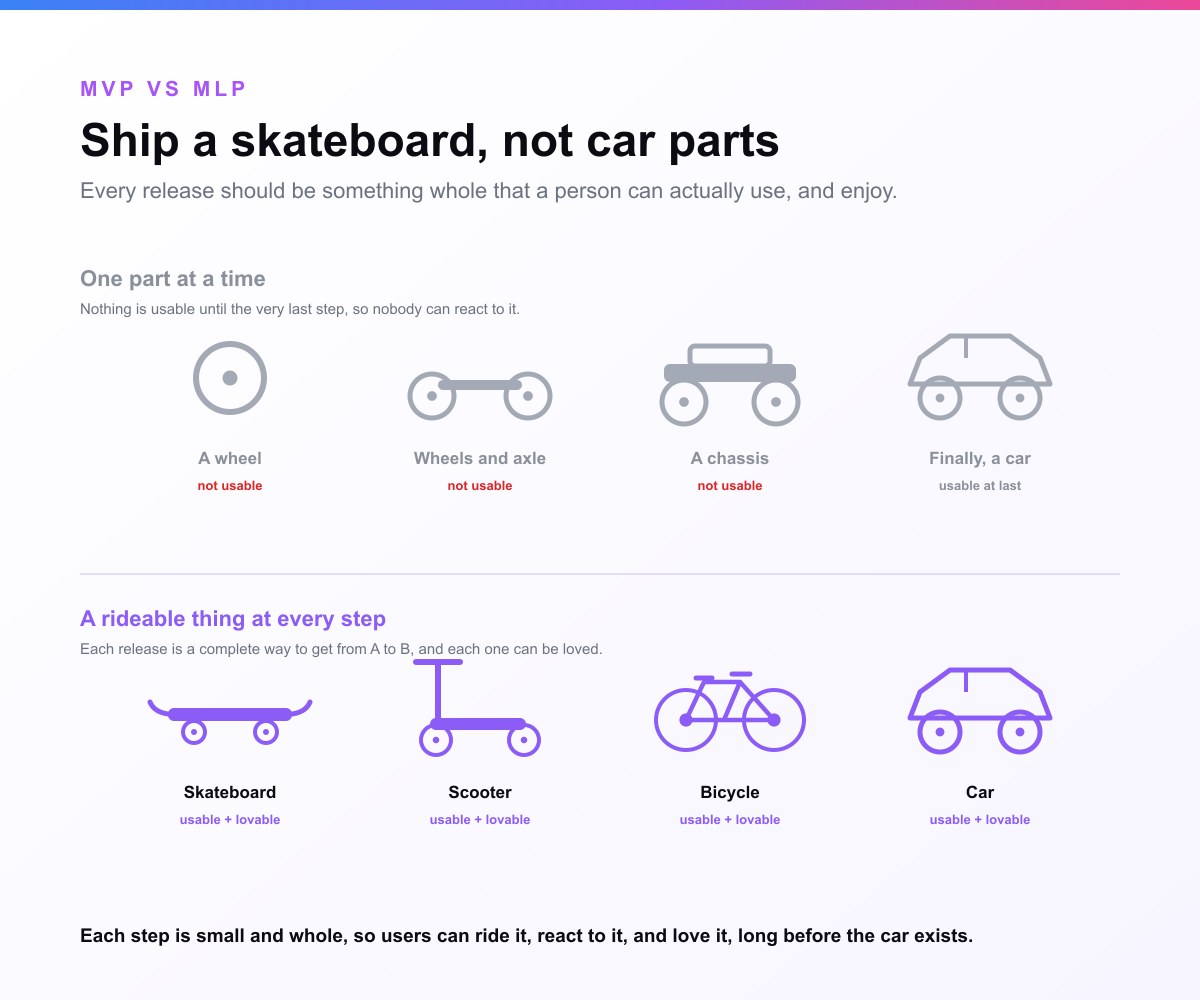
So the honest framing is this: the MLP is what the MVP should usually be in any market where users have choices. It is not a heavier, later thing. It is the same lean release with the dial turned from "good enough to test" to "good enough to love," on a scope kept deliberately small so that is affordable.
MVP, MLP, MMP, and the rest of the "minimum" family
The "minimum X product" shorthand has grown a small family of terms. Knowing them keeps the MVP vs MLP conversation precise.
| Term | Stands for | What it optimizes |
|---|---|---|
| MVP | Minimum Viable Product | The least you build to learn whether the idea is viable and wanted |
| MLP | Minimum Lovable Product | The smallest version that customers genuinely love, not just tolerate |
| MMP | Minimum Marketable Product | The smallest version complete enough to sell and market |
| MDP | Minimum Delightful Product | Often used interchangeably with the MLP, emphasizing delight |
| MMF | Minimum Marketable Feature | The smallest single feature that delivers marketable value |
| MAP | Minimum Awesome Product | An informal cousin of the MLP, same "exceed expectations" intent |
| EVP | Exceptional Viable Product | Delays launch for a polished, market-ready product |
| MVE | Minimum Viable Experience | The whole user journey polished, for a broad audience |
The useful distinction inside the family is what each one optimizes for. The MVP optimizes for learning, the MLP for love, and the minimum marketable product for sellability. They are not rivals so much as different bars you can hold a minimal product to, and the right one depends on your market and your biggest current risk. MDP and MAP are largely rebrands of the MLP idea, useful mainly as reminders that "minimum" should never mean "joyless."
How real products launched lovable, not just viable
The MLP idea is easiest to see in products that stayed narrow but refused to ship something forgettable.
The original iPhone was a minimum lovable product. When Apple launched it in 2007, it was missing features that seemed essential at the time: no copy and paste, no third-party App Store, no 3G, no multitasking. By a strict feature checklist it was incomplete. But the narrow slice it did deliver, multitouch, scrolling, the browser, the way it felt in the hand, was so delightful that people loved it anyway and lined up to buy. Apple shipped a small feature set executed to a lovable standard rather than a complete feature set executed to a viable one. That is the MLP trade in its clearest form.
Superhuman refused to launch until people loved it. Email client Superhuman spent roughly two years building before a public launch. Founder Rahul Vohra has described, in First Round Review's account of how Superhuman built an engine to find product-market fit, holding the product back until a high share of users said they would be "very disappointed" without it, then systematically increasing that share. They obsessed over speed, keyboard-driven flow, and a game-like feel, all on a narrow scope: a faster email experience. That is an MLP discipline, optimizing for love before scale, not just viability.
Slack launched polished on purpose. When Slack opened up, it was minimal in scope (team messaging) but unusually refined in feel: friendly copy, satisfying interactions, thoughtful onboarding. The team treated the quality of the experience as core, not cosmetic, and that lovability drove the explosive word of mouth that a merely functional chat tool would not have earned.
The pattern across all three: narrow scope, high emotional bar. None of them shipped everything. Each shipped a small thing that people loved, then expanded from the loyalty that love created.
How to make an MVP lovable without bloating it
The fear with "lovable" is that it becomes an excuse to gold-plate, polish forever, and never ship. It does not have to. Lovability is about focus, not maximalism. Here is a repeatable way to raise the bar from viable to lovable while keeping the scope minimal.
- Pick the one moment that must delight. Every product has a core moment where the value lands: the first send, the first result, the first "aha." Choose that single moment and make it lovable. You do not need a delightful everything, you need a delightful one thing.
- Cut scope to fund quality. Every feature you remove buys time to make the remaining ones excellent. Lovability is paid for in subtraction. A narrower MLP is what makes the polish affordable inside an MVP-sized budget.
- Slice through every layer, thinly. Following Pasanen, make your one core flow functional, reliable, usable, and delightful, rather than building a thick functional layer with no joy. Depth on a small surface beats breadth with no soul.
- Design the emotion deliberately. Decide what feeling you want at the core moment, fast, effortless, reassuring, fun, and make concrete choices (speed, copy, motion, defaults) that produce it. Delight is engineered, not sprinkled on.
- Protect against gold-plating. Set a clear definition of "lovable enough to ship" for the core moment and stop there. Lovable is a bar to clear, not an infinite pursuit. Perfectionism that delays the release is the failure mode to avoid, and it is one of the MVP development challenges that stalls teams.
- Test for love, not just use. Watch whether early users come back unprompted, react with feeling, and refer others. If they only tolerate it, you have an MVP. If they light up, you have an MLP.
The discipline is the deliverable: a small product, one delightful core, shipped on time. That is very different from a big polished product shipped late, which is what teams build when they mistake "lovable" for "complete."
Which one do you actually need?
The decision is not about which is "better." It is about whether your market and your biggest risk reward a higher emotional bar.
- A plain MVP is enough when you are in a genuinely novel category with little or no competition, when your users are tolerant (early B2B buyers, internal tools), or when your single biggest unknown is feasibility or raw demand and a rough version answers it honestly without scaring users off. Here, speed of learning beats polish.
- You should aim for an MLP when your market is crowded and users compare you against polished incumbents, when you are building a consumer product where emotion drives adoption, or when your growth depends on retention and word of mouth. Here, a charmless MVP risks a false negative, and lovability is the thing actually being tested.
A useful gut check: ask what happens if a real user's first impression is "it works, but it is clunky." If the honest answer is "they will give us a pass because there is nothing else like it," a plain MVP is fine. If the answer is "they will leave and never come back," you need an MLP, because in your market the first impression is the experiment.
When a plain MVP is the right call (and when not)
Lean toward a plain MVP when:
- You are testing a brand-new category where users have no polished alternative to compare against.
- Your buyers tolerate rough edges in exchange for the outcome (many early B2B and internal-tool cases).
- The riskiest assumption is feasibility or demand, and a rough build tests it honestly.
- You need the cheapest, fastest possible read and emotion will not distort the signal.
Do not settle for a plain MVP when:
- You are entering a crowded market where "it works" is table stakes and feel is the differentiator.
- A poor first impression is unrecoverable, because users will not give a clunky product a second chance.
- Your growth model depends on referrals and retention, which love drives and tolerance does not.
When to aim for an MLP (and when not)
Aim for an MLP when:
- Users have real alternatives and will judge you on experience, not just function.
- Word of mouth and retention are central to how the product is meant to grow.
- The emotional quality of the core moment is itself a thing you need to validate.
Hold off on a full MLP push when:
- You have not yet confirmed the basic idea is wanted at all. Test demand with a leaner MVP first, then raise the bar.
- The extra polish would delay shipping past the point where the learning is still useful. Lovable-but-too-late is its own failure.
- You are tempted to add features in the name of "love." That is bloat, not lovability, and it is the opposite of the MLP's intent.
Common mistakes founders make
1. Treating an MLP as "more features." The single most common error. Lovability is depth and polish on a small surface, not a wider feature set. Adding features to be "lovable" produces a bloated, late, still-not-loved product.
2. Gold-plating until you never ship. The opposite error. "Make it lovable" becomes an excuse for endless polish and a release that never comes. Lovable is a bar to clear on the core moment, then ship.
3. Shipping a charmless MVP in a crowded market. Releasing a viable-but-forgettable product where users have great alternatives, then reading the weak adoption as "no demand." That is the false negative the MLP exists to prevent.
4. Putting delight on the wrong thing. Polishing a secondary flow while the core moment stays clunky. Delight has to land on the one moment where the value is felt, not on the edges.
A concrete example
Imagine a founder building an app that auto-generates product descriptions for online sellers.
- The plain MVP ships the single core flow for real: a seller pastes a product, gets one generated description, and can publish it, with payment if you are charging. It might be plain, a little clunky, and visually bare. In a market with no real alternative, that is fine, because the question is simply "will sellers come back and pay."
- The MLP keeps the exact same scope, one description, one publish, but makes that core moment delightful: the result appears in a second, reads impressively well, the interface feels fast and friendly, and the first run produces a genuine "wow." It does not add features. It makes the one feature lovable. In a crowded market full of "AI description" tools, that delight is the difference between a seller who shrugs and one who tells three friends.
Same scope, different bar. The plain MVP tests whether the idea is viable. The MLP tests whether, in a market where sellers have options, the idea is lovable enough to actually win them. A founder in a crowded space who ships only the charmless version risks learning the wrong lesson.
The MVP Development take
In our experience, the MVP-versus-MLP question is really a question about your market, and most founders we work with are building into crowded, choice-rich spaces where a charmless first version quietly fails. The strict "ship it rough, it is only a test" reading of the MVP made sense when shipping anything was hard and alternatives were scarce. Today, users churn in seconds, and a viable-but-forgettable product often returns a false negative that buries a perfectly good idea.
That is why our default is to build a minimal product that is lovable on its one core flow, not rough across many. We take founders to a single, production-standard core experience, designed to delight at the moment the value lands, live for real users, in 3 to 4 weeks on a clear, scoped quote you approve before we start. The scope stays small on purpose, because that is exactly what makes the polish affordable. You get an honest test of the idea and a product users actually enjoy, which is the version that earns retention and word of mouth.
There is no real conflict between viable and lovable. Lovable is what viable should mean in any market with competition. The trick is to keep the scope minimal so "lovable" never turns into "bloated" or "late." We help founders decide which bar their market demands, then build the smallest version that clears it. If you want to see where this sits among the neighboring stages, our comparisons of MVP vs prototype, MVP vs beta, and MVP vs MMP map the steps around it.
Not sure whether your market needs a viable MVP or a lovable one? Walk us through your first user's day and we will find the moment worth making lovable.
Related guides
- What Is an MVP?: a clear definition of the minimum viable product
- How to Build an MVP: the step-by-step founder's playbook
- MVP Examples: 15 Famous MVPs: how the biggest startups validated with an MVP
Frequently asked questions
What is the difference between an MVP and an MLP?
An MVP (minimum viable product) is the smallest build you create to test whether your idea works and is wanted, and it is allowed to be rough as long as it produces honest learning. An MLP (minimum lovable product) keeps the scope just as small but raises the bar from usable to delightful, because the goal is the smallest version people genuinely love rather than merely tolerate. In short, an MVP optimizes for viability and learning, while an MLP optimizes for love and emotional resonance on a deliberately narrow scope.
Is an MLP just an MVP with more features?
No, and this is the most common misunderstanding. An MLP is not wider, it is deeper. It keeps the feature set minimal and pours the saved effort into making the core experience polished, intuitive, and delightful. A single feature that feels magical beats ten features that feel like a chore. Adding features in the name of "lovable" produces bloat, which is the opposite of the MLP's intent.
Which comes first, the MVP or the MLP?
Usually neither comes "first," because the MLP is not a later stage. It is a different bar applied to the same early, minimal product. You decide up front whether your minimal version needs to clear the viable bar or the lovable bar, based on your market. The exception is when basic demand is completely unproven: there it can make sense to test the idea with a leaner MVP, then raise the bar to lovable once you know the idea is wanted.
What does MLP stand for?
MLP stands for minimum lovable product: the smallest version of your product that customers genuinely love, built so the narrow slice it delivers is delightful and emotionally resonant rather than just functional. The term is associated with Aha! co-founder Brian de Haaff and the broader argument that, in competitive markets, aiming for love beats aiming for mere viability.
When should I build an MLP instead of a plain MVP?
Aim for an MLP when your market is crowded and users compare you against polished incumbents, when you are building a consumer product where emotion drives adoption, or when growth depends on retention and word of mouth. In those cases a charmless MVP risks a false negative, where users reject a rough experience rather than the underlying idea. A plain MVP is enough when you are in a novel category with little competition, when your buyers tolerate rough edges, or when feasibility is your single biggest unknown.
Does building an MLP cost more or take longer than an MVP?
Not necessarily, if you keep the scope honest. The lever that makes an MLP affordable is subtraction: a narrower feature set funds the polish on what remains. A lovable product built on a tiny scope can ship on a similar timeline to a rough product built on a wider one. A tightly scoped, lovable core can ship in around 3 to 4 weeks. The cost only balloons when teams mistake "lovable" for "complete" and try to polish a large surface, which is gold-plating, not an MLP.
How do I measure whether a product is "lovable"?
Use love-and-advocacy metrics rather than pure usage. The best-known is Sean Ellis's benchmark, popularized by Superhuman: ask what share of users would be "very disappointed" if they could no longer use the product, and treat roughly 40% or higher as a strong signal. Net Promoter Score, real referral behavior, organic word of mouth, and the emotional language users use to describe the product all point the same way. If people only tolerate it, you have an MVP; if they light up and bring others, you have an MLP.
What is the difference between an MLP and an MMP?
An MLP (minimum lovable product) is the smallest version people genuinely love, optimized for emotional resonance. An MMP (minimum marketable product) is the smallest version complete enough to sell and market successfully, optimized for time-to-market. They answer different questions: the MLP asks "will people love this," the MMP asks "what is the least we can sell." They are not mutually exclusive, the best lean launches are both lovable and marketable. We compare the marketable side in detail in MVP vs MMP.
Is a minimum lovable product the same as product-market fit?
Not the same, but closely linked. Product-market fit is evidence that a market strongly wants your product. An MLP is a way of building that makes fit more likely and easier to detect, because designing for love tends to produce the strong "very disappointed" signal that indicates fit. You build toward an MLP; you measure for fit. One is a product philosophy, the other is a state of demand you reach when the philosophy works.
Can a plain MVP give a false negative?
Yes, and avoiding that is the MLP's core purpose. If you ship something so rough that users bounce off the experience, your weak numbers may reflect the unlovable execution rather than a lack of demand. In a crowded or consumer market, that false negative can kill a genuinely good idea. The MLP guards against it by ensuring the test is run on a version people actually have a reason to care about.
Did the original iPhone count as an MLP?
It is a classic example. The first iPhone launched without copy and paste, an App Store, 3G, or multitasking, so by a feature checklist it was incomplete. But the narrow slice it delivered, multitouch, smooth scrolling, the browser, the feel, was so delightful that people loved it and bought it in droves. Apple shipped a small feature set held to a lovable standard, which is the MLP trade: depth and delight over breadth and completeness.
How is MVP vs MLP different from MVP vs prototype or MVP vs beta?
A prototype comes before the MVP and is a non-functional simulation that tests design. A beta comes after the MVP and is a feature-complete product tested for stability before launch. The MLP is different in kind: it is not a separate stage at all, but a higher bar (lovable rather than merely viable) applied to the minimal product itself. We cover the neighboring stages in MVP vs prototype and MVP vs beta.
Sources and references
This comparison draws on established product and design frameworks and current practice:
- Aha!, The Minimum Lovable Product Brian de Haaff's argument for aiming at love rather than tolerance
- Aha!, Minimum Viable Product vs. Minimum Lovable Product the viability-versus-lovability distinction
- Henrik Kniberg, Making sense of MVP the skateboard-to-car analogy and "earliest lovable product"
- Jussi Pasanen, Build a slice across instead of one layer at a time the functional, reliable, usable, delightful product stack
- First Round Review, How Superhuman Built an Engine to Find Product-Market Fit the "very disappointed" benchmark and building for love before scale
- Eric Ries, The Lean Startup the origin of the MVP and build-measure-learn
- Wikipedia, Minimum viable product the MVP definition and validated-learning purpose
Time and delivery ranges reflect Q2 2026 practice; the 3 to 4 week figure reflects MVP Development delivery data for tightly scoped, single-flow MVP builds.


