


TL;DR
The core difference in MVP vs pilot: an MVP (minimum viable product) is the smallest build you ship to test whether the market wants your idea, while a pilot is a limited, real-world trial of an already-finished product, run with a defined group for a fixed period to prove it works and delivers value before a full rollout. An MVP answers a demand question with a minimal product and early adopters. A pilot answers an operational question with a complete product in a real environment. They sit at opposite ends of the build: one tests whether to build at all, the other tests whether a built product is ready to roll out widely.
Short version: if you are still proving that anyone wants this, you need an MVP. If demand is proven, the product is built, and you want to prove it actually works and pays off in real conditions before committing to a wide rollout, you run a pilot. The MVP comes first and is about learning. The pilot comes much later and is about de-risking deployment, which is why pilots are so common in B2B and enterprise sales. At MVP Development we ship a funding-ready MVP in 3 to 4 weeks on a clear, scoped quote you approve before we start, so founders reach real demand evidence first and worry about piloting a finished product later. More on the order below.
Key Takeaways
- An MVP is the smallest build you ship to test whether the market wants your idea.
- A pilot is a limited, real-world trial of an already-finished product with a defined group for a fixed period.
- An MVP answers a demand question; a pilot answers an operational question.
- The MVP comes first and is about learning; the pilot comes much later and is about de-risking deployment, common in B2B and enterprise.
MVP vs pilot: the difference that matters most
Strip away the jargon and the distinction is about what you are testing and when. An MVP tests desirability: do people want this enough to use and pay for it. It comes early, when the idea itself is still unproven. A pilot tests operational reality: does this finished product actually work, integrate, get adopted, and deliver value in a real environment. It comes late, once the product exists and you are deciding whether to roll it out to everyone.
That one difference cascades into everything else. An MVP is deliberately minimal, sometimes rough, and pointed at early adopters whose behavior tells you whether the idea has legs. A pilot uses a complete, production-ready product and is pointed at a specific, limited group, often a single customer, team, or department, operating in their real-world conditions for a fixed window, usually 30 to 90 days, before a broader launch.
Founders and operators confuse the two constantly, and the confusion is expensive. Call a pilot an MVP and you over-build a polished, deployable product before getting a shred of demand evidence. Call an MVP a pilot and you treat an unvalidated experiment as if it were a rollout decision, measuring operational ROI on something nobody has proven they want.
What is an MVP?
An MVP (minimum viable product) is the smallest version of your product that is genuinely functional and built to test a hypothesis: usually whether real people want what you are making enough to use it and pay. It does one core thing to a real, working standard, ships to actual users, and exists to produce one kind of evidence: do people adopt it, keep using it, and pay. The concept was popularized by Eric Ries in The Lean Startup as the fastest way to start the build-measure-learn loop.
The defining trait of an MVP is that demand is still unproven. You are not refining a known winner, you are testing a hypothesis. That is why an MVP can be narrow and unpolished without failing at its job: its job is learning, not deploying. An MVP sits at a specific point in a company's life, after the idea is shaped and before scaling begins, which we cover in depth in our guide to the MVP stage of a startup.
An MVP can take many forms, from a concierge service to a single-feature app to a landing page, depending on the cheapest honest way to test demand. We map the full set in our breakdown of the types of MVP. The common thread is that every MVP is chosen to maximize what you learn per dollar and per week spent.
What is a pilot?
A pilot (also called a pilot program, pilot project, or pilot test) is a small-scale, real-world trial of a finished or near-finished product, run with a limited, representative group of users for a fixed period before a full-scale rollout. As a pilot experiment in the general sense, it is a preliminary study that tests a concept, process, or product in real conditions to assess feasibility and surface problems before committing to full implementation.
The defining trait of a pilot is that the product already exists and demand is already assumed. You are no longer asking whether people want the thing. You are asking whether the finished product holds up in the messy reality of a live environment: real data, real workflows, real integrations, and real users doing their actual jobs. A product pilot takes a complete product or feature and tests it in a controlled real-world setting with a specific group before rolling it out to everyone.
Pilots are typically time-boxed, often 30 to 90 days, and built around specific business objectives. In a pilot project, an organization runs the new system on a small scale, measures defined outcomes, and uses the results to decide whether, and how, to scale it across the whole operation. The pilot is the rehearsal for the rollout, performed in the real theater rather than a lab.
MVP vs pilot: side-by-side comparison
Here is the full MVP vs pilot comparison across the categories that actually drive the decision.
| Category | MVP | Pilot |
|---|---|---|
| What it is | The smallest build to test an idea | A limited real-world trial of a finished product |
| Primary goal | Validate demand, learn fast | Validate operations and value before full rollout |
| Core question | "Do people actually want this?" | "Does it work and deliver value in the real world?" |
| Product maturity | Minimal, can be rough | Complete, production-ready at small scale |
| What it tests | Desirability and demand | Operational fit, integration, adoption, ROI |
| Stage | Early: before product-market fit | Late: after the product is built, before rollout |
| Setting | Early adopters, often a public release | A defined group in their real environment |
| Duration | Open-ended, until you have learned | Time-boxed, typically 30 to 90 days |
| Success looks like | Evidence people adopt and pay | A confident decision to roll out or buy |
| Primary metrics | Activation, retention, willingness to pay | Adoption, ROI, operational KPIs, satisfaction |
| Risk it reduces | Market risk: nobody wants it | Deployment risk: it fails in real conditions |
The table is the fast answer. The sections below unpack the comparison categories that matter most, because the nuance is where teams place themselves at the wrong stage.
The 6 comparison categories that matter
1. Goal: validate demand vs validate the rollout
This is the category everything else flows from. An MVP validates demand: will real people choose this, use it repeatedly, and pay. A pilot validates the rollout: does the already-wanted product run reliably and deliver measurable value in a real operating environment, enough to justify deploying it everywhere.
The trap is running a pilot when you still need an MVP. Standing up a finished product, integrating it into a real workflow, and measuring ROI is enormous effort spent in the wrong place if demand is unproven. You can run a flawless pilot of a product nobody actually wants. Only the MVP closes the demand question, and it has to come first.
2. Maturity: minimal vs complete
An MVP is minimal by design. It does one core thing and leaves the rest out, because the goal is to test the central value with the least build. A pilot is the opposite: it uses a complete, production-ready product, because you cannot fairly test real-world operations on a fragment. If you are still cutting and adding core features to learn what resonates, you are at the MVP. If the product is built and you are testing it in the field, you are at the pilot.
3. What it tests: desirability vs operability
An MVP tests desirability, whether the market wants the idea. A pilot tests operability, whether the finished product works in real conditions: does it integrate with existing systems, handle real data volumes, fit into actual workflows, and get adopted by real users who were not part of building it. These are different risks. A product can be deeply wanted and still fail a pilot because it does not play well with the customer's real environment, and that is precisely what the pilot exists to find out before a wide rollout.
4. Setting and audience: early adopters vs a real environment
An MVP goes to early adopters, often in a fairly open release, and reads their behavior as a demand signal. A pilot goes to a defined, limited group operating in their real environment, a specific team, department, customer, or site, doing their actual jobs. The setting is the point. The pilot is valuable precisely because it happens in the real world, not a controlled demo, so the problems it surfaces are the ones a full rollout would hit at scale.
5. The metrics you actually track
An MVP and a pilot succeed or fail on different numbers, and using the wrong scorecard wastes the exercise.
MVP metrics are about demand:
- Activation: do new users reach the core value?
- Retention: do they come back after the first use?
- Willingness to pay: will early adopters put money behind it?
- Organic interest: does demand show up without you pushing it?
Pilot metrics are about value and readiness:
- Adoption within the group: do the real users actually use it in their work?
- ROI and business impact: does it deliver the measurable outcome it promised (time saved, cost cut, revenue lifted)?
- Operational fit: does it integrate, perform, and hold up under real conditions?
- Satisfaction and renewal intent: would the group expand it to the whole organization?
The difference is the whole point. MVP numbers tell you whether a business should exist. Pilot numbers tell you whether a finished product is ready, and worth, rolling out widely.
6. The risk each one retires
An MVP retires market risk: the chance you build something nobody wants. It is the cheapest insurance against the single most common cause of startup failure. A pilot retires deployment risk: the chance that a wanted product fails when it meets the real world, breaking on real data, clashing with existing tools, or never getting adopted by the people who have to use it. Both stages exist because they remove different risks at different moments.
Pilot vs beta vs MVP: clearing up the confusion
The pilot is easy to confuse with the beta, since both come after the MVP and both test a near-complete product with a limited group. The difference is what each is looking for.
A beta is mainly about stability and readiness: you release a feature-complete product to a wider group of testers to find bugs, performance issues, and edge cases before a public launch. A pilot is mainly about value and fit in a real operating environment: you deploy the product with a specific group doing real work to prove it delivers the promised outcome and integrates with how they actually operate, usually as the final step before a rollout or a purchase decision. A beta asks "is it stable enough to launch." A pilot asks "does it work and pay off in the real world, so should we roll it out." We cover the readiness side in detail in MVP vs beta.
The cleanest way to keep all three straight is the order: the MVP is the first real product built to test demand; the beta hardens a feature-complete product for stability; the pilot proves that product delivers value in a real environment before full deployment. They are neighbors on the same timeline, not synonyms. Our MVP vs prototype comparison maps the earlier stages that come before any of them.
The main types of pilot
Not all pilots look alike. The right shape depends on who you are testing with and what you most need to prove. Knowing the options keeps the MVP vs pilot decision precise.
| Type of pilot | Who it runs with | What it proves |
|---|---|---|
| Internal pilot | One team or department inside your own company | That the product works operationally before you take it to customers |
| Design-partner pilot | A friendly, hand-picked customer | That it delivers value for a real user, with close feedback and forgiveness for rough edges |
| Paid commercial pilot | A prospect paying a reduced or full fee | That a real buyer gets enough value to convert into a full contract and rollout |
| Limited public pilot | A capped slice of the open market | That the product holds up across a broader, less controlled real-world group |
The progression often runs from internal to design-partner to paid commercial, each one testing the product against a tougher, more realistic bar. The paid commercial pilot is the one that matters most in B2B, because a customer who pays, even a little, is giving you a far stronger signal than one running a free trial out of curiosity. Whichever shape you choose, the pilot still assumes a finished product and a validated idea, which is exactly what separates any of them from an MVP. If demand itself is the open question, none of these is the right move yet, you need an MVP first.
Where the MVP and pilot sit in the timeline
The clearest way to keep them straight is to place them in order. The common sequence runs: shape the idea, build an MVP to validate demand, iterate toward product-market fit, build out the fuller product, then, before deploying it everywhere, run a pilot with a limited group to prove it works in the real world, and finally roll out to the whole market or organization.
| Stage | What it is | Question it answers | Audience |
|---|---|---|---|
| MVP | Smallest build to test the idea | "Do people want it?" | A few early adopters |
| Pilot | Real-world trial of a finished product | "Does it work and deliver value?" | A defined limited group |
| Full rollout | The complete deployment or launch | "Can we serve everyone?" | The whole market or organization |
Skipping straight to a pilot is the classic mistake: it assumes the demand question is already answered when it may not be. Skipping the pilot and rolling a finished product out everywhere at once is the opposite mistake: betting that something that worked in development will survive real-world conditions at scale, with no controlled trial to catch the problems first. Each stage earns the right to the next.
The B2B angle: why pilots dominate enterprise sales
Pilots are most powerful, and most dangerous, in B2B and enterprise. There, a pilot is often a commercial step, not just a technical one: a prospective customer agrees to run your product with one team or department for a fixed window to see whether it delivers, with the implicit or explicit promise that a successful pilot leads to a full contract and rollout. Landing the pilot is how you get a foot in the door; converting it is how you win the account.
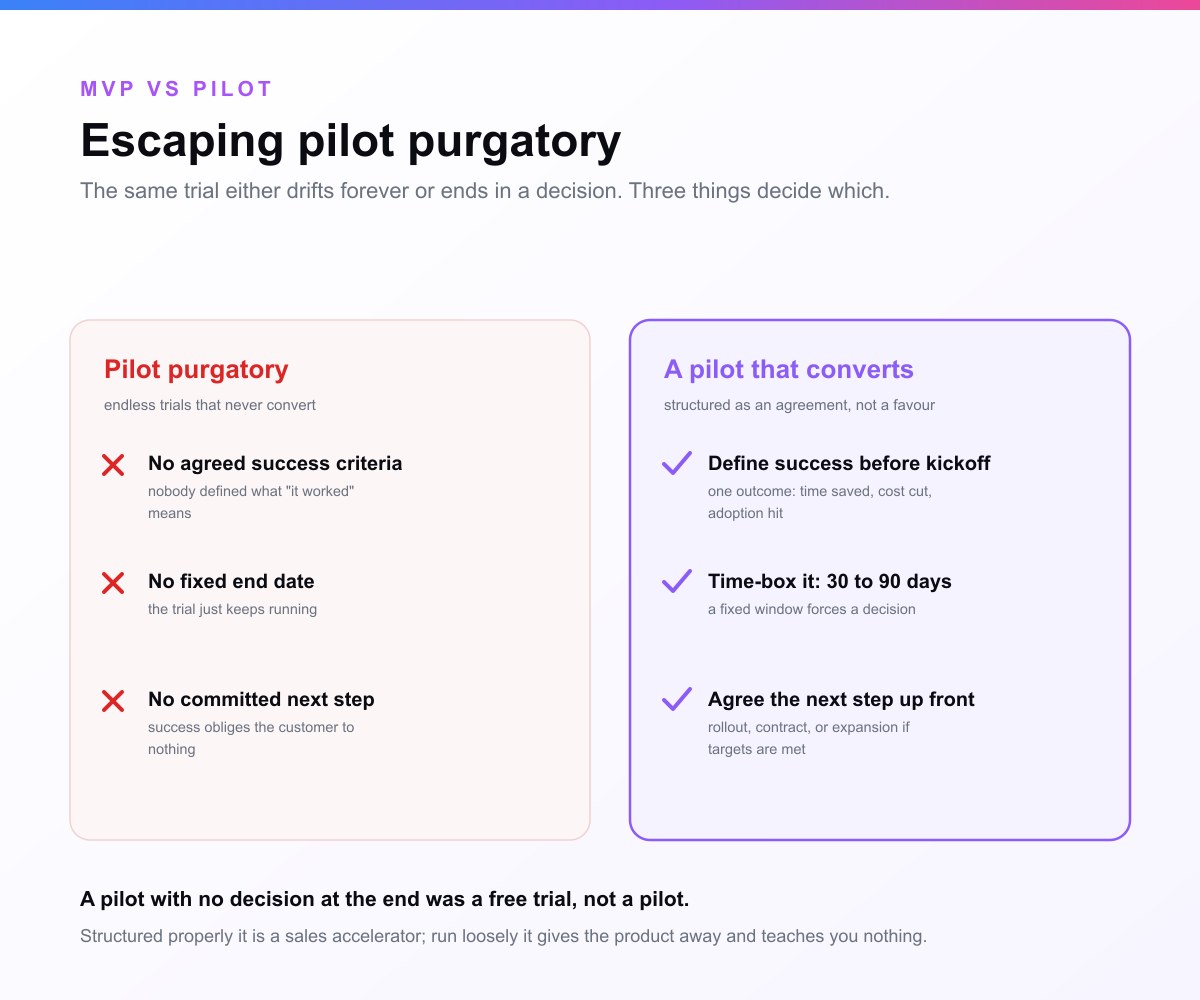
That is also where the trap lives. Teams fall into "pilot purgatory," an endless string of pilots that never convert into full deployments. It happens when a pilot starts with no agreed success criteria, no defined end date, and no commitment about what happens if it succeeds. The customer gets the benefit of using the product cheaply or free, indefinitely, with no obligation to roll it out, and the vendor burns time and cash servicing trials that go nowhere.
The fix is to treat the pilot as a structured agreement, not a favor. Before it starts, agree on the specific outcome that defines success, the metrics you will measure, the fixed duration, and the explicit next step if the pilot hits its targets (a rollout, a contract, an expansion). A pilot designed this way is a sales accelerator. A pilot run loosely is a way to give your product away while learning nothing you can act on.
How to run a pilot that actually converts
A pilot only earns its keep if it ends in a clear decision. Here is a repeatable way to structure one so it does.
- Define success before you start. Write down the single outcome that, if achieved, means the pilot worked: a target for time saved, cost reduced, adoption reached, or revenue lifted. Vague pilots produce vague results and no decision.
- Pick a representative group and a real environment. Choose participants and conditions that look like the eventual full rollout, real data, real workflows, real users. A pilot in an unrealistic setting proves nothing about the rollout.
- Time-box it. Set a fixed window, commonly 30 to 90 days. An open-ended pilot drifts into pilot purgatory and never forces a decision.
- Agree the next step up front. Settle, before kickoff, what happens if the pilot hits its targets: the rollout, the contract, or the expansion. The pilot should have a door at the end, not a hallway.
- Measure the operational reality, not just opinions. Track adoption, integration, performance, and the business outcome, not only whether people liked it. A pilot tests value in the real world, so measure the value in the real world.
- Decide and act. At the end, make the call the pilot was designed to inform: roll out, iterate and re-pilot, or stop. A pilot with no decision at the end was a free trial, not a pilot.
The deliverable of a good pilot is a confident go or no-go on the rollout. That is very different from "they used it and seemed happy," which is the soft non-result that keeps products stuck in trials forever.
Which one do you actually need?
The decision is not about which is "better." It is about which question you most need answered next.
- You need an MVP if demand is unproven. You do not yet know whether real users will adopt and pay, and your next job is to find out with the smallest real product that can answer it. Most early founders are here, even when they describe their plan as a pilot.
- You need a pilot if demand is proven and the product is built. Your next job is to prove the finished product works and delivers value in a real environment before you commit to deploying it everywhere, especially if you are selling into a business that wants evidence before a full contract.
A useful gut check: ask what would change your mind about the product right now. If the honest answer is "seeing whether anyone actually wants it," you need an MVP, no matter how deployable the product feels. If the answer is "seeing whether it works and pays off in a real customer's environment," you are ready for a pilot.
When to build an MVP (and when not to)
Build an MVP when:
- Your biggest open question is whether the market wants and will pay for the product.
- You need real usage data to raise money, decide whether to continue, or shape what to build next.
- You can define a single core flow or experiment worth putting in front of early adopters.
Move past the MVP when:
- Early adopters have clearly validated demand and retention.
- The product has matured beyond the minimal version and the remaining risk has shifted from "do they want it" to "does the finished product work in the real world," which is the signal to plan a pilot.
When to run a pilot (and when not to)
Run a pilot when:
- Demand is validated and the product is built and production-ready.
- You need to prove operational fit, integration, and ROI in a real environment before a wide rollout.
- You are selling into a business that wants real-world evidence before committing to a full contract.
Hold off on a pilot when:
- You have not yet proven anyone wants the product. Build and learn from an MVP first.
- The product is still missing core features you are unsure about. That is MVP iteration, not piloting.
- You cannot define what success looks like or what happens if the pilot works. Without those, you are heading into pilot purgatory, not a real trial. Rushing here is one of the MVP development challenges that traps teams who skip ahead.
Common mistakes teams make
1. Running a pilot before an MVP. Deploying and integrating a finished product to measure ROI before proving anyone wants it. If the market does not want it, a perfectly run pilot changes nothing.
2. Treating an MVP like a pilot. Measuring operational ROI and integration on a minimal experiment, then reading a weak result as a product failure when the real job was simply to test demand.
3. Starting a pilot with no success criteria. The fastest route to pilot purgatory. Without an agreed target, end date, and next step, the pilot drifts and never converts into a rollout or a contract.
4. Confusing a pilot with a beta. Running a stability test (beta) when you needed a real-world value test (pilot), or vice versa. They answer different questions and the wrong one leaves your actual risk unretired.
A concrete example
Imagine a founder building an app that auto-generates product descriptions for online sellers.
- The MVP ships the single core flow for real: a seller connects a store, generates one real description, and publishes it, with payment if you are charging. A small group of early adopters uses it, and you learn the only thing that matters at this stage: do sellers come back and pay? Demand is the question.
- The pilot comes much later, after demand is proven and the full product is built. A mid-size e-commerce company agrees to a 60-day pilot: the tool runs against one real product category in their actual catalog, used by their real merchandising team, measuring time saved per listing and any lift in conversion. If it hits the agreed targets, the pilot converts into a company-wide rollout and an annual contract. Real-world value is the question.
Each step answers a different risk in a different order. A founder who has not proven demand should be building the MVP, not arranging a pilot, no matter how enterprise-ready the vision feels.
The MVP Development take
In our experience, most founders who say they are "lining up a pilot" are actually still at the MVP stage, because demand is not yet proven. The pilot framing feels productive and grown-up, since it sounds like a real customer deploying a real product, but it quietly assumes the very thing the MVP is meant to test. Running an operational trial of a product nobody has shown they want is the most elaborate way to learn you guessed wrong.
That is why our default is to take founders straight to a real, narrow MVP: a single core flow, built to production standard, live for real early adopters, in 3 to 4 weeks on a clear, scoped quote you approve before we start. You get the one thing that actually de-risks the business, evidence of real demand, plus a deployed product you can put in front of investors. The pilot comes later, once demand is proven and a finished product needs to prove itself in a real environment before a wide rollout, which is exactly when a well-structured pilot becomes a powerful sales tool rather than a time sink.
There is no conflict between the two, only an order. The MVP earns the right to build the full product. The pilot proves the full product is ready to deploy. Run them in sequence and each does its job. Collapse them, and you either over-build before you have proof or run trials on an unvalidated idea. We help founders place themselves honestly on that timeline, then build whatever the current stage actually calls for. For the neighboring steps, our comparisons of MVP vs prototype and MVP vs beta map what comes before and alongside the pilot.
Not sure whether you need an MVP or a pilot? Describe the customer you want to pilot with and we will scope a build that survives their procurement.
Related guides
- What Is an MVP?: a clear definition of the minimum viable product
- How to Build an MVP: the step-by-step founder's playbook
- MVP Examples: 15 Famous MVPs: how the biggest startups validated with an MVP
Frequently asked questions
What is the difference between an MVP and a pilot?
An MVP (minimum viable product) is the smallest build you ship to test whether the market wants your idea, optimized for learning with a minimal, sometimes rough product. A pilot is a limited, real-world trial of an already-finished product, run with a defined group for a fixed period to prove it works and delivers value before a full rollout. In short, an MVP tests demand and comes early; a pilot tests real-world operations and comes late.
Is a pilot the same as an MVP?
No. They look related because both involve real users, but the intent differs. An MVP tests whether the product is wanted, using a minimal build. A pilot tests whether an already-wanted, finished product works and delivers value in a real environment before deploying it widely. If demand is still unproven, you are at the MVP, not the pilot.
Which comes first, the MVP or the pilot?
The MVP comes first, always. You build an MVP to validate demand, iterate toward product-market fit, build out the fuller product, and only then run a pilot to prove that product works in the real world before a full rollout. A pilot assumes the demand question is already answered, which is the MVP's job.
What is a pilot program?
A pilot program is a small-scale, real-world trial of a finished or near-finished product, run with a limited, representative group of users for a fixed period, often 30 to 90 days, before a full-scale rollout. It tests usability, integration, operational fit, and business value in real conditions, so an organization can decide whether and how to deploy the product more widely.
How long does a pilot last?
Most pilots are time-boxed to roughly 30 to 90 days. The window needs to be long enough to see real adoption and measure the promised outcome, but short enough to force a clear decision at the end. An open-ended pilot with no fixed duration tends to drift into "pilot purgatory," where it never converts into a rollout or a contract.
What is the difference between a pilot and a beta?
A beta is mainly about stability and readiness: a feature-complete product released to a wider group of testers to find bugs and performance issues before a public launch. A pilot is mainly about value and fit in a real operating environment: a finished product deployed with a specific group doing real work to prove it delivers the promised outcome before a rollout or purchase. A beta asks "is it stable enough to launch," a pilot asks "does it work and pay off in the real world."
Can an MVP be used in a pilot?
Indirectly, and only loosely. Some teams run an early, more complete MVP as a "pilot" with one friendly customer, but a true pilot assumes a finished, production-ready product and measures real-world value, while an MVP is intentionally minimal and measures demand. If the build is still minimal and the open question is whether people want it, you are running an MVP, even if you call it a pilot.
What is pilot purgatory?
Pilot purgatory is the trap of running endless pilots that never convert into full deployments or contracts. It happens when a pilot starts with no agreed success criteria, no fixed end date, and no commitment about what happens if it succeeds. The customer keeps using the product cheaply with no obligation to roll it out, and the vendor burns time and money on trials that go nowhere. The fix is to define success, time-box the pilot, and agree the next step before it begins.
Do pilots happen mostly in B2B?
Pilots are especially common in B2B and enterprise, where a customer wants real-world evidence before committing to a full contract and rollout. A pilot lets them run the product with one team or department first. Pilots also appear in consumer, government, healthcare, and hardware contexts, anywhere an organization wants to prove a finished product works at small scale before deploying it broadly. The B2B version is distinctive because it is usually a commercial step toward a sale.
How do you make a pilot successful?
Define the single outcome that means success before you start, pick a representative group operating in a realistic environment, time-box the trial, and agree the next step (rollout, contract, or expansion) up front. Measure the operational reality, adoption, integration, performance, and business impact, not just whether people liked it. End with a clear go or no-go decision. A pilot with no decision at the end was a free trial, not a pilot.
How is MVP vs pilot different from MVP vs prototype?
A prototype comes before the MVP and is a non-functional simulation that tests design and usability. A pilot comes well after the MVP and is a real-world trial of a finished product that tests operational value before a rollout. The MVP sits between them as the first real, minimal product that tests demand. We cover the earlier stage in MVP vs prototype and the readiness stage in MVP vs beta.
Sources and references
This comparison draws on established product and project frameworks and current practice:
- Userpilot, Product Pilot Guide how a pilot tests a complete product in a real-world setting before rollout
- Wikipedia, Pilot experiment the general definition of a pilot as a preliminary real-conditions test
- ProjectManager, Pilot Project running a new system at small scale to decide on full implementation
- Testsigma, Pilot Testing pilots as the bridge between development and full-scale deployment
- Wikipedia, Minimum viable product the MVP definition and validated-learning purpose
- Eric Ries, The Lean Startup the origin of the MVP concept
Time and delivery ranges reflect Q2 2026 practice; the 3 to 4 week figure reflects MVP Development delivery data for tightly scoped, single-flow MVP builds.


