


TL;DR
An AI MVP is the smallest working version of an AI-powered product, one core flow built on a foundation model, deployed for real users, to test two things at once: whether people want it, and whether the AI can actually do the job well enough. That second question is what makes an AI MVP different from a normal one. A traditional MVP carries market risk; an AI MVP carries market risk plus model risk, the chance that the AI is not reliable enough to deliver the value you are promising.
The good news is that you no longer build the intelligence yourself. You wrap a foundation model (from a provider like OpenAI or Anthropic) in a focused product, add the guardrails and evaluation that make it trustworthy, and ship the one flow that proves the idea. This guide covers what an AI MVP is, how it differs from a traditional MVP, the stack and metrics that matter, real examples, the mistakes that sink most attempts, and a step-by-step path to building one. For the underlying concept, start with what an MVP is.
Key Takeaways
- An AI MVP is the smallest working version of an AI-powered product: one core flow built on a foundation model, deployed for real users.
- It tests two things at once: whether people want it, and whether the AI can do the job well enough.
- A traditional MVP carries market risk; an AI MVP carries market risk plus model risk.
- You no longer build the intelligence yourself; you wrap a foundation model in a focused product with guardrails and evaluation.
- The one flow you ship should prove both the demand and the model's reliability.
What is an AI MVP?
An AI MVP (minimum viable product) is the first working version of an AI-powered product, built with only the features needed to deliver its core value and validate the idea with real users. It is a deployed product whose core value comes from an AI model, scoped to the single workflow that proves both the demand and the model's usefulness.
What is an MVP in AI? The same minimum-viable-product idea, applied to a product whose value depends on a model: large language models, computer vision, speech, recommendation, or any machine-learning capability. "Minimum" means one AI-powered workflow, not a suite of features. "Viable" means that workflow works reliably enough that a real user gets real value, despite the fact that AI outputs are probabilistic and imperfect. An AI MVP is narrow but real: a user gives an input, the AI does the core task, and the result is good enough to be worth using.
It is worth being clear about what an AI MVP is not. It is not a demo that works once on a cherry-picked example. It is not a research project chasing model accuracy for its own sake. And it is not a thin wrapper around a chatbot with no product around it. It is the one AI workflow, deployed and usable, that answers your riskiest question: will people use this, and can the AI deliver the value reliably enough that they keep coming back?
AI MVP vs traditional MVP: the key differences
This is the distinction that matters most, because applying traditional-MVP thinking to an AI product misses the risks that actually sink AI startups. A traditional MVP and an AI MVP share the same goal, validated learning with the least build, but they differ in what they have to validate and how.
| Traditional MVP | AI MVP | |
|---|---|---|
| Core risk | Market risk: will people want it? | Market risk + model risk: can the AI do it well enough? |
| Behavior | Deterministic, same input → same output | Probabilistic, same input → varying output |
| Failure mode | A feature does not exist | The AI gives wrong, unreliable, or unsafe output |
| What you validate | Demand and usability | Demand, usability, and model quality |
| New concerns | : | Hallucination, guardrails, evaluation, cost per use |
| Build effort | Goes into features | Goes into the flow, prompts, eval, and guardrails |
The headline difference: a traditional MVP tests whether people want your solution; an AI MVP also tests whether the AI is good enough to be that solution. A normal feature either works or it does not. An AI feature works probabilistically, it is right most of the time, wrong sometimes, and the same input can produce different outputs. That changes everything about how you design, test, and trust the product.
Three consequences follow. First, you have to evaluate quality, not just ship the feature, because "it ran" is not the same as "it was good." Second, you have to handle failure gracefully, with guardrails and a UX that accounts for the model being wrong, because users churn fast on a tool they cannot trust. Third, every use costs money (inference is not free like a normal feature), so unit economics enter the picture earlier than in a traditional MVP. An AI MVP that ignores these is a demo, not a validated product.
Why AI MVPs are harder to validate, and why that makes them more important
Because an AI MVP carries model risk on top of market risk, the MVP approach is more valuable for AI products, not less. The cheapest way to find out whether the AI can actually do the job at a quality real users accept is to build the smallest version and put it in front of them, not to spend months fine-tuning a model for a use case nobody has confirmed they want.
The trap that kills AI startups is building the impressive version, an elaborate pipeline, a fine-tuned model, a polished interface, before confirming two things: that people have the problem, and that the AI is reliable enough to solve it. An AI MVP tests both at once, cheaply. If the model is not good enough yet, you learn that in weeks for a small cost, instead of after a year of engineering. If it is good enough, you now have evidence to build and raise on.
There is a second reason AI MVPs matter more: AI moves fast. The model that is barely good enough today may be excellent in six months as foundation models improve. An AI MVP lets you ship on today's models, learn, and ride the capability curve, rather than betting everything on a model that does not exist yet. Shipping a narrow, real product now beats perfecting a broad one later.
The wrapper question: is your AI MVP defensible?
The most common doubt about AI MVPs is the "it's just a wrapper" critique, that anyone can call the same model API, so there is no product. It is worth confronting honestly, because it shapes what your MVP should test.
A thin wrapper, a bare chat box on top of a foundation model with nothing around it, is indeed easy to copy and hard to defend. But a real AI MVP is not just the model call; it is the product around it: the specific workflow, the prompts and context engineering, the guardrails, the data you bring, the integrations, the UX that makes the AI usable for a real job, and the feedback loop that improves it over time. Those are where the defensibility lives.
So the right thing for an AI MVP to validate is not "can we call the model" (you can), but "is there a real product and a real user need here, beyond the novelty." The MVP tests whether your specific application of the model solves a problem people will pay for and return to. If it does, you build the moat, proprietary data, workflow depth, integrations, on top of a validated core. If it does not, the wrapper critique was right, and you found out cheaply. Either way, the MVP answered the question.
What to include and what to cut in an AI MVP
Scoping an AI MVP follows the usual discipline, with a few AI-specific must-haves.
Include:
- The one AI-powered core flow. The single workflow where the model delivers your value, built to a usable standard.
- A foundation model via API. Use an existing model (OpenAI, Anthropic, or similar) rather than training your own; the MVP tests the product, not your ML research.
- Prompts and context engineering. The real work of an early AI product is getting reliable output from the model for your specific task.
- Guardrails. Basic safety, validation, and fallback behavior for when the model is wrong or uncertain, because it will be.
- A way to evaluate quality. Even a lightweight eval, a set of test cases you check outputs against, so you know if the AI is actually good enough.
- A feedback loop. A simple way to capture when the AI gets it right or wrong, which is both your eval data and your future moat.
- Usage and quality analytics. Instrument task success, not just sign-ups.
Cut (for now):
- Training or fine-tuning a custom model. Foundation models are good enough to validate almost any AI product idea.
- Multiple models, complex orchestration, and agentic pipelines beyond the one core task.
- A polished, feature-rich interface around the core AI flow.
- Scale infrastructure, caching, and cost optimization for traffic you do not have yet.
- Enterprise features: SSO, audit logs, fine-grained permissions.
The test for every feature is the same as any MVP: does a user need it to get value from the core AI workflow? If not, it waits. The AI-specific version of the discipline is, validate the model's usefulness on one task before you invest in custom models or elaborate pipelines.
Build vs buy: use foundation models, don't train your own
The single most important early decision in an AI MVP is also the easiest to get wrong: do not train your own model. For the overwhelming majority of AI MVPs, you should buy the intelligence, calling a foundation model API, and spend your effort on the product around it.
The reason is economic and strategic. Training or fine-tuning a custom model costs time, money, data, and specialized talent you do not have at the MVP stage, and it answers a question (can we train a model) that is rarely your actual risk. Your actual risk is whether there is a product. Foundation models from the major providers are capable enough to validate nearly any AI product idea today, and they improve constantly, so building on them lets you ship now and get better for free as they advance.
Fine-tuning and custom models have their place, later, once you have validated demand and have proprietary data and a clear reason the foundation model is not enough. At the MVP stage, they are almost always premature optimization. Build the product on a rented model, validate it, and earn the right to invest in custom intelligence with evidence and data behind you.
How to build an AI MVP, step by step
Here is the practical path from idea to a launched, validating AI MVP. A tightly scoped one ships in around three to four weeks.
| Step | What you do | Output |
|---|---|---|
| 1. Validate the need | Confirm people have the problem the AI would solve | A validated problem and hypothesis |
| 2. Define the core AI flow | Find the one workflow where the model delivers value | A scoped AI MVP definition |
| 3. Prototype with the model | Test prompts and outputs on a foundation model API | Evidence the AI can do the task |
| 4. Build the one flow | The flow, prompts, guardrails, and a basic UI | A working, deployed AI product |
| 5. Evaluate and instrument | Wire in quality eval, task success, and cost tracking | A measurable AI product |
| 6. Launch and learn | Put it in front of real users, measure, iterate | Validated learning (or a pivot) |
Validate the need first, the cheapest AI validation often happens before building, through interviews or a landing page. Define the core flow by naming the one task where the model delivers value. Prototype with the model early, because the fastest way to learn whether the AI can do the job is to throw real examples at a foundation model and judge the outputs, before building anything around it. Build the one flow with prompts, guardrails, and a basic UI. Evaluate quality with a test set and instrument task success and cost. Then launch and learn, and let real usage tell you whether the AI is good enough and whether people care.
Notice the AI-specific step: prototyping with the model before building. A few hours testing prompts on real inputs can tell you whether the whole idea is viable, which is the cheapest validation in the entire process.
A concrete AI MVP scoping example
To make the discipline tangible, take an AI idea: a tool that helps support teams handle tickets. The full vision uses AI to auto-categorize tickets, draft replies, summarize threads, suggest knowledge-base articles, detect sentiment, and route to the right agent, an AI platform.
The riskiest assumption is narrower: will support agents trust an AI to draft a reply they can actually send? So the AI MVP scopes to exactly that, the agent opens a ticket, the AI drafts a reply, and the agent edits and sends, and leaves everything else out. No routing, no sentiment, no summarization. One AI workflow: draft a reply an agent will actually use.
That MVP can ship in weeks on a foundation model, go in front of a few real support teams, and answer the only questions that matter, is the draft good enough to save time, and do agents keep using it? The correction rate, how much they edit the draft, tells you whether the AI is good enough; retention tells you whether they care. If both work, you add the next capability; if not, you learned it cheaply. Six AI features collapse into one flow, which is exactly the point.
The AI MVP tech stack
A modern AI MVP stack is mostly about wiring a foundation model into a focused product:
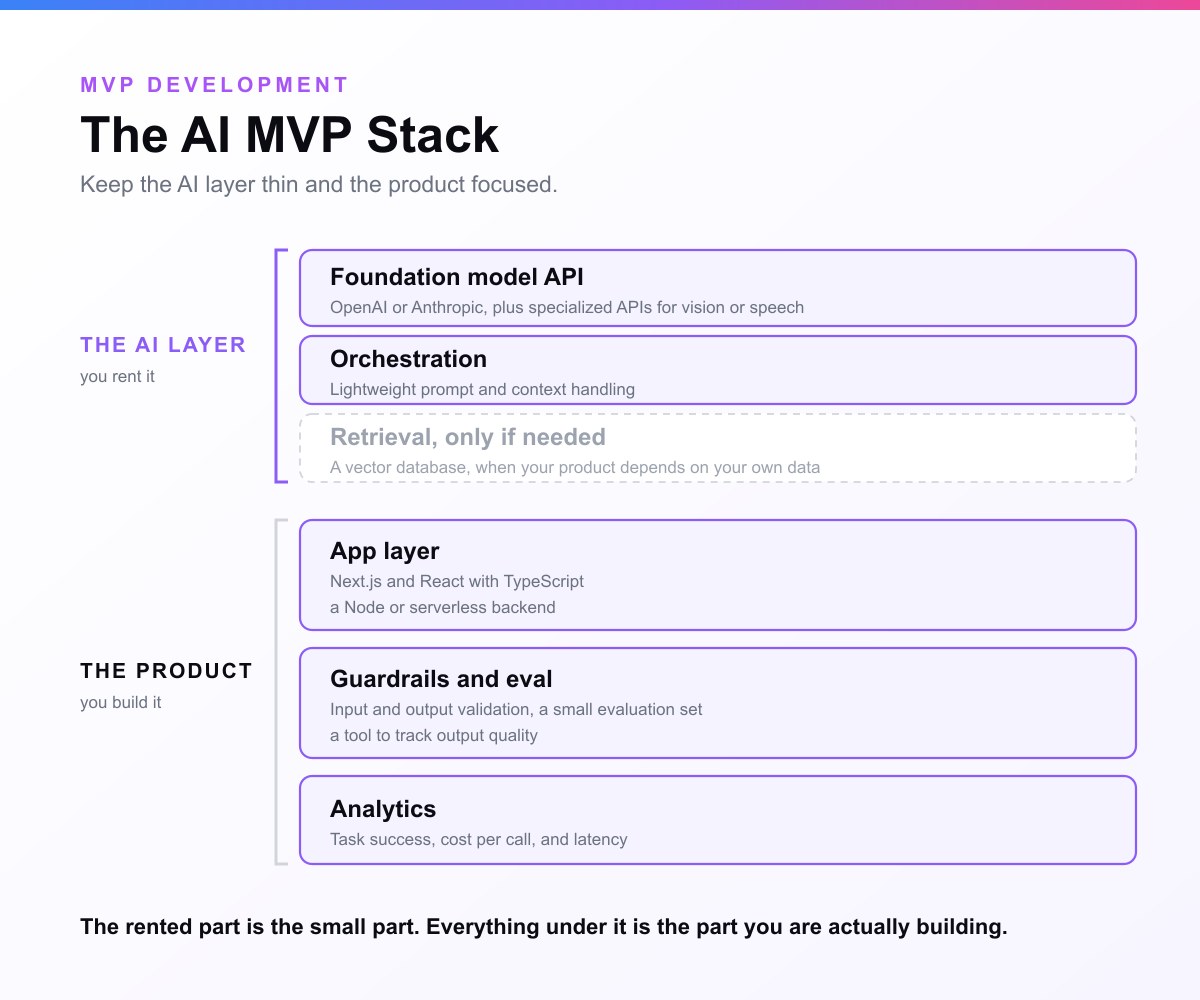
- Foundation model API: OpenAI or Anthropic for language tasks, plus specialized APIs for vision, speech, or other modalities.
- Orchestration: lightweight prompt and context handling; a framework only if you genuinely need retrieval or tools, not by default.
- Retrieval (if needed): a vector database (Pinecone, pgvector, Supabase) for RAG, when your product depends on your own data.
- App layer: Next.js and React with TypeScript, a Node or serverless backend, the same proven web stack used for any web app MVP.
- Guardrails and eval: input/output validation, a small evaluation set, and a tool to track output quality.
- Analytics: product analytics plus AI-specific tracking of task success, cost per call, and latency.
The principle is to keep the AI layer thin and the product focused: use managed model APIs, avoid premature ML infrastructure, and spend your build effort on the one workflow and the guardrails that make the model trustworthy. A no-code or low-code build can validate the very earliest version too; see no-code MVP. The stack matters less than the discipline: validate that the model is good enough on one task before building anything heavier.
RAG, fine-tuning, and agents: what an AI MVP actually needs
The AI ecosystem is full of techniques that sound essential and usually are not, at the MVP stage. Knowing which to use and which to defer keeps the build lean.
Retrieval-augmented generation (RAG) is worth it if your product genuinely depends on your own data, answering questions over a company's documents, for example. Then a simple retrieval setup, a vector database plus the model, is part of the core flow. If your product does not need private data to deliver value, skip RAG; it is complexity you have not earned.
Fine-tuning and custom models are almost always premature for an MVP. Foundation models with good prompting handle the vast majority of AI product tasks well enough to validate. Fine-tune later, once you have validated demand, proprietary data, and a specific quality gap the base model cannot close. At the MVP stage it is cost and time spent on a question that is rarely your real risk.
Agents and multi-step orchestration are tempting and usually overkill early. A single, well-prompted model call that does one task reliably beats a fragile chain of agent steps that fails unpredictably. Ship the one workflow first; add orchestration only when a single step provably cannot do the job.
The pattern is the same across all three: start with the simplest thing, a well-prompted foundation model on one task, and add retrieval, fine-tuning, or agents only when the core is validated and a specific limitation forces the upgrade. Most AI MVPs need far less machinery than founders expect, and that restraint is what keeps them shippable in weeks.
AI MVP metrics: what to measure
An AI MVP has the usual product metrics plus a layer that traditional products do not: you have to measure whether the AI is actually any good.
| Metric | What it tells you | Healthy early signal |
|---|---|---|
| Task success rate | Does the AI complete the job correctly? | High and stable on real inputs |
| Output quality / eval score | Is the output good, not just present? | Consistently passes your eval set |
| Correction / retry rate | How often users fix or redo the AI's work | Low and falling |
| Activation | Do users reach value with the AI? | 30%+ complete the core task |
| Retention | Do they keep using it? | A flattening retention curve |
| Cost per task | Is the unit economics viable? | Below the value delivered |
Task success and quality are the AI-specific metrics that matter most, because they tell you whether the model is good enough to build a business on. A flood of sign-ups means nothing if the AI gets the job wrong half the time, users will not come back. Retention is the truest signal here too: people return to an AI tool only if it reliably does something useful. And because every call costs money, cost per task belongs in the MVP from day one, an AI product that delights users but costs more per use than it earns is not viable. We go deeper on product metrics in MVP metrics; the AI-specific addition is to measure quality and unit cost, not just usage.
How to evaluate an AI MVP
Evaluation is the AI-specific discipline that separates a real AI MVP from a demo. Because the model is probabilistic, you cannot simply ship the feature and assume it works; you need a way to know whether the output is actually good on real inputs, not cherry-picked ones.
You do not need a research-grade eval harness for an MVP. You need a small set of representative test cases, real inputs your users would actually give, with a sense of what a good output looks like for each. Run them through the model whenever you change a prompt or the flow, and check whether quality holds. This catches the silent regressions that are easy to miss when you are eyeballing one example at a time.
For tasks where "good" is subjective, drafting, summarizing, human judgment is the eval: have a person rate a sample of outputs against simple criteria. For tasks with a right answer, classification, extraction, you can score automatically against expected results. Either way the goal is the same: a repeatable signal of whether the AI is good enough, so you are deciding with evidence, not vibes.
The most valuable eval source is real usage. Once the MVP is live, capture where the AI got it right and where users had to correct it, that correction data is both your ongoing quality signal and, later, the proprietary dataset that becomes your moat. Designing that feedback loop in from the start is one of the highest-leverage things an AI MVP can do, because it turns every use into both validation and a future advantage.
AI MVP examples: lean ways AI products start
AI products tend to start as one narrow capability, not a broad platform, which is exactly the MVP posture.
- A focused assistant that does one job, drafting a specific kind of document, answering questions over one knowledge base, summarizing one type of content, rather than a general "AI for everything." The MVP is the single task done reliably.
- A "copilot" feature inside an existing workflow, one AI action that saves real time, validated by whether people use it repeatedly, before building a full agent.
- A wizard-of-oz AI MVP, where the "AI" is partly a human behind the scenes at first, used to validate that the output is valuable before automating it, the AI-era version of a classic concierge MVP. See the types of MVP for that pattern.
The thread across all of them: one capability, real users, and proof that the AI output is valuable and reliable before scaling. The lesson is that an AI MVP is one model-powered task done well, not a platform of features, and the narrower the task, the easier it is to make the AI genuinely good at it.
Common AI MVP mistakes
AI MVPs fail in some traditional ways and some new, AI-specific ones.
Building the impressive version before validating. Founders fine-tune models and build elaborate pipelines before confirming anyone wants the product or that the AI is good enough. Validate with a foundation model first; earn the right to build custom.
Ignoring evaluation. Shipping AI features with no way to measure output quality means you cannot tell if the product actually works. "It ran" is not "it was good." Build a lightweight eval from day one.
No guardrails or failure UX. AI is wrong sometimes, so a product that assumes perfect output breaks users' trust the first time it hallucinates. Design for the model being wrong: validation, fallbacks, and a UX that signals uncertainty.
Shipping a thin wrapper with no product. A bare model call with no workflow, data, or UX around it is easy to copy and easy to abandon. The MVP should test a real product, not a demo of the model.
Ignoring cost per use. Because inference costs money, an AI MVP that does not track cost per task can validate usage while quietly being unprofitable. Watch unit economics early.
Chasing accuracy instead of usefulness. A model that is 95% accurate on a task nobody needs is worth less than an 80%-accurate one on a task people love. Optimize for validated user value, not benchmark scores.
How much does an AI MVP cost, and how long does it take?
A tightly scoped AI MVP, one model-powered workflow on a foundation model API, with guardrails and a basic UI, typically ships in around three to four weeks with a senior team, and costs a fraction of training a custom model or building a full AI platform. The biggest driver of both is scope and whether you stick to a rented foundation model: building on an API keeps the timeline in weeks, while custom models, complex pipelines, and proprietary data infrastructure push it into months and a different budget entirely.
For the full breakdown of what drives the number, see our guides on how much it costs to build an MVP and how long it takes to build an MVP. The AI-specific headline: because foundation models hand you the intelligence, almost all of the build effort goes into the one workflow, the prompts, the guardrails, and the evaluation that make the AI trustworthy, which is what keeps a focused AI MVP measured in weeks. The ongoing cost to watch is inference, the per-use model cost, which is why cost per task belongs in your metrics from the start.
Build your AI MVP with a team that ships real products
Knowing what an AI MVP should be and actually shipping one, reliable, trustworthy, and scoped, are different things. The hard part is the discipline: wrapping a foundation model in a real product, building the guardrails and evaluation that make it trustworthy, and resisting the urge to train custom models before the idea is validated. That is exactly what we do.
- We scope to the one AI workflow. We find the single model-powered flow that proves your idea and build it well, with the guardrails and eval that make it usable, not a thin demo.
- We ship in 3 to 4 weeks. A complete, deployed, investor-ready AI MVP on a proven foundation-model stack, built by senior engineers on a scoped, fixed quote.
- You own production-grade code. Architected to extend, add custom models, data, and depth, once the core is validated, not a throwaway prototype.
Explore our AI MVP development service, or if you are not yet sure what to build, start with a free MVP consultation.
Have an AI idea worth proving? Bring us your AI idea and we will separate the model risk from the product risk before you commit a budget.
Related guides
- AI Agent MVP, building an autonomous, tool-using AI agent MVP
- AI Chatbot MVP, building a conversational, RAG-grounded chatbot MVP
- What is an MVP?, the definition, types, and examples
- How to build an MVP, the full build process
- SaaS MVP, building a software-as-a-service MVP
- MVP validation, confirming demand before you build
- MVP metrics, what to measure and why
- Marketplace MVP, building a two-sided marketplace MVP
Frequently asked questions
What is an MVP in AI?
In AI, an MVP (minimum viable product) is the smallest working version of an AI-powered product: a deployed product built on a foundation model, with only the one core workflow needed to deliver value and validate the idea. It tests two things, whether people want the product and whether the AI can do the job reliably enough, using a rented model rather than a custom-trained one. "Minimum" refers to scope (one AI workflow), and "viable" means the model's output is good enough that real users get real value despite AI being imperfect.
What is the difference between an AI MVP and a traditional MVP?
A traditional MVP validates market risk, whether people want your solution. An AI MVP validates that plus model risk, whether the AI is good enough to deliver the value reliably. AI products behave probabilistically (the same input can give different outputs), can be wrong or unsafe, and cost money per use, so an AI MVP also has to evaluate output quality, build guardrails for failure, and watch cost per task, concerns a traditional MVP does not have. The goal is the same, validated learning with the least build, but an AI MVP has more to prove.
Do you need to train your own model for an AI MVP?
No. For almost every AI MVP, you should use a foundation model via API (OpenAI, Anthropic, or similar) rather than training or fine-tuning your own. Foundation models are capable enough to validate nearly any AI product idea, and they improve over time, so building on them lets you ship now. Training a custom model is expensive, slow, and answers a question (can we train a model) that is rarely your real risk at the MVP stage. Custom models come later, once demand is validated and you have proprietary data and a clear reason the foundation model is not enough.
Is an AI MVP just a wrapper around ChatGPT?
A thin wrapper, a bare chat box with nothing around it, is easy to copy and hard to defend, but a real AI MVP is the product around the model: the specific workflow, prompts, guardrails, data, integrations, UX, and feedback loop. Those are where the value and defensibility live. The job of the AI MVP is to validate whether your specific application of the model solves a real problem people return to, not merely that you can call the API. If it does, you build the moat, proprietary data and workflow depth, on a validated core.
What metrics matter for an AI MVP?
The metrics that matter most for an AI MVP are task success rate and output quality (is the AI actually good at the job), retention (do people keep using it), and cost per task (are the unit economics viable). These sit on top of the usual activation and retention. The AI-specific point is that usage alone can mislead, an AI tool that gets the job wrong will not retain users, and one that costs more per use than it delivers is not a business, so you measure quality and unit cost, not just sign-ups.
How long does it take to build an AI MVP?
A tightly scoped AI MVP, one model-powered workflow on a foundation-model API with guardrails and a basic UI, typically takes about three to four weeks with a senior team. The timeline is driven by scope and by sticking to a rented foundation model: building on an API keeps it in weeks, while training custom models or building complex pipelines pushes it into months. Because foundation models provide the intelligence, the build effort goes into the workflow, prompts, guardrails, and evaluation that make the AI usable and trustworthy.
Can foundation models really validate any AI MVP?
For the large majority of AI product ideas, yes. Today's foundation models from providers like OpenAI and Anthropic are capable enough to test whether your specific application solves a real problem, with good prompting and the right product around them. The point of an AI MVP is to validate the product and the demand, not to prove you can train a model, so a rented model is almost always the fastest, cheapest way to find out whether the idea works. If, after validating, you hit a specific quality gap the base model genuinely cannot close, that is the moment to consider fine-tuning or a custom model, with evidence and data behind the decision rather than as a premature bet.
Sources & references
This guide draws on established lean-startup practice and AI product guidance:
- Eric Ries, The Lean Startup, validated learning and the build-measure-learn loop
- Google Cloud, Why Create and Test an MVP of Your AI Product, validating AI products with an MVP
- Product School, AI MVP, building a minimum viable product for AI
- Atlassian, Minimum Viable Product, the MVP in agile product development
The 3 to 4 week figure reflects MVP Development delivery data for tightly scoped AI MVP builds.


