


TL;DR
The core difference in MVP vs MMF: an MVP (minimum viable product) is the smallest whole product you build to learn whether people want your idea, while an MMF (minimum marketable feature) is the smallest single piece of functionality that has real market value on its own. An MVP is about information: it exists to test a hypothesis with the least effort. An MMF is about value: it exists to deliver something the market actually wants, one self-contained feature at a time. One is a product built to learn. The other is a feature built to earn.
Short version: if you are still proving that anyone wants this, you think in MVPs, the smallest product that tests demand. Once the idea is validated and you are building out and shipping the real product, you think in MMFs, slicing the work into the smallest chunks that each deliver marketable value. The MVP is usually a one-time learning vehicle early on. MMFs are the ongoing unit of delivery after that. At MVP Development we ship a focused MVP in 3 to 4 weeks on a clear, scoped quote you approve before we start, then help you sequence what comes next as marketable features rather than one giant build. More on how they fit together below.
Key Takeaways
- An MVP is the smallest whole product you build to learn whether people want your idea.
- An MMF (minimum marketable feature) is the smallest single piece of functionality with real market value on its own.
- An MVP is about information (testing a hypothesis); an MMF is about value (delivering something the market wants).
- The MVP is a one-time learning vehicle early on; MMFs are the ongoing unit of delivery after validation.
MVP vs MMF: the difference that matters most
Strip both terms down and they differ on two axes at once: what they are and why they exist. An MVP is a whole product, kept minimal, that exists to learn. Its job is to get information, will real people adopt and pay, with the least build. An MMF is a single feature, kept minimal, that exists to deliver value. Its job is to put something genuinely marketable in front of customers, one self-contained slice at a time.
The cleanest way to hold the difference: an MVP is a product built for learning, and an MMF is a feature built for value. As one widely repeated framing puts it, minimum viable products are intended to get information, while minimum marketable features are intended to capture value. The MVP reduces uncertainty. The MMF delivers and captures worth.
That difference matters because the two operate at different moments and different scales. You reach for an MVP when the big question is still "should this exist at all," and you usually only need a few. You reach for MMFs constantly once the product is real and you are deciding how to slice the build so each release ships something the market actually values, rather than waiting months for one enormous launch.
What is an MVP?
An MVP (minimum viable product) is the smallest version of your product that is genuinely functional and built to test a hypothesis: usually whether real people want what you are making enough to use it and pay. It does one core thing to a working standard, ships to actual users, and exists to generate validated learning with the least time and effort. The concept was popularized by Eric Ries in The Lean Startup as the fastest way to get through the build-measure-learn loop.
The defining trait of an MVP is that something important is still unproven, most often demand. You are not refining a known winner, you are running an experiment, and the product exists to remove that uncertainty. That is why an MVP can be narrow and even rough without failing at its job: its job is learning, not capturing value. The MVP sits at a specific point in a company's life, after the idea is shaped and before scaling begins, which we cover in our guide to the MVP stage of a startup.
An MVP can take many forms, from a concierge service to a fake-door test to a single-feature app, depending on the cheapest honest way to test demand. We map the full set in our breakdown of the types of MVP. The common thread is that every MVP is chosen to maximize what you learn per dollar and per week spent.
What is an MMF?
An MMF (minimum marketable feature) is the smallest piece of functionality that delivers significant value to a customer and has intrinsic market value on its own. As the Agile Alliance defines it, it is a small, self-contained feature that can be developed quickly and that delivers meaningful value to the user. The keyword is marketable: an MMF is not a fragment or a piece of plumbing, it is a slice of functionality the market would actually notice and value if you shipped only that.
The term comes from Mark Denne and Dr. Jane Cleland-Huang's 2003 book Software by Numbers, which introduced the Incremental Funding Methodology (IFM), an ROI-informed way to build software in carefully prioritized chunks of customer-valued functionality. Those chunks are the MMFs. The idea was financial as much as technical: if you deliver real, marketable value in small increments, each increment can start returning value sooner, rather than sinking cost into one long build that pays back nothing until the end.
So where an MVP is a whole (minimal) product aimed at learning, an MMF is a single (minimal) feature aimed at delivering value. A minimum marketable feature is the unit you use to slice a real product roadmap into the smallest pieces that each stand on their own as something worth shipping and, ideally, worth paying for.
MVP vs MMF: side-by-side comparison
Here is the full MVP vs MMF comparison across the categories that actually drive the decision.
| Category | MVP | MMF |
|---|---|---|
| Stands for | Minimum Viable Product | Minimum Marketable Feature |
| What it is | The smallest whole product to test an idea | The smallest single feature with standalone market value |
| Scope unit | A product | A feature |
| Primary goal | Learn: get information | Deliver: capture value |
| The bar it clears | Viable: enough to test the hypothesis | Marketable: enough that the market values it alone |
| Origin | Frank Robinson, popularized by Eric Ries | Denne and Cleland-Huang, Software by Numbers |
| Stage | Early: before product-market fit | Ongoing: slicing delivery of a validated product |
| Must be sellable | Not necessarily, it can be an experiment | Yes, it has intrinsic market value |
| How often you use it | A few times, to find fit | Repeatedly, as the unit of delivery |
| The money angle | A cost of learning | An ROI lever that can fund the next feature |
| Risk it reduces | Market risk: building the wrong thing | Value risk: shipping work that does not pay off |
The table is the fast answer. The sections below unpack the categories where the two are most often confused, because they sound alike but do very different jobs.
The 6 comparison categories that matter
1. Goal: learning vs delivering value
This is the category everything else flows from. An MVP exists to learn: it is a question in product form, asking whether the market wants the idea. An MMF exists to deliver and capture value: it is an answer in feature form, putting something the market values into customers' hands. One is built to reduce uncertainty, the other to produce worth. Judge an MVP on revenue and you will over-build it; judge an MMF on "what did we learn" and you will under-ship it.
2. Scope unit: a product vs a feature
An MVP is a whole product, even if a tiny one. It stands on its own as a thing a user can use end to end, however narrow. An MMF is a single feature, a slice of a larger product, defined by being the smallest such slice that still carries market value by itself. This is the most concrete difference: when you talk MVP you are scoping a product; when you talk MMF you are slicing a product into the smallest valuable pieces.
3. Viable vs marketable
The middle words give the game away. An MVP only has to be viable: functional enough to test the hypothesis honestly. It does not need to be sellable, and some of the best MVPs are not. An MMF has to be marketable: the market has to recognize and value it on its own, which is a higher and different bar. Viable means "good enough to learn from." Marketable means "good enough that customers would notice and want this specific slice."
4. Stage and frequency: one-off vs ongoing
You typically reach for an MVP a handful of times, early, while you are still hunting for product-market fit. Once you have it, the MVP framing stops being the right tool. MMFs, by contrast, are an ongoing unit of work: every release of a real, growing product can be expressed as one or more MMFs. The MVP is an early milestone. The MMF is a repeatable way to slice delivery for the rest of the product's life, which is why it shows up so much in agile roadmapping. We get into sequencing the build in our MVP roadmap guide.
5. The money angle: cost of learning vs ROI lever
An MVP is, financially, a cost you pay to buy a lesson. A well-run one is cheap, but you are spending to learn, not to earn. An MMF flips that. Because each MMF carries real market value, it can start returning value as soon as it ships, which is the whole point of the Incremental Funding Methodology that introduced the term. Sequenced well, early MMFs can help fund later ones, turning the roadmap into something closer to self-funding rather than one long bet that only pays back at the end. We break down what shapes these numbers in our guide to how much it costs to build an MVP.
6. The risk each one retires
An MVP retires market risk: the chance you build something nobody wants. An MMF retires value and delivery risk: the chance you pour months into features that do not actually move the needle, or that you delay all value to a distant big-bang launch instead of shipping worth along the way. Both reduce waste, but at different layers: the MVP makes sure you build the right product, the MMF makes sure you build it in pieces that each pull their weight.
How MMF, MMP, and MMR fit together
The "marketable" family is a set of nested ideas, and seeing the nesting clears up most of the confusion. The MMF is the building block; the others are aggregations of it.
| Term | Stands for | What it is |
|---|---|---|
| MMF | Minimum Marketable Feature | The smallest single feature with market value on its own |
| MMP | Minimum Marketable Product | The smallest complete product you can sell, often built from one or more MMFs |
| MMR | Minimum Marketable Release | The smallest shippable release, usually a bundle of MMFs delivered together |
Read bottom-up, an MMF is one valuable feature, a minimum marketable product is the smallest set of features that adds up to something sellable, and a minimum marketable release is the package of features you actually ship in one go. All three share the premise that demand is already validated and the question is now what to deliver, which is exactly what separates the whole family from the MVP. The MVP asks whether to build at all; the marketable family asks how to slice and ship what you have decided to build.
The incremental funding angle: how MMFs pay for themselves
The part of the MMF idea that people miss is that it was born as a financial concept, not just a slicing one. In Software by Numbers, the point of breaking a product into minimum marketable features was to change the cash-flow shape of software development. Instead of investing for a long time and seeing a return only at the end, you sequence the work so the most valuable, most marketable chunks ship first and begin returning value early.
That reframes the roadmap as a series of investments, each with its own return, rather than one monolithic bet. You prioritize MMFs by value and cost, ship the ones with the best payoff soonest, and let the value they generate help justify and even fund the next ones. It lowers the peak amount of money at risk, shortens the time to first return, and gives you real evidence to decide what to build next.
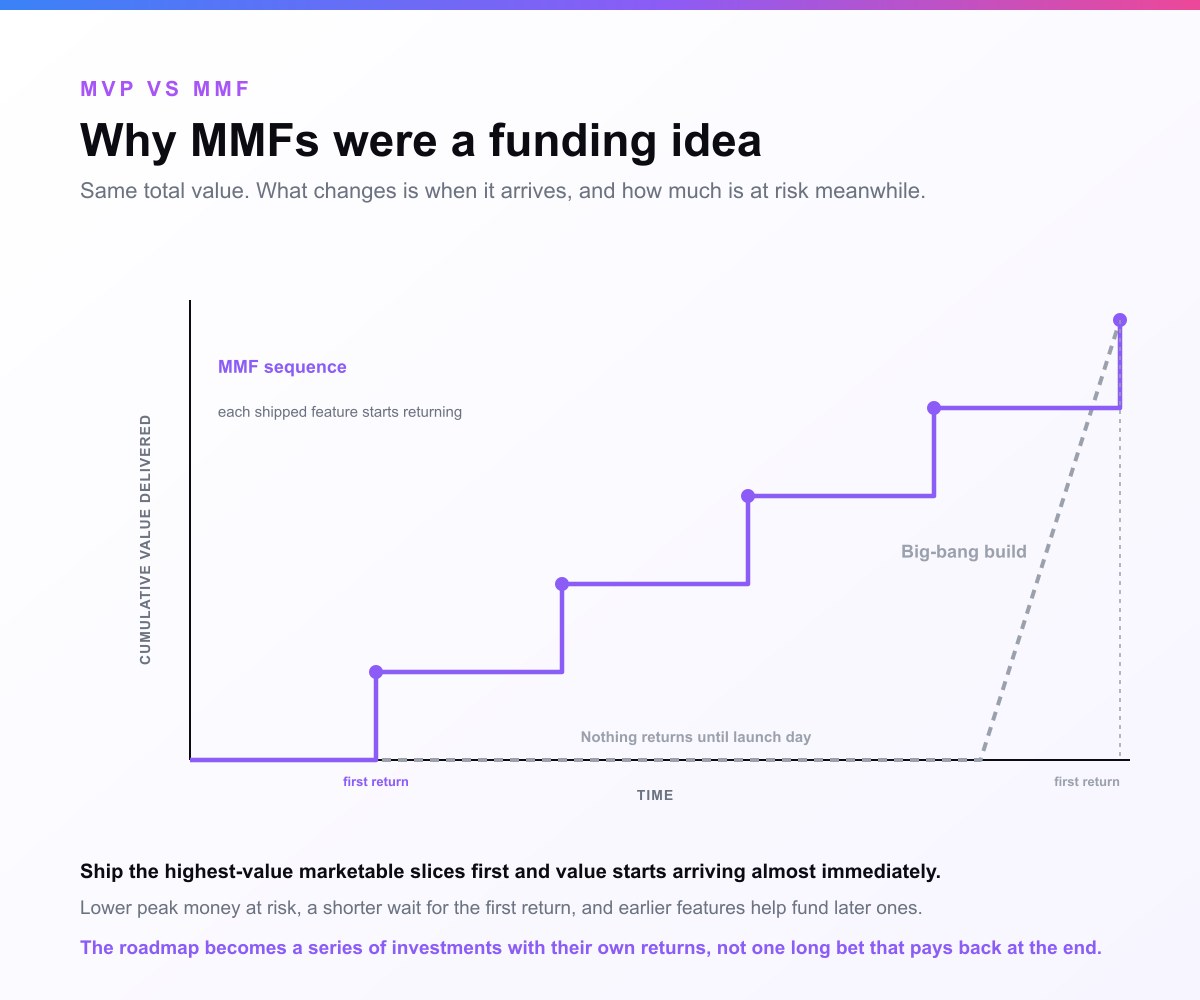
This is why MMF thinking pairs so naturally with an MVP, but does a different job. The MVP answers "is this worth funding at all" by testing demand cheaply. MMFs answer "in what order do we build and ship the validated product so value arrives as early as possible." One de-risks the decision to invest; the other optimizes the return on that investment.
How to sequence MMFs: shipping value in the right order
Once you are thinking in MMFs, the next question is order. The whole advantage of slicing a product into marketable features is lost if you ship them in a random sequence, so MMFs are meant to be prioritized, not just listed. The logic follows straight from their funding roots: ship the features that deliver the most value for the least cost first, so returns start early and inform what comes next.
A simple way to order them is to weigh each MMF on two axes and rank accordingly:
- Value: how much the market actually wants this slice, measured in revenue, retention, adoption, or willingness to pay, not internal enthusiasm.
- Cost and time: how much effort and how long it takes to ship the minimal version of the feature.
- Dependencies: whether other features must land first, which can force an otherwise lower-priority MMF earlier.
- Confidence: how sure you are about the value, since a high-value but uncertain MMF may be worth shipping early precisely to learn.
Teams often formalize this with scoring approaches like value-versus-effort, RICE, or weighted shortest job first, but the principle is the same without the acronyms: highest marketable value, soonest, for the least build. Sequenced this way, your roadmap stops being one long march to a distant launch and becomes a steady stream of releases that each carry their own worth, which is exactly the cash-flow shape the minimum marketable feature was invented to produce. We cover how this fits the broader build plan in our MVP roadmap guide.
Where the MVP and MMF meet in practice
Because they operate on different axes, product and feature, learning and value, the MVP and the MMF are not rivals you choose between so much as tools you use in sequence. The common flow runs like this: use an MVP to validate that the idea is wanted, reach product-market fit, then express the rest of the build as a prioritized stream of MMFs, shipping the most valuable marketable features first.
| Stage | Tool | Question it answers |
|---|---|---|
| Validate the idea | MVP | "Do people want this at all?" |
| Build out the product | MMFs | "What is the smallest valuable slice to ship next?" |
| Package a launch | MMR / MMP | "Which features do we bundle into a sellable release?" |
There is a tempting but mistaken shortcut here: treating your MVP as if it were just your first MMF. They can look similar, a small thing shipped early, but the intent differs. The MVP may include scaffolding that is not marketable on its own because its job is to test a hypothesis, while an MMF must carry market value by definition. Once you have validated the idea, though, your delivery does become a sequence of MMFs, and the MVP recedes into history as the experiment that earned you the right to ship them.
How to define a good MMF
The discipline of MMFs is in the slicing. A feature is a true minimum marketable feature when it passes a few tests at once. Use these to keep your slices honest.
- Minimal. It is the smallest version of the feature that still works. If you can cut more without destroying the value, it is not minimal yet.
- Marketable. The market would notice and value this slice on its own. If a customer would shrug at it shipped alone, it is a fragment, not an MMF.
- Self-contained. It can be built and delivered independently, without waiting on three other half-features to be useful. Independence is what lets you ship and earn early.
- Valuable. It delivers significant value to a real stakeholder, not just a tick on an internal roadmap. Value to the customer is the test, not effort spent.
- Sized for speed. It can be developed quickly. Marketable value that takes a year to ship is not an MMF, it is a project hiding behind the label.
A simple gut check ties them together: if you shipped only this slice and nothing else this quarter, would a customer notice, value it, and maybe pay more for it? If yes, it is an MMF. If the honest answer is "not until the rest arrives," you have sliced too thin or in the wrong place.
Which one do you actually need?
The decision is not about which is "better." It is about which question you are answering right now.
- You think in MVPs when the idea itself is unproven. Your job is to learn whether real users will adopt and pay, with the smallest whole product that can answer it. Most early founders are here, even when they are already arguing about features.
- You think in MMFs when the idea is validated and you are building and shipping the real product. Your job is to slice the work into the smallest pieces that each deliver marketable value, and to ship the most valuable ones first.
A useful gut check: ask whether your open question is "should this exist" or "what do we ship next." If it is the former, you need an MVP. If it is the latter, you are working in MMFs, sequencing marketable features to deliver value as early as possible.
When to think in MVPs (and when not to)
Think in MVPs when:
- Demand is unproven and your biggest risk is building something nobody wants.
- You need real usage evidence to raise money, decide whether to continue, or shape direction.
- You can define a single core product experiment worth putting in front of early adopters.
Move past MVP thinking when:
- The idea is validated and the risk has shifted from "do they want it" to "how do we deliver it well."
- You are now scoping a real, growing product, which is the moment to start slicing work into MMFs.
When to think in MMFs (and when not to)
Think in MMFs when:
- The product is validated and you are deciding what to build and ship next.
- You want value to arrive early and often, rather than all at once at a distant launch.
- You need to prioritize a roadmap by return, shipping the highest-value marketable slices first.
Hold off on MMF thinking when:
- You have not proven anyone wants the product. Slicing a validated roadmap is pointless if the idea is unvalidated. Test it with an MVP first.
- You are using "marketable feature" as a label to justify scope creep. An MMF is minimal by definition, and forgetting that is one of the MVP development challenges that quietly bloats a build.
Common mistakes teams make
1. Treating the MVP as your first MMF. They look alike but differ in intent: an MVP can include non-marketable scaffolding because its job is learning, while an MMF must carry market value on its own. Conflating them leads you to either over-build the MVP or mis-scope the first feature.
2. Slicing MMFs too thin. Cutting so deep that a slice has no standalone market value turns an MMF into a fragment. If a customer would not notice it shipped alone, it is not marketable, and you have lost the point.
3. Slicing MMFs too fat. The opposite error: packing so much into one "feature" that it becomes a mini-project, delaying value and defeating the incremental-funding logic. Minimal is half the definition.
4. Using MMFs before validating demand. Carefully sequencing marketable features for a product nobody has shown they want is elaborate motion in the wrong direction. Validate with an MVP, then optimize delivery with MMFs.
A concrete example
Imagine a founder building an app that auto-generates product descriptions for online sellers.
- The MVP tests the idea with the least build: a single flow where a seller generates one real description and publishes it, shipped to a few early adopters to learn the only thing that matters yet, do sellers come back and pay. It is a whole, if tiny, product, and its job is learning. Some of it (a rough dashboard, manual steps behind the scenes) is not "marketable" on its own, and that is fine, because it exists to test demand.
- The MMFs come after demand is proven, as the way you build out the real product. "Bulk-generate descriptions for a whole catalog" is one MMF: shipped alone, sellers would notice and value it, and it can start earning. "Auto-publish to Shopify" is another. "Multi-language descriptions" is another. Each is a small, self-contained, marketable slice, and you ship them in order of value so the product delivers worth continuously instead of waiting for one giant release.
Same product, two different jobs. The MVP answered "is this worth building." The MMFs answer "what is the most valuable slice to ship next, and in what order." A founder who has not proven demand should be building the MVP, not arguing about which MMF comes first.
The MVP Development take
In our experience, founders mix these up because both promise to keep things small, but "small" is doing different work in each. The MVP keeps the product small so you can learn cheaply whether the idea is real. The MMF keeps each feature small so that, once the idea is real, every release delivers value the market actually wants instead of disappearing into a long build. Confuse them and you either treat a learning experiment like a revenue feature, or you start optimizing delivery for a product nobody has validated.
That is why our default is to start with a genuine MVP: a single core flow, built to production standard, live for real early adopters, in 3 to 4 weeks on a clear, scoped quote you approve before we start. Its job is to buy you the most important lesson, real demand evidence, as cheaply as possible. Once that lesson is in, the conversation naturally shifts to MMFs: we help you express the next phase as a prioritized stream of marketable features, so value keeps arriving as the product grows, rather than betting everything on one far-off launch.
There is no conflict between the two, just a handoff. The MVP earns the right to build the real product by proving someone wants it. MMFs then build that product in slices that each pull their weight. Run them in that order and each does its job. Collapse them, and you either over-build before you have proof or ship features in a vacuum. If you want to see how this connects to the neighboring "marketable" ideas, our comparisons of MVP vs MMP, MVP vs MLP, and MVP vs SLC map the rest of the landscape.
Not sure whether you are still validating an idea or ready to slice it into features? List the features fighting for your budget and we will help you pick the one that is genuinely marketable.
Related guides
- What Is an MVP?: a clear definition of the minimum viable product
- How to Build an MVP: the step-by-step founder's playbook
- MVP Examples: 15 Famous MVPs: how the biggest startups validated with an MVP
Frequently asked questions
What is the difference between an MVP and an MMF?
An MVP (minimum viable product) is the smallest whole product you build to learn whether the market wants your idea, optimized for information with the least effort. An MMF (minimum marketable feature) is the smallest single feature that has real market value on its own, optimized for delivering value. In short, an MVP is a product built to learn, and an MMF is a feature built to earn. The MVP comes early to validate; MMFs come after, as the unit you ship the real product in.
What does MMF stand for?
MMF stands for minimum marketable feature: the smallest unit of functionality with intrinsic market value, meaning a small, self-contained feature that delivers significant value to the customer on its own. The term comes from Mark Denne and Jane Cleland-Huang's 2003 book Software by Numbers, where MMFs are the prioritized chunks of value at the heart of the Incremental Funding Methodology.
Is an MMF the same as an MVP?
No. They share the word "minimum" and both stay small, but they differ on two axes. An MVP is a whole product built to learn whether the idea is wanted, and it does not have to be sellable. An MMF is a single feature that must be marketable, carrying value the market recognizes on its own. One is a product for learning, the other a feature for delivering value.
Which comes first, the MVP or the MMF?
The MVP usually comes first. You build an MVP to validate that the idea is wanted, and only once it is validated do you express the rest of the build as a stream of MMFs, shipping the most valuable marketable features first. Trying to sequence MMFs before validating demand is optimizing delivery for a product nobody has shown they want.
How is an MMF different from an MMP?
An MMF (minimum marketable feature) is a single feature with standalone market value. An MMP (minimum marketable product) is the smallest complete product you can sell, usually built from one or more MMFs. The MMF is the building block; the MMP is the smallest sellable assembly of those blocks. A bundle of MMFs shipped together is a minimum marketable release (MMR). We cover the product-level idea in MVP vs MMP.
Does an MMF have to make money on its own?
It has to have intrinsic market value on its own, which is closely related but not identical to directly making money. The test is whether the market would notice and value the feature if you shipped only it. In the Incremental Funding Methodology that introduced the term, MMFs are sequenced precisely so they can start returning value early, so revenue or measurable business value is very much the spirit of the idea.
Can an MVP be made of MMFs?
It is cleaner to say a validated product is built from MMFs, and the MVP is the experiment that precedes them. An MVP can resemble a first marketable feature, but it may also include non-marketable scaffolding because its job is to test a hypothesis, not to be sellable. Once demand is proven, your ongoing delivery is best expressed as a sequence of MMFs.
What is the Incremental Funding Methodology?
It is the approach introduced in Software by Numbers that breaks a product into minimum marketable features and sequences them by return, so the most valuable, most marketable chunks ship first and start generating value early. The goal is to lower the amount of money at risk at any one time, shorten the time to first return, and let earlier features help justify and fund later ones, instead of one long build that only pays back at the end.
How do I know if something is a real MMF?
Check that it is minimal, marketable, self-contained, valuable, and quick to build. The simplest gut check: if you shipped only this slice this quarter, would a customer notice it, value it, and maybe pay more for it? If yes, it is a minimum marketable feature. If the value only appears once several other pieces also land, you have sliced too thin or in the wrong place.
When should I use MMF thinking instead of MVP thinking?
Use MVP thinking when the idea is unproven and your biggest risk is building the wrong thing. Switch to MMF thinking once demand is validated and you are building and shipping the real product, when the question changes from "should this exist" to "what is the most valuable slice to ship next." MVPs validate; MMFs deliver.
How is MVP vs MMF different from MVP vs MMP or MVP vs MLP?
All three compare the MVP against a member of the "minimum" family, but at different levels. MVP vs MMF compares a product-to-learn against a single feature-to-deliver. MVP vs MMP compares it against the smallest sellable product. MVP vs MLP compares it against the smallest version people love. The MMF is the smallest unit of the marketable family; the MMP and MLP are product-level ideas. We map them in MVP vs MMP and MVP vs MLP.
Sources and references
This comparison draws on established product and software-delivery frameworks and current practice:
- Agile Alliance, Minimum Marketable Feature the self-contained, market-valuable feature definition
- ProductPlan, Minimum Marketable Feature how MMFs slice a roadmap into marketable value
- Innolution, MVP and MMF and MRF, Oh My! how the MVP, MMF, and release-level ideas relate
- InsideProduct, Is there a Difference Between MVP and MMF? information versus value as the core distinction
- Wikipedia, Minimum viable product the MVP definition and validated-learning purpose
- Eric Ries, The Lean Startup the origin of the MVP concept
The MMF concept and the Incremental Funding Methodology originate in Mark Denne and Jane Cleland-Huang's Software by Numbers (2003). Time and delivery ranges reflect Q2 2026 practice; the 3 to 4 week figure reflects MVP Development delivery data for tightly scoped, single-flow MVP builds.


