


TL;DR
To build an MVP, you validate demand first, cut your idea down to a single core flow, choose the lightest build approach that delivers it to production quality, then ship it to real users and let their behavior tell you what to do next. The mistake almost every first-time founder makes is starting with the build. The build is step seven, not step one. Get the order right and an MVP takes weeks and a modest budget; get it wrong and it takes quarters and your runway.
This is the full step-by-step playbook: define the problem, map the user, prioritize ruthlessly down to one flow, pick your build approach and stack, design, build in scoped sprints, test, launch, and iterate, plus how long it takes, what it costs, the mistakes that sink builds, and how the process shifts by business type. The goal of an MVP is not a small product; it is the fastest path to evidence. At MVP Development we run this exact process to ship founders a funding-ready MVP in 3-4 weeks. More on that at the end.
Key Takeaways
- Validation comes first, not code. In a sound process, building is step seven of ten, not step one.
- The order that works: validate demand, cut to one core flow, pick the lightest build approach, design, build in scoped sprints, test, launch, then iterate.
- Scope discipline is the biggest cost lever: get the order right and an MVP ships in weeks on a modest budget; get it wrong and it takes quarters and your runway.
- An MVP's goal is not a small product; it is the fastest path to evidence.
- A tightly scoped, single-flow MVP can be built to production quality in 3-4 weeks.
What an MVP actually is (and isn't)
A minimum viable product is the smallest version of your product that delivers real value to real users and lets you learn whether the idea works. The term comes from Eric Ries's Lean Startup, and the operative word is viable: an MVP is not a broken or half-built product, it is a complete, working solution to one problem, stripped of everything that is not essential to proving the core idea.
The most useful way to think about it: an MVP is an experiment with a working product as the apparatus. Its job is to answer a question, do people want this, and does our solution deliver it?, not to be feature-complete. That single reframe changes every decision downstream. You stop asking "what should this product do?" and start asking "what is the one thing it must do to prove the idea?" Everything in this guide flows from that distinction. If you want the full taxonomy of MVP formats, from landing pages to single-feature builds, see our guide to the types of MVP.
What an MVP is not: a prototype (that is a non-functional mock, see MVP vs prototype), a proof of concept (an internal technical test, see MVP vs POC), or a v1.0 of the full product. Conflating these is the single most common reason MVPs balloon in scope.
Step 0: Validate before you build
The cheapest MVP is the one you never have to build. Before you write a line of code or scope a single feature, confirm that the demand is real, because building is the most expensive way to discover that nobody wanted it.
This is its own discipline, and we cover it end-to-end in the MVP validation guide: customer interviews to confirm the problem, landing-page smoke tests and fake-door tests to confirm interest, and pre-sales to confirm willingness to pay. Run a two-week validation sprint first. If strangers act, sign up, click, or pay, you have earned the right to build. If they do not, you just saved yourself months and a budget.
Treat this as a hard gate, not an optional step. Founders who skip validation and jump straight to building are not moving faster; they are spending their most expensive resource (engineering time) on a question a landing page could have answered for a few hundred dollars. The rest of this guide assumes you have cleared this gate, that you have evidence, not just conviction.
The MVP build process at a glance
Here is the full sequence. The build itself is one step among many, and the steps before it are what keep it small.
| Phase | Steps | Output |
|---|---|---|
| Validate | 0. Confirm demand | Evidence people want it |
| Define | 1. Problem & hypothesis · 2. Users & journey · 3. Prioritize to one flow | A scoped, written spec |
| Design | 4. Build approach · 5. Tech stack · 6. UX & prototype | A buildable plan |
| Build | 7. Scoped sprints · 8. Test & QA | A working product |
| Learn | 9. Launch · 10. Measure & iterate | Real usage data |
The discipline that makes this work is keeping the Define phase honest. Most MVPs fail not in the build but in the definition, because the founder never cut the scope down to a single core flow. Get steps 1-3 right and the build is fast and cheap. Get them wrong and no amount of engineering speed will save you.
Step 1: Define the core problem and one hypothesis
Start by writing down, in one sentence, the single problem your MVP solves and the one hypothesis it tests. Not three problems. One. "Freelance designers waste hours every month on manual invoicing, and they will pay for a tool that automates it." That sentence is your north star; every feature either serves it or gets cut.
The discipline here is subtraction. Your full product vision might solve ten problems for five user types. Your MVP solves one problem for one user type. The reason is not just speed, it is signal: if your MVP does ten things, and it succeeds or fails, you will not know which thing drove the result. A focused MVP gives you a clean read on a single hypothesis. A bloated one gives you noise.
Write down your riskiest assumption explicitly, the belief that, if wrong, kills the whole thing. Then design the MVP to test exactly that. If the riskiest assumption is "people will pay," the MVP needs a payment flow more than it needs polish. If it is "the core workflow saves real time," the MVP needs that workflow to genuinely work, and nothing else. Naming the riskiest assumption tells you what the MVP must nail and what it can fake or skip. This is the connective tissue between validation and the build: the assumption you validated is the one the MVP must now prove at product scale.
Step 2: Know your user and map the core journey
You cannot build a focused product for a vague user. Define one specific user, their context, their goal, and the moment they feel the problem most acutely. The narrower the better: "freelance graphic designers who invoice 5-15 clients a month and currently use spreadsheets" beats "small businesses."
Then map the core user journey, the shortest path from the user arriving to the user getting the core value. Write out every step: they land, they sign up, they do X, they get Y. This map is your scope. Anything on the critical path to value is in the MVP; anything off it is not. Settings pages, profile customization, admin dashboards, onboarding tours, these feel necessary but rarely sit on the critical path to proving the core idea.
A useful test for every proposed feature: does the user reach the core value without it? If yes, cut it from the MVP. The core journey for a marketplace might be "find a listing → contact the seller → complete a transaction," nothing about reviews, profiles, or messaging history is required to prove the core exchange works. Mapping this journey honestly is what turns a sprawling idea into a buildable single-feature MVP.
Step 3: Prioritize features and cut to one core flow
This is where MVPs are won or lost. You have a list of everything the product could do. Now you cut it to what it must do, using a framework to keep the decision objective instead of emotional.
The quick version: sort every feature with MoSCoW (Must / Should / Could / Won't) and build only the Must-haves, the features the core flow does not function without. Use RICE (Reach × Impact × Confidence ÷ Effort) to rank when you must choose between Must-haves. Above all, prioritize by your riskiest assumption: the feature that tests it is a must, polish is not. For the full method, including the Kano model and a worked example, see our guide to MVP feature prioritization.
| Feature | MoSCoW | On core flow? | In MVP? |
|---|---|---|---|
| User signup | Must | Yes | ✅ |
| The one core workflow | Must | Yes | ✅ |
| Payment (if "will they pay" is the risk) | Must | Yes | ✅ |
| Profile customization | Could | No | ❌ |
| Admin dashboard | Should | No | ❌ |
| Social sharing | Could | No | ❌ |
The output of this step is a written, scoped spec: a short list of Must-have features that together deliver the one core flow. If that list has more than a handful of items, you have not cut deeply enough. The most common cause of MVP development challenges, blown timelines and budgets, traces directly back to a Define phase that never produced a truly minimal scope.
Step 4: Choose your build approach
How you build matters as much as what you build. There are four realistic paths, and the right one depends on your technical risk, budget, and timeline.
- No-code / low-code. Tools like visual app builders let non-technical founders ship a working product fast and cheap. Ideal when your core flow is standard (forms, dashboards, simple marketplaces) and the technical risk is low. The trade-off is ceiling: no-code can hit walls on custom logic, scale, or unique UX. See our guide to the no-code MVP for when it fits and when to go custom.
- Custom development, in-house. Hiring engineers gives you maximum control and owned code, but it is the slowest and most expensive path to a first version, you are recruiting before you have proof. Rarely the right call at the MVP stage.
- Custom development, freelancers. Cheaper and faster to start than hiring, but coordination, quality, and continuity risk are real. Works for simple builds with a strong technical founder steering.
- Custom development, an MVP agency. A specialized partner ships a production-grade MVP fast without you building a team, the right fit when the core flow needs real engineering, you want owned code, and speed matters. This is what we do.
| Approach | Speed | Cost | Ceiling | Best when |
|---|---|---|---|---|
| No-code | Fastest | Lowest | Low | Standard flow, low technical risk |
| In-house hire | Slowest | Highest | High | You're scaling, not validating |
| Freelancers | Medium | Low-med | Medium | Simple build, technical founder |
| MVP agency | Fast | Medium | High | Custom flow, owned code, speed |
The honest filter: if your core flow is genuinely novel or technical, no-code will fight you, and the fastest route to a production-grade MVP is a senior team that has done it before. If your flow is standard, no-code is the cheapest way to prove it.
Build vs buy: how to decide in 2 minutes
"Build vs buy" is the same choice in different words: build means custom development (in-house, freelancers, or an agency); buy means assembling your MVP on existing no-code or off-the-shelf tools instead of writing it from scratch. A fast rule:
- Buy (no-code / off-the-shelf) when your core flow is standard, technical risk is low, and you mainly need to prove demand, it is the cheapest, fastest way to a real test. Deep-dive: no-code MVP.
- Build (custom) when your core flow is genuinely novel or technical, you need to own and scale the code, or a platform ceiling would force a rebuild soon anyway. Deep-dive: custom MVP.
For most founders the answer is buy to validate, then build what proves out, don't write custom code for a flow a no-code tool could test this week, and don't trap a genuinely technical product on a platform it will outgrow.
Step 5: Pick your tech stack
If you are building custom, the stack should optimize for one thing at the MVP stage: speed to a working, production-grade product you can scale later. This is not the moment for exotic technology or premature optimization for millions of users you do not have.
The principles that matter:
- Boring and proven beats novel and clever. Mature frameworks with large communities mean faster development, easier hiring, and fewer surprises. Save the bleeding edge for when you have product-market fit.
- Managed services over building infrastructure. Use hosted databases, authentication, and deployment platforms so your engineering time goes into the core flow, not into plumbing.
- One stack, not five. A unified stack (shared language across front and back end where possible) keeps a small team fast.
- Scalable enough, not infinitely scalable. Your MVP needs to handle your first hundreds of users reliably, not your imaginary millions. Architect for the next stage, not the final one.
The right stack is invisible to users and lets you ship the core flow fast. Founders who agonize over stack choices at the MVP stage are usually avoiding the harder work of scoping. Pick a proven stack, owned and production-grade so it scales past the MVP, and move on to building.
Step 6: Design the experience
Before building, design the core flow, first as a low-fidelity wireframe (boxes and arrows showing each screen), then as a clickable prototype if the experience carries real risk. The point is not visual polish; it is catching flow problems before they are expensive to fix in code. A prototype lets you walk a few real users through the journey and watch where they hesitate.
Keep the design minimal and conventional. Users do not need a novel interface; they need to reach the core value without friction. Use established patterns, standard navigation, familiar controls, so the product feels intuitive without custom design investment. Every hour spent on a bespoke component that is not the core flow is an hour not spent on the thing that proves your idea.
Design discipline mirrors feature discipline: one clean flow, conventional patterns, no decorative complexity. The MVP should look credible and trustworthy, especially if you are raising, but it does not need to look like a mature, ten-screen product. It needs to make the one core flow obvious and frictionless.
Step 7: Build in scoped sprints
Now you build, and the discipline established in steps 1-3 pays off. Work in short sprints, build the core flow end-to-end first, then refine. Resist the gravitational pull of scope creep: every "while we're at it, let's also add…" is runway spent on a question you have not earned the right to ask.
The order matters. Build a thin slice of the entire core flow first, signup to core value to the end, even if rough, so you have a working product early. Then deepen and polish that flow. This "walking skeleton" approach means you always have something demoable, and it surfaces integration problems early instead of in the final week. For the full phase-by-phase breakdown of how a build runs, see the MVP development process and how to sequence it with an MVP roadmap.
Protect the scope ruthlessly. The spec you wrote in step 3 is a contract with your future self. When a new idea appears mid-build, and it will, write it on a "v2" list and keep building the agreed scope. The MVPs that ship on time are the ones where the founder defended the scope; the ones that slip are the ones where every week added "just one more thing."
Step 8: Test and QA
An MVP is minimal in scope, not in quality. The one core flow has to work, reliably, because a broken core flow produces a false negative: users churn not because they did not want it, but because it did not function. That is the worst possible outcome, you kill a good idea on a bug.
Test the critical path thoroughly: the signup, the core workflow, the payment if you have one. Cover the main paths and the obvious failure cases (bad input, network errors, empty states). You do not need exhaustive coverage of every edge case, that is over-engineering for an MVP, but the core flow must be solid enough that real users get a real experience. Polish on the periphery can wait; reliability on the core path cannot.
This is the line between "minimal" and "shoddy." Minimal means few features. Shoddy means the features you have do not work. An MVP is the former, never the latter, especially if you are putting it in front of investors, where a crash mid-demo undoes months of work.
Step 9: Launch to real users
Launch means getting the MVP in front of the real, problem-having strangers you have been targeting, not friends, not your network. The waitlist you built during validation is your launch list. A "soft launch" to a controlled group first lets you catch issues before a wider push.
Keep launch lightweight. You are not launching a finished company; you are putting an experiment into the world to collect data. Instrument everything before you launch (see the next step) so that the moment users arrive, you are learning. Then drive your validated audience to it, the same channels that worked in validation, the same communities, the same ad angles.
The mindset: launch is not a finish line, it is the start of the learning. The product going live is when the real validation, usage by real users, finally begins. Everything before this was a proxy; now you get the truth.
Step 10: Measure and iterate
The MVP exists to produce data, so measurement is not optional, it is the point. Before launch, pick the one or two metrics that prove or disprove your hypothesis, and instrument them. For most MVPs the two that matter are activation (do new users reach the core value?) and retention (do they come back?). Vanity metrics, signups, page views, social followers, measure curiosity, not value; ignore them.
Then iterate based on what the data and user feedback tell you. The loop is Lean Startup's build-measure-learn: ship, watch how real users behave, learn, and adjust. Some iterations refine the core flow; some reveal you targeted the wrong user; some, the honest ones, tell you to pivot. All of them are progress, because all of them are evidence.
This is where the MVP earns its keep. A product that ships and then sits un-instrumented is just a small product. A product that ships, measures, and iterates is a learning machine, which is the entire reason the MVP exists. Watch activation and retention, talk to the users who churn, and let real behavior, not your roadmap, decide what to build next.
How long it takes and what it costs
A well-scoped MVP, one core flow, built by a capable team, typically ships in a few weeks to a few months, depending on the complexity of that flow and the build approach. No-code can be days to weeks; custom builds run weeks to a couple of months. We break down the full phase-by-phase timeline in how long it takes to build an MVP.
Cost follows the same logic, it tracks scope and approach, not arbitrary price tags. A no-code MVP can cost very little; a custom agency build is a larger but scoped investment. The full breakdown, with real 2026 numbers, is in how much it costs to build an MVP. The single biggest lever on both time and cost is the same one from step 3: scope. A tightly scoped MVP is fast and affordable; a bloated one is neither, regardless of how you build it.
Estimate your MVP
Three taps for a ballpark, using the same model as our full calculator.
Platform
Scope
Who builds it
Ballpark
$10,300–$39,000
2–7 weeks · The flow, plus billing and email
Or skip the estimate: a working AI prototype of your idea for $350 in 7 days, fixed. See what it includes
A ballpark, not a quote. Want the detailed version with every feature? Open the full calculator.
A realistic 4-week MVP build timeline
Once you have validated and scoped, the build itself runs on a predictable cadence. Here is how a tightly scoped MVP comes together in about four weeks, the rhythm we use to ship a funding-ready product.
Week 1, define and design. Lock the scope and write the final core-flow spec. Wireframe every screen on the critical path, build a clickable prototype if the experience carries risk, and stand up the foundations, repository, environments, the chosen stack, authentication, and deployment pipeline, so week two is pure feature work. Most slipped timelines trace back to a fuzzy week one; a sharp spec here is what makes the rest fast.
Week 2, build the walking skeleton. Build the entire core flow end-to-end, signup to core value, even if rough. The goal is a working, demoable product by the end of the week, not a polished one. This early thin slice surfaces integration problems while there is still time to fix them, and it means you always have something to show.
Week 3, deepen and harden. Refine the core flow, add the payment path if "will they pay" is your risk, and handle the main failure cases, bad input, empty states, network errors. Quality-assure the critical path thoroughly. Scope stays frozen; new ideas go on the v2 list.
Week 4, test, launch, and instrument. Final QA on the critical path, soft-launch to a controlled group, fix what breaks, and instrument activation and retention before the wider launch. Deploy to production with a live URL, the artifact that makes the MVP funding-ready.
| Week | Focus | Output |
|---|---|---|
| 1 | Define & design | Locked spec, wireframes, infra ready |
| 2 | Build the skeleton | Working end-to-end core flow |
| 3 | Deepen & harden | Polished, reliable core flow + payments |
| 4 | Test, launch, instrument | Live, measured, funding-ready MVP |
Four weeks is achievable precisely because the scope is one core flow. Stretch the scope and the timeline stretches with it, which is why every week of this plan depends on the discipline of steps 1-3.
The MVP build checklist
Use this to keep yourself honest at the two moments that matter most, before you build, and before you launch.
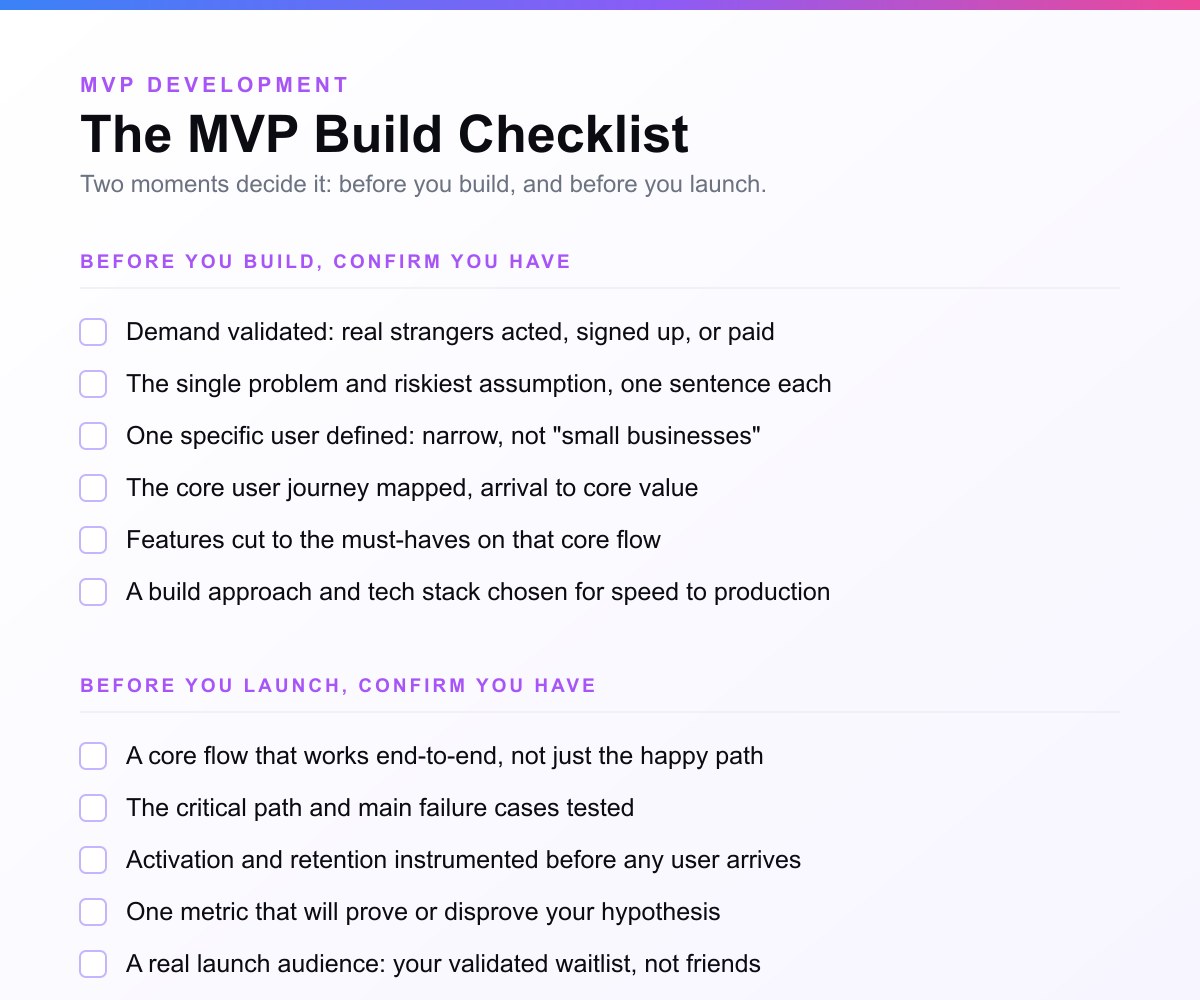
Before you build, confirm you have:
- Demand validated, real strangers acted, signed up, or paid
- The single problem and riskiest assumption written in one sentence each
- One specific user defined, narrow, not "small businesses"
- The core user journey mapped, arrival to core value
- Features cut to the must-haves on that core flow (MoSCoW + RICE)
- A build approach and tech stack chosen for speed to production
Before you launch, confirm you have:
- A core flow that works end-to-end, reliably, not just on the happy path
- The critical path and main failure cases tested
- Activation and retention instrumented before any user arrives
- One metric defined that will prove or disprove your hypothesis
- A real launch audience ready, your validated waitlist, not friends
If you cannot tick the "before you build" boxes, you are not ready to build, you are still defining, and that is cheaper to fix now than mid-sprint. If you cannot tick the "before you launch" boxes, you will launch blind and misread the results. The checklist is short on purpose: an MVP has few moving parts, and that is the point.
Common mistakes when building an MVP
1. Skipping validation. Building before confirming demand is the most expensive mistake there is. Validate first, always.
2. Building too much. The cardinal sin: an MVP that is not minimal. Ten features instead of one core flow turns weeks into months and muddies your signal. When in doubt, cut.
3. Confusing minimal with shoddy. Few features, built well, not many features, built badly. The core flow must work reliably or you will misread a quality failure as a demand failure.
4. Perfectionism and endless polish. Refining the UI for weeks instead of shipping. Done and learning beats perfect and theoretical. Launch when the core flow works, not when it is beautiful.
5. Ignoring metrics. Launching without instrumentation means flying blind. If you cannot measure activation and retention, you cannot learn, and an MVP that does not produce learning has failed at its only job.
6. Falling for scope creep. Every mid-build "let's also add…" pushes the launch and burns runway. Defend the scope; park new ideas on a v2 list.
7. Building for millions of users you don't have. Premature scaling, over-architecting, and gold-plating infrastructure for traffic that does not exist yet. Build for your first hundred users; earn the right to scale.
How the process shifts by business type
The ten steps are universal, but the emphasis changes with what you are building.
- SaaS. The cleanest fit for the standard process, one core workflow, signup, and (often) payment. The risk is usually "will they pay for this," so the MVP needs a working payment path early. See SaaS MVP development.
- Marketplaces. The hard part is liquidity, you must seed both supply and demand. The MVP often starts manual (concierge matching) before automating the exchange. Sequencing the two sides is everything; see marketplace MVP development.
- Mobile apps. Distribution and acquisition cost are the constraint, and app-store friction is real. Validate hard before committing to a native build, and consider whether a responsive web MVP can prove the idea first. See mobile app MVP development.
- AI products. The risk is whether the model output is good enough to deliver the core value, so the MVP must prove output quality on real data, not just a polished wrapper. Often a Wizard-of-Oz approach (humans behind the curtain) validates the experience before the model is production-ready. See AI MVP development.
Whatever the category, the principle holds: identify the riskiest thing about your build, demand, liquidity, distribution, or output quality, and make the MVP prove exactly that. If your idea does not fit a standard mold, a custom MVP build scopes the process to your specific risk.
The fast track: build your MVP in 3-4 weeks
The ten steps above are what we run at MVP Development, compressed into a tight, senior-built engagement. The reason founders come to us is the same reason this guide exists: the process is simple to describe and hard to execute with discipline, especially the scoping. It is easy to say "cut to one core flow"; it is hard to actually do it when it is your idea.
- We enforce the discipline. We help you validate, then scope to the one core flow that proves your idea, the hardest and most valuable part of the whole process.
- We ship in 3-4 weeks. A complete, funding-ready MVP, built by senior engineers with AI-accelerated tooling, on a clear, scoped quote you approve before we start.
- It's funding-ready by default. A deployed product with a working core flow and a live URL, the artifact that turns a pre-seed conversation into a check.
- You own production-grade code. Built to scale past the MVP, not a throwaway you rewrite after product-market fit.
The honest trade-off is scope, not quality: we build the one validated flow, not ten guesses, which is exactly what this guide tells you to do anyway. You get through the build in 28 days instead of two quarters, with the discipline already enforced.
Not ready to build yet? Our idea validation page covers the cheaper steps that come first, from a demand test you run yourself to a proof of concept.
Ready to build your MVP? Tell us where you are in this journey and we will map your next three steps together.
Related guides
Building a specific kind of product? These go deeper on the build:
- By product type: SaaS MVP, AI MVP, and Marketplace MVP.
- Design it right: MVP UX design, the core flow users actually want.
- Choose the stack: MVP tech stack, how to pick the right technologies.
- Launch it right: MVP launch strategy, how to ship it to real users and learn.
- Why it pays off: the benefits of an MVP.
- Hiring help: MVP development agency, how to choose the right build partner.
- Write the spec first: MVP requirements document, the PRD to hand your build team (+ a free fill-in template).
Frequently asked questions
How do you build an MVP step by step?
Validate demand first, then define the single problem and core hypothesis, identify one specific user and map the core journey, prioritize features down to the one core flow (using MoSCoW or RICE), choose your build approach and tech stack, design the flow as a wireframe and prototype, build it in scoped sprints, test the critical path thoroughly, launch to real users, and measure activation and retention to decide what to iterate next.
What is the first step in building an MVP?
Validation, not building. Before any code, confirm the problem is real and people will act on your solution, through customer interviews, a landing-page smoke test, or pre-sales. Building before validating is the most expensive way to learn nobody wanted it. Once demand is proven, the first build step is defining the single core problem and hypothesis your MVP will test.
How long does it take to build an MVP?
A well-scoped MVP with one core flow typically takes a few weeks to a few months, depending on complexity and build approach. No-code builds can take days to weeks; custom builds run weeks to a couple of months. The biggest factor is scope, a tightly scoped single-flow MVP is fast, while a bloated one drags on regardless of how you build it.
How much does it cost to build an MVP?
Cost tracks scope and build approach. A no-code MVP can cost very little, while a custom agency build is a larger but scoped investment, often in the low five figures for a tightly defined single flow. The cost driver is the same as the time driver: how minimal your scope is. Cutting to one core flow is the single biggest lever on both.
Can I build an MVP without coding?
Yes. No-code and low-code tools let non-technical founders build a working MVP when the core flow is standard (forms, dashboards, simple marketplaces). The trade-off is a lower ceiling on custom logic, scale, and unique UX. If your core flow is genuinely novel or technical, no-code will hit walls, and a custom build, in-house, freelance, or via an agency, becomes the faster route to a production-grade product.
Should I build or buy my MVP?
"Buy" (assemble it on no-code or off-the-shelf tools) when your core flow is standard and you mainly need to validate demand, it is the fastest, cheapest way to a real test. "Build" (custom development) when the flow is genuinely novel or technical, you need to own and scale the code, or a no-code ceiling would force a rebuild soon. The pragmatic path for most founders is to buy to validate, then build what proves out, so you neither over-engineer an unproven idea nor trap a technical product on a platform it will outgrow.
What should an MVP include?
Only the features required to deliver one core flow and test your riskiest assumption, typically user signup, the single core workflow, and (if "will they pay" is the risk) a payment path. Everything else, profiles, settings, admin dashboards, social features, is excluded. If a feature is not on the critical path from the user arriving to the user getting the core value, it does not belong in the MVP.
How many features should an MVP have?
As few as possible while still delivering real value, usually a single core flow built from a handful of must-have features. If your feature list has more than a few items, you have not scoped tightly enough. The test for every feature is "does the core flow break without it?" If no, cut it to a v2 list and build it later if the data justifies it.
What's the difference between an MVP and a prototype?
A prototype is a non-functional mock used to test design and flow; an MVP is a working product real users can actually use to get value. You often build a prototype during the design step (step 6) to catch flow problems cheaply, then build the MVP. Confusing the two, treating a clickable mock as an MVP, is a common reason founders think they have validated when they have only tested an interface.
What happens after you build an MVP?
You launch to real users, measure activation and retention, gather feedback, and iterate, refining the core flow, fixing what breaks, and deciding whether to double down, pivot, or expand. The MVP is the start of the learning, not the end of the work. Strong signals (users returning, paying, referring) tell you it is time to move past the MVP toward product-market fit and the next funding round.
Sources & references
This guide draws on lean-startup and product-development practice:
- Eric Ries, The Lean Startup, the build-measure-learn loop and the origin of the MVP
- Atlassian, Minimum Viable Product, the MVP in agile product development
- Y Combinator, How to Talk to Users, validating the problem before you build
- Shortform, The Original Dropbox MVP Explainer Video, proving demand before building the product
Timelines and cost ranges reflect Q2 2026 practice; the 3-4 week figure reflects MVP Development delivery data for tightly scoped builds.


