


TL;DR
The core benefit of an MVP is that it lets you learn whether an idea works before you spend the time and money to build it in full. A minimum viable product is the smallest version of your product that still delivers real value, and shipping one first reduces your biggest risk (building something nobody wants), saves time and money, replaces opinions with real evidence, gets you to market faster, makes you fundable, and gives you the usage data to build the right full product next.
Those benefits compound: each one feeds the next, which is why the MVP has become the default first step for serious founders and product teams. This guide breaks down the nine concrete benefits of building an MVP, who gains the most from each, the honest trade-offs and downsides, and how to actually capture the upside instead of leaving it on the table. If you want the underlying definition first, start with our guide to what an MVP is. At MVP Development we turn validated ideas into funding-ready MVPs in 21 days, more on that at the end.
Key Takeaways
- The core benefit of an MVP is learning whether an idea works before you spend the time and money to build it in full.
- It reduces your single biggest risk: building something nobody wants.
- It replaces opinions with real usage evidence, gets you to market faster, and makes you fundable.
- The nine benefits compound: each one feeds the next.
- Skipping the MVP means betting your full budget on an unvalidated guess.
More data: the sourced figures on cost, timelines, and feature waste are in our MVP statistics for 2026.
What an MVP is, in one line
An MVP (minimum viable product) is a version of a new product built with the minimum set of features needed to deliver real value to early users and learn whether the idea actually works, with the least possible effort and cost. It is a real, working product, deliberately narrow, not a prototype, a mockup, or a slide. For the full definition, types, and examples, see what is an MVP. This guide is about the other half of the question: once you understand what an MVP is, why should you build one? What do you actually get out of it?
The short answer is that an MVP changes the economics of being wrong. Most of the benefits below are variations on a single theme: you find out the truth about your idea early, while it is still cheap to act on, instead of late, after you have spent the budget.
The benefits of an MVP at a glance
| Benefit | What it gives you | Who gains most |
|---|---|---|
| Reduces risk | Proof the idea works before you bet the budget | Every founder |
| Saves time and money | A scoped build in weeks, not a full build in quarters | Bootstrapped and lean teams |
| Produces real evidence | User behavior instead of opinions and surveys | Data-driven founders, investors |
| Faster time to market | Something real in users' hands sooner | First-movers, competitive markets |
| Makes you fundable | A working product with traction beats a deck | Pre-seed and seed founders |
| Guides the roadmap | Real usage tells you what to build next | Product teams |
| Forces focus | Kills scope creep, one core flow only | First-time founders |
| Builds early users | A feedback loop and early adopters from day one | Community-led products |
| Compounds | Each benefit feeds the next | Anyone building under uncertainty |
The rest of this guide takes each of these in turn, with the reasoning behind it and how to actually realize it.
1. It reduces the single biggest risk in product
The most common reason startups fail is not that they cannot build the product, it is that they build a product nobody wants. CB Insights' analysis of startup post-mortems found that 42% of startups fail because there was no market need for what they built, the single most common cause. An MVP exists precisely to catch that failure early, while it is still cheap to fix.
When you build the full product first and then discover the market does not want it, you have spent the maximum amount of time and money to learn the most expensive possible lesson. When you build an MVP first, you spend a fraction of that to learn the same lesson, and you still have your runway, your team, and your nerve intact. This is the asymmetry at the heart of the MVP: an MVP that confirms demand costs you a little, while skipping it and building the wrong thing can cost you everything.
Framed in business terms, the MVP is a risk-management tool. It turns one large, all-at-once bet into a small, informed, sequential one. You are not betting the company on an untested assumption, you are buying cheap insurance against the most common cause of startup death. Even when the MVP "fails" by disproving your assumption, that is a win: you found out before, not after, and you can pivot or stop with most of your resources still in hand.
2. It saves time and money
A full product takes months or quarters to build and costs accordingly. A well-scoped MVP, cut to one core flow, ships in weeks for a fraction of that, because you are deliberately not building the secondary features, the edge cases, the admin tooling, and the polish that consume most of a full build's budget.
The savings are not just the absolute cost of the smaller build, they are the cost of everything you avoid building. Every feature you ship before validating demand is a feature you may have to rip out, rebuild, or abandon when reality contradicts your plan. The MVP saves you from paying to build features nobody ends up wanting, and that is a huge share of a typical build: the Standish Group's CHAOS research found that 64% of software features are "rarely" or "never" used (45% never, 19% rarely). Most of a full build's budget goes into functionality that delivers little or no value.
This is why the MVP is the natural choice for bootstrapped and capital-efficient teams. It stretches a limited budget furthest by spending it only on what has to be proven first. For a concrete sense of the numbers, see our guides on how much it costs to build an MVP and how long it takes to build an MVP. The headline: a tightly scoped, senior-built MVP can ship in as little as three to four weeks, which is a different order of investment from a full product build.
3. It replaces opinions with real evidence
Before you ship anything, every belief about your product is a hypothesis: that people have the problem, that they want your solution, that they will use it, that they will pay. Surveys, interviews, and your own conviction can hint at the answers, but they cannot confirm them, because what people say they will do and what they actually do are different things.
An MVP produces the one thing opinions cannot: real behavior from real users in a real product. This is what Eric Ries calls validated learning, progress measured not in features shipped but in things proven about your customers and market. Instead of arguing about whether a feature matters, you watch whether people use it. Instead of guessing at demand, you measure activation and retention. The MVP runs a tight build, measure, learn loop, and each turn converts an assumption into evidence.
That evidence is more honest, and more useful, than anything you can gather without a live product. It tells you not just whether people like the idea in the abstract, but whether they will adopt it in practice, which is the only signal that actually predicts a business. To make this benefit real, the MVP has to be instrumented from the start, which is why the metrics that matter, activation, retention, and engagement rather than vanity numbers, should be designed in before launch.
4. It gets you to market faster
Because an MVP is small, it ships early, and shipping early has compounding advantages. You start learning sooner, you start earning sooner, and in a competitive market, you stake a claim before someone else does. Time to market is itself a benefit, and the MVP is the fastest credible way to get a real product in front of real users.
Speed to market matters most when the window is contested. If several teams are chasing the same opportunity, the one that ships a usable product first gets the early users, the early feedback, and the head start on iteration, while the others are still building. The MVP lets you be that team without cutting corners on the core experience, because "minimum" applies to scope, not to quality.
There is also a momentum benefit. A launched product, however small, creates real signals: sign-ups, usage, sometimes revenue. Those signals energize the team, attract early advocates, and give you something concrete to talk about with customers and investors. A product that exists in the world generates opportunities that a product still in development simply cannot.
5. It makes you fundable
For founders, the MVP has become close to the price of entry for raising money. In today's market, even pre-seed investors increasingly want to see traction, a working product with early usage, not just a pitch deck and a plan. The MVP is how you produce that proof, and an MVP built for the US market is what most American investors are pattern-matching against. A deployed product with a working core flow and real users is the artifact that turns an investor conversation from "we think people want this" into "we know, here is the usage."
This benefit is concrete and well-documented in startup history. Dropbox validated demand with a simple explainer video before building its product and used the resulting waitlist surge as proof. Countless funded startups raised on the back of an MVP that showed early adoption rather than a finished product. A working MVP with traction is far more fundable than the most polished deck, because it de-risks the investment in exactly the way investors care about.
The MVP also signals something investors weigh heavily: that the founders can ship. A team that has taken an idea to a live, working product has demonstrated execution, not just vision. For exactly what investors assess in an MVP and the metrics that move a round, see how investors evaluate an MVP. We go deeper on where this sits in the startup journey in the MVP stage of a startup, and you can see the pattern across real companies in our MVP examples.
Fundable is a specific bar, not a feeling. The metrics investors read, the numbers that move a pre-seed or seed round and the ones they discount as vanity, are in our guide to what investors want in an MVP. This section makes the case that an MVP gets you there; that guide is the checklist for when you are in the room.
6. It guides your roadmap with real usage
One of the most underrated benefits of an MVP is what it tells you after launch. Once real users are in the product, their behavior becomes the most reliable guide to what you should build next. Instead of planning the full roadmap on assumptions, you let actual usage reveal what matters, which features get used, where people drop off, what they ask for, what they ignore.
This means the full product you eventually build is the right one, shaped by evidence rather than guesswork. Founders who skip the MVP and build their whole roadmap up front frequently discover that half of it was wrong, that the features they were sure mattered go unused, while the thing users actually wanted was never on the plan. The MVP catches that before you have built the wrong roadmap, not after.
In agile terms, the MVP is the first increment that lets the build, measure, learn loop start, and every increment after it is prioritized by what the previous one taught you. That is the core of the MVP in agile: responding to real change over following a fixed plan. The roadmap stops being a document you defend and becomes a hypothesis you keep testing.
7. It forces focus and kills scope creep
The discipline an MVP imposes is a benefit in its own right. To build an MVP, you have to answer a hard question: what is the one core flow that proves this idea? Everything else gets deferred. That forced prioritization is uncomfortable, and it is exactly what most early teams need, because the instinct to build everything at once is what sinks so many first products.
Scope creep is the quiet killer of timelines and budgets. Every "while we're at it, let's also add…" pushes the launch further out and the cost higher, often for features that turn out not to matter. The MVP gives you a principled way to say no: if it is not essential to proving the core hypothesis, it is not in the MVP. That clarity keeps the build fast, the budget contained, and the team aligned on the one thing that has to work.
This focus also produces a better product, not a worse one. A product that does one thing well beats a product that does ten things adequately, especially at the start, when you are trying to win over early users who have no patience for bloat. The MVP's constraint, do the core flow excellently and nothing else yet, tends to yield exactly the kind of sharp, usable first product that early adopters respond to.
8. It builds a relationship with real users early
Launching an MVP puts you in contact with real users far sooner than a full build would, and those early users are disproportionately valuable. They are the people who adopted your product when it was minimal, which means they care about the problem you are solving. Their feedback is candid, their engagement is real, and many of them become advocates, the first members of a community around your product.
This early relationship is a benefit you cannot buy later. Early adopters tell you what is confusing, what is missing, and what is genuinely useful, in language and detail no survey will ever capture. They help you find product-market fit by reacting to a real product rather than a concept. And because they were there first, they often feel ownership, referring others, tolerating rough edges, and giving you the runway to improve.
A full-product launch, by contrast, delays all of this. You spend months building in isolation, then unveil something to users you have never actually listened to. The MVP inverts that: you get users early, listen continuously, and shape the product around them. The result is a product that fits the market because the market helped build it.
9. The benefits compound
The single most important thing to understand about the benefits of an MVP is that they are not independent, they reinforce each other. Reducing risk saves money. Saving money extends runway. Real evidence makes you fundable. Funding buys time to build the right roadmap. Early users sharpen that roadmap further. Each benefit feeds the next, which is why building an MVP is not just a cost-saving tactic but a fundamentally better way to build under uncertainty.
The meta-benefit underneath all nine is a shift in posture: from expensive certainty-seeking ("let's build everything so we're sure it's right") to cheap learning ("let's test the riskiest thing first and let reality guide us"). That shift, from guessing to learning, is the entire reason the practice exists, and it is what separates founders who build the right product from those who build a product and hope.
The cost of skipping the MVP
The benefits of an MVP are easiest to see in their absence, in what happens to teams that skip it. The most common path to failure runs like this: a founder is certain the idea will work, spends six months and the bulk of the budget building the full product, launches to silence, and only then discovers the market did not want it. Every benefit above is now a cost paid in reverse, the risk that was never tested, the money spent building features nobody uses, the time lost, the evidence that arrived too late to act on.
Skipping the MVP does not remove the uncertainty, it just defers the moment you confront it to the most expensive possible point. The questions an MVP answers in weeks for a fraction of the budget, do people want this? will they use it? will they pay?, do not go away when you ignore them. They get answered anyway, by the market, after you have committed everything, when the answer is far more costly to act on.
There is also an opportunity cost. The months spent building the wrong full product are months not spent learning, iterating, or pursuing a better version of the idea. A team that builds an MVP first and learns its assumption was wrong can pivot in week four with most of its runway intact. A team that skips the MVP learns the same thing in month nine, with the runway gone and the team demoralized. Same lesson, vastly different price. This asymmetry, cheap to learn early, ruinous to learn late, is the strongest argument for building an MVP, and it is simply the flip side of every benefit in this guide.
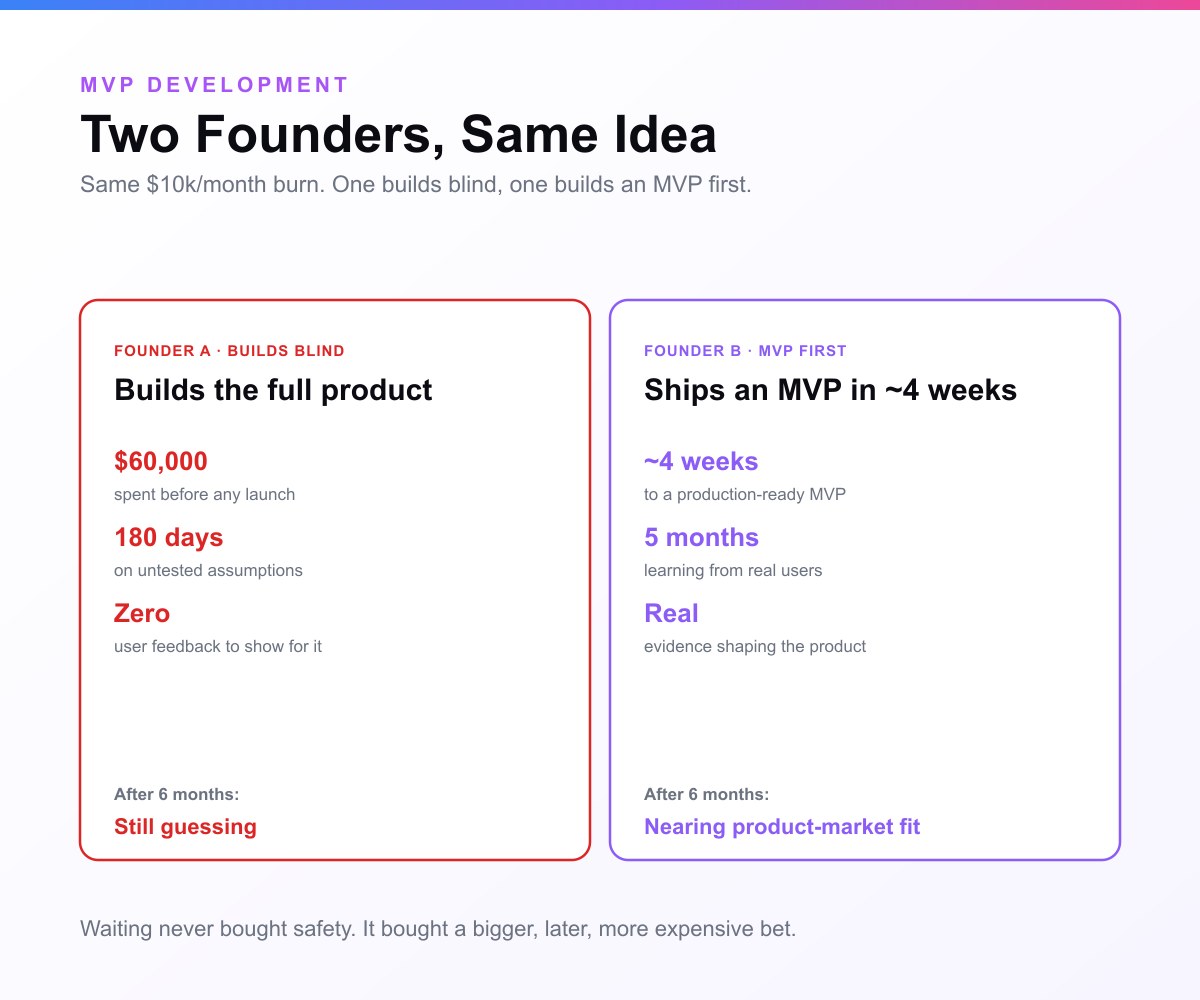
Put real numbers on it, and the hidden cost of not building an MVP becomes obvious. Picture two founders chasing the same idea, each burning $10,000 a month. Founder A spends six months building the full product before launch, that's $60,000 and 180 days spent on untested assumptions, with zero user feedback to show for it. Founder B ships a production-ready MVP in about four weeks for a fraction of that, then spends the next five months learning from real users and steering toward what they actually want. Even with an equally good idea, Founder B reaches product-market fit sooner, on less capital, with a product shaped by evidence, while Founder A is still guessing. That gap is the real cost of delay: waiting never bought safety, it bought a bigger, later, more expensive bet. The instinct that more planning is always safer is, at the MVP stage, usually backwards, the safest thing you can do with an unproven idea is test it cheaply, now.
How an MVP's benefits compare to the alternatives
It also helps to see the benefits relative to the other ways founders try to de-risk a new product. Each alternative captures some of the MVP's benefits but trades away others.
| Approach | What it gives you | What it misses |
|---|---|---|
| Build the full product | A complete, polished product | Every MVP benefit, maximum risk, time, and cost before any evidence |
| A prototype only | Cheap design and flow feedback | No real usage, no demand proof, it is not a working product |
| A no-code tool | Speed and low cost | Captures most MVP benefits well, may hit limits at scale |
| A minimum viable product | Risk reduction, evidence, speed, fundability, owned code | The deliberately deferred features (by design) |
A prototype is useful, but it tests design, not demand, so it cannot give you the evidence, fundability, or usage-driven roadmap benefits, because no one is actually using a real product. Building the full product gives you everything except the point: it spends the maximum before learning anything. A no-code MVP is often an excellent way to capture the MVP's benefits cheaply, and the right choice when your core flow fits what no-code tools can do well.
The MVP sits at the efficient frontier: it captures the benefits that actually de-risk a business, demand evidence, speed to market, fundability, and a real user relationship, at the lowest cost that still produces a genuine, usable product. That balance is exactly why it became the default first step.
The benefits of an MVP by who you are
The benefits land differently depending on your role. Here is who gains most from what.
- First-time founders gain the most from focus and risk reduction. The MVP imposes the discipline that experience would otherwise have to teach the hard way, and it caps the downside of an unproven idea.
- Bootstrapped founders gain the most from time and money saved. With no outside capital, spending only on what must be proven first is the difference between reaching validation and running out of runway.
- Founders raising capital gain the most from fundability. A working MVP with traction is the artifact that moves a pre-seed or seed conversation forward, often the single biggest lever on whether a round closes.
- Product teams inside larger companies gain the most from evidence and roadmap guidance. The MVP lets them test a new line or feature with minimal risk and bring data, not opinions, to the prioritization table.
- Engineering teams gain from scope clarity. A defined core flow means a clean, buildable spec instead of an ever-shifting target, which is faster and more satisfying to build.
The common thread: anyone building something genuinely uncertain benefits, because the MVP's job is to resolve uncertainty cheaply, and uncertainty is the one thing every new product shares.
The honest trade-offs: when the benefits don't apply
An honest guide has to cover the other side. The MVP is not free of cost or risk, and there are situations where its benefits are weaker or where it can be done badly. Knowing these keeps you from misapplying the approach.
A bad MVP can teach you the wrong lesson. If you cut too far and ship something that does not actually work, users churn on the broken experience, not on the idea, and you misread a quality failure as a demand failure. The benefit of "real evidence" only holds if the MVP is genuinely viable. Minimal scope, viable quality, always.
Some markets cannot ship a bare-bones product. In regulated spaces like parts of healthcare or finance, a minimal version may not be able to credibly or legally launch. The lighter validation methods (landing pages, concierge tests) still apply, but a full software MVP may need more than the absolute minimum to be testable at all.
An MVP can dent a strong existing brand. For an established company with a premium reputation, releasing something visibly unfinished under the main brand can carry a cost. The usual fix is to test under a separate name or with a limited audience, but the trade-off is real.
The discipline is hard and easy to fake. Many "MVPs" are not minimal at all, they are full builds wearing the name, which forfeits the time and cost benefits entirely. The benefits accrue only if you actually keep the scope minimal, which is the hardest part to do.
None of these negate the benefits for the vast majority of new products. They are reasons to apply the MVP well, not reasons to skip it. The asymmetry still favors building one: the cost of a good MVP is small, and the cost of building the wrong full product is enormous.
How to actually capture these benefits
The benefits above are real, but they are not automatic. You realize them only if the MVP is done with discipline. A few practices separate an MVP that delivers the upside from one that wastes it.
Validate before you build. The fastest, cheapest learning often happens before any code, through interviews, landing pages, and pre-sales. Confirming demand first is what makes the later build a safe bet. Our MVP validation guide covers the full process.
Cut to one core flow. The time, cost, and focus benefits all depend on genuinely minimal scope. Define the single riskiest hypothesis and build only the flow that tests it. Everything else waits. The full method is in how to build an MVP.
Keep the quality viable. Minimal in scope, never in quality. The core flow must work reliably, or the evidence you gather is corrupted by a quality failure masquerading as a demand failure.
Instrument it from day one. The "real evidence" benefit only exists if you can measure behavior. Decide which metrics matter before launch, and build the product to capture them.
Choose the lightest build that answers your question. Sometimes that is a no-code MVP; sometimes it is a single-feature custom build. Picking the right format is how you keep speed and cost down without sacrificing the learning.
Done this way, every benefit in this guide is on the table. Done carelessly, an MVP becomes a half-finished product that delivers none of them, which is why the how matters as much as the why.
Real examples: the benefits in action
The clearest way to see the benefits is in companies that built MVPs first. Each captured a specific benefit before scaling.
- Dropbox captured evidence and fundability: a three-minute explainer video proved demand (the waitlist jumped from around 5,000 to 75,000 overnight) before the product was built.
- Airbnb captured risk reduction: renting air mattresses in the founders' own apartment tested the core hypothesis (would strangers pay to stay in someone's home?) for almost nothing.
- Zappos captured time and money saved: selling shoes by photographing local stock with no inventory or warehouse proved demand before building any infrastructure.
- Uber captured focus: one feature (request a black car) in one city, nothing else, proved the core idea before it became a global platform.
The pattern across all of them: each answered its riskiest question with the least possible product, captured a specific benefit, and only scaled once the proof was in. The full set is in our MVP examples guide.
Build an MVP that actually delivers these benefits
Knowing the benefits and capturing them are different things. The benefits accrue only when the MVP is genuinely minimal, viable in quality, validated, and measured, which is the discipline most teams find hardest. That is exactly what we do at MVP Development.
- We help you scope to the one core flow. We pressure-test the idea and cut it to the single flow that proves it, the hardest and most valuable part, so the time, cost, and focus benefits are real.
- We ship in 21 days. A complete, funding-ready MVP built by senior engineers on a clear, scoped quote you approve before we start.
- It's funding-ready by default. A deployed product with a working core flow and a live URL, the artifact that turns a pre-seed conversation into a check.
- You own production-grade code. Built to scale past the MVP and guided by real usage, not a throwaway prototype.
Explore our MVP development services or go straight to a custom MVP build.
Have an idea worth proving? Tell us what you are weighing up and we will show you what an MVP would actually buy you.
Related guides
- What is an MVP?, the full definition, types, and examples
- How to build an MVP, the step-by-step process
- MVP validation, confirming demand before you build
- How much does it cost to build an MVP?
- The MVP stage of a startup, where the MVP fits and what comes next
Frequently asked questions
What are the main benefits of an MVP?
The main benefits of an MVP are that it reduces risk (you learn whether the idea works before betting the full budget), saves time and money (a scoped build ships in weeks for a fraction of the full cost), produces real evidence from actual users, gets you to market faster, makes you more fundable, and gives you the usage data to build the right full product next. These benefits compound, each one reinforces the others, which is why the MVP has become the default first step for serious founders.
Why should you build an MVP?
You should build an MVP because it is the cheapest, fastest way to find out whether people actually want your product before you commit the time and money to build it in full. Most new products fail not from bad execution but from building something nobody wanted, and the MVP catches that risk early, while it is still cheap to act on. It replaces guessing with evidence, and it produces the working product with traction that investors and users increasingly expect.
What are the advantages of a minimum viable product?
The advantages of a minimum viable product are lower risk, lower cost, faster time to market, real validated learning instead of opinions, stronger fundability, an evidence-based roadmap, sharper focus, and an early relationship with real users. The underlying advantage is economic: an MVP changes the cost of being wrong, you find out the truth about your idea early and cheaply rather than late and expensively.
Are there any disadvantages or downsides to an MVP?
Yes, though they are reasons to do the MVP well rather than skip it. A poorly scoped MVP can ship something that does not work, leading you to misread a quality failure as a lack of demand. Some regulated markets cannot launch a bare-bones product. Releasing an unfinished product under a strong existing brand can carry reputational cost. And many "MVPs" are not actually minimal, which forfeits the time and cost benefits. Applied with discipline, minimal scope but viable quality, validated and measured, these downsides are avoidable.
What is the single biggest benefit of an MVP?
The single biggest benefit is risk reduction: you learn whether the idea works before you spend the time and money to build it in full. Because the most common cause of startup failure is building something nobody wants, an MVP that tests demand first is the cheapest insurance a founder can buy against the most expensive mistake in product.
Do MVPs help with fundraising?
Yes. A working MVP with early traction is significantly more fundable than a pitch deck alone. In today's market, even pre-seed investors increasingly want to see a real product with usage, not just a plan. The MVP produces that proof, and it also signals that the founding team can execute, which investors weigh heavily. Many funded startups raised on the strength of an MVP that demonstrated adoption before the full product existed.
How does an MVP actually save money?
An MVP saves money in two ways. The obvious one is the smaller build: a scoped MVP costs a fraction of a full product because you only build one core flow. The larger, less visible saving is everything you avoid building, every feature you would have shipped on a guess and then had to rebuild or abandon once real usage contradicted the plan. By validating demand before committing the full budget, the MVP prevents the most expensive mistake in product: spending months building something nobody wanted. See how much it costs to build an MVP for the numbers.
When is an MVP not worth building?
An MVP is less necessary when there is little real uncertainty, a well-understood product in an already-validated market, or a trivial feature with minimal downside. In some regulated spaces a bare-bones version cannot legally or credibly ship, so you may need more than a minimal product to test at all. And an established premium brand may not want to release something visibly unfinished under its main name. In nearly every other case, where you genuinely do not know whether people want what you are about to build, the asymmetry favors building one: an MVP costs little, and building the wrong full product costs everything.
Sources & references
This guide draws on established lean-startup practice and startup-failure research:
- Eric Ries, The Lean Startup, validated learning and the build-measure-learn loop behind the MVP's benefits
- Atlassian, Minimum Viable Product, the MVP as the first increment that starts the learning process
- CB Insights, Top Reasons Startups Fail, "no market need" as a leading cause of failure, the risk the MVP exists to reduce
- Minimum Viable Product, Wikipedia, the concept's origin and evolution
The 21-day figure reflects MVP Development delivery data for tightly scoped builds.


