


TL;DR
A landing page MVP is a single web page that describes your product as if it already exists and asks visitors to take one action: sign up, join a waitlist, or click to buy. It measures real demand before you write a line of product code. You are not testing whether you can build the thing. You are testing whether enough people want it badly enough to act. The signal is behavioral, a click or an email, not an opinion in a survey, which is why it is one of the cleanest, cheapest ways to validate an idea.
Where it fits: the landing page MVP sits in the demand-validation family, alongside the fake door and crowdfunding approaches. It answers one question, "do people want this?", and it answers it in days. Once the page proves demand, you build the real product. At MVP Development we help founders read that signal honestly and then ship the validated product, usually a single-feature MVP, funding-ready in 3 to 4 weeks. This guide is the full playbook: the anatomy, the steps, the tools, the benchmarks, and the famous examples. It is one of the eight types of MVP in our wider map.
Key Takeaways
- A landing page MVP is a single page that describes your product as if it exists and asks visitors to take one action.
- It measures real demand before you write a line of product code.
- The signal is behavioral, a click or an email, not an opinion in a survey.
- It sits in the demand-validation family alongside the fake door and crowdfunding approaches.
- It answers one question, "do people want this?", and it answers it in days.
What is a landing page MVP?
A landing page MVP is a minimum viable product where the "product" is a single, focused web page. The page presents a clear value proposition, shows what the product would do, and offers one call to action that captures intent: an email signup, a waitlist join, a "notify me," or a pricing button that leads to a checkout or a "coming soon."
The crucial idea is that the page behaves as if the product is real. Visitors are not told "we are thinking about building this, what do you think?" They are shown a finished-looking promise and invited to act on it. When they sign up or click to buy, that action is a far stronger demand signal than any survey response, because the person has spent something real, their attention, their email address, sometimes their money, to get access to a product they believe exists.
This is why a landing page MVP is often called a smoke test: where there is smoke (clicks, signups, payments), there is probably fire (real demand). You learn whether the market wants your idea before you spend weeks or months building it. If nobody signs up, you have saved yourself an expensive build for a product nobody wanted. If signups pour in, you have a validated concept and, usefully, a list of early users to talk to and launch to.
A landing page MVP does not validate whether your product works, whether users will stay, or whether the unit economics make sense. It validates one thing extremely well: that the promise resonates enough to make strangers act. That focus is its strength. It is the fastest way to kill a bad idea or to find the confidence (and the early list) to build a good one.
Landing page MVP vs the other demand-validation MVPs
The landing page MVP belongs to the demand-validation bucket, which asks "do enough people actually want this?" It is easy to confuse with its siblings, so here is how they differ.
| MVP type | What it is | What the signal proves | Commitment asked |
|---|---|---|---|
| Landing page | A page that pitches the whole product and asks for a signup or click | The pitch resonates and people want in | Low (an email or a click) |
| Fake door | A button or feature inside an existing flow that leads to a "coming soon" | People would use a specific feature | Low (a click on intent) |
| Crowdfunding | A campaign on Kickstarter or similar asking for money before the product exists | People will pay real money upfront | High (a pre-order) |
The fake door MVP differs in scope and placement: it tests demand for one specific feature by putting a fake entry point inside a product (or an ad) that people already use, then measuring who clicks the door that leads nowhere yet. A landing page MVP pitches the entire product on a dedicated page. We cover that distinction in depth in the types of MVP guide, and the fake door gets its own deep dive.
The crowdfunding MVP raises the commitment level dramatically: instead of an email, it asks for money. That makes its signal stronger (people paying is the strongest validation there is) but also slower and more demanding to run.
There is also overlap with the manual validation types. A concierge MVP and a Wizard of Oz MVP test whether you can deliver and whether people will use an automated-looking product, by doing the work by hand. A landing page MVP often comes first: prove people want it, then run a concierge or Wizard of Oz test to learn how to deliver it, then build. They stack neatly in sequence.
The four kinds of landing page MVP, by the commitment you ask for
“Landing page MVP” covers four different tests, and they are not interchangeable. What separates them is the size of the ask. A bigger ask converts fewer people and proves more; a smaller ask converts more people and proves less. Pick the ask that matches how much you already know.
| Type | What you ask for | What a signup proves | Use it when | The trap |
|---|---|---|---|---|
| Waitlist | An email address | The pitch is understood and mildly wanted | You have no idea yet whether anyone cares | Emails are nearly free to give. A long waitlist is not demand, it is curiosity with a form |
| Fake-door CTA | A click on “Start”, “Buy” or “Download” that leads to “not yet” | People intended to use it, not just hear about it | You want intent, not interest, and you can tolerate a little annoyance | Tell people at the “not yet” page what happened, or the same visitors will never trust the real launch |
| Pricing page | A plan choice, then an email | People will pay, and roughly how much | The idea is validated and the open question is the business model | Plans need real numbers on them. A page with “Contact us” on every tier tests nothing |
| Pre-order or deposit | Money, refundable | People want it enough to pay before it exists | You are about to spend real budget building and want the strongest signal a page can give | Refund every cent if you do not ship on the terms you promised, and say so up front |
The useful pattern is to escalate. Start with the waitlist if you genuinely know nothing, but do not stop there: once the waitlist converts, replace the form with a pricing page, then with a deposit. Each step filters out the people who were only curious, and the number that survives to the deposit is the one an investor will take seriously. Buffer did exactly this, moving from a two-page “which plan?” test to real payments within weeks; the pre-sales MVP is the deposit step on its own, and the fake door is the second row applied to a single feature rather than a whole product.
One rule across all four: the ask has to sit on a page that pitches the real product at its real price. Softening the offer to lift conversion is the fastest way to validate something you were never going to build.
When to use a landing page MVP
A landing page MVP earns its place at the very start of an idea, when the most expensive risk is building something nobody wants. Use it when:
- You have a clear value proposition but no proof of demand. You can describe the product in one sentence and you want to know if that sentence makes strangers act.
- The build is non-trivial. If the product would take weeks or months and real money to build, a few days on a landing page is cheap insurance.
- You want an early-adopter list. Even a "failed" test gives you a list of interested people. A successful one gives you a launch audience and a set of users to interview.
- You are choosing between several ideas. Run a page for each, send comparable traffic, and let the conversion rates pick the winner. This is one of the fastest ways to prioritize a roadmap or a pivot.
- You are pre-fundraising. A landing page with real signups is concrete traction you can show investors, far more persuasive than a deck full of assumptions.
It is the wrong tool when the risk is elsewhere. If you already know people want the product (you have a waitlist, paying competitors, or an underserved market screaming for it) and the open question is whether you can build or deliver it, skip the landing page and run a Wizard of Oz or concierge test, or just build a single-feature MVP. And if your audience is tiny and high-value (say, ten enterprise buyers), a landing page is the wrong instrument: go talk to them directly. Landing pages shine when you can drive enough traffic to read a statistically meaningful signal.
Anatomy of a high-converting landing page MVP
A landing page MVP is not a homepage. It has exactly one job, so every element should push toward the single action. The pages that validate cleanly tend to share the same anatomy.
- A specific, benefit-led headline. Not "The future of productivity" but a concrete promise. Robinhood's page led with "$0 commission stock trading. Stop paying up to $10 for every trade." It names the benefit and the pain in one breath. Vague headlines produce vague signals.
- A subheadline that adds the how. One line that explains how the promise is delivered, enough to make it believable without burying the visitor in detail.
- A hero visual or short demo. A clean mockup, a product shot, or a short video that makes the promise feel real. Dropbox famously used a demo video here because the product itself was hard to show.
- Two or three value propositions. The reasons to care, each a benefit, not a feature. Keep them scannable.
- A single, unmissable call to action. One CTA, repeated. "Get early access," "Join the waitlist," "See pricing." Multiple competing CTAs split your signal and muddy the read.
- A friction-right signup. Usually just an email field. The less you ask, the higher the conversion, but a slightly higher-friction step (like choosing a plan) can produce a stronger, more qualified signal. More on that trade-off below.
- Light social proof, if you have it. "Join 2,000 founders on the waitlist," a logo, a testimonial. It lifts conversion, but do not fake it.
- No navigation, no escape hatches. A landing page MVP should not link out to a blog, an about page, or social profiles. Every exit is a lost signal. One page, one goal.
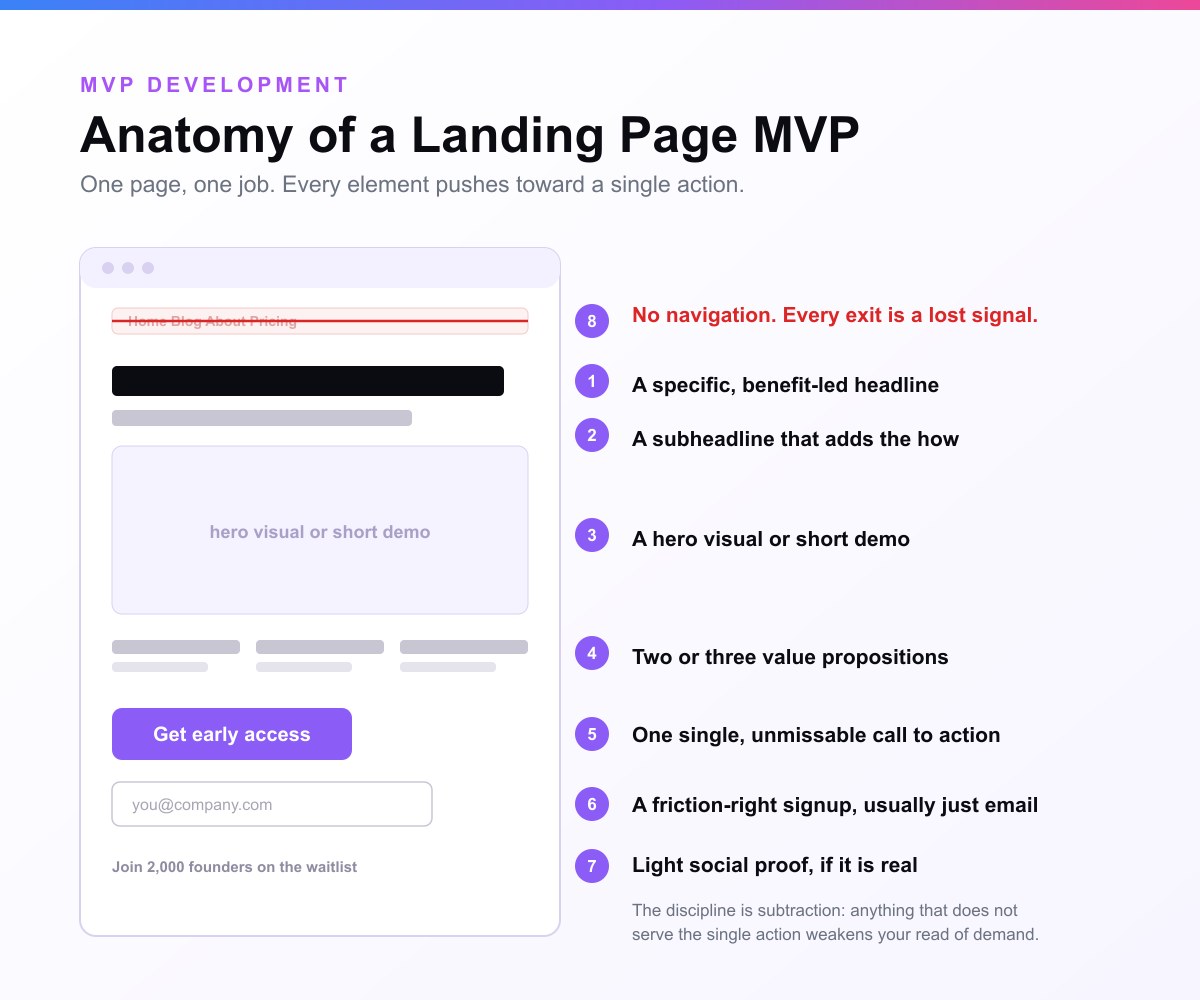
The discipline here is subtraction. Every element that does not serve the single action is noise that weakens your read of demand. When the page proves demand, that validated promise is what a custom MVP build turns into a real product.
How to build a landing page MVP: a step-by-step playbook
You can build and launch a landing page MVP in a day or two with no engineering. Here is the repeatable process.
Step 1: Write the promise first
Before you touch a page builder, write the headline and subheadline. If you cannot describe the product as a sharp, believable promise in two sentences, the problem is the idea, not the page. This copy is the actual thing you are testing. The design is just the delivery mechanism.
Step 2: Define the single action and the signal it sends
Decide exactly what a visitor does and what that action proves. An email signup proves curiosity. A waitlist join with a referral mechanic proves curiosity plus willingness to share. Clicking a specific paid plan proves willingness to pay. Pick the action whose signal answers your actual question, then design the whole page around it.
Step 3: Build the page with a no-code tool
Use a landing page builder (Carrd, Framer, Webflow, Unbounce) so you can ship in hours, not days. Keep it to one screen of scrolling. Resist the urge to add features, FAQs, and a footer full of links. Match the visual quality to the promise: a fintech or B2B product needs to look credible, so a polished template matters.
Step 4: Wire up capture and analytics
Connect the form to an email tool (Mailchimp, ConvertKit, a waitlist service) so you collect the list. Add lightweight analytics (Plausible, PostHog, or GA4) so you can measure visitors, conversion rate, and where drop-off happens. Without analytics, you have a page but no experiment.
Step 5: Drive real, representative traffic
A landing page without traffic proves nothing. Send a few hundred to a couple of thousand visitors from a source that resembles your real market: targeted ads, relevant communities, a launch post, a niche newsletter, or a warm list. Note the source, because cold traffic and warm traffic convert very differently, and you need to know which you measured.
Step 6: Read the conversion rate against a benchmark
Compare your signup rate to realistic benchmarks (covered in the next section) and to your own threshold for "worth building." A 1 percent signup rate from a warm audience is a red flag. A 20 percent rate is a strong green light. The number only means something relative to traffic quality and the commitment you asked for.
Step 7: Talk to the people who signed up
The list is half the value. Email the signups, ask what made them act, what they expected, and what they would pay. These conversations turn a yes/no demand signal into a product spec. They are also your warm launch audience when the real product ships.
The landing page MVP toolkit
You can run a complete landing page MVP without a developer. A typical stack:
- Page builders: Carrd (cheapest and fastest for a single page), Framer and Webflow (more design control, still no code), Unbounce and Instapage (built for conversion testing), Typedream or Softr (no-code with logic).
- Email and list capture: Mailchimp, ConvertKit, or Beehiiv to collect and nurture signups.
- Waitlist with referrals: getwaitlist, Prefinery, KickoffLabs, or Viral Loops add the referral leaderboard mechanic that powered Robinhood's pre-launch growth.
- Forms and surveys: Typeform or Tally for a richer signup that captures a little qualifying data.
- Analytics: Plausible or PostHog for clean, privacy-friendly conversion tracking, or GA4 if you already use it.
- Payment intent: a Stripe payment link or a "pre-order" button lets you test willingness to pay without building a real checkout.
The point of the toolkit is speed. None of it requires engineering, which is exactly why a landing page MVP can be live by the end of the week and why it is wasteful to build a custom page just to run the test.
What to measure, and what "validated" actually looks like
The headline metric is conversion rate: of the people who landed, how many took the action. But a raw number is meaningless without context, so anchor it to benchmarks and to the commitment you asked for.
Useful benchmarks, each with its source:
- The median landing page converts at 6.6 percent across industries, according to Unbounce’s 2024 Conversion Benchmark Report, which covers 41,000 landing pages, 464 million visitors and 57 million conversions from Q4 2024.
- SaaS landing pages run lower, at a median of 3.8 percent in the same report, the lowest of any industry it tracks. For B2B SaaS by page type, daydream (April 2026) puts self-serve signup pages at 4 to 10 percent and demo-request pages at 1.5 to 4 percent.
- Waitlist pages convert higher, because the ask is light. Waitlister, which sells waitlist software, says the median waitlist in its own data converts about 11 percent of visitors (June 2026). It is a vendor’s figure from its own customers, so treat it as a guide rather than a benchmark.
- Traffic source dominates the result. Visitors from a relevant community or your own list convert far better than cold ad traffic. We found no published measurement of the gap that we would trust, so we do not put a number on it.
Robinhood's pre-launch page is often said to have converted above 50 percent. Every page we found repeating that figure is a waitlist vendor, and none gives a source, so treat it as a story rather than a benchmark. What the archived page does show is one sharp promise and one email field, covered in the archive check further down this page.
Three principles keep your read honest:
- Match the metric to the commitment. A 30 percent email signup rate is weaker evidence than a 5 percent rate of people clicking a real paid plan. The higher the commitment in the action, the stronger the validation, even at lower percentages. Buffer's genius was inserting a pricing step so that a click meant "I would pay," not just "I am curious."
- Get enough sample. A handful of visitors tells you nothing. Aim for at least a few hundred, ideally a thousand or more, before you trust the rate. Small samples swing wildly.
- Set the threshold before you launch. Decide in advance what conversion rate would make you build, pause, or pivot. Deciding after you see the number is how founders rationalize a weak result into a green light.
Real landing page MVP examples
The pattern is best understood through the companies that used it before they had a product.
Buffer
Buffer is the textbook landing page MVP. Founder Joel Gascoigne wanted to know if anyone would pay to schedule social posts, so before building anything he made a simple two-page site. The first page explained what Buffer did, written as if it already existed, with a "Plans and Pricing" button. Clicking it led to a pricing page. When a visitor chose a plan, they hit a short message: Buffer was not quite ready, leave your email to be notified. That extra pricing step was the masterstroke: it tested not just curiosity but willingness to pay, and the plan they clicked revealed their price sensitivity. The signal was strong enough that Joel had his first paying customer within four days of tweeting the link, and Buffer launched roughly seven weeks later. He validated demand and pricing before writing product code. (We tell the full story in our Buffer MVP case study.)
Dropbox
Dropbox could not easily show its product in a static page, and the working version was hard to build, so Drew Houston recorded a short demo video that walked through how seamless file sync would feel, and put it on a landing page with a request-beta email signup. The video was the "product" in the landing page MVP: it made the promise vivid and believable. The beta waitlist reportedly jumped from around 5,000 to 75,000 people overnight. That signal told Dropbox the demand was real and gave them a launch list, all before the product was finished.
Robinhood
Robinhood launched with no product, just a landing page and a referral waitlist. The page made one sharp promise, commission-free stock trading, with a single email field and a "Get Early Access" button. A referral leaderboard rewarded people for sharing, and each signup brought in roughly three more. The page converted above 50 percent, and Robinhood amassed close to a million people on the waitlist before launch, with no paid ads and no real product. It is the clearest demonstration that a landing page MVP can validate demand and build a launch audience at the same time.
Smaller, everyday examples
Most landing page MVPs are not famous. A solo founder runs a Carrd page describing a niche tool, spends a small budget on targeted ads, and watches whether the signup rate clears their threshold. An agency tests three positioning angles for the same product with three pages to see which promise lands. A B2B team puts up a page for a feature they are considering and gates a "request access" button. The mechanics are identical to Buffer's: a believable promise, a single action, a measured signal.
Landing page MVPs and AI in 2026
AI has made the landing page MVP faster to run and, paradoxically, more important to run well. Page builders now generate copy, layout, and even imagery from a prompt, so you can stand up a credible page in under an hour and spin up variants per audience for almost no effort. That lowers the cost of testing several ideas at once.
It also raises the noise floor. When anyone can launch a slick AI-generated page in minutes, slickness stops being a signal and the promise has to do the real work. The clarity of your value proposition matters more than ever, because polish is now free and undifferentiating. And for AI products specifically, the landing page MVP pairs naturally with a Wizard of Oz follow-up: prove people want the AI outcome with a page, then deliver that outcome by hand (often with AI assistance) before you invest in building the model. The page proves demand; the Wizard of Oz test proves you can deliver it.
Pros and cons of the landing page MVP
Pros:
- Fast and cheap. Live in a day or two with no engineering, for the cost of a page builder and some traffic.
- Behavioral, not hypothetical. A click or an email is real intent, far stronger than survey opinions.
- Builds a launch list. Even a negative result leaves you with interested people to interview; a positive one gives you an audience.
- De-risks the build. It can kill a bad idea before you spend weeks on it, or give you the confidence and traction to commit.
- Investor-ready evidence. Real signups are concrete traction for a fundraise.
Cons:
- It only tests the pitch, not the product. People wanting your promise does not mean they will use, stay, or pay long term.
- Signal quality depends on traffic. Bad or unrepresentative traffic produces a misleading number.
- Low-commitment actions can mislead. An email is cheap to give; many signups never convert to users. Stronger asks give truer signals.
- It can be gamed by hype. A viral launch can inflate signups for a product that has no durable demand.
- No insight into delivery. It tells you nothing about how to build or operate the thing, which is why it pairs with the manual-validation types.
Common mistakes founders make
- Building a homepage instead of a landing page. Navigation, multiple CTAs, and a footer of links scatter the signal. One page, one action.
- A vague promise. "Reimagine your workflow" tells you nothing when people do not sign up. A specific promise produces a specific, readable result.
- Measuring the wrong action. A high email signup rate feels great but proves only curiosity. If your real question is willingness to pay, make people click a price.
- Too little traffic, or the wrong traffic. Reading a conversion rate off fifty visitors, or off friends and family, is self-deception. Use enough representative traffic.
- No predefined threshold. Without a number you committed to in advance, any result becomes "promising." Decide what success looks like before you look.
- Faking social proof. Invented testimonials or "10,000 users" badges corrupt the experiment and your credibility. If you do not have proof, do not fake it.
- Stopping at the number. The signups are a list of warm prospects. Founders who never email them throw away half the value of the test.
Signs your landing page MVP is working (and when to stop)
Your page is validating demand when the conversion rate clears your predefined threshold against realistic benchmarks, when the signal holds across more than one traffic source (so it is not a fluke of one channel), and when the people who sign up engage further: they reply to your emails, answer questions, and ask when they can get in. Qualitative pull, people chasing you, is often a stronger signal than the raw percentage.
Stop and rethink when the rate stays low across good, representative traffic, when signups go silent the moment you try to talk to them, or when the only conversions come from a hype spike that does not repeat. A landing page MVP is a quick experiment, not a project to nurse for months. If a sharp promise to a relevant audience cannot clear a reasonable bar in a couple of well-run iterations, that is itself a finding: the demand you imagined may not be there, and it is cheaper to learn that now.
How to graduate from a landing page to a real product
A validated landing page is a starting line, not a finish line. The path forward usually runs in this order.
- Mine the list. Interview the people who signed up. Turn their words into a precise spec of the one thing they actually want.
- Decide what to build first. In almost every case, the answer is the single core feature that delivers the promise the page made, not the full vision. That is a single-feature MVP.
- Consider a manual bridge. If the build is meaningful, run a concierge or Wizard of Oz test first to learn exactly how to deliver before you automate.
- Build the real thing, scoped tightly. Ship the validated core to your waitlist, then iterate on real usage. This is where the landing page audience becomes your first cohort of users.
The discipline is to keep building the smallest thing that honors the promise, then let real usage, not assumptions, drive what comes next.
A worked example
Imagine a founder with an idea for an app that turns long meeting recordings into shareable summaries. The expensive risk is not the build, it is whether busy managers care enough to change their habit.
She writes the promise: "Turn any meeting into a one-page summary your team will actually read." She builds a single Carrd page in an afternoon: the headline, a subheadline explaining how it works, a clean mockup of a summary, three benefit bullets, and one CTA, "Get early access," with an email field. She wires the form to ConvertKit and adds Plausible analytics. She sets her threshold in advance: above 10 percent signup from relevant traffic means build, below 4 percent means rethink.
She spends a small budget on ads targeting operations and product managers, and posts in two relevant communities, tagging each source. Over a week, 1,400 people visit and 220 sign up, a 15.7 percent rate, well above her bar, and stronger from the community traffic than the ads. She emails all 220, and forty reply within a day asking when they can get in and what tools it will connect to. That qualitative pull confirms the number.
She has her answer in nine days for the cost of a page and some ad spend. Now she builds the one feature that delivers the promise, summarization from a recording, and ships it to those 220 people first. That is the entire point of a landing page MVP: a fast, cheap, behavioral read on demand, plus a warm audience to launch to.
How MVP Development helps
A landing page MVP is something most founders can run themselves, and we encourage it: it is the cheapest way to learn whether an idea has legs before anyone writes product code. Where we come in is the next step, when the page has proven demand and you have a list of people waiting.
We help you read the signal honestly (a high email rate is not the same as willingness to pay), turn your signup conversations into a tight spec, and then build the validated product, usually a single-feature MVP shipped funding-ready in 3 to 4 weeks by senior engineers, on a clear, scoped quote you approve before we start. You launch the real thing to the audience your landing page already gathered, instead of starting from zero.
Validated demand with a landing page and ready to build? Show us your landing page numbers and we will tell you whether it is time to build the product behind it.
The famous examples, checked against the archive
Articles on landing page MVPs keep returning to the same five companies: Dropbox, Buffer, Robinhood, Airbnb and Groupon. The pages those stories describe can still be opened in the Wayback Machine, so we opened them.
Across 5 companies routinely cited as landing page MVP examples, MVP Development found the Wayback Machine holds a snapshot of all 5 inside the window each story is dated to. Read 24 September 2026.
That sounds like a clean result and it is not one. A snapshot existing says nothing about what the page was. Reading the five pages, only 3 of the 5 are a page testing demand before the product existed.
The three that hold up
Dropbox is the clearest. The snapshot from 20 February 2007 reads “We haven’t launched yet, but we’d be happy to let you know when that happens”, with an email field under it. A pre-launch landing page, exactly as advertised.
One thing the retellings merge: that page is from February 2007. Drew Houston’s own Startup Lessons Learned deck dates the Hacker News screencast to April 2007, and the video that took the waiting list “from 5,000 to 75,000 in one day” to March 2008. Three steps over thirteen months, usually told as one.
Buffer is the best documented of the five. The snapshot from 23 October 2010 shows the three-step explanation with a “Plans and Pricing” link, which is the second page of the two-page test.
Its founder wrote the experiment up himself, in more detail than any of the other four. Joel Gascoigne’s account, published on the Buffer blog in 2011, says the aim of the two-page MVP “was to check whether people would even consider using the app”.
His numbers are more precise than the versions in circulation. The seven weeks people quote is build time, “evenings and weekends over a period of 7 weeks”, and the first paying customer arrived “within 4 days of launching”.
Robinhood matches its story closely, but a year later than it is usually dated. The April 2013 and January 2014 snapshots are an empty placeholder with a copyright line and a privacy link. The landing page appears on 28 February 2014, reading “$0 commission stock trading. Stop paying up to $10 for every trade” above an email field and a “Get Early Access” button.
The two that do not
Airbnb was never a landing page test. The first capture, 11 October 2007, is already a multi-page site: story, FAQ, vacancies, list your airbed, conference guide, press, advertise.
By March 2008 it has host and attend flows, accounts and an event search. It was a working booking site, operated by hand, from the earliest capture onwards. There is no point in the archive where it is a page asking whether anyone wants this.
Groupon is a different company. The page usually cited is thepoint.com in April 2008, which describes itself as “a platform for group action… organizing group action around a tipping point”. Groupon was spun out of The Point later that year. Two products, one story.
A correction to this page
Until 27 September 2026 this page, in its advice on headlines, quoted Robinhood as “Stop paying up to $10 every trade”. The archived page reads “for every trade”. One word, and we had been repeating the version that circulates rather than the one on the page.
That is the same fault this section documents, committed a few screens higher up. The snapshot it comes from is linked in the Robinhood entry above.
What this does not measure
Whether the stories are false. A company can have run a landing page test the archive never captured, and the Wayback Machine is not a complete record of the web. What this measures is what a reader can verify today.
The raw collection is also a warning about itself. Asking only “is there a snapshot” returned 5 of 5 and would have been published as a clean result. The finding only appeared when a person opened the five pages and read them.
How to cite these figures
Free to quote with attribution. Every snapshot is linked above so the reading can be disputed page by page.
Across 5 companies routinely cited as landing page MVP examples, MVP Development found all 5 are archived, 3 were a page testing demand before the product existed, and 2 have a first-party account by a founder (read 24 September 2026). https://mvpdevelopment.company/blog/landing-page-mvp
The dataset carries each company’s snapshot URL, the verbatim text read from it, and the reason for each verdict: landing-page-mvp-canon-2026-09-24.json.
Related guides
- Paid Ad MVP: how to buy the cold traffic that lands on this page
- What Is an MVP?: the full definition of a minimum viable product, and what makes one work
- MVP Examples: 15 Famous MVPs: see these MVP types in action at Airbnb, Dropbox, Uber, and more
- How to Build an MVP: the step-by-step process from idea to launch
Frequently asked questions
What is a landing page MVP?
A landing page MVP is a single web page that presents your product as if it already exists and asks visitors to take one action, usually an email signup, a waitlist join, or a click to buy. It is a way to measure real demand before building the product. The action people take is a behavioral signal of intent, which is far more reliable than asking people whether they would use something in a survey.
What is an example of a landing page MVP?
The classic example is Buffer, whose founder built a two-page site describing the product and a pricing page, and collected emails from people who clicked to buy before any product existed, getting a paying customer within days. Dropbox used a demo video on a landing page to grow its beta waitlist from about 5,000 to 75,000 overnight, and Robinhood used a referral waitlist page to gather close to a million signups before launch.
How is a landing page MVP different from a fake door MVP?
Scope and placement. A landing page MVP pitches the entire product on a dedicated page and measures signups. A fake door MVP tests demand for one specific feature by placing a fake entry point, a button that leads to a "coming soon," inside a product or ad people already use, and measuring clicks. The landing page tests the whole idea; the fake door tests one feature within an existing experience.
How long does it take to build a landing page MVP?
Usually a day or two. With a no-code builder like Carrd, Framer, or Webflow, an email tool, and basic analytics, there is no engineering to do. The longer part is driving enough representative traffic to read a meaningful conversion rate, which typically takes a few days to a couple of weeks depending on your channels.
What is a good conversion rate for a landing page MVP?
It depends on traffic and the action you ask for. As a rough guide, the median landing page converts at 6.6 percent and SaaS pages at 3.8 percent, according to Unbounce’s 2024 Conversion Benchmark Report, and Waitlister, a waitlist software vendor, puts the median waitlist near 11 percent in its own data. Warm, relevant traffic converts much higher than cold. The key is to set your own threshold in advance and to weight a lower rate on a high-commitment action (clicking a real price) more heavily than a high rate on a cheap one (an email).
Does a landing page MVP validate that people will pay?
Only if you design it to. A plain email signup proves curiosity, not willingness to pay. To test payment intent, add a step with real pricing, like Buffer's pricing page or a Stripe payment link, so that the action a visitor takes is choosing or clicking a paid plan. The plan they pick also reveals price sensitivity. Charging or asking for a card produces the strongest signal short of full crowdfunding.
How much traffic do I need for a landing page MVP?
Enough that the conversion rate is stable, not a coincidence. A few dozen visitors will swing wildly and tell you nothing. Aim for at least a few hundred, and ideally a thousand or more, from a source that resembles your real market. Just as important as volume is representativeness: friends and family will convert kindly and mislead you, so use traffic that reflects actual buyers.
What comes after a successful landing page MVP?
You interview the people who signed up, turn their needs into a precise spec, and build the single core feature that delivers the promise your page made, a single-feature MVP. If the build is substantial, you might run a concierge or Wizard of Oz test first to learn how to deliver before automating. Then you launch the real product to the waitlist the landing page gathered.
Is a landing page MVP the same as a smoke test?
Effectively, yes. "Smoke test" is the lean-startup term for a page that advertises a product and measures whether people act on it, on the logic that where there is smoke (clicks, signups) there is fire (demand). A landing page MVP is the most common form of a smoke test. The terms are used interchangeably in practice.
Can a landing page MVP fail even if the product is good?
Yes, and that is its main limitation. A weak promise, the wrong traffic, an ugly or non-credible page, or a poorly chosen action can all produce a low signup rate for an idea that would actually succeed. That is why you should test a sharp version of the promise, with representative traffic, before concluding demand is absent. Conversely, a viral spike can make a doomed idea look validated, so always check that the signal holds across more than one channel.
Where does the landing page MVP fit among the other MVP types?
It is one of the three demand-validation types, alongside the fake door and crowdfunding approaches, in the broader map of MVP types. Demand validation answers "do people want this?" Manual types like concierge and Wizard of Oz answer "can we deliver it, and will they use it?" Product types like the single-feature MVP answer "does the built product get used?" Landing page MVPs usually come first, because proving demand is the cheapest risk to retire.
Which kind of landing page MVP should I start with?
Match the ask to what you already know. If you have no evidence anyone wants the product, start with a waitlist and move to a fake-door CTA or pricing page as soon as it converts. If you are about to commit real budget to a build, go straight to a refundable deposit; it is the only page signal that reliably impresses an investor.
Is a waitlist enough to validate an idea?
On its own, no. An email costs the visitor nothing, so a waitlist proves the pitch is understood and mildly wanted, not that anyone will pay. Treat it as the first filter, then raise the commitment: a plan choice, then a deposit. What survives to the deposit is your demand.
Sources and references
This guide draws on documented startup histories and published landing page benchmarks:
- Buffer, idea to paying customers in 7 weeks the founder's own account of the two-page validation
- Joel Gascoigne, validating with a landing page MVP the method and the two-step pricing test
- daydream, landing page conversion benchmarks conversion rates for B2B SaaS by page type
- Unbounce, 2024 Conversion Benchmark Report median conversion rates across industries and for SaaS
- Waitlister, waitlist statistics the median waitlist conversion rate, from its own customer data
- getwaitlist, the Robinhood waitlist the referral waitlist that reached a million signups
- The Lean Startup the validation and smoke-test principles behind the method


