


TL;DR
A prototype MVP uses an interactive, high-fidelity prototype, a clickable model of the product, to validate the experience and flow with real users before committing to a real build. Users click through what looks and feels like a finished app, and you watch whether the design makes sense, where they get stuck, and whether the core task works. It is the lightest of the build-something MVP types, because nothing is actually built: the prototype only simulates the product. It sits on the line between a design tool and a true MVP, and where it lands depends entirely on how you use it.
Where it fits: the prototype MVP is the experience-validation member of the product-validation family, alongside the single-feature and piecemeal approaches. Unlike those, it does not deliver real value or produce real usage data; it validates whether the experience and flow work before any code exists. Because a prototype is not a working product, there is a real debate about whether it counts as an MVP at all, which we settle in our MVP vs prototype comparison. This guide is the practical playbook for using a prototype as a validation step: when it is the right tool, how to build and test one, the metrics, and its honest limits. It is one of the eight types of MVP in our wider map.
Key Takeaways
- A prototype MVP uses an interactive, high-fidelity clickable model to validate the experience and flow before a real build.
- Users click through what looks and feels like a finished app while you watch where they get stuck.
- It is the lightest of the build-something types, because nothing is actually built; the prototype only simulates the product.
- Unlike a single-feature or piecemeal MVP, it does not deliver real value or produce real usage data.
- Because it is not a working product, there is real debate about whether it counts as an MVP at all.
What is a prototype MVP?
A prototype MVP is a validation approach where you build a high-fidelity, interactive prototype, a clickable, realistic-looking model of the product, and test it with real users to validate the experience before building the real thing. The prototype looks and behaves like a finished app: real screens, real branding, tappable buttons, and screen-to-screen navigation. But behind the interface there is nothing real: no working backend, no live data, no actual functionality. It is a convincing simulation, not a product.
The purpose is to validate the experience and the flow: does the design make sense to users, can they complete the core task, where do they hesitate or get confused, and does the product feel right before anyone writes code? This is design and usability validation, and it is genuinely valuable. Catching a broken flow or a confusing screen in a prototype costs minutes to fix; catching it after the product is built costs weeks. The prototype lets you test the experience cheaply and change it freely, before the expensive part begins.
Here is the important tension, and the reason a prototype MVP is the most debated type: a prototype does not deliver real value, so it does not test real demand, real usage, or real retention. A pure prototype is a design artifact, not a minimum viable product in the strict, validated-learning sense. It becomes MVP-like only when it is functional enough and tested rigorously enough with real target users to validate the core experience as a stand-in for the product. That distinction matters, and it is the heart of the MVP vs prototype debate. For this guide, the practical view is: a prototype MVP validates the experience and flow, which is one real kind of product risk, and it does so faster and cheaper than building anything.
What a prototype MVP is not: it is not a working product (that is a single-feature or piecemeal MVP), it is not a demand test (that is a landing page or fake door), and it is not a low-fidelity wireframe (which tests rough concepts, not the real experience). It is a realistic, clickable model used to validate the experience before the build.
Low-fidelity vs high-fidelity: which one validates the experience?
Not every prototype is a prototype MVP. Prototypes exist on a fidelity spectrum, and where yours sits determines what it can validate.
A low-fidelity prototype, a sketch, a wireframe, a rough grayscale flow, tests structure and concept: is the information in roughly the right place, does the broad sequence make sense? It is fast and useful very early, but it is too abstract to validate the real experience, because users react differently to a polished interface than to boxes and placeholder text. They cannot tell you whether the product feels right when it does not yet look like the product.
A high-fidelity prototype, with real branding, real content, realistic data, and working click-through navigation, is what a prototype MVP requires. It is close enough to the finished product that users respond as they would to the real thing, which is the only way to get honest signal on usability, flow, and comprehension. The trade is effort: high-fidelity prototypes take longer to build, though AI design tools have shrunk that cost dramatically.
The rule of thumb: use low-fidelity to shape the concept early, and high-fidelity, the true prototype MVP, to validate the actual experience before building. Testing the experience on a low-fidelity model gives false comfort, because users are reacting to a sketch, not to the product they would actually use.
Prototype MVP vs single-feature and piecemeal
All three are product-validation MVPs, but the prototype is fundamentally different: it does not function.
| MVP type | Is it a working product? | What it validates |
|---|---|---|
| Prototype | No, a clickable simulation | The experience, flow, and usability |
| Piecemeal | Yes, stitched from existing tools | The working product gets used |
| Single-feature | Yes, purpose-built code | The built core gets used and can scale |
A single-feature MVP and a piecemeal MVP are real, working products: users do real things and you measure real usage and retention. A prototype MVP is a simulation: users click through a model and you measure whether the experience works, but no real value changes hands and no real usage data exists. So the spectrum within the product types runs from prototype (looks real, does nothing) to piecemeal (works, but stitched) to single-feature (works and is built to last).
This is why the prototype validates a different risk. The working-product MVPs answer "does the product get used and kept?" The prototype answers a question that comes earlier: "does the experience and flow even make sense to users?" You can have a product people want (demand validated) that fails because the experience is confusing. The prototype MVP de-risks that specific failure, the usability and flow, before you spend on building. It is the lightest, earliest, cheapest of the product-validation steps, and the one that touches real users without touching real code.
It also differs from the demand and manual types. Demand tests (landing page, fake door, crowdfunding) measure whether people want the idea. Manual types (concierge, Wizard of Oz) deliver real value by hand. A prototype delivers no value at all; it validates the design of the experience. Each tests a different risk, and a prototype is the right tool only when the experience itself is the risk worth retiring first.
When to use a prototype MVP
A prototype MVP is the right tool when the biggest open risk is the experience, and you want to validate the design before building. Use it when:
- The product is experience-heavy or complex. If the value depends on a non-obvious flow, an intricate interface, or a novel interaction, testing that flow before building it saves enormous rework.
- The build is expensive and you want design certainty first. When building is costly, validating the experience in a prototype is cheap insurance against building the wrong design. Prototyping before development can cut significant build time by catching design problems early.
- You need to test usability, not demand. Demand tests tell you people want the idea. A prototype tells you whether they can actually use what you would build. These are different risks, and the prototype owns usability.
- You are aligning a team or stakeholders. A realistic clickable prototype gets everyone agreeing on what the product is before engineering starts, far better than a spec document.
- You are pitching or fundraising on vision. A polished, interactive prototype communicates the product vision vividly, even though it is not yet real.
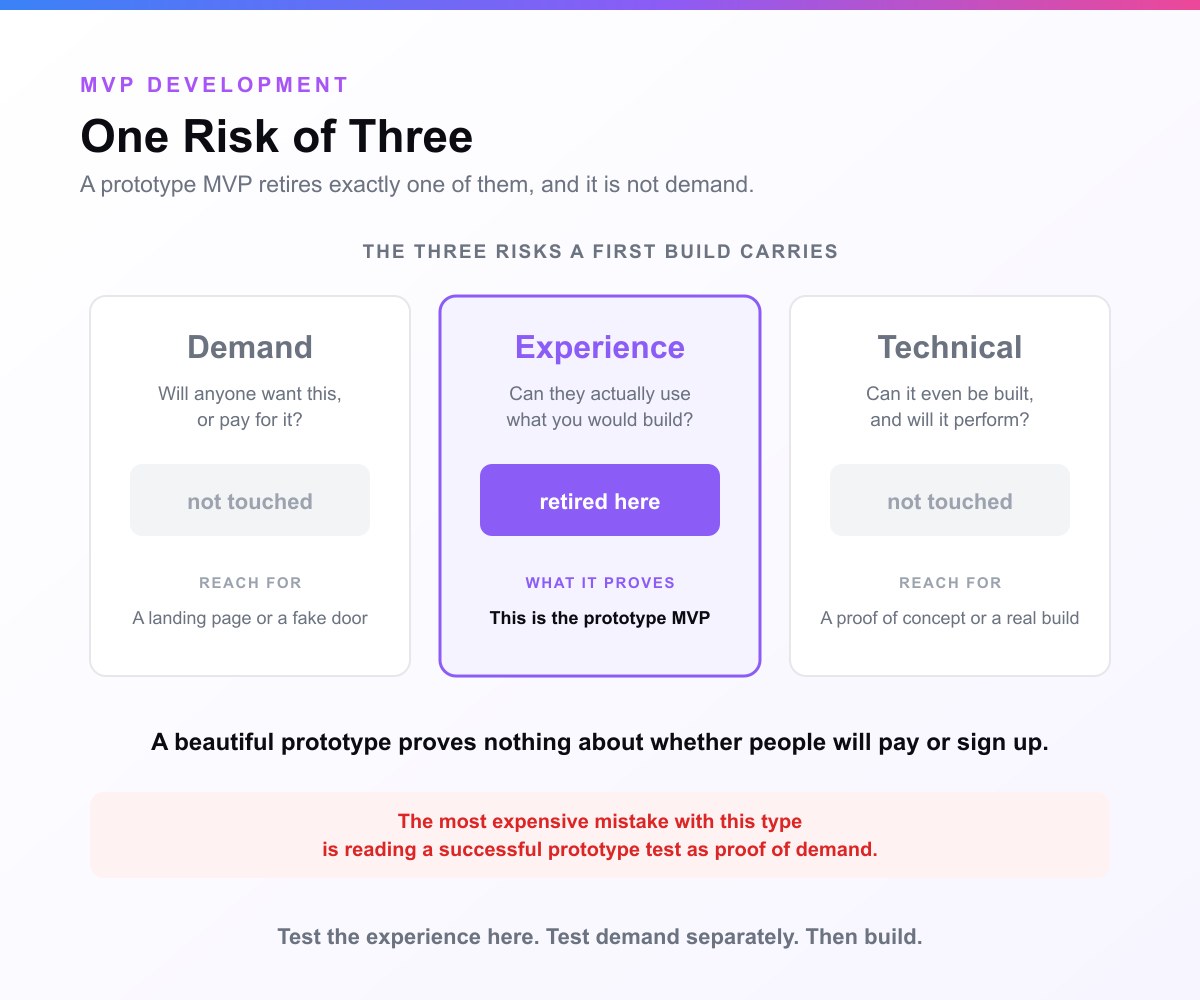
It is the wrong tool in several cases. If your risk is demand (will anyone want this?), a prototype will not tell you; use a landing page or fake door instead, because a beautiful prototype proves nothing about whether people will pay or sign up. If your risk is technical (can this even be built or perform?), you need a proof of concept or a real build, not a simulation. And if the experience is simple and well understood, prototyping may be wasted ceremony; just build the single-feature MVP. The prototype earns its place specifically when the experience and flow carry real risk that is cheaper to retire in a model than in code.
How to build and test a prototype MVP
A prototype is only validation if you test it properly with real users. A pretty prototype admired internally proves nothing. Here is the disciplined process.
Step 1: Define the core task to validate
Decide the one or few key tasks the prototype must prove users can complete: signing up and reaching the value, completing the core action, understanding what the product does. The prototype exists to test these, not to look pretty. As the usability adage goes, a few complete, clickable scenarios beat a hundred polished but non-interactive screens.
Step 2: Build a high-fidelity, clickable flow
In a prototyping tool, build the real screens for those tasks with real branding, fonts, and content, and wire them together so users can click through the flow as if it were a live app. Fidelity matters here: the closer to the real experience, the more honest the feedback. Build the critical path deeply rather than every screen shallowly.
Step 3: Recruit real target users
Test with people who match your actual audience, not your team or your friends. Internal admiration and the politeness of friends both produce false positives. The whole value is watching genuine target users meet the experience cold.
Step 4: Run usability tests, and watch
Give users the core task and observe them attempt it, ideally without guiding them. Watch where they hesitate, misclick, get lost, or give up. The friction you see, buttons that confuse, navigation that misleads, a flow that does not match their mental model, is the gold. Ask them to think aloud, and listen more than you talk.
Step 5: Measure task success and usability
Capture both behavior and perception: did they complete the task (success rate), how long and how many wrong turns did it take, and how did they rate the ease and clarity. Tools that run prototype tests at scale can gather this from many users; small in-person sessions catch the deep "why." Both matter.
Step 6: Iterate the design, fast
Because nothing is built, fixing problems is changing a prototype, minutes of work. Revise the flow, retest, revise again. This rapid loop, test, learn, change, retest, is the entire point: you are buying design certainty cheaply before the expensive build.
Step 7: Decide whether the experience is validated
When real users can complete the core task smoothly, understand the product, and find the flow natural, the experience is validated and you have a tested design to build against. If they cannot, you have learned, cheaply, that the design needs rethinking before a line of code is written.
The prototype MVP toolkit
A prototype MVP is built and tested with design and usability tools:
- Prototyping tools: Figma is the dominant choice for high-fidelity interactive prototypes; Framer, Adobe XD, ProtoPie, InVision, Marvel, and Axure are alternatives, with ProtoPie and Framer strong for advanced interactions.
- Usability testing platforms: Maze, UserTesting, Useberry, Lookback, or Loop11 run tests on a prototype with real users at scale, capturing task success, paths, and feedback. Maze, for example, integrates directly with Figma to test a clickable flow.
- Recruiting: panels and tools to find real target users to test with, rather than your own circle.
- AI design tools: AI-assisted design and prototyping tools can now generate high-fidelity screens and flows from a prompt, making the prototype faster to build and iterate.
The toolkit is design-and-research, not engineering, which is exactly why a prototype MVP is cheap and fast: you are validating with a model, not a build.
What to measure in a prototype MVP
Because a prototype is not a real product, the metrics are about the experience, not usage or retention. You measure whether the design works.
- Task success rate: of users given the core task, how many complete it? This is the headline metric. A low success rate means the flow is broken, regardless of how nice it looks.
- Time and effort on task: how long it takes and how many wrong turns users make. Smooth, direct completion is the goal; lots of backtracking signals confusion.
- Error and drop-off points: exactly where users hesitate, misclick, or give up. These pinpoint the specific screens or steps to fix.
- Comprehension: can users explain what the product does and why they would use it after seeing it? A flow they can complete but not understand is only half-validated.
- Perceived usability: how users rate the ease and clarity, captured through a standard usability scale or simple questions, plus their qualitative reactions.
What you explicitly cannot measure with a prototype is real demand, real retention, or willingness to pay, because nothing real is happening. That is the prototype's boundary: it validates that the experience works, not that the market wants it or that people will keep using it. Confusing a successful prototype test for proof of demand is the single most common and most expensive mistake with this type, which is exactly why it pairs with the demand tests rather than replacing them.
Real-world patterns: how prototype MVPs get used
Unlike landing pages or crowdfunding campaigns, prototype validation usually happens quietly and internally, so there are fewer famous "the prototype was our MVP" headlines. But the pattern is everywhere in how serious product teams work.
Design-led product teams
Mature product organizations rarely build a complex new flow without prototyping and usability-testing it first. The team builds a high-fidelity Figma prototype of the new experience, runs it past target users, watches them struggle or succeed, and irons out the flow before engineering touches it. The prototype is the experience-validation MVP, and it routinely saves teams from building confusing designs that would have failed in the market.
Complex and high-stakes interfaces
The more intricate or high-stakes the experience, fintech onboarding, healthcare workflows, data-heavy dashboards, hardware companion apps, the more valuable a prototype MVP becomes. When a wrong flow is expensive or even dangerous, validating the experience in a clickable model first is not optional, it is responsible. These products almost always prototype the core flows with real users before building.
Founders pitching a vision
Many founders use a polished interactive prototype to communicate and validate their vision, with users and with investors, before building. It makes the abstract concrete: people can click through the future product and react to the real experience. Used honestly (as experience validation, not proof of demand), it is a powerful early step. The risk is treating investor enthusiasm for a beautiful prototype as market validation, which it is not.
The common thread: a prototype MVP is the step where the experience meets real users before the product meets real engineering. It is upstream, cheap, and design-focused, and its value is catching the flow problems that would otherwise be discovered, expensively, after the build.
Prototype MVPs and AI in 2026
AI has transformed how fast a prototype MVP can be built. AI-assisted design tools generate high-fidelity screens, flows, and even interactive prototypes from a text prompt, collapsing what used to be days of design work into minutes. A founder can now describe a product and get a clickable, realistic prototype to test almost immediately, and iterate it just as fast.
This makes the prototype MVP cheaper and faster, but it sharpens the central caution rather than removing it. When anyone can generate a beautiful prototype in minutes, the prototype proves even less about demand than before, because polish is now free. The discipline is to use AI to build and iterate the prototype quickly, then still do the hard part: test it with real target users and watch them struggle. The technology has made the artifact trivial to produce; the validation, observing real users meet the experience, is the work that actually retires risk. And because AI also compresses the real build, the gap between a validated prototype and a working single-feature MVP is now weeks, which means the prototype should be a quick experience-validation step, not a long detour you mistake for progress.
Pros and cons of the prototype MVP
Pros:
- Cheap and fast experience validation. You test the design with real users without building anything, catching flow problems in minutes rather than weeks.
- It de-risks the experience specifically. It retires usability and flow risk, a real failure mode that demand tests miss entirely.
- It is easy to iterate. Changing a prototype is changing a design file, so you can test, learn, and revise rapidly.
- It aligns teams and communicates vision. A realistic clickable model gets stakeholders and investors agreeing on the product before engineering starts.
- It feeds the build. A validated prototype becomes the tested design spec that the real product is built against.
Cons:
- It proves nothing about demand. A great prototype test does not mean anyone will want, use, or pay for the product. This is the most dangerous misconception.
- It is not a working product. No real value, no real usage, no retention data, so it cannot validate product-market fit.
- It can mislead with polish. Beautiful prototypes generate enthusiasm that is easy to mistake for validation.
- It only works if tested rigorously. A prototype admired internally, or shown to friends, validates nothing. The value is entirely in real-user testing.
- It is the most debated "MVP." Strictly, a pure prototype is a design artifact, not an MVP, so calling it one can cause teams to skip the validation that actually matters.
Common mistakes founders make
- Mistaking a prototype test for demand validation. The biggest and costliest error: assuming that because users could use it and liked it, they will want and pay for it. Validate demand separately.
- Testing with the wrong people. Showing the prototype to the team, friends, or investors and reading their politeness as proof. Test with real target users meeting it cold.
- Polishing instead of testing. Spending weeks perfecting the prototype rather than putting a good-enough version in front of users and learning. The learning is the point, not the artifact.
- Building every screen shallowly. A hundred non-clickable screens prove nothing; a few complete, interactive scenarios prove the core task. Go deep on the critical path.
- Guiding the user during the test. Telling users where to click to make the test "succeed," which hides exactly the confusion you need to find. Stay quiet and watch.
- Treating the prototype as the destination. Iterating a prototype forever instead of building, especially now that a real build is only weeks away. The prototype is a step, not the product.
Signs your prototype MVP is working (and when to build)
Your prototype is validating the experience when real target users complete the core task smoothly and without help, take a fairly direct path rather than backtracking, can explain what the product does and why they would use it, and rate the experience as clear and easy. When users meet the flow cold and just get it, the design is validated, and you have a tested spec to build against.
The signal that it is time to stop prototyping and start building is when the experience is validated and demand is validated separately, the prototype has done its narrow job and further iteration is polishing, not learning. Conversely, if users keep getting stuck in the same place across iterations, the design needs rethinking, not building. And critically, do not let a successful prototype lull you into skipping demand validation: a validated experience with no validated demand is a beautifully usable product nobody wants. The prototype tells you the experience works; you still need a landing page, fake door, or real usage to know the market wants it. When both the experience and the demand check out, build.
How to graduate from a prototype to a real product
A validated prototype is a tested design ready to become real. The path forward:
- Confirm demand is also validated. Before building, make sure you have separately proven people want the product, not just that the experience works. A prototype alone is not enough to justify the build.
- Use the prototype as the build spec. The validated prototype is the blueprint: the screens, flows, and interactions engineers build against. Little is lost in translation because the design is already tested.
- Build the core as a real product. Build the validated experience for real, almost always starting with a single-feature MVP that delivers the core flow you proved, or a piecemeal version if tools can deliver it.
- Keep testing with real usage. The prototype validated the experience in a test; real usage now validates whether people actually adopt and retain it. The prototype reduces design risk, but only a real product retires product-market-fit risk.
The discipline is to treat the prototype as an experience-validation step that feeds the build, never as a substitute for building or for validating demand.
A worked example
Imagine a founder building a personal-finance app with a genuinely novel core flow: an unusual way to visualize and reallocate spending that, if it confuses people, kills the product. Demand is plausible (people want better money tools), but the real risk is whether anyone can actually understand and use the novel interface. Building it to find out would take weeks.
So she builds a prototype MVP. In Figma, she creates a high-fidelity, clickable version of the core flow: onboarding, connecting an account (simulated), and the novel reallocation screen, with real branding and realistic data. She wires it so a user can click through the whole core task as if it were a live app. Then she recruits eight people who match her target users, gives each the task "set up your budget and move money between categories," and watches silently, using a testing tool to capture where they click and get stuck.
The first round is humbling: six of eight cannot figure out the reallocation gesture, the heart of the product. She redesigns it, retests with new users, and this time seven of eight complete it smoothly and describe it as intuitive. The novel core flow is validated, and it took days and zero engineering. She has a tested design spec and the confidence that the experience works. Now she validates demand separately with a landing page, and only once both check out does she build the real thing, a single-feature MVP of that exact, validated flow. The prototype MVP did its precise job: it retired the experience risk cheaply, before the build, and saved her from shipping an interface most people could not use.
How MVP Development helps
A prototype MVP is often run by a founder or a designer, and it is a smart step when the experience carries real risk. Where we help is on both sides of it: validating the right risk in the right order, and turning a validated prototype into a real product fast.
We help you avoid the central trap, mistaking a beautiful prototype for proven demand, by sequencing validation correctly: test the experience with a prototype, test demand separately, and only then build. When both check out, we build the validated design for real, almost always a single-feature MVP, shipped funding-ready in 3 to 4 weeks by senior engineers, built directly against your tested prototype so little is lost between design and product, on a clear, scoped quote you approve before we start. Because a validated prototype is already a tested spec, the build is faster and surer: you are constructing an experience you know works, not guessing.
Validated your experience in a prototype and ready to make it real? Send over the prototype and we will quote the road from clickable to shippable.
Related guides
- What Is an MVP?: the full definition of a minimum viable product, and what makes one work
- MVP Examples: 15 Famous MVPs: see these MVP types in action at Airbnb, Dropbox, Uber, and more
- How to Build an MVP: the step-by-step process from idea to launch
Frequently asked questions
What is a prototype MVP?
A prototype MVP uses a high-fidelity, interactive prototype, a clickable, realistic model of the product, tested with real users to validate the experience and flow before building anything. Users click through what looks like a finished app, and you watch whether they can complete the core task, where they get confused, and whether the design makes sense. It validates the experience cheaply, but because nothing is actually built, it does not test real demand, usage, or retention.
Is a prototype actually an MVP?
This is the most debated question about the type. Strictly, a pure prototype is a design artifact, not a minimum viable product, because it delivers no real value and produces no validated learning about the market. It becomes MVP-like only when it is functional and tested rigorously with real target users to validate the core experience as a stand-in for the product. We unpack this fully in our MVP vs prototype comparison. The practical view: a prototype validates the experience, which is one real product risk, but it is not a substitute for a working MVP or for demand validation.
What is an example of a prototype MVP?
Prototype validation usually happens internally, so there are fewer famous examples than for landing pages or crowdfunding. The common pattern is a product team building a high-fidelity Figma prototype of a new flow, testing it with real target users, watching where they struggle, and fixing the design before engineering builds it. It is especially standard for complex or high-stakes experiences, fintech onboarding, healthcare workflows, data-heavy dashboards, where a confusing flow is expensive to ship.
How is a prototype MVP different from a single-feature MVP?
A single-feature MVP is a real, working product: users do real things and you measure real usage and retention. A prototype MVP is a clickable simulation: users test a model and you measure whether the experience works, but nothing real happens. The single-feature MVP answers "does the built product get used and kept?" The prototype answers an earlier question, "does the experience and flow make sense?" The prototype usually comes first, then becomes the spec for the single-feature build.
What should I measure in a prototype MVP?
Experience metrics, not usage. Measure task success rate (can users complete the core task), time and wrong turns on task, where users hesitate or drop off, whether they understand what the product does, and how they rate the ease and clarity. You cannot measure real demand, retention, or willingness to pay with a prototype, because nothing real is happening. The prototype validates that the experience works, not that the market wants it.
What tools do I use to build a prototype MVP?
For building the prototype: Figma is the most common, with Framer, Adobe XD, ProtoPie, InVision, Marvel, and Axure as alternatives. For testing it with real users at scale: Maze (which integrates with Figma), UserTesting, Useberry, or Lookback capture task success and feedback. AI-assisted design tools can now generate high-fidelity prototypes from a prompt, making them faster to build and iterate. The toolkit is design and research, not engineering.
Does a prototype MVP validate demand?
No, and assuming it does is the most expensive mistake with this type. A prototype validates whether the experience and flow work, that users can use the product and understand it. It says nothing about whether people want it, will pay for it, or will keep using it, because nothing real is at stake when someone clicks through a model. You must validate demand separately, with a landing page, fake door, or real usage. A usable product nobody wants is still a failure.
How many users should I test a prototype with?
For catching usability problems, even a handful of well-chosen target users, often around five, surfaces the majority of serious issues in a flow, which is why small qualitative sessions are so valuable. To gather quantitative task-success data, testing tools let you run the prototype with larger numbers. The key is not the count but the fit: test with people who match your real audience, meeting the prototype cold, rather than your team or friends whose feedback is biased.
How is a prototype MVP different from a wireframe or POC?
A wireframe is low-fidelity and tests rough concepts and structure, not the real experience; a prototype MVP is high-fidelity and clickable, testing the actual experience. A proof of concept (POC) tests whether something is technically feasible to build, an engineering question; a prototype tests whether the experience works, a design question. The prototype sits between the rough wireframe and the real build, validating the realistic experience before code.
What comes after a validated prototype?
You confirm demand is also validated, then use the prototype as the build spec and construct the real product, almost always a single-feature MVP of the core flow you proved, or a piecemeal version if tools can deliver it. Then you test with real usage, because the prototype validated the experience in a test, but only a real product reveals whether people actually adopt and retain it. The prototype reduces design risk; the real build retires the rest.
Where does the prototype MVP fit among the other MVP types?
It is the experience-validation member of the three product-validation types, with the single-feature and piecemeal approaches, in the broader map of MVP types. Demand types (landing page, fake door, crowdfunding) ask "do people want this?" Manual types (concierge, Wizard of Oz) ask "can we deliver it by hand?" Product types ask "does the built product work?" The prototype answers the narrowest, earliest version of that: "does the experience and flow make sense?", before any product is built.
Sources and references
This guide draws on design-research practice and lean-validation principles:
- Figma, high-fidelity prototyping what high-fidelity prototypes are and how they validate UX
- Figma, MVP testing methods where prototype testing fits among validation methods
- Maze, Figma prototype testing running usability tests on a clickable prototype
- The Lean Startup validated learning and the limits of artifacts that do not test the market


