


TL;DR
A SaaS MVP is the smallest working version of a software-as-a-service product, one core workflow, deployed in the browser with sign-up and the single feature that delivers value, built to test whether people will use and pay for it before you build the full platform. It is a real, running app on a subscription model, deliberately narrow: one flow, done well, in front of real users fast.
SaaS is almost the ideal product type for the MVP approach. It runs in the browser, so there is no app-store review and you can ship updates instantly; it is subscription-based, so you can test willingness to pay directly; and it produces clean usage data, so you can measure activation, retention, and churn from day one. This guide covers what a SaaS MVP is, real examples, the features and metrics that actually matter, the tech stack, the common mistakes, and a step-by-step path to building one that validates fast. For the underlying concept, start with what an MVP is.
Key Takeaways
- A SaaS MVP is the smallest working version of a software-as-a-service product: one core workflow with sign-up and the single feature that delivers value.
- It is built to test whether people will use and pay for it before you build the full platform.
- SaaS is almost ideal for the MVP approach: it runs in the browser, ships updates instantly, and produces clean usage data.
- Its subscription model lets you test willingness to pay directly.
- You measure activation, retention, and churn from day one.
What is a SaaS MVP?
A SaaS MVP (minimum viable product) is the first working version of a software-as-a-service product, built with only the features needed to deliver its core value and validate the idea with real, paying-capable users. It is a deployed web application, running on a subscription model, scoped to the single workflow that proves the business.
What does MVP mean in SaaS? The same thing it means anywhere, the minimum viable product, applied to a subscription software product. "Minimum" means one core workflow, not a dashboard full of features. "Viable" means that workflow actually works to a production standard, because users will not pay for, or stick with, a broken tool. A SaaS MVP is narrow but real: a user can sign up, reach the core value, and (often) pay, even though ninety percent of the eventual product does not exist yet.
It helps to be precise about what a SaaS MVP is not. It is not a landing page (that tests interest, not usage). It is not a clickable prototype (that tests design, not demand). It is not version one of the full platform with every feature your roadmap imagines. It is the one workflow, deployed and usable, that answers your riskiest question: will people adopt this, keep using it, and pay?
Why SaaS is built for the MVP approach
Some product types fight the MVP model. SaaS embraces it, which is why so much MVP thinking comes from the SaaS world.
It ships and updates instantly. A SaaS product lives in the browser, so there is no app-store review and no install friction. You deploy the MVP behind a URL, and when you learn something, you push an update every user has immediately. The build-measure-learn loop runs faster in SaaS than almost anywhere else.
It tests willingness to pay directly. Because SaaS is subscription-based, you can put a price on the MVP and learn the single most important thing a business can know, whether people will actually pay, not just whether they like the idea. A SaaS MVP can validate revenue, not just usage.
It generates clean, continuous data. Every action in a SaaS product is measurable: sign-ups, activation, feature usage, retention, churn. That instrumentation is what turns the MVP from a guess into an experiment. You are not asking users what they think; you are watching what they do, week after week.
It is built to extend. A well-architected SaaS MVP grows into the full product rather than getting thrown away. You ship one workflow now and add the rest on the same foundation, which is exactly the posture the MVP rewards. The web is the fastest place to ship one, which is why most software MVPs start there; our guide to web app MVP development covers that angle in depth.
What makes a SaaS MVP different from a generic MVP
The MVP principles are universal, but a SaaS MVP has a specific shape, and knowing it keeps the scope honest.
The core flow is almost always sign-up to first value. For a SaaS product, the moment that matters is when a new user reaches the "aha", the first time the tool does the useful thing it promises. The entire MVP is organized around making that path short and reliable: account creation, the one core feature, and the result. Everything that does not move a user toward first value, settings, team management, integrations, admin tooling, is out of scope for the MVP.
A SaaS MVP also has to handle a few things a throwaway MVP can skip: basic authentication (users need accounts), data persistence (their work has to be saved), and often a payment path if you are testing willingness to pay. These are not optional polish; they are part of being a real, usable SaaS product. The art is keeping each of them minimal, an auth provider instead of a custom identity system, a single pricing tier instead of a billing matrix.
What you defer is everything that assumes scale you do not have: complex permissions, multi-tenancy beyond the basics, enterprise SSO, deep integrations, and analytics dashboards. Those belong to the version you build after the MVP proves the core. A SaaS MVP is one tenant's worth of value, done well, not an enterprise platform in miniature.
How to validate a SaaS MVP before you build
The cheapest SaaS validation happens before you write much code, and skipping it is how founders end up building a polished product nobody wanted. A few SaaS-specific methods do most of the work.
The landing-page test. Put up a page describing the product and its value with a clear call to action, sign up, join the waitlist, or see pricing, drive a little traffic to it, and measure whether people convert. It is the fastest way to test whether the promise resonates, and it costs almost nothing.
The pricing-page test. Buffer's approach: add a pricing page behind the call to action. If people click through to choose a paid plan, you have evidence of willingness to pay before building anything, the strongest early SaaS signal there is.
Pre-sales and design partners. For B2B SaaS especially, sell the MVP before it exists. A handful of customers who commit, or pay, in advance both fund the build and prove the demand, and their detailed feedback shapes the core flow.
The concierge approach. Deliver the core value manually at first, by hand, behind a simple interface, to validate that the workflow delivers value before you automate it. Many automation and ops SaaS products started exactly this way.
The goal of all of these is the same: spend as little as possible to learn whether the SaaS idea is worth building, so the MVP you do build is a calculated bet, not a hope. Our full MVP validation guide covers the methods in depth; for SaaS, the willingness-to-pay tests are the ones that matter most.
B2B vs B2C SaaS MVPs: how the MVP differs
The MVP approach is the same for both, but the core flow, the validation, and the metrics shift depending on who you sell to.
A B2B SaaS MVP usually has a narrower, deeper core flow, the one workflow a team relies on, and validation often happens through direct sales and a handful of design-partner customers rather than a flood of self-serve sign-ups. You can validate a B2B SaaS MVP with as few as a few engaged customers, because each one represents real revenue and gives detailed feedback. The early signals that matter are activation within the account, retention, and whether they will pay and expand. Reading product-market fit for a B2B SaaS MVP leans on qualitative signals and retention more than raw volume.
A B2C or prosumer SaaS MVP usually needs a frictionless self-serve flow and a larger number of users to read the signal, because individual users churn more and pay less. Validation is more about activation and retention at scale, and onboarding has to carry more weight, since there is no salesperson to guide the user to value. Acquisition and time-to-value matter more here.
The practical upshot: for B2B, scope the one workflow your design partners need and sell it directly; for B2C, scope the one workflow a self-serve user can reach value on alone, and instrument activation hard. Both are MVPs, one core flow, real users, validated learning, but the path to the signal differs, and designing for the wrong one wastes the experiment. If you're selling to businesses, our B2B MVP guide goes deep on design partners, pilots, the buyer-vs-user problem, and reading B2B product-market fit.
SaaS MVP examples: lean starts that became big products
The best way to understand a SaaS MVP is to see how large SaaS companies started, because almost none launched a full platform. Each shipped one workflow and grew from there.
- Slack began as an internal tool the founders built to communicate while making a game. The MVP was the one workflow that mattered, real-time team messaging, and it was good enough internally that it became the product. One core flow, validated by real daily use before it was ever sold.
- Buffer validated the SaaS idea with a two-page experiment, a landing page describing the product and a second page showing pricing plans behind a button, before building anything. Clicks on the paid plans proved people would pay; then the founder built the minimal scheduling tool. Demand first, product second.
- Mailchimp started as a side feature of a web-design agency, a simple email tool for a few clients, before it was spun out as a standalone SaaS product. The MVP was one job, send a basic email campaign, done well enough to be worth paying for.
- Zapier launched with a small set of integrations and a founding team that wired up new ones by hand as users requested them, a manual, do-things-that-do-not-scale approach to validating that people wanted automation before building the full engine.
- Dropbox tested demand for file sync with a three-minute explainer video before building the hard backend, then shipped a minimal product once the waitlist proved the appetite.
The pattern across all of them: one core workflow, real users, and proof of demand before scale. See more in our MVP examples guide. The SaaS-specific lesson is that the core flow is usually a single repeated action, send a message, schedule a post, send a campaign, and the MVP is that action made real, not the platform around it.
SaaS MVP features: what to include and what to cut
Deciding the feature set is where most SaaS MVPs go wrong, by including too much. Here is the honest split.
Include (the must-haves):
- Sign-up and authentication. Users need accounts, so use an auth provider rather than building identity from scratch.
- The one core feature. The single workflow that delivers your product's promise, built to production quality. This is the MVP.
- Data persistence. Their work has to be saved reliably; a SaaS tool that loses data is not viable.
- A basic, usable UI. Clean and credible, scoped to the core flow. See MVP UX design for how to scope the experience.
- A payment path, if you are testing pricing. A single plan, a checkout, nothing more.
- Analytics. Instrument activation, usage, and retention from day one, or you cannot learn.
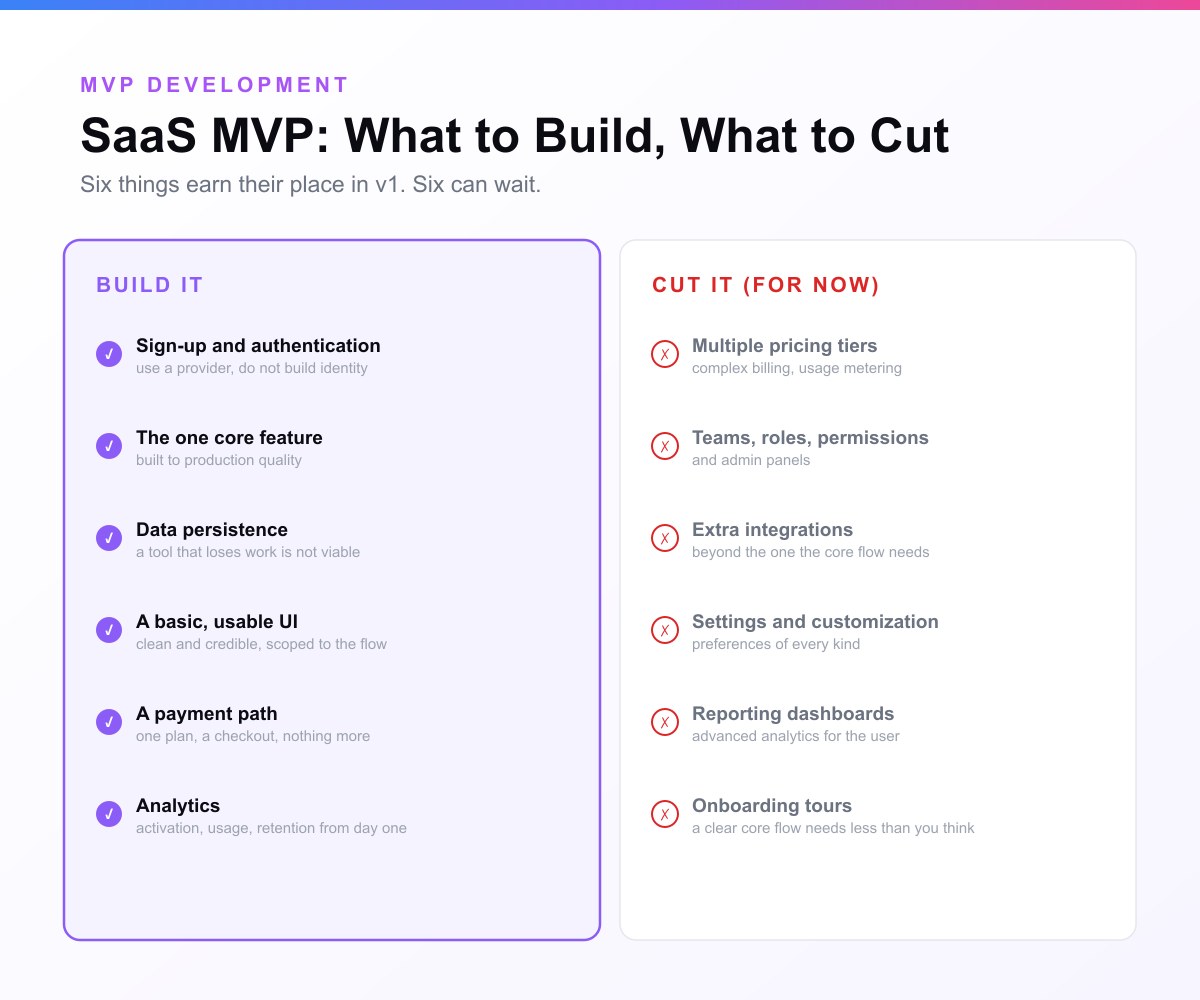
Cut (the not-yet):
- Multiple pricing tiers, complex billing, and usage metering.
- Team and role management, permissions, and admin panels.
- Integrations beyond the one your core flow truly needs.
- Settings, customization, and preferences.
- Reporting dashboards and advanced analytics for the user.
- Onboarding tours and in-app messaging (a clear core flow needs less of this than you think).
The test for every feature is the same: does a user need it to reach first value on the core workflow? If not, it waits. A useful framework here is MoSCoW (must have, should have, could have, will not have), applied ruthlessly. The discipline of cutting is covered in depth in how to build an MVP; for SaaS specifically, the rule of thumb is one workflow, one plan, one tenant's worth of value.
How to build a SaaS MVP, step by step
Here is the practical path from idea to a launched, validating SaaS MVP. A tightly scoped one ships in around three to four weeks.
| Step | What you do | Output |
|---|---|---|
| 1. Validate demand | Confirm people want this before building | A validated problem and core hypothesis |
| 2. Define the core flow | Find the single sign-up-to-value workflow | A scoped MVP definition |
| 3. Design the experience | Wireframe and prototype the core flow | A tested, dev-ready design |
| 4. Build the one workflow | Auth, the core feature, persistence, optional billing | A working, deployed SaaS app |
| 5. Instrument it | Wire in activation, usage, and retention metrics | A measurable product |
| 6. Launch and learn | Put it in front of real users, measure, iterate | Validated learning (or a pivot) |
Validate first. The cheapest SaaS validation often happens before any code, a landing page, pre-sales, or interviews, exactly as Buffer did. Our MVP validation guide covers the methods. Define the core flow by naming the one workflow that proves the idea and cutting everything else. Design the experience so the path to first value is short and clear. Build the one workflow to production quality on a proven stack, deferring everything non-essential. Instrument it so you can measure activation and retention, not vanity sign-ups. Then launch and learn, and let real usage tell you what to build next.
Notice what is not on the list: building the full platform, every integration, and an enterprise feature set up front. That restraint is what gets a SaaS MVP live in weeks instead of quarters.
A concrete SaaS MVP scoping example
To make the scope discipline tangible, take a SaaS idea: a tool that helps agencies manage client projects. The full vision has projects, tasks, time tracking, invoicing, client portals, file sharing, team chat, reporting, and integrations with a dozen other tools. That is a platform, not an MVP.
The riskiest assumption is narrower: will an agency run a client project in this tool instead of in spreadsheets and email? So the SaaS MVP scopes to exactly that, sign up, create a project, add tasks, and share it with a client, and leaves everything else out. No invoicing, no time tracking, no integrations, no reporting. One workflow: run a single client project, end to end.
That MVP can launch in weeks, get in front of a handful of real agencies, and answer the only question that matters, do they adopt it and keep using it? If they do, you add the next most-requested feature based on what they actually ask for; if they do not, you have learned it cheaply. Ten features collapse into one flow, which is almost always more aggressive than it first feels comfortable to be, and that is exactly the point.
The SaaS MVP tech stack
You do not need an exotic stack; you need a proven one you can move fast on. A common, modern SaaS MVP stack looks like this:
- Frontend: Next.js and React with TypeScript, for a fast, responsive, SEO-friendly app.
- Backend: Node (often with a framework like NestJS), with a PostgreSQL database, or a managed backend like Supabase that bundles auth, database, and storage.
- Auth: an auth provider (Supabase Auth, Clerk, Auth0) rather than custom identity.
- Payments: Stripe, with a single plan to start.
- Infrastructure: a platform like Vercel for the frontend and managed hosting for the backend, so you spend zero time on ops.
- Analytics: a product-analytics tool (PostHog, Mixpanel) wired to your activation and retention events.
The principle is to use managed services for everything that is not your core differentiator, auth, hosting, payments, so your build time goes into the one workflow that actually proves the business. A no-code or low-code build can also work for the earliest validation; see no-code MVP for when that fits. The stack matters less than the discipline: ship the core flow, own the code, and architect it so version two grows from the MVP instead of being rewritten.
SaaS MVP metrics: what to measure
A SaaS MVP exists to produce evidence, and in SaaS the evidence is unusually clean. These are the metrics that tell you whether the MVP is working, and the vanity numbers that feel good but prove nothing.
| Metric | What it tells you | Healthy early signal |
|---|---|---|
| Activation rate | Do new users reach first value? | 30%+ complete the core action |
| Time to value | How fast users reach the "aha" | Minutes, not days |
| Week-4 retention | Do they keep coming back? | A flattening retention curve |
| Churn | How fast users leave | Low and stable, not climbing |
| MRR / paying conversion | Will they actually pay? | Any real paid conversions early |
| NPS / qualitative feedback | Why the numbers move | Specific, repeated value statements |
Activation and retention are the two that matter most in a SaaS MVP, because they tell you whether the core workflow actually delivers value people come back for. Retention is the truest signal in SaaS: a product people return to, week after week, has found something real, while a flood of sign-ups that never come back is a clearer "no" than a small base that sticks is a "yes." If you are charging, early paid conversion is the strongest validation of all, it proves willingness to pay, not just willingness to try. We go deeper on this in MVP metrics; the SaaS-specific point is to watch retention and revenue, not raw sign-ups.
Should a SaaS MVP charge from day one?
One question comes up for every SaaS MVP: should you charge from the start, or launch free and add pricing later? For a subscription business, the answer leans strongly toward charging early, because price is part of what you are validating.
The reason is simple. The riskiest assumption in most SaaS businesses is not "will people use this," it is "will people pay for this." A free MVP can validate usage, but it leaves the most important question untested, and "users love it but will not pay" is one of the most common ways a SaaS startup dies slowly. Putting even a simple price on the MVP turns a usage test into a business test.
You do not need a full pricing matrix. A single plan, one price, one checkout, is enough to learn whether people will pull out a card. Many SaaS MVPs use a short free trial that converts to a paid plan, which tests both activation (do they reach value in the trial) and willingness to pay (do they convert) in one flow. Others pre-sell, taking payment or commitments before the product is fully built, which validates revenue at the lowest possible cost.
There are exceptions. If your model depends on network effects or scale, a marketplace-like SaaS, or a freemium product where free users drive paid conversion, a free tier may be part of the core hypothesis, in which case usage is the right early signal. But for the typical B2B or prosumer SaaS, charging early is the more honest test. The principle is to test the part of the model that is actually risky, and for most SaaS, that is price.
Common SaaS MVP mistakes
Most SaaS MVPs stumble in predictable ways. Avoiding these is most of the battle.
Building too many features. The defining SaaS MVP mistake: shipping a "minimum" product with ten features because each one feels essential. It blows the timeline, dilutes the core flow, and makes the product harder to learn from. One workflow, done well.
Skipping validation and building on a hunch. Founders who are sure the market wants their SaaS often build the whole thing before testing demand, the exact overconfidence the MVP exists to check. Validate first; it is far cheaper than building.
Over-engineering for scale you do not have. Designing multi-tenancy, microservices, and enterprise infrastructure for an MVP with zero users wastes the time and budget the MVP was meant to save. Build for the first hundred users, not the first million; you can re-architect once you have product-market fit, which is what scaling your MVP is for.
Measuring vanity metrics. Counting sign-ups and page views instead of activation, retention, and revenue makes a struggling MVP look healthy. Instrument the metrics that predict a business.
Treating the MVP as the finished product. A SaaS MVP is the start of an iterative loop, not a one-off launch. Ship it, measure, and let real usage shape the roadmap, instead of building the full platform you imagined up front.
Charging nothing and learning nothing about price. If your model is subscription, testing a price, even a simple one, is part of validation. A free MVP can validate usage but tells you nothing about willingness to pay, which for SaaS is the whole game.
SaaS MVP vs the full SaaS product
It helps to be explicit about how a SaaS MVP differs from the full product, because the instinct to build "real" software pulls founders toward the full version too early.
The full SaaS product is built for scale and completeness: multiple plans and billing, team and permission management, integrations, enterprise features, dashboards, and the reliability a large customer base demands. It assumes the market is proven and worth investing in heavily, which is true after product-market fit.
A SaaS MVP is the opposite posture. It is one workflow, one plan, basic auth, and the minimum infrastructure to serve the first users, built to test whether the business works at all. It assumes the idea is still a hypothesis, so it spends as little as possible to validate it.
| SaaS MVP | Full SaaS product | |
|---|---|---|
| Scope | One core workflow | Full feature set |
| Billing | One plan, or a trial | Tiers, metering, enterprise |
| Users | First adopters | A scaled customer base |
| Infrastructure | Minimal, managed services | Built for scale and reliability |
| Goal | Validate the business | Capture a proven market |
The mistake is building the full product for an unvalidated idea, the exact thing the MVP exists to prevent. Build the MVP, prove the core, then scale into the full product, which is what scaling your MVP is about.
How much does a SaaS MVP cost, and how long does it take?
A tightly scoped SaaS MVP, one core workflow, auth, persistence, and an optional payment path, typically ships in around three to four weeks with a senior team, and costs a fraction of the full platform. The biggest driver of both cost and timeline is scope: the more workflows and integrations you add, the longer and more expensive it gets, which is exactly why the discipline of cutting to one core flow pays off twice, in speed and in budget.
For the full breakdown of what drives the number, see our guides on how much it costs to build an MVP and how long it takes to build an MVP. The headline for SaaS specifically: because the stack is proven and the hosting, auth, and payments are managed services, almost all of the build effort goes into the one workflow that proves the business, which is what keeps a focused SaaS MVP measured in weeks.
A useful way to think about the trade-off is in terms of what each dollar buys you in learning. Every feature you add to the MVP before launch is budget spent on a guess; every feature you defer until after real usage is budget spent on evidence. A lean SaaS MVP is simply the version that maximizes learning per dollar, which is why the cheapest path to a successful SaaS product is almost always the narrowest first version, not the most complete one.
If what you want is not the theory but the build, that is a different page. Our SaaS MVP development services cover the multi-tenant foundation, billing, auth and the one core flow, at fixed prices from $350 for a working prototype, with the scope agreed before work starts. This guide stays on how to think about a SaaS MVP; that page is what it costs to have one built.
If what you want is not the theory but the build, that is a different page. Our SaaS MVP development services cover the multi-tenant foundation, billing, auth and the one core flow, at fixed prices from $350 for a working prototype, with the scope agreed before work starts. This guide stays on how to think about a SaaS MVP; that page is what it costs to have one built.
Build your SaaS MVP with a team that keeps it lean
Knowing what a SaaS MVP should be and actually shipping one are different things. The hard part is the discipline, scoping to one workflow, resisting feature creep, building viable quality without over-engineering for scale you do not have yet. That is exactly what we do.
- We scope to the one core flow. We find the sign-up-to-value workflow that proves your SaaS idea and build it well, instead of spreading thin across a feature list.
- We ship in 3 to 4 weeks. A complete, deployed, investor-ready SaaS MVP with auth, the core feature, and a payment path if you need one, built by senior engineers on a scoped, fixed quote.
- You own production-grade code. Architected to scale past the MVP into the full platform, not a throwaway prototype.
Explore our SaaS MVP development service, or if you are not yet sure what to build, start with a free MVP consultation.
Have a SaaS idea worth proving? Describe the workflow your SaaS replaces and we will scope the version customers pay for first.
What the stack above actually costs before you have users
The stack section names tools without prices, which is the normal way this is written and not much use when you are deciding whether you can afford to start.
Across the 14 managed services named as the default SaaS MVP stack, MVP Development found all 14 can be started at no monthly cost. Read 24 September 2026.
That is the answer to the question most founders are really asking. Infrastructure is not what stops you building a SaaS MVP. At zero users you can run the whole thing for nothing.
Where free ends
Eleven of the 14 are subscriptions. Eight of those eleven publish a flat price for their cheapest paid plan: $5, $20, $20, $20, $25, $25, $26 and $35 a month. The median is $22.50.
Railway is the cheapest way out of a free tier at $5 a month. Auth0 is the dearest at $35. Paying all eight entry tiers at once comes to $176 a month.
That $176 is a ceiling, not a forecast. It assumes you outgrow every free tier at once and pay every vendor, which is not how it happens; most MVPs use four or five of these and cross one limit at a time.
The other three subscriptions publish no flat entry price at all. Neon, PostHog and Mixpanel bill by usage, so there is no tier to quote. Neon publishes a “typical spend” of $15 a month for intermittent load, which is an estimate rather than a price.
The payment processors work differently
Stripe, Lemon Squeezy and Polar charge no monthly fee at all. They take a share of each transaction instead, so their cost is zero until you have revenue and then scales with it.
Stripe’s standard online card rate is 2.9% plus 30 cents. Lemon Squeezy takes 5% plus 50 cents as a merchant of record, which covers sales tax handling. Polar takes 5.00% plus 50 cents on its free tier, falling to 3.80% plus 40 cents on a $20 a month plan.
Adding those percentages to the subscription total would be meaningless, so they are counted separately here. The first bill a SaaS MVP gets is a subscription. The first bill that grows is a percentage.
What went wrong reading this
A pricing page is mostly not the price. The extractor returned add-on charges, per-seat rates, per-unit rates, enterprise tiers, startup credit offers and, in one case, the output of an interactive slider, all alongside the two numbers that matter.
Vercel’s “$300” and “$350” are an SSO add-on and a HIPAA agreement. Mixpanel’s “$120” is a slider estimate. Render’s “$7” is one service, not the workspace plan. Every figure published above was read off the vendor’s page by a person.
One URL was wrong and was not replaced with a guess. Polar’s /pricing returns a 404, so its homepage was read instead, which is where Polar publishes its rates.
What this does not measure
Whether the free tiers are equivalent. They are not, and it is the most important caveat here. The limits differ by orders of magnitude and are counted in different units: monthly active users, events, rows, emails, errors.
Clerk is the clearest example. Its pricing page advertises “Free Up to 50K Users”, but the 50,000 monthly active users are included with the paid Pro plan. The free plan’s own ceiling is not stated plainly anywhere on that page.
Nor does any of this measure what your build costs. These are the running costs of the services a SaaS MVP sits on, not the cost of writing the product.
We are not in this sample. It is a list of tool vendors and we are not one, so unlike our agency studies there is no row here measuring us by the same code.
How to cite these figures
Free to quote with attribution. Prices move, so the read date matters more than usual here.
Across the 14 managed services named as the standard SaaS MVP stack, MVP Development found all 14 can be started at no monthly cost, and that the median cheapest paid plan among the eight publishing a flat price is $22.50 a month (read 24 September 2026). https://mvpdevelopment.company/blog/saas-mvp
The dataset carries every vendor’s free tier, its first paid plan, the three that bill by usage instead, the processor rates and the corrections made to the raw extraction: saas-mvp-stack-pricing-2026-09-24.json.
Related guides
- Martech MVP, building SaaS into the most crowded category in software
- What is an MVP?, the definition, types, and examples
- How to build an MVP, the full build process
- MVP validation, confirming demand before you build
- MVP metrics, what to measure and why
- MVP UX design, designing the core flow users want
- AI MVP, building an MVP for an AI-powered product
- Marketplace MVP, building a two-sided marketplace MVP
- Ecommerce MVP: the single-seller storefront counterpart
Frequently asked questions
What is a SaaS MVP?
A SaaS MVP (minimum viable product) is the smallest working version of a software-as-a-service product: a deployed web application, on a subscription model, built with only the one core workflow needed to deliver value and validate the idea with real users. A user can sign up, reach the core value, and often pay, while most of the eventual platform does not exist yet. It is a real, usable SaaS product, deliberately narrow, created to test whether people will adopt, retain, and pay before you build the full thing.
What does MVP mean in SaaS?
In SaaS, MVP stands for minimum viable product, the smallest version of a subscription software product that still delivers real value and tests the idea. "Minimum" refers to scope, one core workflow rather than a full feature set, and "viable" means that workflow works to a production standard, because users will not pay for or stick with a broken tool. The goal is validated learning about adoption, retention, and willingness to pay, with the least build.
How do you build a SaaS MVP?
You build a SaaS MVP by validating demand first, then scoping to the single sign-up-to-value workflow, designing that flow, building it (auth, the core feature, data persistence, and an optional payment path) on a proven stack, instrumenting activation and retention, and launching to real users to learn. The key discipline is cutting to one core workflow and using managed services for auth, hosting, and payments, so the build effort goes into the feature that proves the business. A tightly scoped SaaS MVP ships in around three to four weeks.
What features should a SaaS MVP have?
A SaaS MVP should have sign-up and authentication, the one core feature that delivers your value, reliable data persistence, a clean and usable UI, analytics to measure activation and retention, and a payment path if you are testing pricing. It should not have multiple pricing tiers, team and permission management, deep integrations, settings, or reporting dashboards, those come after the core is validated. The test for any feature is whether a user needs it to reach first value; if not, it waits.
What metrics matter for a SaaS MVP?
The metrics that matter most for a SaaS MVP are activation rate (do new users reach first value), retention (do they keep coming back), and, if you are charging, paid conversion and churn. Retention is the truest SaaS signal: a product people return to week after week has found something real. Avoid vanity metrics like total sign-ups and page views, which can make a struggling MVP look healthy; measure the behaviors that predict a sustainable subscription business.
How long does it take to build a SaaS MVP?
A tightly scoped SaaS MVP, one core workflow with auth, persistence, and an optional payment path, typically takes about three to four weeks to build with a senior team. The timeline is driven almost entirely by scope: the more workflows and integrations you add, the longer it takes. Using a proven stack and managed services for auth, hosting, and payments keeps the build focused on the one feature that proves the business, which is what keeps a focused SaaS MVP measured in weeks rather than months.
Should a SaaS MVP be free or paid?
For most SaaS businesses, charge from the start, even a single simple plan, because willingness to pay is usually the riskiest assumption and a free MVP leaves it untested. A short paid trial or a pre-sale validates both usage and revenue. The exception is models that depend on a free tier for network effects or freemium conversion, where usage is the right early signal. The principle is to test the part of your model that is actually risky, and for most SaaS, that is price.
What is the difference between a SaaS MVP and a prototype?
A prototype is a non-functional mockup that tests design and flow; a SaaS MVP is a real, deployed application that tests demand with actual users who can sign up, use the core feature, and often pay. You might build a prototype to validate the experience cheaply, then build the MVP as the real product. Confusing the two leads founders to think they have validated demand when they have only tested an interface. See MVP vs prototype for the full distinction.
Sources & references
This guide draws on established lean-startup and SaaS practice:
- Eric Ries, The Lean Startup, validated learning and the build-measure-learn loop
- Paul Graham, Do Things That Don't Scale, the manual, lean way many SaaS products start
- Y Combinator, Startup Library, building and validating early-stage SaaS products
- Atlassian, Minimum Viable Product, the MVP in agile product development
The 3 to 4 week figure reflects MVP Development delivery data for tightly scoped SaaS MVP builds.


