


TL;DR
A single-feature MVP is a real, working product that does exactly one thing: the single core feature that delivers your value. Everything else is cut. You build that one feature to production quality, ship it to real users, and learn whether the core of your product actually gets used. It is the type most people picture when they hear "MVP," and for good reason: it is the cleanest way to prove that the heart of your product works, without the time, cost, and distraction of building the full vision.
Where it fits: the single-feature MVP is the central member of the product-validation family, alongside the piecemeal and prototype approaches. Unlike the demand tests (landing page, fake door, crowdfunding) which only measure whether people want the idea, a single-feature MVP is a built product that answers a harder question: does the thing get used and kept? It is the type we build most at MVP Development: a focused, real product shipped funding-ready in 3 to 4 weeks. This is the full playbook: how to find your one feature, how to build it, the famous examples, and how to know when to add the second. It is one of the eight types of MVP in our wider map.
Key Takeaways
- A single-feature MVP is a real, working product that does exactly one thing: the single core feature that delivers your value.
- Everything else is cut; you build that one feature to production quality and ship it to real users.
- It is the type most people picture when they hear "MVP," and the cleanest way to prove the heart of your product works.
- Unlike demand tests, it is a built product that answers a harder question: does the thing get used and kept?
- It is the central member of the product-validation family, alongside the piecemeal and prototype approaches.
What is a single-feature MVP?
A single-feature MVP is a minimum viable product reduced to its essential core: one feature, built well, that delivers the central value of your product. It is a real, functioning product that users can actually use, not a mockup, not a manual service in disguise, and not a demand test. The discipline is ruthless subtraction: you identify the one feature that defines your value, you build that to a real standard, and you cut, defer, or fake everything else.
This is the "minimum" in minimum viable product taken seriously. Most founders imagine their product as a constellation of features, dashboards, settings, integrations, social features, analytics. A single-feature MVP asks: if you could ship only one of those, the one that proves the whole idea, which would it be? Then it ships only that. Instagram did not launch as a full social network; it launched as a way to take a photo, filter it, and share it. Spotify did not launch as a music ecosystem; it launched as a way to stream a song instantly. Each stripped a complex vision down to the single feature that carried the value.
The purpose is product validation: proving that the core of your product gets used and kept. The demand tests answer "do people want this?" A single-feature MVP answers the next, harder question: "when we actually build the core, do people use it, come back to it, and find it valuable?" That is a question you can only answer by building something real, and the single feature is the smallest real thing you can build to answer it.
A single-feature MVP is not a low-quality MVP. The "minimum" is about scope, not craft. You are building one thing, so you build it well: it should work reliably, feel good to use, and genuinely deliver the value. A broken or ugly single feature fails the test for the wrong reason. The art is narrow scope, high quality.
Single-feature MVP vs the other product-validation types
The single-feature MVP sits in the product-validation bucket with the piecemeal and prototype approaches. All three involve building something, but they differ in what and how.
| MVP type | What it is | What it proves |
|---|---|---|
| Single-feature | A real, purpose-built product doing one core thing | The core feature gets used and delivers value |
| Piecemeal | The product assembled from existing tools and no-code | The workflow works, stitched from off-the-shelf parts |
| Prototype | A clickable, high-fidelity model, not production software | The experience and flow resonate before real building |
A piecemeal MVP delivers the same kind of value but wires it together from existing tools, no-code platforms, and APIs rather than building custom software. It is faster and cheaper, but limited by the tools and harder to scale. A single-feature MVP is purpose-built and production-grade, just narrow. A prototype MVP is not a working product at all; it is an interactive model used to validate the experience and flow before committing to a real build, which is why we contrast it carefully with a true MVP in our MVP vs prototype comparison.
The single-feature MVP also differs fundamentally from the demand and manual types. The demand tests (landing page, fake door, crowdfunding) do not build anything; they measure intent against a thing that does not exist. The manual types (concierge, Wizard of Oz) deliver value by hand to learn what to build. A single-feature MVP is the step those often lead to: once you know people want it and what to build, you build the real core. It is frequently the destination of the whole MVP sequence, the first piece of real, automated product you ship.
When to use a single-feature MVP
A single-feature MVP is the right choice when you are ready to build real software and you want to prove the core before expanding. Use it when:
- You have validated demand and need to prove the product. Demand tests told you people want it; now you need to know the built thing gets used. The single feature is how you find out.
- Your value concentrates in one core action. If there is a single thing users come to your product to do, that thing is your MVP, and the rest can wait.
- You want real retention data, not just interest. Signups and clicks measure curiosity. A working single feature measures whether people come back, which is the signal that actually predicts a business.
- You are raising or about to. A real product with real users and real retention is dramatically more fundable than a deck or a waitlist. A single-feature MVP is the fastest path to that evidence.
- Speed and focus matter. Building one feature well is far faster than building ten features adequately, and it produces clearer learning.
It is the wrong tool in a few cases. If you have not validated that anyone wants the product, building even one feature may be premature; a landing page or fake door is cheaper first. If your value genuinely cannot be delivered by any single feature (some products are only useful as a connected whole), you may need a slightly larger slice, though this is rarer than founders think. And if you can validate the core by stitching existing tools, a piecemeal approach might prove it without custom building at all. The single-feature MVP earns its place when you are ready to build real software and the value can be proven by one well-built core.
The hardest part: finding your one feature
Building a single feature is the easy part. Choosing which single feature is where most founders struggle, because it requires killing ideas they love. Here is how to find it.
- Identify the core value, in one sentence. What is the single most important thing your product does for a user? Not the vision, the value. "Schedule social posts." "Stream any song instantly." "Take and share a beautiful photo." If you cannot say it in one sentence, you have not found the core yet.
- Find the riskiest assumption. Your MVP should test the thing most likely to kill the company if it is wrong. Often that is whether the core action delivers enough value that people return. Build the feature that puts that assumption to the test.
- Separate the "magic moment" from the "machinery." Most products have one moment where the user feels the value, and a lot of supporting machinery (settings, dashboards, admin, integrations). The magic moment is your feature; the machinery can wait, be faked, or be skipped.
- Cut to the bone, then cut again. Whatever you think the minimum is, it is probably still too big. Instagram cut a whole check-in social network down to photo sharing. The discipline is to keep removing until removing one more thing would break the core value.
- Beware the "but users will need X" trap. They might, eventually. But "eventually" is not the MVP. If the core feature delivers value without X, ship without X and add it only when real users prove they need it.
This triage is the intellectual heart of a single-feature MVP, and it is genuinely hard because it means saying no to good ideas. But the founders who get it right ship faster, learn cleaner, and avoid building a pile of features around a core that was never validated.
How to build a single-feature MVP: a step-by-step playbook
Once you have chosen the feature, the build is a focused sprint. The process:
Step 1: Define the one feature and the one metric
Write down exactly what the single feature does, and the single metric that proves it works, usually a measure of real, repeated use (activation and retention), not signups. The whole build serves that feature and that metric.
Step 2: Map the shortest path to the magic moment
Trace the minimum steps a user takes from arriving to feeling the value. Everything on that path you build; everything off it you cut. The goal is to get users to the magic moment as directly as possible.
Step 3: Fake or skip the supporting machinery
The single feature usually needs some scaffolding (auth, basic data, a screen or two). Build the minimum of that, and fake or defer the rest: manual onboarding, a spreadsheet instead of an admin panel, a hardcoded option instead of settings. Spend your build budget on the core feature, not the machinery around it.
Step 4: Build the one feature to real quality
This is where you do not cut corners. The single feature should work reliably and feel good, because you are testing whether it delivers value, and a broken feature fails for the wrong reason. Narrow scope, high quality, is the whole discipline.
Step 5: Ship it to real users fast
Get it in front of real users quickly, ideally the warm audience a demand test already gathered. Real usage by real users is the only thing that produces the signal you are after. A single feature, well-built, can ship in a matter of weeks, not months.
Step 6: Measure use and retention, then talk to users
Watch whether people use the feature, come back to it, and get value. Pair the numbers with conversations: why do they return, or why did they stop? This tells you whether the core is validated and what the next most valuable thing to build is.
Step 7: Decide what comes second, from evidence
Only after the core is validated do you choose the second feature, and you choose it from real usage data and user conversations, not from your original feature list. The single-feature MVP earns you the right, and the evidence, to expand deliberately.
The single-feature MVP toolkit
The modern stack makes a single-feature MVP faster to build than ever. A typical setup:
- App framework: a full-stack framework like Next.js (React) gives you a production-grade web app quickly; React Native or Flutter for mobile.
- Backend and database: managed platforms like Supabase, Firebase, or a hosted PostgreSQL handle auth, data, and storage without building infrastructure.
- Hosting: Vercel, Netlify, or similar deploy and scale with almost no ops work.
- Auth and payments: drop-in auth (Supabase Auth, Clerk, Auth0) and Stripe for payments mean you do not build these from scratch.
- AI building blocks: model APIs (the latest Claude models, for instance) and orchestration tools let a single feature include genuine AI without a research project.
- Analytics: PostHog, Amplitude, or Mixpanel to measure the activation and retention that tell you whether the feature works.
The point of the stack is to spend almost all of your effort on the one feature that matters, and almost none on the undifferentiated plumbing around it. Modern tools and AI-assisted development are why a real, single-feature product can now ship in weeks.
What to measure: does the core get used?
The single-feature MVP exists to answer a question the demand tests cannot: does the built product actually get used and kept? So the metrics shift from interest to behavior.
- Activation: of the people who try the feature, how many reach the magic moment and experience the value? Low activation means the feature works but the path to value is broken.
- Retention: do people come back and use the feature again? This is the single most important signal, because repeated use is what separates a real product from a one-time novelty. Curiosity gets a first use; value gets a second.
- Engagement depth: how often and how deeply do active users use the feature? Rising engagement among a core group is a strong sign you have found something.
- Qualitative pull: are users asking for more, telling others, complaining when it breaks? Emotional investment is often a clearer signal than any single number.
What you are explicitly not optimizing for yet is breadth of features, vanity signups, or revenue scale. A single-feature MVP is validated when a meaningful group of real users uses the core feature, comes back to it, and would be genuinely disappointed to lose it. That last test, the "would you be very disappointed if this went away" question, is one of the most reliable reads on whether a single feature has found product-market fit in miniature.
Real single-feature MVP examples
The pattern is best seen in products that started as one feature and grew into giants.
Instagram is the definitive single-feature MVP story. It began as Burbn, a cluttered location check-in app with too many features and little traction. Founders Kevin Systrom and Mike Krieger watched how people actually used Burbn and noticed one behavior dominated: photo sharing. So they made a brutal decision: they stripped away everything else, the check-ins, the plans, the social mechanics, and kept only photos, filters, and sharing. They relaunched as Instagram, and the single-feature product gained 25,000 users in its first 24 hours and around 10 million within its first year. It was acquired by Facebook for about a billion dollars roughly two years later. The lesson is the power of subtraction: the winning product was hiding inside the bloated one, as a single feature.
Spotify
Spotify focused its MVP on one feature that everything else depended on: instant, seamless music streaming. While competitors piled on catalogs and social features, Spotify obsessed over making a song play immediately with no lag, the magic moment. The earliest version let people stream songs, and little else. By nailing the single feature that mattered most, the experience of instant playback, it built the foundation everything else grew on. It is a reminder that the single feature can be a quality bar (zero latency) as much as a function.
Amazon
Amazon launched in 1994 as a single-feature product: an online store that sold only books, with a simple website and a low-price angle. It did not try to be the everything store on day one. It proved that people would buy online, in one category, then expanded category by category from that validated core. The single feature was the beachhead.
Foursquare and Facebook
Foursquare launched with essentially one feature: checking in to locations and earning badges, a focused core that validated location-based social behavior before anything else was added. Facebook's earliest version did one thing: connect students within a college and let them post to each other. Both grew into platforms, but each began as a single, well-chosen feature that proved the core behavior.
The discipline of saying no
The hardest, most important skill in a single-feature MVP is not engineering; it is restraint. Every founder feels the pull to add "just one more" feature, because each addition feels essential and each omission feels risky. This is exactly the instinct that turns a clean MVP into a bloated, slow, unfocused product that learns nothing clearly.
The discipline of saying no protects three things. It protects speed: one feature ships in weeks, ten features ship in months, if ever. It protects learning: when you ship one feature, you know exactly what users responded to; when you ship ten, you cannot tell which one matters. And it protects quality: the same effort spread across one feature produces something excellent, spread across ten produces ten mediocre things. Burbn failed partly because it did too much; Instagram won by doing one thing beautifully.
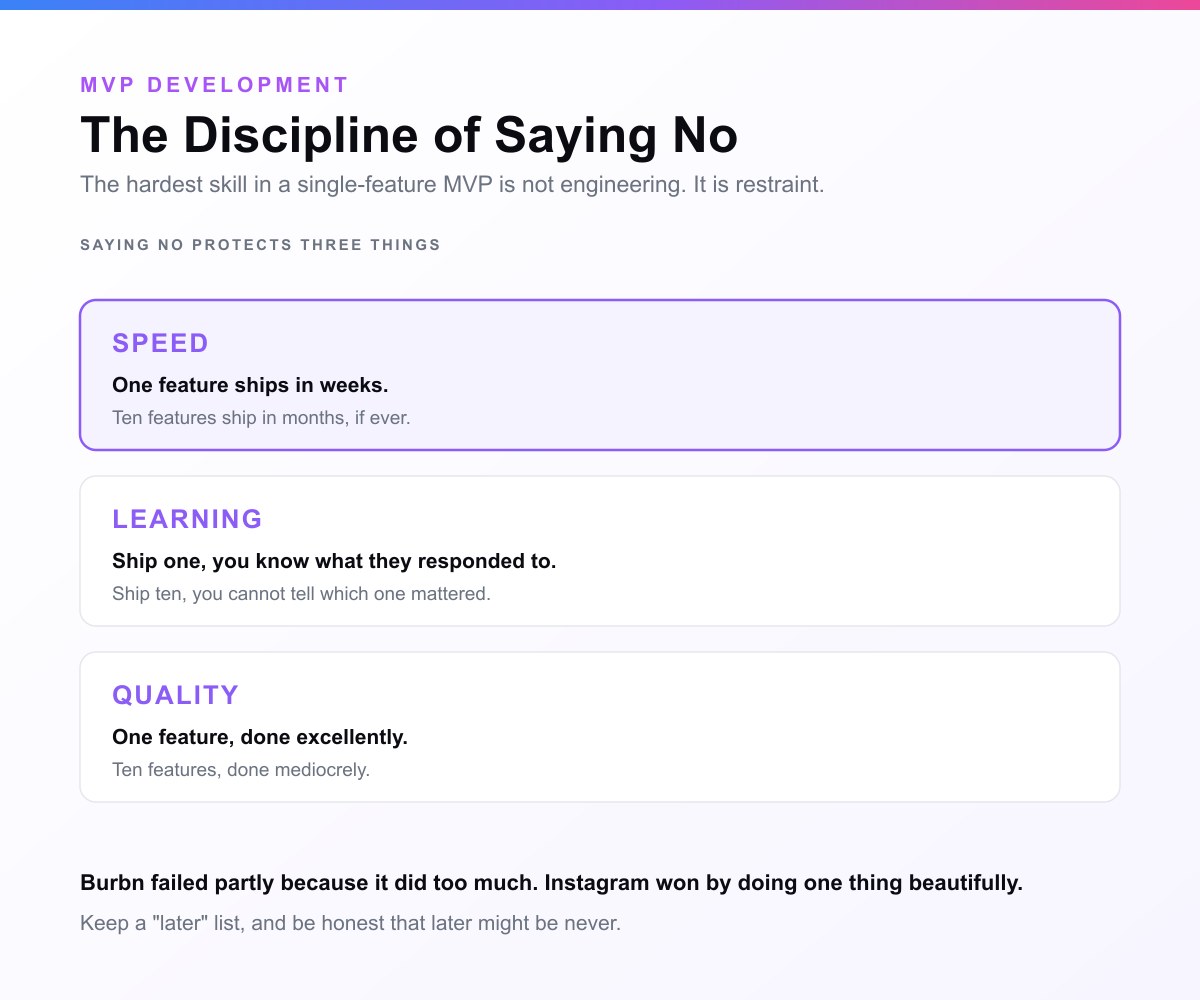
Practically, saying no means maintaining a "later" list and being honest that "later" might be never. It means resisting the stakeholder, investor, or your own enthusiasm that insists a feature is essential, and asking: does the core value work without it? If yes, it waits. The founders who can hold this line ship faster and learn more than those who cannot, and it is often the single biggest determinant of whether an MVP succeeds.
Single-feature MVPs and AI in 2026
AI has changed single-feature MVPs in two ways. First, the single feature itself is increasingly an AI feature: the one thing the product does is summarize, generate, classify, or assist, powered by a model. This makes choosing the feature even more important, because AI features are easy to bolt on everywhere and most valuable when one is done exceptionally well rather than ten done shallowly.
Second, AI has compressed the build. AI-assisted development lets a small senior team build a real, production-grade single feature far faster than before, which is why a focused MVP can now ship in weeks. The constraint has shifted from "can we build it?" to "did we choose the right one feature, and did we build it well?" That makes the triage, finding the one feature that delivers value, the highest-leverage decision in the whole process. The technology to build is cheap and fast; the judgment about what to build is where the value now sits. It also means the bar for quality is higher: when anyone can generate a feature quickly, the single feature has to be genuinely good to stand out.
Pros and cons of the single-feature MVP
Pros:
- It validates the real product, not just interest. You learn whether the built core gets used and kept, the question that actually predicts success.
- It is fast and focused. One feature ships in weeks, and the focus produces clear learning.
- It produces real retention data. The strongest evidence of a viable product, and the most fundable.
- It forces clarity. Choosing one feature makes you understand your true value proposition.
- It is a foundation, not a throwaway. Done well, the single feature is the real first version you build on, not a test you discard.
Cons:
- Choosing the feature is hard. Picking the wrong "one thing" wastes a real build, and the choice requires killing ideas you love.
- It requires building. Unlike demand tests, it costs real engineering time and money, so it should follow demand validation, not precede it.
- Some value needs more than one feature. A few products genuinely cannot be proven by a single feature, though fewer than founders assume.
- The discipline is unnatural. The constant pressure to add features works against the whole method.
- It tests the product, not the market. It assumes demand is already validated; it will not tell you whether anyone wanted the product in the first place.
Common mistakes founders make
- Shipping two or three features instead of one. "Single" keeps sliding to "just a few." Each addition slows the build and muddies the learning. Hold the line at one.
- Choosing the wrong feature. Building a feature you love rather than the one that carries the core value or tests the riskiest assumption.
- Confusing minimum with low quality. Shipping a broken or ugly single feature, which fails the test for the wrong reason. Narrow scope, high quality.
- Building the machinery instead of the magic. Spending the budget on admin panels, settings, and dashboards rather than the one feature that delivers value.
- Measuring signups instead of retention. Celebrating interest while ignoring whether anyone comes back, which is the only signal that matters here.
- Adding the second feature too early. Expanding before the core is validated, so you never learn whether the first feature actually worked.
- Skipping demand validation first. Building a single feature for a product nobody wanted. The single-feature MVP tests the product, not the market.
Signs your single-feature MVP is working (and when to expand)
Your single feature is validated when real users do not just try it but return to it, when retention holds rather than decaying to zero after the first use, when engagement deepens among a core group, and when users show emotional pull: asking for more, telling others, reacting when it breaks. The clearest test is whether a meaningful group would be genuinely disappointed to lose it. When those signals line up, the core is proven.
That is also the signal that you have earned the right to expand. The time to add the second feature is when the first is validated and your users, through their behavior and their requests, are telling you what the next most valuable thing is. You expand from evidence, not from your original feature list. Conversely, if the single feature does not retain, do not respond by adding more features to compensate; that almost never works. A core that nobody returns to is a signal to rethink the feature, the audience, or the value, not to pile more on top of an unvalidated foundation. The whole point of the single-feature MVP is to learn this clearly, before you have built the pile.
How to graduate from a single feature to a full product
A validated single feature is the foundation of your real product. Growing from it deliberately:
- Confirm the core retains. Before expanding, be sure the single feature genuinely keeps users. Expansion built on a weak core inherits the weakness.
- Let usage pick the second feature. Build the next feature that your real users' behavior and requests point to, not the next item on your original list. The evidence has changed since you started.
- Add one at a time, measuring each. Expand feature by feature, checking that each addition deepens engagement rather than diluting focus. Keep the single-feature discipline as you grow.
- Protect the magic moment. As the product grows, guard the core experience that made the single feature work. Many products lose what made them special by burying it under additions.
The discipline that built the single-feature MVP, ruthless focus on what delivers value, is the same discipline that should guide its growth. The product gets bigger; the focus on value should not get weaker.
A worked example
Imagine a founder who has validated, with a landing page, that busy managers want a tool to turn meeting recordings into shareable summaries. Demand is proven. Now the question is the product one: when we actually build summarization, do people use it and come back?
She resists building the full vision, integrations with every calendar, a team dashboard, analytics, permissions, and instead defines the single feature: upload a recording, get a clean one-page summary. That is the magic moment. Everything else, sharing settings, team management, integrations, she fakes or defers. She builds that one feature to real quality on a modern stack, with an AI model doing the summarization, and ships it in a few weeks to the 220 people from her landing-page waitlist.
She measures not signups but use: how many upload a second recording, and a third. In the first weeks, 35 percent of users come back to summarize another meeting within a week, and a core group uses it almost daily, telling her they would be lost without it. That retention, not the initial interest, is the real validation: the built core gets used and kept. From their behavior and requests, the next feature becomes obvious (they want to share summaries to Slack), so she builds that second, measured, focused. The single-feature MVP did its job: it proved the core works, with real users, fast, and pointed clearly at what to build next.
How MVP Development helps
The single-feature MVP is the type we build most, because it is where validation turns into a real product. Once you know what to build, whether from a demand test, a manual validation, or clear conviction, the job is to build the one core feature well and fast, and to resist the pull to build everything else.
That is exactly what we do: we help you find the single feature that carries your value (the triage is half the battle), then build it to production quality as a single-feature MVP, shipped funding-ready in 3 to 4 weeks by senior engineers, on a modern, AI-accelerated stack, with a clear, scoped quote you approve before we start. You get a real product real users can use, instrumented so you can see whether the core retains, and a team that knows how to keep the scope honest so you ship and learn instead of building forever.
Know your one feature and ready to build it? Name the one feature your product is really about and we will scope the MVP around it and nothing else.
Related guides
- What Is an MVP?: the full definition of a minimum viable product, and what makes one work
- MVP Examples: 15 Famous MVPs: see these MVP types in action at Airbnb, Dropbox, Uber, and more
- How to Build an MVP: the step-by-step process from idea to launch
- The Amazon MVP: one category (books), done completely, then expanded
Frequently asked questions
What is a single-feature MVP?
A single-feature MVP is a real, working product that does exactly one thing: the single core feature that delivers your value. Everything else is cut, faked, or deferred. You build that one feature to production quality and ship it to real users to learn whether the core of your product actually gets used and kept. It is the type most people mean when they say "MVP," and it focuses all your effort on proving the one thing that matters most.
What is an example of a single-feature MVP?
Instagram is the classic example: it began as a cluttered check-in app called Burbn, then stripped down to a single feature, photo sharing with filters, and grew from there. Spotify focused its MVP on one feature, instant music streaming, while ignoring everything else. Amazon launched selling only books. In each case, a complex vision was reduced to one well-built core feature that proved the idea before anything else was added.
How is a single-feature MVP different from a landing page MVP?
A landing page MVP does not build anything; it measures whether people want a product by asking for a signup. A single-feature MVP is a real, working product that you build to learn whether the core actually gets used and kept. The landing page answers "do people want this?" The single-feature MVP answers the harder, later question: "when we build the core, do people use it and come back?" They are often used in sequence: validate demand first, then build the single feature.
How do I choose which feature to build?
Identify the core value of your product in one sentence, find the riskiest assumption that could kill the company if it is wrong, and separate the "magic moment" where users feel the value from the supporting machinery. Build the feature that delivers that magic moment and tests that assumption. Then cut everything else to the bone. The hardest part is restraint: whatever you think the minimum is, it is usually still too big.
Is a single-feature MVP low quality?
No. "Minimum" refers to scope, not craft. You are building only one feature, so you build it well: it should work reliably, feel good to use, and genuinely deliver value. A broken or ugly single feature fails the test for the wrong reason, because you cannot tell whether users rejected the idea or just the bad execution. The discipline is narrow scope, high quality.
What should I measure in a single-feature MVP?
Use and retention, not signups. Measure activation (how many users reach the magic moment), retention (how many come back and use the feature again), and engagement depth. Retention is the most important signal, because repeated use is what separates a real product from a one-time novelty. Pair the numbers with user conversations. The product is validated when a meaningful group uses the core, returns to it, and would be genuinely disappointed to lose it.
When should I add the second feature?
When the first feature is validated, meaning real users return to it and it retains, and when their behavior and requests point clearly to what the next most valuable thing is. You expand from evidence, not from your original feature list. If the single feature does not retain, do not add more features to compensate; that almost never works. A core nobody returns to is a signal to rethink the feature or the audience, not to build on top of it.
How long does it take to build a single-feature MVP?
A well-scoped single feature can ship in weeks rather than months, especially on a modern stack with AI-assisted development. The timeline depends far more on scope discipline than on engineering: a genuinely single feature is fast, while a "single feature" that has quietly grown into three is not. At MVP Development we build focused single-feature MVPs funding-ready in 3 to 4 weeks, which is possible precisely because the scope is kept honest.
How is a single-feature MVP different from a piecemeal MVP?
A single-feature MVP is purpose-built: you write real, production-grade software for the one core feature. A piecemeal MVP assembles the product from existing tools, no-code platforms, and APIs rather than building custom software. Piecemeal is often faster and cheaper but limited by the tools and harder to scale; single-feature is custom and scalable but takes real engineering. Which is right depends on whether your core feature can be delivered with off-the-shelf parts or needs to be built.
Can a single-feature MVP use AI?
Yes, and increasingly the single feature is an AI feature: the one thing the product does is generate, summarize, classify, or assist, powered by a model. AI also makes the build faster, so a real AI-backed single feature can ship in weeks. The key is to do one AI feature exceptionally well rather than scatter shallow AI across the product, and to keep the quality bar high, because when AI features are easy to generate, the single feature has to be genuinely good to matter.
Where does the single-feature MVP fit among the other MVP types?
It is the central product-validation type, with the piecemeal and prototype approaches, in the broader map of MVP types. Demand types (landing page, fake door, crowdfunding) ask "do people want this?" Manual types (concierge, Wizard of Oz) ask "can we deliver it?" The single-feature MVP asks "does the built core get used?" It is frequently the destination of the whole sequence: the first piece of real, automated product you ship.
Sources and references
This guide draws on documented startup histories and lean-product practice:
- Startup Archive, how Systrom pivoted Burbn into Instagram the single-feature pivot in detail
- RST Software, examples of successful MVPs Spotify, Amazon, and other single-feature launches
- Atlassian, what is a minimum viable product the core-feature MVP principle
- The Lean Startup validated learning and the build-measure-learn loop


