


TL;DR
The core difference in MVP vs beta: an MVP is the first real version of a product, launched to test whether the market wants it at all, while a beta is a near-complete, already-validated product released to a limited group to test whether it is stable and ready for full launch. An MVP answers a demand question with a minimal product and early adopters. A beta answers a readiness question with a feature-complete product and a wider test group. They look alike, since both are working software in front of real users, but they sit at opposite ends of the build and answer different risks.
Short version: if you are still proving that anyone wants this, you are at the MVP. If demand is already proven and you are hardening a finished product before you open the doors, you are at the beta. At MVP Development we ship a funding-ready MVP in 3 to 4 weeks on a clear, scoped quote you approve before we start, so founders reach real demand evidence first and worry about beta hardening later. More on the order below.
Key Takeaways
- An MVP is the first real version, launched to test whether the market wants the product at all.
- A beta is a near-complete, already-validated product released to a limited group to test stability and readiness.
- An MVP answers a demand question; a beta answers a readiness question.
- If you are still proving anyone wants this, you are at the MVP; if demand is proven and you are hardening a finished product, you are at the beta.
MVP vs beta: the difference that matters most
Strip away the jargon and the distinction is about timing and intent. An MVP comes first and asks a market question: do people want this enough to use and pay for it. A beta comes much later and asks an engineering question: is this finished product stable and ready to release to everyone.
That one difference cascades into everything else. An MVP is deliberately minimal, often rough, and pointed at a small group of early adopters whose behavior tells you whether the idea has legs. A beta is deliberately near-complete, comparatively polished, and pointed at a larger limited group whose usage surfaces the bugs, performance limits, and edge cases you need to fix before a public launch.
Founders confuse the two constantly, and the confusion is expensive. Call a beta an MVP and you over-build for months before getting a shred of demand evidence. Call an MVP a beta and you treat unvalidated software as if it were a launch candidate, polishing and load-testing a product nobody has proven they want.
What is an MVP?
An MVP (minimum viable product) is the smallest version of your product that is genuinely functional and delivers real value, built to learn whether the market wants it. It does one core thing to a real, working standard, ships to actual users, and exists to produce one kind of evidence: do people adopt it, keep using it, and pay.
The defining trait of an MVP is that demand is still unproven. You are not refining a known winner, you are testing a hypothesis. That is why an MVP can be narrow and unpolished without failing at its job: its job is learning, not launching. An MVP sits at a specific point in a company's life, after the idea is shaped and before scaling begins, which we cover in depth in our guide to the MVP stage of a startup.
An MVP can take many forms, from a concierge service to a single-feature app to a landing page, depending on the cheapest honest way to test demand. We map the full set in our breakdown of the types of MVP.
What is a beta?
A beta is a near-complete, feature-complete version of a product, released to a limited group of real users to test stability, performance, and readiness before a full public launch. Named after the second letter of the Greek alphabet, beta is the development phase that follows alpha (internal testing) and precedes general availability.
The defining trait of a beta is that the product concept is already validated. You are no longer asking whether people want it. You are asking whether the finished thing holds up under real-world conditions: diverse devices, messy data, unexpected usage, and load you cannot fully simulate in-house. A beta phase generally begins when the software is feature-complete but still likely to contain known or unknown bugs.
A beta is the final rehearsal before opening night. The script is written and the cast is set. What you are testing is whether the show runs cleanly in front of an audience.
MVP vs beta: side-by-side comparison
Here is the full MVP vs beta comparison across the categories that actually drive the decision.
| Category | MVP | Beta |
|---|---|---|
| What it is | The first minimal, working version of a product | A near-complete product before full launch |
| Core question | "Do people actually want this?" | "Is this ready and stable to launch?" |
| What it tests | Market demand and product-market fit | Stability, performance, and readiness |
| Stage | Early: the first real product | Late: after the MVP, before general release |
| Completeness | Minimal, one core flow | Feature-complete, most of the product |
| Demand status | Unproven, being tested | Already validated |
| Polish | Rough is acceptable | Comparatively polished |
| Audience | A few early adopters | A larger limited group of testers |
| Who pays | Early adopters may pay to use it | Testers often test for free or are incentivized |
| Primary metrics | Activation, retention, conversion | Crash rate, bug reports, performance, NPS |
| Risk it reduces | "Will the market adopt and pay?" | "Will the product break at launch?" |
The table is the fast answer. The sections below unpack the comparison categories that matter most, because the nuance is where founders place themselves at the wrong stage.
The 6 comparison categories that matter
1. Purpose: validate demand vs validate readiness
This is the category everything else flows from. An MVP validates demand: will real people choose this, use it repeatedly, and pay. A beta validates readiness: does the already-wanted product run reliably for a wide enough slice of users to launch publicly.
The trap is running a beta when you still need an MVP. Polishing, hardening, and load-testing a product whose demand is unproven is effort spent in the wrong place. You can ship a flawless, bug-free product that nobody wants. Only the MVP closes the demand question, and it has to come first.
2. Completeness: minimal vs feature-complete
An MVP is minimal by design. It does one core thing well and leaves the rest out, because the goal is to test the central value proposition with the least build. According to GeeksforGeeks, an MVP carries the minimal functionality needed for early users to solve their task, while a beta is almost the final version with an extended feature set.
A beta is feature-complete. The scope that will ship at launch is essentially all there. What remains is fixing defects and smoothing rough edges, not deciding what the product is. If you are still cutting and adding core features to learn what resonates, you are at the MVP, not the beta.
3. Audience: early adopters vs a wider test group
An MVP goes to a small group of early adopters: users who tolerate rough edges in exchange for solving a real problem early. Their behavior is the signal. You are watching whether they come back and convert, not whether they find every bug.
A beta goes to a larger limited group whose job is closer to stress-testing. As Feedough puts it, an MVP early adopter will pay to use the product, whereas a beta tester often needs to be incentivized to hunt for bugs. The audiences differ because the questions differ: early adopters reveal demand, beta testers reveal defects.
4. Polish and stability expectations
An MVP can be rough. A clunky flow or a missing nicety does not invalidate the demand signal, as long as the core value works. Founders who over-polish an MVP usually waste time perfecting a product whose premise is unproven.
A beta is held to a higher bar. It should be stable enough that real users can rely on it for real work, even if some bugs remain. The whole point of the beta is to find and fix the stability issues that internal testing missed, so reliability is the target, not an afterthought. This is a core reason a beta is not just a bigger MVP.
5. The metrics you actually track
An MVP and a beta succeed or fail on different numbers, and using the wrong scorecard wastes the exercise.
MVP metrics are behavioral and demand-focused:
- Activation: do new users reach the core value?
- Retention: do they come back after the first use?
- Conversion: do they take the action that matters (sign up, pay, invite)?
- Organic growth: does usage spread without you pushing it?
Beta metrics are stability and readiness-focused:
- Crash and error rate: how often does the product fail under real use?
- Bug reports: what breaks, how severe, how often?
- Performance: does it hold up under load, on slow networks, on varied devices?
- Satisfaction and NPS: are testers confident enough to recommend it at launch?
The difference is the whole point. MVP numbers tell you whether a business exists. Beta numbers tell you whether the product is safe to put in front of everyone.
6. Where each sits in the timeline
The release of an MVP always precedes a beta. The common order is: shape the idea, build the MVP, learn from early adopters, iterate toward product-market fit, then, once the product is feature-complete and demand is real, run a beta to harden it before general availability.
Skipping straight from idea to beta is the classic mistake. It assumes the answer to the demand question before asking it. Skipping the beta entirely and launching an unhardened product to everyone is the opposite mistake: shipping a validated idea on shaky engineering. Both stages exist because they retire different risks at different times.
Alpha, beta, and where the MVP fits
Beta has two siblings that complete the picture: alpha (the phase before it) and general availability (the phase after). Placing the MVP against all three removes most of the confusion.
| Stage | What it is | Question it answers | Audience |
|---|---|---|---|
| MVP | The first minimal, real product | "Do people want it?" | A few early adopters |
| Alpha | Early internal testing of a feature-complete build | "Does it work in-house?" | Internal team |
| Beta | External testing of a near-final product | "Is it stable and ready?" | A limited external group |
| GA (launch) | The full public release | "Can we serve everyone?" | The whole market |
Alpha testing happens internally, in a controlled environment, using white-box techniques, before the product reaches outside users. Beta testing happens externally, with real users, in real-world conditions. The MVP is the odd one out: it is not a testing phase of a finished product at all, it is the first product, built to test the idea itself. Alpha and beta assume the product should exist. The MVP is how you earn the right to assume that.
Open beta vs closed beta
If a beta is the right stage for you, the next decision is how wide to open it. The two common shapes test different things.
- Closed beta: a hand-picked group that meets specific criteria. Closed betas give you controlled, in-depth feedback from users who match your target profile. Best when you want focused, high-quality input and tight control over who sees an unfinished product.
- Open beta: anyone interested can join. Open betas are about testing at scale, surfacing performance issues under heavy load and the rare bugs that only appear with thousands of concurrent users. Best when stability under volume is the main unknown.
Many teams run a closed beta first for depth, then an open beta for scale. The choice is not about which is better, it is about whether your remaining risk is quality of feedback (closed) or behavior under load (open). Note that neither is an MVP: both assume a validated, feature-complete product, which is the line that separates a beta of any kind from an MVP.
How long a beta runs, and how many testers it needs
A beta has a shape that an MVP does not, and the numbers make the difference concrete. Centercode, which has run beta programs for two decades, puts the execution phase of a beta at 3 to 12 weeks: shorter and you cannot see the bugs that only appear with repeated use, longer and tester participation collapses. The platforms enforce their own limits on top of that. Apple’s TestFlight allows up to 10,000 external testers per app and expires each build after 90 days. Google Play requires a personal developer account created after November 2023 to run a closed test with at least 12 testers opted in for 14 continuous days before it will let the app go to production at all.
An MVP cohort looks nothing like that. It is often 10 to 50 people, hand-picked, and it is judged on one question: did they come back and would they pay. Nobody counts crash reports on an MVP; there is not enough surface area to crash.
| MVP | Closed beta | Open beta | |
|---|---|---|---|
| Typical size | 10 to 50 early adopters | 20 to a few hundred, screened | Hundreds to thousands, self-selected |
| Typical length | Until the demand question is answered, often 4 to 8 weeks | 3 to 12 weeks | 3 to 12 weeks, sometimes rolling |
| What ends it | A retention or payment signal, or the lack of one | A stable build with the known bug list closed | Performance under load holds |
| The number that matters | Week-4 retention, conversion to paid | Bugs found and fixed, task completion | Crash rate, latency, support volume |
If your plan says “beta” but your cohort is fifteen people you recruited by hand and the thing you are watching is whether they log in on day 10, you are running an MVP, and the launch plan and metrics should be the MVP ones.
Why a beta is not just a bigger MVP
The single most costly misconception in the MVP vs beta debate is treating a beta as a scaled-up MVP, a slightly bigger version of the same exercise. It is not. They answer different questions at different times, so one cannot stand in for the other.
This shows up in two expensive ways. The first: a founder treats the MVP like a beta, polishing and hardening a minimal product before any demand is proven. Months go into stability and feature completeness for a premise no user has validated. The MVP did its job poorly because it was asked to be a launch candidate instead of a learning tool.
The second: a founder treats a beta like an MVP, releasing a feature-complete product to a wide group and reading "they used it without complaint" as proof of demand. But by the beta stage the demand question should already be answered. If it is not, the beta is testing readiness for a launch that may never deserve to happen, which is effort layered on an unverified bet.
As one investor framing puts it, your MVP is not a beta version of your product. The fix is to hold the stages apart: an MVP proves the market wants it, a beta proves the wanted product is ready. Skipping one in favor of the other, as multiple practitioners note, is a serious mistake, not a shortcut.
How real products used each
The clearest way to understand the distinction is to see each stage doing its actual job.
Dropbox used an MVP-style demand test. Before building the full product, Drew Houston released a short demo video showing how Dropbox would work. It was a demand test, not a readiness test: the goal was to learn whether anyone wanted file sync that simple. The waitlist jumped from around 5,000 to 75,000 overnight. That is an MVP move, answering "do people want this" before committing to the build.
Gmail ran one of the longest betas in software history. Google launched Gmail in 2004 and kept the public "beta" label until 2009, years after it was clearly a validated, widely used product. The point of a beta, hardening and proving readiness at scale, was stretched far past its normal length, but the intent was classic beta: a feature-rich product, used by real people, being refined before being declared generally available. Demand was never in question by then. Readiness and scale were.
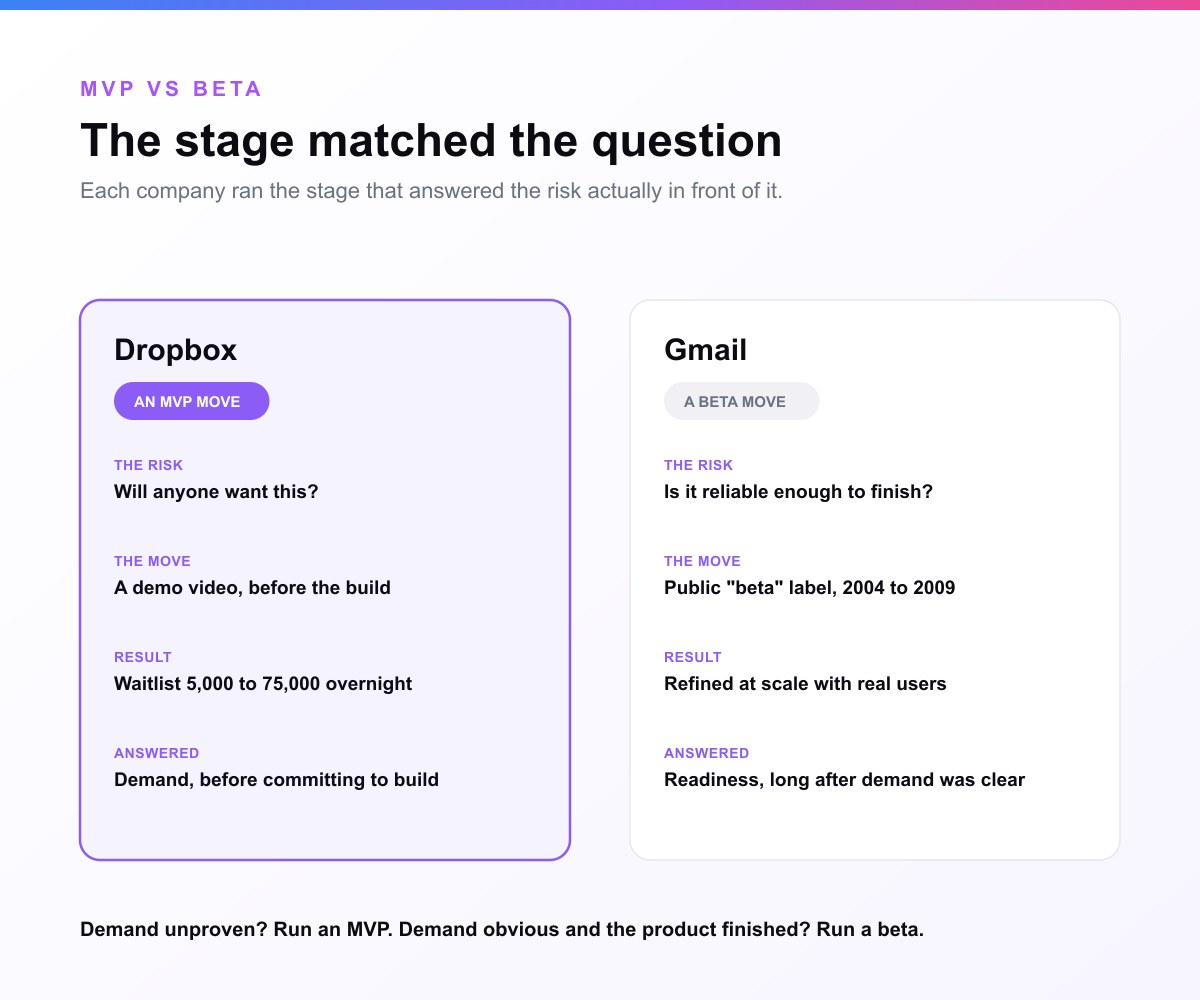
The contrast is the article in two stories. Dropbox's risk was "will anyone want this," which only a demand test could answer. Gmail's risk, once it existed, was "is this reliable enough to call finished," which only a beta could answer. Each tool matched the question on the table, which is exactly the decision in front of you.
Which stage are you actually in?
The decision is not about which is "better." It is about which question you most need answered next. Use this simple logic:
- You are at the MVP if demand is unproven. You do not yet know whether real users will adopt and pay, and your next job is to find out with the smallest real product that can answer it. This is where most founders actually are, even when they describe their plan as a beta.
- You are at the beta if demand is proven and the product is feature-complete. Early adopters have shown they want it, the scope is essentially set, and your next job is to harden the finished product with a limited group before opening to everyone.
A useful gut check: ask what would change your mind about the product right now. If the honest answer is "seeing whether anyone actually wants it," you need an MVP, not a beta, no matter how far along the build feels.
When to run a beta (and when not to)
Run a beta when:
- Demand is already validated and the product is feature-complete.
- You need to catch stability, performance, and edge-case issues before a public launch.
- You want a limited group of real users to confirm readiness, not to confirm the idea.
Hold off on a beta when:
- You have not yet proven anyone wants the product. Build and learn from an MVP first.
- The product is still missing core features you are unsure about. That is MVP iteration, not beta.
- You are tempted to "soft launch as a beta" mainly to lower expectations for an unvalidated product. That is a label, not a strategy.
When to build an MVP (and when not to)
Build an MVP when:
- Your biggest question is whether the market wants and will pay for the product.
- You need real usage data to raise money, decide whether to continue, or shape what to build next.
- You can define a single core flow worth shipping to early adopters.
Move past the MVP when:
- Early adopters have clearly validated demand and retention.
- You have a roadmap for the feature-complete product, which is what an MVP roadmap is for.
- The remaining risk has shifted from "do they want it" to "is it ready," which is the signal to plan a beta.
Common mistakes founders make
1. Calling an MVP a beta. Labeling a demand test as a beta implies the idea is validated when it is not. It quietly skips the most important question and sets the wrong success metrics (stability instead of demand).
2. Building an MVP to beta-quality. Hardening, load-testing, and polishing a minimal product before any demand is proven. The effort is real, but it answers a question you have not earned the right to ask yet.
3. Skipping the MVP and going straight to beta. Assuming demand and spending months on a feature-complete product, then "beta testing" it. If the market does not want it, a flawless beta changes nothing. This is one of the core MVP development challenges we see sink startups.
4. Skipping the beta and launching cold. Taking a validated product straight to full public release with no limited hardening phase. Real-world conditions surface bugs internal testing never could, and a public launch is an expensive place to discover them.
A concrete example
Imagine a founder building an app that auto-generates product descriptions for online sellers.
- The MVP ships the single core flow for real: a seller connects a store, generates one real description, and publishes it, with payment if you are charging. A small group of early adopters uses it, and you learn the only thing that matters at this stage: do sellers come back and pay? Demand is the question.
- The beta comes much later, after demand is proven and the full product (bulk generation, templates, integrations, billing tiers) is feature-complete. You invite a larger limited group, watch for crashes under real catalogs, measure performance on large stores, and fix the bugs that only appear in the wild. Readiness is the question.
Each step answers a different risk in a different order. A founder who has not proven demand should be building the MVP, not planning a beta, no matter how complete the vision feels.
The MVP Development take
In our experience, most founders who say they are "launching a beta" are actually at the MVP stage and have not yet proven demand. The beta framing feels safer, since it implies the product is real and nearly done, but it skips the question that decides whether the product should exist at all. A polished beta of an unwanted product is the most expensive way to learn you guessed wrong.
That is why our default is to take founders straight to a real, narrow MVP: a single core flow, built to production standard, live for real early adopters, in 3 to 4 weeks on a clear, scoped quote you approve before we start. You get the one thing that actually de-risks the business, evidence of real demand, plus a deployed product you can put in front of investors. The beta comes later, once demand is proven and the feature-complete product needs hardening before a public launch.
There is no conflict between the two stages, only an order. The MVP earns the right to build the full product. The beta makes sure the full product is ready. Run them in that sequence and each one does its job. Collapse them, and you either over-build before you have proof or launch shaky software on a validated idea. We help founders place themselves honestly on that timeline, then build whatever the current stage actually calls for.
Not sure which stage you are in? Tell us what you are trying to learn and we will say honestly whether an MVP or a beta gets you there faster.
Related guides
- What Is an MVP?: a clear definition of the minimum viable product
- How to Build an MVP: the step-by-step founder's playbook
- MVP Examples: 15 Famous MVPs: how the biggest startups validated with an MVP
Frequently asked questions
What is the difference between an MVP and a beta?
An MVP is the first minimal, working version of a product, launched to test whether the market wants it at all. A beta is a near-complete, already-validated product released to a limited group to test stability and readiness before a full launch. In short, an MVP tests demand and comes early; a beta tests readiness and comes late.
Is a beta the same as an MVP?
No. They look similar because both are working software used by real people, but the intent differs. An MVP tests whether the product is wanted; a beta tests whether an already-wanted, feature-complete product is stable enough to launch. If demand is still unproven, you are at the MVP, not the beta.
Which comes first, the MVP or the beta?
The MVP comes first, always. You build an MVP to prove demand, iterate toward product-market fit, complete the product, and only then run a beta to harden it before general availability. A beta assumes the demand question is already answered, which is the MVP's job.
Can an MVP become a beta?
Indirectly. An MVP can evolve into the full product over many iterations, and that feature-complete product is what you eventually put into beta. But the MVP itself is not a beta, because at the MVP stage demand is still unproven and the product is intentionally minimal rather than feature-complete.
What is the difference between alpha, beta, and MVP?
Alpha is early internal testing of a feature-complete build, done in-house. Beta is external testing of a near-final product with a limited group of real users. An MVP is not a testing phase at all: it is the first minimal product, built to validate the idea before a full product exists. Alpha and beta assume the product should exist; the MVP is how you prove it should.
Should a beta product be polished?
More than an MVP, yes. A beta should be stable enough that real users can rely on it for real work, since the goal is to confirm readiness and catch the stability issues internal testing missed. Some bugs are expected, but a beta that crashes constantly is not ready to be a beta. An MVP, by contrast, can be rough as long as the core value works.
What is the difference between an open beta and a closed beta?
A closed beta limits participation to a hand-picked group, giving controlled, in-depth feedback from users who match your target profile. An open beta lets anyone join and is about testing at scale, surfacing performance issues and rare bugs that only appear with large numbers of users. Many teams run a closed beta first, then an open beta.
Do beta users pay?
Usually not, or not full price. Beta testers are often given free or discounted access, and sometimes incentivized, because their job is to find bugs and stress the product. MVP early adopters are different: a willingness to pay for an MVP is part of the demand signal you are testing. That difference in the money relationship reflects the different purpose of each stage.
Is an MVP a beta version of the product?
No. A beta version is a near-complete product being tested for readiness, while an MVP is a deliberately minimal product being tested for demand. Treating your MVP as a beta version assumes the idea is validated and the scope is set, neither of which is true at the MVP stage. The two sit at opposite ends of the build.
What comes after a beta?
General availability, the full public launch, where the product opens to the whole market. After the beta confirms stability and readiness, you fix the remaining issues, remove the beta label, and release. From there the focus shifts to scaling and growth, a different stage with different goals than either the MVP or the beta.
How is MVP vs beta different from MVP vs prototype?
A prototype comes before the MVP and is a non-functional simulation that tests design. A beta comes after the MVP and is a feature-complete product that tests readiness. The MVP sits between them as the first real, minimal product that tests demand. We cover the earlier comparison in detail in MVP vs prototype.
Does an MVP come before a beta?
Yes, almost always. The MVP settles whether people want the product; the beta comes later and settles whether the finished product is stable enough to release widely. A team that runs a beta without an MVP is hardening a product nobody has yet asked for.
How long should a beta test last?
Three to twelve weeks for the testing phase itself, per Centercode’s benchmarks. Apple’s TestFlight expires builds after 90 days, and Google Play’s closed-test requirement for new personal accounts is 14 continuous days with 12 testers, which sets a practical floor.
Can an MVP also be a beta?
Not in any useful sense. They answer different questions with different people. If you find yourself calling the same release both, decide which question you actually need answered first; for a first product it is the MVP’s demand question.
Sources and references
This comparison draws on established product and software-release frameworks and current practice:
- GeeksforGeeks, MVP vs Beta Release purpose, completeness, and audience differences
- Feedough, MVP vs Beta the demand-vs-readiness distinction and who pays
- SDH, MVP vs Beta-version functionality and target-audience contrasts
- Wikipedia, Software release life cycle alpha, beta, and general-availability definitions
- Eric Ries, The Lean Startup the origin of the MVP concept
- Centercode, How Long Should My Beta Test Be?, execution phase of 3 to 12 weeks
- Apple Developer, TestFlight, up to 10,000 external testers, builds expire after 90 days
- Google Play Console Help, Closed testing requirements for new personal developer accounts, 12 testers for 14 continuous days
Time and delivery ranges reflect Q2 2026 practice; the 3 to 4 week figure reflects MVP Development delivery data for tightly scoped, single-flow MVP builds.


