


TL;DR
The core difference in MVP vs MBI: an MVP (minimum viable product) is the smallest product you build to learn whether a market exists for an idea, while an MBI (minimum business increment) is the smallest increment of work that delivers realized business value, including everything needed to actually capture that value. Put most simply: an MVP is an investment in learning, and an MBI is an investment in value. The MVP reduces uncertainty about a new idea. The MBI delivers concrete value on a real product, sooner, by bundling not just the feature but the operations, documentation, and marketing required to make that value real.
Short version: if you are still proving that a market exists for a new idea, you think in MVPs, the smallest experiment that produces learning. If the product is established and you are delivering value to a real market, you think in MBIs, the smallest slice of value you can fully realize and ship now. The MVP is about discovery. The MBI is about delivering value incrementally. At MVP Development we ship a focused MVP in 3 to 4 weeks on a clear, scoped quote you approve before we start, then help you plan what follows as increments of real value rather than one giant release. More on how they differ below.
Key Takeaways
- An MVP is the smallest product you build to learn whether a market exists for an idea.
- An MBI (minimum business increment) is the smallest increment of work that delivers realized business value, including everything needed to capture it.
- An MVP is an investment in learning; an MBI is an investment in value.
- Think in MVPs while proving a market exists; think in MBIs once the product is established and you are delivering value incrementally.
MVP vs MBI: the difference that matters most
Strip both terms down and the difference is about what you are investing in. An MVP is an investment in learning: you spend the least possible to discover whether anyone wants a new idea. An MBI is an investment in value: you deliver the smallest slice of real business value you can fully realize, on a product that already exists, so the organization captures worth sooner.
That single difference, learning versus value realization, drives everything else. An MVP can be incomplete and rough because its job is to produce information, not to let a customer finish their work. An MBI cannot be a fragment: it has to deliver value the business can actually realize, which means it includes far more than code. As Net Objectives, who coined the term, put it, an MBI contains all of the pieces required for value realization, including any work required by documentation, operations, and marketing.
The two also live in different contexts. The MVP belongs to the world of new products and early adopters, where the open question is "does a market exist for this." The MBI belongs to established products and real markets, where the question is "what is the smallest increment of value we can deliver and realize right now." One explores. The other delivers.
What is an MVP?
An MVP (minimum viable product) is the smallest version of your product that is genuinely functional and built to test a hypothesis: usually whether real people want what you are making enough to use it and pay. It does one core thing to a working standard, ships to actual users, and exists to generate validated learning with the least time and effort. The concept was popularized by Eric Ries in The Lean Startup as the fastest way to get through the build-measure-learn loop.
The defining trait of an MVP is that something important is still unproven, most often whether a market exists at all. You are not delivering value to an established customer base, you are running an experiment to reduce uncertainty about a new idea. That is why an MVP can be narrow, rough, and even unable to let a customer complete their full job: its purpose is learning, not value realization. The MVP sits at a specific point in a company's life, after the idea is shaped and before scaling begins, which we cover in our guide to the MVP stage of a startup.
An MVP can take many forms, from a concierge service to a fake-door test to a single-feature app, depending on the cheapest honest way to test demand. We map the full set in our breakdown of the types of MVP. The common thread is that every MVP is chosen to maximize what you learn per dollar and per week spent.
What is an MBI?
An MBI (minimum business increment) is the smallest piece of value that can be realized by a customer, internal or external, in a way consistent with your organization's strategy. As the Disciplined Agile guidance from PMI frames it, the MBI focuses on the realization of business value quickly. It is not a reason to deliver less, it is a reason to deliver sooner.
The term was coined by Al Shalloway at Net Objectives in 2006. They had been using "minimum marketable feature" for about six months, but many IT groups objected that they did not "market" anything and did not build "products," so the team settled on minimum business increment as a name that is more descriptive and works for all kinds of organizations, not just those selling software to a market.
The defining trait of an MBI is that it includes everything required to realize the value, not just the software. A feature sitting in production is not value until customers can actually use it to get an outcome, which often means documentation, operational support, training, sales enablement, and marketing all have to be ready too. The MBI bundles all of that into one increment, so when it ships, the value is genuinely realized, not merely built. That is what makes an MBI "more than an MVP," and more than a feature: it is a complete, deliverable slice of business value.
MVP vs MBI: side-by-side comparison
Here is the full MVP vs MBI comparison across the categories that actually drive the decision.
| Category | MVP | MBI |
|---|---|---|
| Stands for | Minimum Viable Product | Minimum Business Increment |
| What it is | The smallest product built to test an idea | The smallest increment that delivers realized value |
| Core purpose | An investment in learning | An investment in value |
| Question it answers | "Does a market exist for this?" | "What is the smallest slice of real value we can deliver now?" |
| What it includes | Mostly the product or experiment | All work to realize value: dev, ops, docs, marketing |
| Typical context | New product, early adopters, startup | Established product, real market, any organization |
| Can the customer complete their job? | Maybe not, it is a test | Yes, it must deliver usable value |
| What "done" means | Learning captured | Value realized in the business |
| Origin | Frank Robinson, popularized by Eric Ries | Al Shalloway, Net Objectives, 2006 |
| Risk it reduces | Market risk: building the wrong thing | Realization risk: building value that never lands |
The table is the fast answer. The sections below unpack the categories where teams most often pick the wrong tool for their situation.
The 6 comparison categories that matter
1. Purpose: learning vs value realization
This is the category everything else flows from. An MVP is an investment in learning: its job is to reduce uncertainty about whether an idea is wanted, with the least spend. An MBI is an investment in value: its job is to deliver a slice of real business value that the organization can realize now. Judge an MVP by the revenue it produces and you will over-build it. Judge an MBI by "what did we learn" and you will under-deliver, because its point was to realize value, not to run an experiment.
2. Scope: an experiment vs an end-to-end increment of value
An MVP is scoped as an experiment, often just enough product to test the riskiest assumption, and it can stop at the edge of the software. An MBI is scoped as a complete increment of value, which means it reaches past the code to include the operations, documentation, and go-to-market work needed for the value to actually be realized. This is the most concrete difference: an MVP is usually "the product, minimally," while an MBI is "everything required to deliver this slice of value, minimally."
3. Context: a new product vs an established one
The MVP belongs to new products and early adopters, where you are still asking whether a market exists. The MBI belongs to established products and real markets, where the market clearly exists and the question is how to deliver value to it incrementally. As one comparison puts it, the goal of an MVP is to create a new product for early adopters, while an MBI helps solidify an offering to an existing market segment or extend it to a new one. They suit different moments in a product's life.
4. Completeness of value: a test vs a finished slice
In the MVP stage, the product may not have everything a customer needs to complete their full business transaction, and that is acceptable, because the goal is feedback and validation at minimal cost. In the MBI stage, the increment must let the customer actually complete the job and realize the value, because that is the entire point. An MVP can leave the loop open to learn; an MBI must close the loop to deliver.
5. What "done" means
For an MVP, done means you have the learning you came for: a clear read on whether the idea is wanted. The build can be discarded or rewritten afterward, because it was a means to an answer. For an MBI, done means the value is realized in the business: customers are getting the outcome, and the organization is capturing the worth. The deliverable is value in the world, not a lesson in a deck.
6. The risk each one retires
An MVP retires market risk: the chance you pour resources into a product nobody wants. An MBI retires realization risk: the chance you build something valuable on paper that never turns into actual business value because the surrounding work, support, enablement, marketing, was never done, so the feature ships and nothing changes. Both reduce waste, but at different layers: the MVP makes sure you build the right thing, the MBI makes sure the thing you build actually delivers value.
MBI vs MMF: why Net Objectives renamed it
If the MBI sounds close to the minimum marketable feature, that is no accident: it grew directly out of it. Net Objectives used minimum marketable feature for about six months before coining the MBI, and the change was deliberate. Two problems pushed them to rename it.
First, the language did not fit everyone. Internal IT teams objected that they did not "market" anything and did not ship "products" to a market, so "marketable feature" felt wrong for the value they delivered inside an organization. "Business increment" works whether you sell to customers or serve another department.
Second, and more importantly, the MBI is broader than the MMF. An MMF is the smallest feature with market value, focused on the functionality itself. An MBI wraps that feature in everything required to actually realize the value: the operations to support it, the documentation to use it, the marketing and sales enablement to put it in front of people. You can think of an MBI as one or more MMFs plus all the non-development work that turns shipped functionality into realized value. The MMF asks "what is the smallest valuable feature." The MBI asks "what is the smallest amount of total work that delivers realized value."
What "all the pieces for value realization" really means
The idea that most separates the MBI from both the MVP and the MMF is that building a feature is not the same as delivering value. A capability sitting in production delivers nothing until people can find it, understand it, rely on it, and use it to get an outcome. The MBI makes that explicit by refusing to call an increment "done" until the value is actually realizable.
In practice, that means a single MBI can include:
- The development work: the feature or change itself.
- The operational work: support readiness, monitoring, the ability to run the thing reliably.
- The documentation and enablement: help content, training, internal know-how so people can use and support it.
- The go-to-market work: the marketing and sales activity needed for customers to know about it and adopt it.
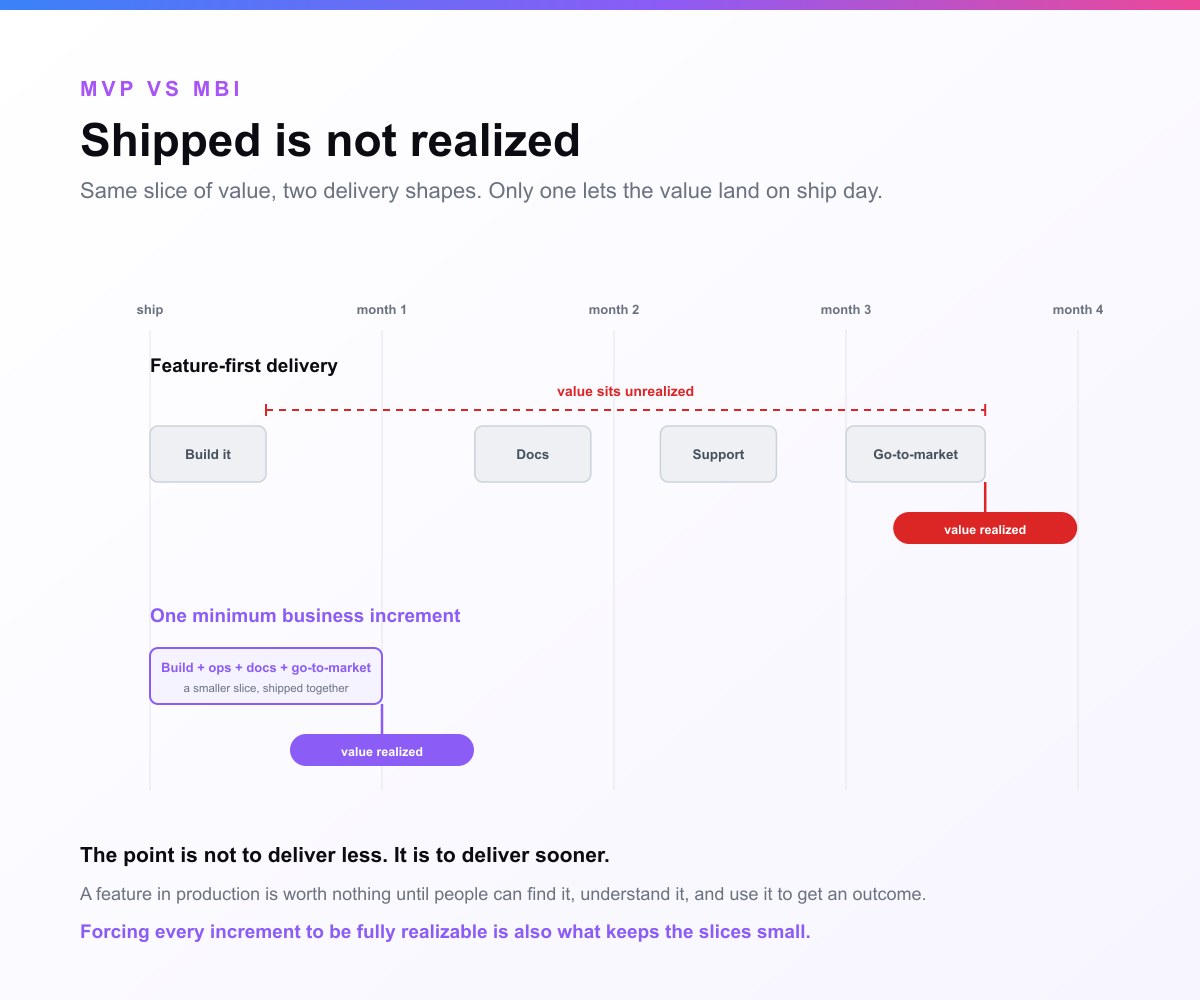
Bundling these into one increment is what lets the MBI "deliver sooner, not less." Instead of shipping a feature in one sprint and the marketing three months later, by which point the value has been sitting unrealized, the MBI sequences the smallest complete slice so the value lands as soon as it ships. This is also why MBIs tend to produce smaller, more valuable features: forcing every increment to be fully realizable pressures teams to cut to what is genuinely needed now. We talk about sequencing this kind of incremental delivery in our MVP roadmap guide.
MBI, MMF, MMP, and MMR: where the increment sits
The MBI belongs to a small family of "smallest valuable chunk" terms, and seeing them side by side makes its scope clear. They are not competitors so much as different-sized units of value, from a single feature up to a full delivered increment.
| Term | Stands for | What it is |
|---|---|---|
| MMF | Minimum Marketable Feature | The smallest single feature with market value on its own |
| MMR | Minimum Marketable Release | The smallest shippable release, usually a bundle of MMFs |
| MMP | Minimum Marketable Product | The smallest complete product you can sell |
| MBI | Minimum Business Increment | The smallest increment of fully realized value, including the work to deliver it |
The MBI is the broadest of these because it is the only one defined by realized value rather than by the product or feature alone. An MMF is the functionality; a minimum marketable product is a sellable assembly of functionality; but an MBI deliberately includes the operations, documentation, and go-to-market work that turn any of those into value the business actually captures. That is also why "business increment" survived where "marketable feature" did not: it describes the whole unit of value delivery, in any organization, not just the part a customer sees. All of them sit on the delivery side of the line, which is what separates the entire family from the MVP, the only one of the group whose job is to learn rather than to deliver.
Where the MVP and MBI fit together
Because they serve different moments, the MVP and the MBI are best understood as a sequence rather than a choice. The common flow: use an MVP to learn whether a market exists for a new idea, reach that validation, and then, as the product becomes real and established, deliver its ongoing growth as a stream of MBIs, each a fully realizable slice of business value.
| Stage | Tool | Question it answers |
|---|---|---|
| Validate a new idea | MVP | "Does a market exist for this?" |
| Deliver value on the product | MBIs | "What is the smallest slice of value we can fully realize now?" |
| Grow the offering | More MBIs | "What value do we deliver next, end to end?" |
There is a tempting shortcut worth avoiding: treating your MVP as your first MBI. They differ in intent. The MVP may leave the customer unable to complete their job because its purpose is learning, while an MBI must deliver realized value. Once the idea is validated and the product is established, though, your delivery does become a series of MBIs, and the MVP recedes into history as the experiment that proved the market was there.
How to define a good MBI
The discipline of the MBI is in the slicing, and it is stricter than it looks because the slice has to be both minimal and fully realizable. A good MBI passes these tests at once.
- It delivers realized value. A customer, internal or external, can use it to complete a real outcome, not just admire a feature. If the value is not realizable yet, it is not an MBI.
- It is the smallest such slice. You cannot remove anything and still deliver realized value. Minimal is half the definition, and it is what makes value arrive sooner.
- It includes everything needed to realize the value. Development, operations, documentation, and go-to-market are all part of the increment, not follow-on work. The increment is not done until the value can actually land.
- It aligns with strategy. The value it realizes is consistent with where the organization is trying to go, not a locally interesting feature that pulls in a different direction.
- It enables feedback and a pivot. Because it delivers real value quickly, it also produces real signal, giving you the chance to adjust before investing in the next increment.
A simple gut check ties them together: if you shipped only this increment, would a customer get real value and would the business capture it, with nothing else needed to make that happen? If yes, it is a minimum business increment. If the value depends on work you have parked for later, the increment is not complete.
Which one do you actually need?
The decision is not about which is "better." It is about which question you are answering right now.
- You think in MVPs when the idea is new and unproven. Your job is to learn whether a market exists, with the smallest experiment that can answer it. Most early founders are here, even when they are already talking about roadmaps and increments.
- You think in MBIs when the product is established and the market is real. Your job is to deliver value incrementally, slicing the work into the smallest pieces that each realize genuine business value, end to end.
A useful gut check: ask whether your open question is "does a market exist for this" or "what value do we deliver next." If it is the former, you need an MVP. If it is the latter, you are working in MBIs, sequencing fully realizable slices of value.
When to think in MVPs (and when not to)
Think in MVPs when:
- The idea is new and the existence of a market is your biggest unknown.
- You need real evidence to decide whether to invest further, raise money, or continue.
- You can define a single experiment worth putting in front of early adopters.
Move past MVP thinking when:
- The market is validated and the product is becoming established.
- The question has shifted from "does anyone want this" to "how do we deliver value to the people who clearly do," which is the moment to start slicing MBIs.
When to think in MBIs (and when not to)
Think in MBIs when:
- The product is established and serving a real market, and you are deciding what value to deliver next.
- You want value realized sooner, with each increment including everything needed to actually capture it.
- You need to keep features small and focused on what is genuinely needed now, aligned to strategy.
Hold off on MBI thinking when:
- You have not proven a market exists. Slicing fully realizable value increments for a product nobody has validated is effort in the wrong place. Test with an MVP first.
- You are using "increment" as a label for a fragment that does not actually realize value. An MBI that leaves the value unrealized is just an unfinished feature, which is one of the MVP development challenges teams run into when they skip ahead.
Common mistakes teams make
1. Treating the MVP as your first MBI. They look alike but differ in intent. An MVP can leave the customer's job unfinished because its purpose is learning, while an MBI must realize value. Conflating them leads you to either over-build the MVP or ship an MBI that does not actually deliver.
2. Shipping a feature and calling it an increment. The most common MBI mistake: building the code but deferring the operations, documentation, or marketing, so the value never actually lands. An MBI is not done until the value can be realized.
3. Slicing MBIs too large. Packing too much into one increment delays the value and defeats the "deliver sooner" point. Minimal is half the definition.
4. Using MBIs before validating the market. Carefully sequencing realizable value for a product nobody has shown they want is elaborate motion in the wrong direction. Validate with an MVP, then deliver with MBIs.
A concrete example
Imagine a company with an app that auto-generates product descriptions for online sellers.
- The MVP came first, back when the idea was unproven: a single flow where a seller generated one real description, shipped to a few early adopters to learn the only thing that mattered then, do sellers want this and will they pay. It was an investment in learning, and parts of it did not even let a seller complete their full workflow, which was fine, because the goal was a market signal.
- The MBI comes now that the product is established and selling. Suppose the company wants to win Spanish-speaking sellers in Latin America. The MBI is not just "add Spanish output." It is the smallest fully realizable slice of that value: the Spanish-generation feature, plus the localized help docs, the support team briefed to handle Spanish tickets, and the marketing and sales enablement to reach that segment, all shipped together so the value is actually realized and revenue from that segment can land. That is an investment in value, delivered end to end.
Same company, two different jobs. The MVP asked "does a market exist." The MBI asks "what is the smallest slice of value we can fully realize for this market now." A team that has not validated the market should be building an MVP, not slicing MBIs.
The MVP Development take
In our experience, founders meet the MBI later than the MVP, and for good reason: it is a tool for established products, while most of the people we work with are still proving a market exists. The danger is borrowing the MBI's grown-up, enterprise vocabulary too early, talking about "delivering business increments" before you have any evidence that the business should exist. An elaborately realized increment of value, complete with ops and marketing, is wasted if nobody wanted the product in the first place.
That is why our default is to start with a genuine MVP: a single core flow, built to production standard, live for real early adopters, in 3 to 4 weeks on a clear, scoped quote you approve before we start. Its job is to buy the most important lesson, real evidence that a market exists, as cheaply as possible. Once that lesson is in and the product is real, the conversation naturally shifts toward MBIs: we help you plan growth as increments of value that are actually realizable, not just features that ship and sit.
There is no conflict between the two, only an order and a context. The MVP is an investment in learning that earns the right to invest in value. The MBI is an investment in value that pays that learning off, end to end. Run them in sequence and each does its job. Collapse them, and you either over-engineer value delivery before you have proof, or you ship learning experiments and wonder why no value lands. If you want to see how this connects to the neighboring ideas, our comparisons of MVP vs MMF and MVP vs MMP map the rest of the landscape.
Not sure whether you are still validating a market or ready to deliver value increments? Describe the business you want to validate and we will scope the increment that proves people pay.
Related guides
- What Is an MVP?: a clear definition of the minimum viable product
- How to Build an MVP: the step-by-step founder's playbook
- MVP Examples: 15 Famous MVPs: how the biggest startups validated with an MVP
Frequently asked questions
What is the difference between an MVP and an MBI?
An MVP (minimum viable product) is the smallest product you build to learn whether a market exists for an idea, optimized for learning with the least spend. An MBI (minimum business increment) is the smallest increment of work that delivers realized business value, including everything needed to capture it. The cleanest framing: an MVP is an investment in learning, and an MBI is an investment in value. The MVP explores a new idea; the MBI delivers value on an established product.
What does MBI stand for?
MBI stands for minimum business increment: the smallest piece of value that can be realized by a customer, internal or external, consistent with the organization's strategy. It includes all the work required to realize that value, not just development, but also operations, documentation, and marketing. The term was coined by Al Shalloway at Net Objectives in 2006.
Why was the MBI created instead of using MVP or MMF?
Net Objectives had used "minimum marketable feature" for about six months, but many IT teams objected that they did not market products, so the team renamed it the minimum business increment, which works for any organization. The MBI is also broader than both the MVP and the MMF: where the MVP focuses on learning and the MMF on a marketable feature, the MBI focuses on delivering fully realized business value, including the operations and go-to-market work around the feature.
Is an MBI the same as an MVP?
No. They differ in purpose and context. An MVP is an experiment to learn whether a new idea has a market, and it can leave the customer's job unfinished. An MBI is a fully realizable slice of value delivered on an established product, and it must let the customer complete their job and the business capture the value. An MVP explores; an MBI delivers.
How is an MBI different from an MMF?
An MMF (minimum marketable feature) is the smallest single feature with market value, focused on the functionality. An MBI (minimum business increment) wraps that feature in everything needed to realize the value: operations, documentation, and marketing. You can think of an MBI as one or more MMFs plus all the non-development work that turns shipped functionality into realized value. We cover the feature-level idea in MVP vs MMF.
Which comes first, the MVP or the MBI?
The MVP usually comes first. You build an MVP to learn whether a market exists for a new idea, and once that is validated and the product becomes established, you deliver its growth as a series of MBIs. An MBI assumes there is a real market to deliver value to, which is exactly what the MVP is meant to confirm.
Does an MBI include more than software?
Yes, and that is its defining feature. An MBI contains all of the pieces required for value realization, which often includes documentation, operational support, training, and marketing, not just the code. The reasoning is that a feature in production delivers no value until customers can actually find, understand, and use it to get an outcome, so the increment is not "done" until all of that is in place.
Is an MBI only for big companies?
No. The MBI was named to work for any organization, including internal IT teams that do not sell products, precisely because "minimum business increment" describes value delivery in any context. That said, it is most useful for established products and real markets, while the MVP is the better tool for brand-new ideas where the existence of a market is still in question.
What does "deliver sooner, not less" mean?
It is the core idea behind the MBI: the goal is not to cut scope for its own sake, but to slice work so that real value is realized as early as possible. By bundling everything needed to realize a small slice of value and shipping it now, rather than building a large feature whose value lands months later, you get worth and feedback sooner, and you can pivot based on what you learn.
When should I use MBI thinking instead of MVP thinking?
Use MVP thinking when the idea is new and your biggest risk is that no market exists. Switch to MBI thinking once the market is validated and the product is established, when the question changes from "does anyone want this" to "what is the smallest slice of value we can fully realize next." MVPs validate; MBIs deliver realized value.
How is MVP vs MBI different from MVP vs MMP or MVP vs MMF?
They all compare the MVP against a delivery-focused concept, but at different scopes. MVP vs MMF compares it against a single marketable feature. MVP vs MMP compares it against the smallest sellable product. MVP vs MBI compares it against the smallest fully realizable increment of business value, which is the broadest of the three because it includes the operations and go-to-market work, not just the product. We map them in MVP vs MMF and MVP vs MMP.
Sources and references
This comparison draws on established product and agile-delivery frameworks and current practice:
- PMI Disciplined Agile, MVPs and MBIs the value-realization focus and how MBIs differ from MVPs
- Al Shalloway, Minimum Business Increments the origin of the term and its definition
- LogRocket, How to choose between an MVP vs MBI strategy learning versus value as the core distinction
- iZenBridge, Difference Between MVP and MBI the new-product versus established-product contexts
- Wikipedia, Minimum viable product the MVP definition and validated-learning purpose
- Eric Ries, The Lean Startup the origin of the MVP concept
The MBI concept originates with Al Shalloway and Net Objectives (2006). Time and delivery ranges reflect Q2 2026 practice; the 3 to 4 week figure reflects MVP Development delivery data for tightly scoped, single-flow MVP builds.


