


TL;DR
An MVP and agile are built for the same job: learning fast. An MVP is the smallest version of your product that lets real users do the core job, and agile is the practice of building software in small, iterative increments with constant feedback. Put them together and the method is simple: dump every idea into a backlog, use MoSCoW to cut it down to the must-haves, build those in short sprints that each end in usable software, demo, gather feedback, and repeat.
This guide covers the agile mechanics specifically: the product backlog, MoSCoW and RICE prioritization, sprints and increments, the difference between an increment and the MVP, the ceremonies that matter, Scrum versus Kanban, and the mistakes that quietly kill agile MVP projects. For the phase-by-phase walkthrough of building an MVP, see our separate guide on the MVP development process; this one is about the agile method that powers it.
Key Takeaways
- MVPs and agile share one job: learning fast.
- The method: backlog every idea, cut to must-haves with MoSCoW, build in short sprints, demo, gather feedback, and repeat.
- An increment is not the MVP: the MVP is the increment that first lets real users do the core job.
- Fixed scope plus a real deadline is what turns agile into a fundable MVP in weeks.
- Scrum or Kanban both work; the discipline of small increments and constant feedback matters more than the framework.
At a Glance
| Concept | Role in an agile MVP |
|---|---|
| Product backlog | Every idea, ranked |
| MoSCoW | Cut to the must-haves |
| Sprint | Build in short increments |
| Increment vs MVP | The MVP is the increment that first delivers the core job |
| Scrum or Kanban | Either works; discipline matters more |
What "MVP in Agile" actually means
Two ideas sit underneath the phrase, and it helps to separate them.
A minimum viable product is the smallest version of your idea that delivers real value and lets you test your most important assumption with real users. Its purpose is learning, not completeness. Eric Ries popularized the concept in The Lean Startup as the fastest way to start the cycle of learning that a startup runs on.
Agile is a way of building software in small, iterative steps. Instead of planning an entire product up front and delivering it once, agile teams deliver working software in short cycles, gather feedback, and adapt. The Agile Manifesto values working software, customer collaboration, and responding to change over rigid plans and documentation.
"MVP in Agile," then, means using agile's iterative, feedback-driven engine to build and evolve a minimum viable product. The fit is natural because the two share a worldview: work in small batches, get real feedback quickly, and treat change as expected rather than as failure. An MVP is an experiment, and agile is the experimental method that runs it.
Why agile fits an MVP better than waterfall
The alternative to agile is waterfall, where you specify the whole product, build it in one long sequence, and release once at the end. For most products that is already risky. For an MVP it defeats the entire purpose.
An MVP exists precisely because you do not yet know what the product should be. You are testing a hypothesis. Committing to a complete, fixed specification up front is a bet that you already have the answer, which is the one thing an MVP assumes you do not. By the time a waterfall MVP shipped, you would have spent months building features no user had validated.
Agile flips this. Because work ships in small increments, you start learning after the first sprint, not after the final release. Because change is welcome, the feedback from sprint one can reshape sprint two. Because each increment is usable, you always have something real to put in front of users. That is exactly the behavior an MVP needs: ship a little, learn a lot, adjust, and go again.
Put simply, waterfall optimizes for delivering a known thing efficiently, and agile optimizes for discovering the right thing quickly. An MVP is a discovery exercise, so agile wins.
The build-measure-learn loop
The clearest way to see why MVP and agile belong together is the build-measure-learn loop from lean startup thinking.
- Build. Turn your current best idea into the smallest product or increment that can test it.
- Measure. Put it in front of real users and watch what they actually do, using real data rather than opinions.
- Learn. Turn that evidence into a decision: persevere, change direction, or kill the idea.
Then you run the loop again. The faster you complete each cycle, the faster you learn, and learning speed is the real competitive advantage of an early-stage product.
Agile is the engine that turns this loop. Each sprint is one rotation: you build an increment, you demo and measure it, and you learn enough to re-order the backlog for the next sprint. The MVP is simply the first build worth measuring with real users. Seen this way, "MVP in agile" is just the build-measure-learn loop running on a sprint cadence.
Agile, lean, and the MVP: how the pieces fit together
The terms agile, lean startup, and MVP get used almost interchangeably, but they are three distinct things that happen to work well together, and seeing the difference makes the whole approach clearer.
Lean startup is the business philosophy. It says to validate ideas with real customers as early and cheaply as possible, using the build-measure-learn loop, rather than spending a year building in secret. The MVP is lean startup's primary tool: the smallest build that produces real learning.
Agile is the software-development practice. It says to build in small iterations with constant feedback, using frameworks like Scrum or Kanban. It is concerned with how the building actually gets done.
So the relationship reads cleanly: lean startup tells you to build an MVP in order to learn, the MVP defines what to build first, and agile is the method you use to build and then evolve it. You can run agile without lean thinking, and you can hold lean principles without agile delivery, but for an early-stage product the three reinforce each other. Lean sets the goal, the MVP sets the scope, and agile sets the pace.
It starts with the product backlog
Every agile MVP begins with a single artifact: the product backlog. The backlog is one ordered list of everything the product could become, from the core flow to the wildest future feature, ranked by priority. There is exactly one, and the product owner is responsible for its order.
For an MVP, the backlog plays a specific role. Early on it is where you capture every idea without judgment: features, integrations, edge cases, nice-to-haves. The discipline comes next, when you order that list so the items that prove your riskiest assumption sit at the very top and everything speculative sinks to the bottom.
The crucial mental model is that the MVP is the top slice of the backlog. It is not a separate document. It is the smallest set of backlog items that, once built, lets you put a usable product in front of real users and learn. Everything below that line is explicitly "later." Keeping a single, ordered backlog is what stops an MVP from quietly growing into a full product, because adding something new forces you to rank it against everything else rather than just bolt it on.
Prioritizing the MVP scope with MoSCoW
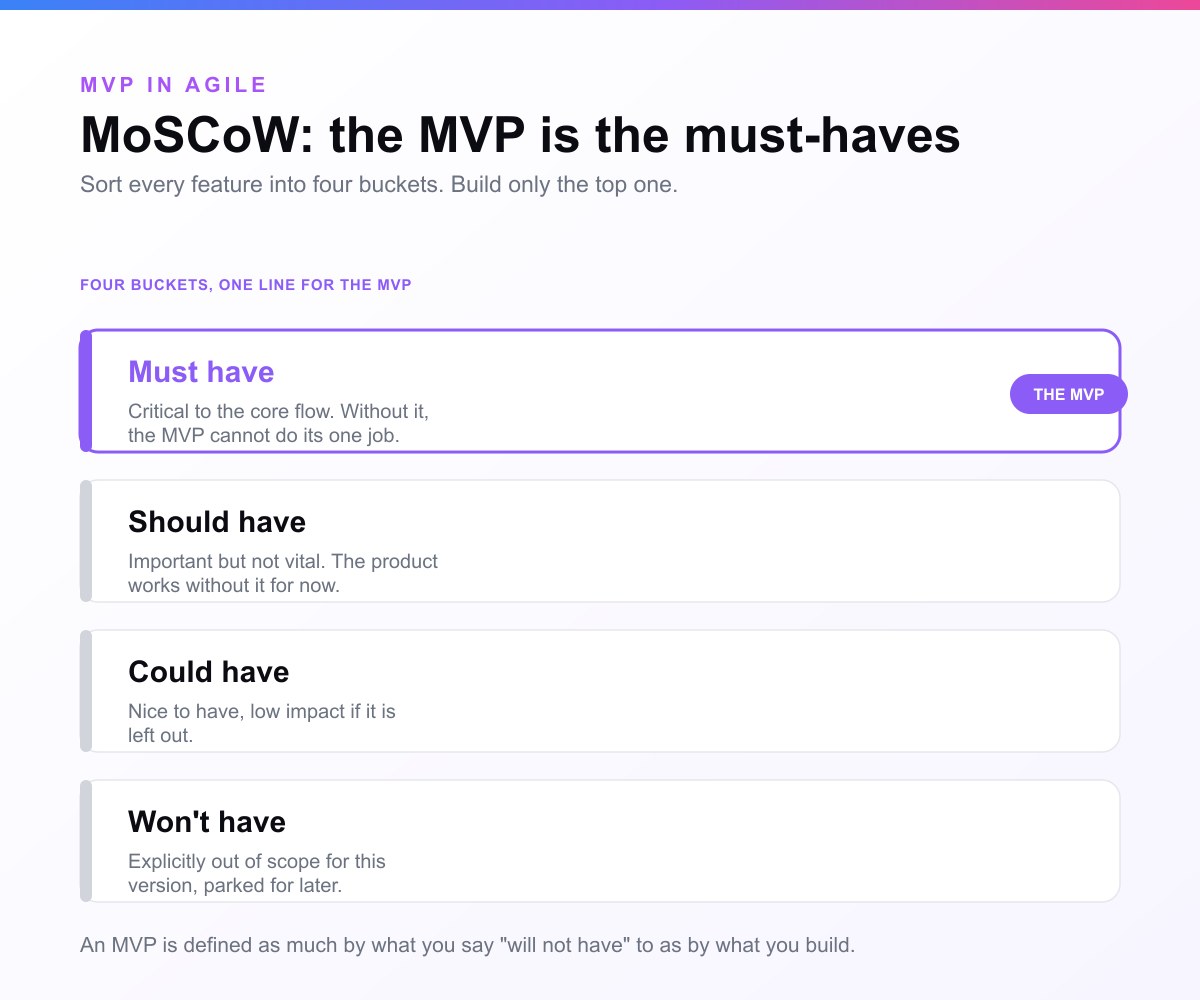
A backlog is only useful if it is ruthlessly ordered, and the most common tool for ordering an MVP is the MoSCoW method. It sorts every candidate feature into four buckets:
- Must have. Critical to the core flow. Without it, the MVP cannot do its one job and is not worth shipping.
- Should have. Important but not vital. The product works without it for now.
- Could have. Nice to have, low impact if it is left out.
- Will not have. Explicitly out of scope for this version, parked for later.
The MVP is the must-haves, and only the must-haves. That is the entire trick. Founders instinctively want to pull "should haves" forward because they feel important, and every one of them stretches the timeline and dilutes the test. A disciplined MoSCoW pass is how you keep the first version genuinely minimal.
When you need to order items within a bucket, RICE is a useful second tool: score each feature by Reach, Impact, Confidence, and Effort, and let the math break ties instead of opinion. However you do it, the principle is the same: an MVP is defined as much by what you say "will not have" to as by what you build. For turning that prioritized scope into a sequenced plan with a timeline, see our guide on building an MVP roadmap.
Prioritize your own features right here. Score each by impact vs effort and it sorts them so your must-haves (the Quick Wins) rise to the top:
Your prioritized features (6)
User signup & login
Auth · impact 5 · effort 2
Core workflow (your main feature)
Core · impact 5 · effort 3
In-app notifications
Engagement · impact 3 · effort 3
Payments / checkout
Payments · impact 4 · effort 4
Dark mode
Nice-to-have · impact 2 · effort 1
Admin dashboard
Admin · impact 2 · effort 4
Writing MVP requirements as user stories
Agile teams do not write long requirement documents. They write user stories: short, plain-language descriptions of something a user wants, in the form "As a [type of user], I want [a goal] so that [a benefit]." For an MVP, user stories are the unit the backlog is made of, and writing them well is how you keep scope small and focused on people rather than features.
A good MVP story is small enough to finish inside a single sprint, written from the user's point of view, and paired with acceptance criteria: the short list of conditions that make it genuinely done. For example, "As a new user, I want to sign up with my email so that I can save my work," with acceptance criteria covering input validation, the error states, and a confirmation message.
Stories that are too big to fit in one sprint are called epics, and you split them into smaller stories. That splitting is itself a scoping tool, because breaking an epic down forces you to see which slices are truly must-have and which are should-haves in disguise. For an MVP you want each story to describe one concrete, testable piece of the core flow and nothing more. The discipline of user stories keeps the team building for a user and a reason, which is exactly the focus an MVP needs.
Sprints: building the MVP in increments
With a prioritized backlog in hand, agile builds the MVP in sprints. A sprint is a short, fixed time box, usually one or two weeks, in which the team turns a slice of the backlog into working software.
Each sprint follows the same rhythm. At sprint planning, the team pulls the highest-priority items off the product backlog into the sprint backlog and commits to a sprint goal. During the sprint they build those items. At the end, they have a potentially shippable increment: working software that could, in principle, go to users.
For an MVP, the power of this is that the product grows in usable steps rather than appearing all at once at the end. After sprint one you might have authentication and the first screen. After sprint two, the core action works end to end. After sprint three, payments are wired in. At no point are you sitting on months of unfinished, untested code. You are always close to something you could show a user, which keeps the whole effort honest and the feedback flowing.
Short sprints also cap your risk. The most you can ever waste building the wrong thing is one sprint, because the next planning session is a chance to re-prioritize based on what you just learned.
The increment versus the MVP: a distinction worth getting right
A point that trips up a lot of teams: an increment and an MVP are not the same thing, even though both come out of sprints.
An increment is the sum of working software completed in a sprint, integrated with everything done before it. You produce an increment every sprint, and most of them are not yet something you would call an MVP. They are progress.
An MVP is a release decision. It is the point at which you have accumulated enough increments to put a usable product in front of real users and test your core assumption. The MVP is reached when the core flow works end to end, not necessarily at the end of any particular sprint.
In practice, that means you run several sprints producing increments, and at some point the product owner decides "this is enough to learn from" and releases the MVP. After that, sprints keep producing increments, but now each one is shaped by real user feedback rather than guesses. Understanding this keeps expectations honest: the first sprint does not produce the MVP, and the MVP is not the finish line. It is the moment the learning loop goes live.
A worked example: an MVP across three sprints
To make the mechanics concrete, imagine a founder building a tool for freelance designers to send contracts and get paid. The riskiest assumption is that designers will pay for automated contracts and invoicing.
The backlog is ordered with MoSCoW, and the must-haves come out as: sign up, create a client, send a contract, and send an invoice. Everything else, templates, reminders, a portfolio page, a dashboard, is parked as could-have or will-not-have.
Sprint one pulls in authentication and creating a client. At the demo, the team shows a working sign-up and a client list. It is an increment, useful progress, but not yet the MVP.
Sprint two builds the contract flow: create, send, and track a contract. The demo now shows a designer going from sign-up to a sent contract. Still an increment, but the core is taking shape.
Sprint three adds invoicing and payment through Stripe. At the demo, a designer can sign up, add a client, send a contract, and collect payment, end to end. The product owner decides this is enough to learn from and releases it to ten real designers. That release is the MVP.
From there, sprints keep producing increments, but each one is now shaped by what those ten designers actually do. If the data shows they send invoices but ignore contracts, sprint four doubles down on invoicing and the contract feature gets reconsidered. That is the build-measure-learn loop running on a sprint cadence, with each rotation cheaper and better-informed than the last.
The agile ceremonies that matter for an MVP
Agile comes with a set of recurring events, or ceremonies. On a small MVP team you want these lightweight, but a few genuinely earn their place.
- Sprint planning. The team agrees the sprint goal and pulls the right backlog items in. For an MVP this is where scope discipline lives: only items that move the core flow forward get pulled.
- The daily standup. A short daily sync to surface blockers fast. On a tiny team it can be five minutes, but keeping momentum and catching blockers early matters more the faster you are moving.
- The sprint review, or demo. The single most important ceremony for an MVP. You show working software to stakeholders and, ideally, users, and gather feedback. This is where measuring and learning happen, so it is the ceremony you never skip.
- The retrospective. A short look at how the team is working, not what it is building, so the process itself improves sprint over sprint.
The mistake is to import the full weight of Scrum ceremony onto a three-person MVP team. Take the spirit, small increments and frequent feedback, and run the events as lightly as your team allows. The demo is the one to protect.
Definition of Done: when an MVP increment is really finished
Agile teams agree a Definition of Done: a shared checklist of what "finished" actually means for any piece of work. Without one, "done" quietly drifts, and an increment that looks complete in a demo turns out to be untested or insecure under the surface.
For an MVP, a lightweight Definition of Done keeps quality honest without slowing you down. A typical one says a story is done when the code is written and reviewed, it works on the core path, it has basic automated tests, it handles the obvious error cases, it is secure, and it is deployed to a staging or production environment. Not gold-plated, but genuinely usable by a real person.
This matters more for an MVP than founders expect, because the MVP is the foundation you will scale and the codebase investors will run diligence on. A clear Definition of Done is what stops "we shipped fast" from quietly meaning "we shipped fragile." It is the guardrail that lets a team move at sprint speed and still hand over something real, which is the difference between an MVP that becomes a product and one that has to be rebuilt the moment it gets traction.
Scrum or Kanban for an MVP?
Agile is an umbrella, and the two frameworks teams reach for most are Scrum and Kanban. Both work for an MVP, and the choice depends on how stable your priorities are.
Scrum organizes work into fixed sprints with planning, a sprint goal, and a review at the end. The cadence creates focus and a natural rhythm of demo-and-learn, which suits a concentrated MVP push where you want to ship the core flow in a known number of cycles. Most agency-built MVPs run on a Scrum-like cadence for exactly this reason.
Kanban drops fixed sprints in favor of continuous flow: a board, work-in-progress limits, and a steady stream of items pulled as capacity frees up. It shines when priorities shift constantly or when you are in rapid post-launch iteration, responding to user feedback as it arrives rather than planning in two-week blocks.
Plenty of teams blend the two into "Scrumban," using Scrum's cadence and demos while managing flow on a Kanban board. For a first MVP build, a light Scrum cadence usually gives the most useful structure, and many teams shift toward Kanban once the product is live and iteration becomes continuous.
Roles on an agile MVP team
Agile defines a handful of roles, and even a tiny MVP team should consciously cover them.
- The product owner owns the backlog and its order, which means they own what the MVP is and is not. On a startup MVP this is almost always the founder or someone speaking directly for them. It is the one role you cannot delegate to a build partner, because it is the source of truth for priorities.
- The development team is the cross-functional group that turns backlog items into a working increment each sprint. On an MVP this might be two or three engineers and a designer.
- The scrum master or facilitator keeps the process healthy and clears blockers. On a small team this is often a hat someone else wears rather than a dedicated person.
The role that most often goes wrong is the product owner. When nobody clearly owns priority calls, the backlog loses its order, every feature feels urgent, and the MVP swells. Protect that seat above all others.
The agile metrics that matter for an MVP
Agile teams track a handful of metrics, and for an MVP the skill is watching the right ones and ignoring the vanity ones.
Inside the build, velocity (how much the team completes per sprint) and cycle time (how long a story takes from start to done) help you predict and smooth delivery. They are genuinely useful for planning the next sprint, but they measure output, not success. A team can have a beautiful, rising velocity chart and still be building something nobody wants.
The metric that actually matters for an MVP is the one success metric you defined for the product itself: the sign-ups, activations, paid conversions, or repeat usage that tell you whether the idea is working. Before launch, the build metrics keep the team honest about pace. After launch, the product metric takes over completely, because the entire purpose of the MVP was never to ship efficiently, it was to learn whether you are building the right thing at all.
The trap is optimizing the wrong number. Shipping more story points faster feels like progress, but if the success metric is flat, the correct agile response is to change direction, not to build more of the same. The value of running an MVP on a sprint cadence is that it gives you the rhythm to read that signal and act on it quickly, instead of discovering a year in that the velocity was high and the traction was zero.
Common agile MVP mistakes
Agile is simple to describe and easy to do badly. These are the failures that show up again and again on MVP projects.
- Treating agile as "no plan." Agile is not the absence of planning, it is continuous planning. An MVP still needs a clear goal and an ordered backlog, just not a frozen 60-page spec.
- Sprints with no demo or feedback. If you build increments but never put them in front of anyone, you get the cost of agile with none of the learning. The demo is the point.
- Scope creep into the sprint. Pulling new work into a sprint mid-stream breaks the sprint goal and the timeline. New ideas go to the backlog, not into the current sprint.
- Increments that are not usable. "Potentially shippable" is the standard for a reason. Half-built slices that cannot be demoed defeat the purpose of iterating.
- Never actually releasing. The MVP only earns its keep once real users touch it. Endlessly polishing increments without releasing is just waterfall with extra steps.
- Over-ceremony on a tiny team. Three people do not need the full Scrum ritual. Keep the events as light as the team allows and protect the demo.
Almost all of these trace back to forgetting that the point of agile, for an MVP, is to learn from real users as fast as possible.
Fixed scope and a real deadline: agile for an MVP
A fair objection to agile is that "we will figure it out as we go" sounds like the opposite of a fixed timeline. For an MVP, the two are reconciled by time-boxing.
Ongoing agile for a mature product is open-ended: the team runs sprints indefinitely, re-prioritizing forever. An MVP build is different. It is a bounded set of sprints aimed at one outcome, a usable core flow you can learn from, with the scope locked to the must-haves before the first sprint. You still work in increments with demos, but the backlog for the MVP itself is finite, not infinite.
That is how a build partner can promise both agile delivery and a 3-4 week timeline without contradiction. The agility lives in how the work is built and demoed each week, and in the freedom to adjust within the core flow. The fixed part is the scope and the deadline, which were locked up front. Agile on the inside, a commitment on the outside. After the MVP ships, the team can shift to open-ended, feedback-driven agile, but the first build is a focused, time-boxed campaign with a finish line. The result is the best of both worlds: the adaptability of agile and the certainty of a real date.
How agile gets you to a fundable MVP in weeks
The reason a tightly run agile process can deliver a fundable MVP in about 3-4 weeks is that every part of it is tuned for speed of learning, not volume of output.
- A tight backlog, ordered hard. A MoSCoW pass cuts scope to the must-haves before any code is written, so the team only ever builds the core flow.
- Short sprints with real demos. Weekly working-software demos keep scope honest and surface problems while they are cheap to fix.
- Shippable increments from day one. Infrastructure and deployment are set up early, so every increment could go live, which keeps the team close to a releasable product the entire time.
- The build-measure-learn loop, run weekly. Each sprint feeds the next, so direction is corrected on real evidence rather than at the end.
- Senior people who have run the loop before. Experience is what lets a team move at sprint speed without relearning the method on your budget.
That is the whole reason agile and the MVP fit together so well: both are machines for turning uncertainty into evidence quickly, and run with discipline they turn an idea into an investor-ready product in weeks rather than quarters.
A lightweight agile MVP checklist
Before you start your first sprint, you should be able to check each of these.
- There is one product backlog, ordered by priority.
- A MoSCoW pass has reduced the MVP to the must-haves only.
- The riskiest assumption is named and sits at the top of the backlog.
- Sprints are short and fixed (one to two weeks).
- Every sprint ends in a demo of working software.
- Each increment is genuinely usable, not half-built.
- Someone clearly owns the product-owner role and the priorities.
- You know when you will release the MVP to real users to start learning.
Related guides
- What Is an MVP?: the minimum viable product, explained
- How to Build an MVP: the full step-by-step process
- MVP Validation: validate demand before you build
- MVP Metrics: how to measure whether your MVP works
Frequently Asked Questions
What does MVP mean in agile?
In agile, an MVP is the smallest usable version of your product, built so you can put it in front of real users and test your most important assumption. Agile builds it iteratively: the team prioritizes a backlog, builds the must-have features in short sprints, demos working software, gathers feedback, and refines. The MVP is the first release worth learning from, and agile is the method that gets you there and keeps improving it.
Is an MVP the same as a sprint increment?
No. An increment is the working software completed in a single sprint, and you produce one every sprint. An MVP is a release decision: the point at which enough increments have accumulated that the core flow works end to end and you can put a usable product in front of real users. You build many increments, and at some point the product owner decides one of them is the MVP and releases it.
Why is agile good for building an MVP?
Because an MVP exists to learn, and agile is built for learning. Waterfall plans the whole product up front and ships once, which assumes you already know the answer. Agile delivers in small increments with constant feedback, so you start learning after the first sprint and can change direction cheaply. That iterative, feedback-driven loop is exactly what an MVP, as an experiment, needs.
How do you prioritize an MVP backlog?
The most common method is MoSCoW: sort every feature into must have, should have, could have, and will not have. The MVP is the must-haves only. When you need to order items inside a bucket, RICE (reach, impact, confidence, effort) helps you score them objectively. The guiding rule is that an MVP is defined as much by what you cut as by what you build.
Should I use Scrum or Kanban for an MVP?
Both work. Scrum, with its fixed sprints and demos, gives a focused MVP build a clear cadence and rhythm of learning, which is why most first builds use it. Kanban, with its continuous flow, suits constantly shifting priorities and rapid post-launch iteration. Many teams blend them into Scrumban: a Scrum cadence with a Kanban board. For a first MVP, a light Scrum cadence is usually the most useful structure.
How long are sprints for an MVP?
One to two weeks is standard, and for a fast MVP build many teams run one-week sprints. Shorter sprints mean more frequent demos and feedback, which is the whole point, and they cap your risk: the most you can spend building the wrong thing is a single sprint before you can re-prioritize.
Do I need a full Scrum team to build an MVP?
No. You need the roles covered, not a large team. A product owner who owns priorities (usually the founder), a small cross-functional development team, and someone facilitating the process is enough. On a small MVP team one person often wears several hats. What you should not skip is the product-owner role, because that is where scope discipline comes from.
What is the difference between the MVP development process and MVP in agile?
They are complementary. The MVP development process describes the phases an MVP moves through, discovery, scoping, design, build, testing, and launch. MVP in agile describes the method used to run the build and iteration: backlogs, MoSCoW, sprints, increments, and the build-measure-learn loop. The process tells you what happens; agile tells you how the work is organized to happen quickly. See our MVP development process guide for the phase-by-phase view.
How does agile reduce the risk of building an MVP?
Agile reduces risk by shrinking the size of every bet. Because work ships in small increments with feedback after each one, you never build for months on an unvalidated assumption. The worst case is a single wasted sprint, after which you re-prioritize on real evidence. Frequent demos catch misunderstandings early, and a usable increment every cycle keeps you close to a releasable product. In short, agile turns one big risky bet into a series of small, correctable ones.
Can agile MVP development have a fixed timeline?
Yes, through time-boxing. For an MVP you lock the scope to the must-haves and fix the number of sprints up front, then work agile inside that box: weekly increments, demos, and the freedom to adjust within the core flow. The delivery stays genuinely agile, while the scope and deadline are commitments made before sprint one. That is how a scoped MVP can be both agile and reliably shipped in about 3-4 weeks.
What tools do you need for agile MVP development?
Less than you might think. A single backlog in a tool like Jira or Linear, or even a simple board, is enough to manage stories and sprints. You need version control and a deployment pipeline so every increment can ship, basic analytics to measure your success metric, and a way to demo working software. For a small MVP team, lightweight tools beat heavy process every time: the goal is to keep the build-measure-learn loop turning, not to administer a framework.
If you want a senior team that runs this exact agile loop and hands over a product you fully own, that is what we do. Custom MVP development at MVP Development builds your MVP in disciplined weekly sprints and ships an investor-ready first version in 3-4 weeks. Tell us how your team ships today and we will fit the MVP process into it rather than against it.
Sources & references
- Atlassian, Minimum Viable Product: a practical definition and scoping guidance
- Agile Alliance, MVP glossary entry: the canonical agile definition
- Scrum.org: Scrum framework reference


