


TL;DR
A marketplace MVP is the smallest working version of a two-sided marketplace, the one transaction loop, deployed for real users, that proves supply and demand will actually transact. It is not a feature-complete platform; it is the single core flow, a buyer finds a seller, they transact, and trust holds, scoped tightly enough to test the only thing that matters: liquidity.
Marketplaces are harder to MVP than other products, because you have to solve the chicken-and-egg problem, no buyers without sellers, no sellers without buyers. The whole art of a marketplace MVP is concentrating just enough supply and demand in one narrow niche that a real transaction happens, then proving people come back. This guide covers what a marketplace MVP is, the chicken-and-egg problem, the core transaction loop, the trust layer, real examples, the metrics that matter, and how to build one. For the underlying concept, start with what an MVP is.
Key Takeaways
- A marketplace MVP is the smallest working version of a two-sided marketplace: one transaction loop, deployed for real users.
- It proves the only thing that matters at first: liquidity, that supply and demand will actually transact.
- Marketplaces are harder to MVP because you must solve the chicken-and-egg problem: no buyers without sellers, no sellers without buyers.
- The art is concentrating just enough supply and demand in one narrow niche that a real transaction happens.
- Success is measured by whether people come back and transact again, not by feature completeness.
What is a marketplace MVP?
A marketplace MVP (minimum viable product) is the first working version of a two-sided marketplace, built with only the features needed to enable a single core transaction between supply and demand, and validate that people will actually use it. It is a real, deployed platform where one side lists or offers something, the other side finds and transacts, and the marketplace takes its cut, scoped to the narrowest niche that can reach liquidity.
What is an MVP in a marketplace? The same minimum-viable-product idea, applied to a platform business that connects two groups, buyers and sellers, riders and drivers, guests and hosts. "Minimum" means one transaction loop in one niche, not a global platform with every category. "Viable" means the loop actually works: a real buyer can find a real seller and complete a real transaction, with enough trust that they would do it again. A marketplace MVP is narrow but real, one category, one city, one use case, done well enough to prove the model.
It helps to be clear about what a marketplace MVP is not. It is not a directory or a listings page with no transaction. It is not a landing page collecting emails from both sides. And it is not version one of the full platform with reviews, messaging, dispute resolution, and ten categories. It is the one transaction loop, deployed, that answers the only question that matters for a marketplace: will supply and demand find each other and transact, repeatedly?
Why marketplaces are the hardest product to MVP
Most product types have one user to satisfy. A marketplace has two, and they will not show up without each other. That is what makes a marketplace MVP fundamentally harder than a SaaS or a mobile MVP, and why the usual MVP advice has to be adapted.
A normal MVP tests one risk: will people use this? A marketplace MVP tests a compounded one: will both sides show up, find each other, and transact, all at once? You can build a beautiful marketplace and have it sit empty because there is supply but no demand, or demand but no supply. The product working is necessary but not sufficient; liquidity is the real product, and liquidity is what the MVP has to prove.
This changes the entire approach. For a marketplace MVP, the build is often the easy part, the hard part is getting enough of both sides into one place that a transaction can happen. So a marketplace MVP is as much a go-to-market experiment as a product one, and the smartest ones spend more effort on concentrating supply and demand than on features. Keep that in mind throughout: the goal is not a polished platform, it is a single proven transaction.
The chicken-and-egg problem (and how an MVP solves it)
Every marketplace faces the same paradox at the start: buyers will not come without sellers, and sellers will not come without buyers. Solving this chicken-and-egg problem is the central challenge of a marketplace MVP, and there are a few proven ways through it.
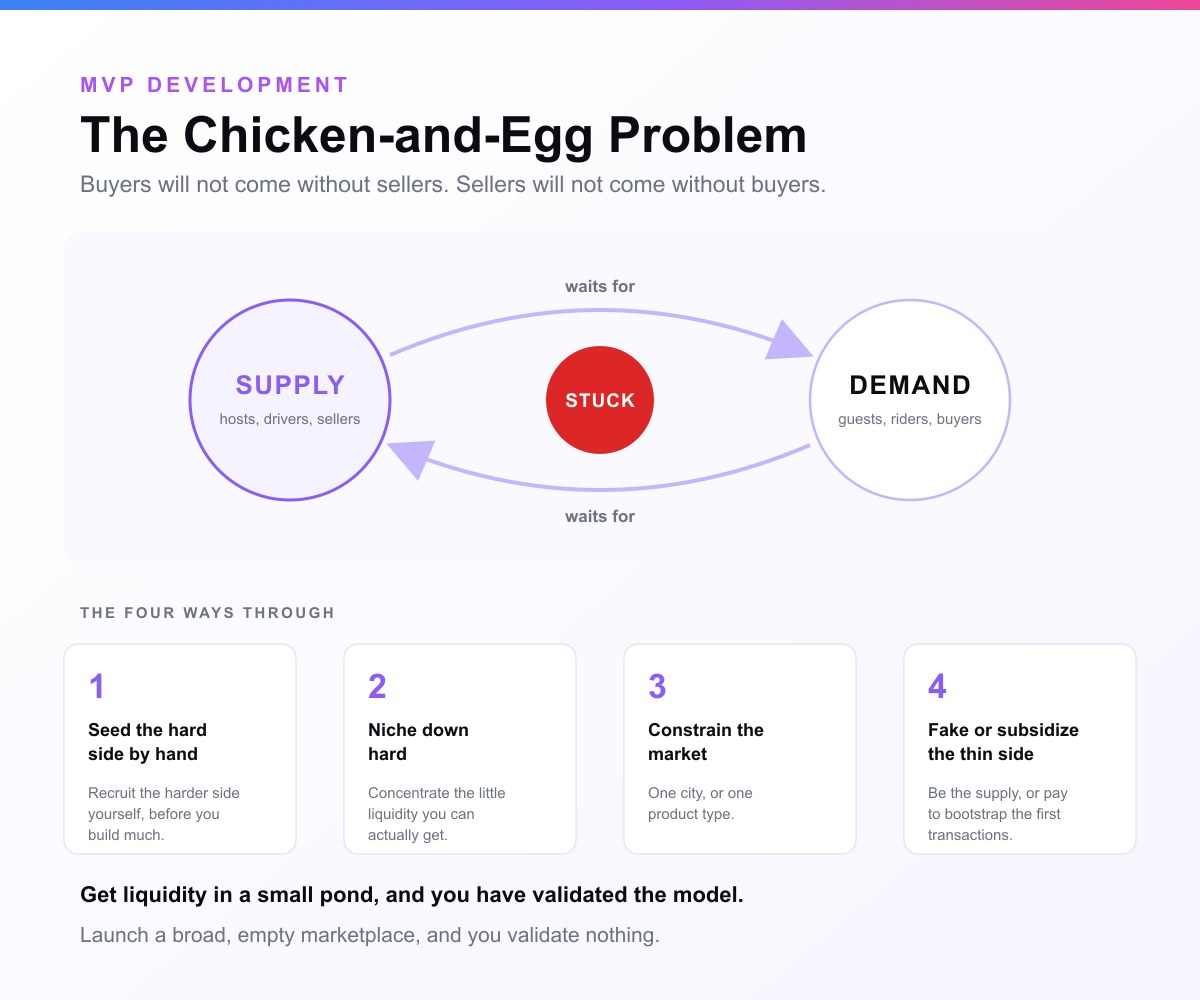
Pick the harder side and seed it manually. Usually one side is harder to get (often supply). Get it first, by hand, before you build much. Airbnb's founders personally recruited and photographed early hosts; Uber seeded drivers before riders. A marketplace MVP often starts with founders manually building one side of the market.
Niche down hard to concentrate liquidity. A marketplace with ten sellers spread across a country is empty; ten sellers in one neighborhood, one category, is a functioning market. The single most important MVP decision is narrowing the scope until the supply and demand you can get are dense enough to actually meet. One city, one vertical, one use case.
Constrain the market geographically or by category. Limiting the MVP to a single city or a single product type makes liquidity achievable with far fewer users. You expand only after the loop works in the first niche.
Fake or subsidize the thin side. Early on, founders sometimes act as the supply (a concierge approach) or subsidize one side to bootstrap activity. The point is to manufacture the first transactions so you can prove the loop, then let it run on its own.
The MVP's job is to prove that within one narrow niche, supply and demand will transact and come back. Get liquidity in a small pond, and you have validated the model; try to launch a broad, empty marketplace, and you validate nothing.
The core flow: the transaction loop
For a SaaS MVP the core flow is sign-up to first value; for a marketplace MVP, it is the transaction loop: the path from a buyer arriving to a completed transaction and back again. Everything in the MVP exists to make that loop happen reliably.
The loop has a few stages: discover (a buyer finds relevant supply), match (they connect with the right seller or listing), transact (they complete the exchange, often with payment), and return (the experience was good enough that they come back, or refer others). Your marketplace MVP needs to support this loop end to end for one niche, and nothing outside it.
Designing around the loop, rather than around a pile of features, is what keeps a marketplace MVP focused. Every screen and feature earns its place by moving a user through discover → match → transact. Advanced search, recommendation engines, messaging threads, and seller dashboards are deferred unless the core loop genuinely cannot function without them. The test for scope is simple: can a buyer find a seller and complete a transaction? If yes, the rest waits.
Pick one side, one niche, and nail it first
The biggest mistake in a marketplace MVP is trying to build both sides, broadly, at once. The winning move is the opposite: pick the niche where you can most easily concentrate liquidity, and dominate it before expanding.
Narrow on three axes. Category: one product or service type, not many. Geography: one city or region, not the world. Use case: one specific job, not every possible transaction. Airbnb did not launch "rent any space anywhere", it started with air mattresses for conference-goers in specific cities. Uber did not launch global ride-sharing, it started with black cars in San Francisco. Narrow is not a limitation; it is the mechanism that makes liquidity possible with the few users an MVP can realistically get.
The principle is concentrate, don't spread. A dense, working market in a tiny niche beats a sparse, empty one across a huge one, every time. Once the loop works in the first niche, the same loop expands to the next category or city. The MVP's job is to prove the loop in one place; scaling it is what comes after, which is what scaling your MVP addresses.
Getting your first transactions
The hardest moment for a marketplace is the very beginning, before any liquidity exists. A few practical tactics get the first transactions flowing.
Go where the supply already gathers. Recruit your first suppliers from places they already are, existing forums, groups, competitors' platforms, or in person. Manual outreach beats waiting for sign-ups.
Bring the demand yourself at first. Until the marketplace pulls its own demand, you bring it, through your network, a small ad budget, or direct outreach, to the supply you have seeded. A few real transactions are worth more than a thousand sign-ups.
Make the first transactions happen by hand. Match buyers and sellers manually, follow up personally, and remove every bit of friction. The goal is to manufacture proof that the loop works, even if it takes founder hours per transaction at first.
Concentrate, don't spread. Put all of this effort into one niche, so the few transactions you create are dense enough to feel like a real market rather than scattered noise.
Single-sided, two-sided, and managed marketplace MVPs
Not every marketplace MVP has the same shape, and knowing the type clarifies what to build.
A two-sided marketplace connects independent supply and demand, hosts and guests, drivers and riders, and the MVP has to attract and balance both. This is the classic, hardest case, and most of this guide addresses it.
A managed (or full-stack) marketplace takes on more of the transaction itself, vetting supply, setting prices, handling fulfillment, so the platform controls quality and trust. For an MVP, a managed approach can be a feature, not a bug: by handling more manually, you remove friction and trust problems, at the cost of doing more by hand. Many marketplace MVPs are effectively managed at first, with founders curating both sides.
A single-sided start seeds one side first and operates almost like a service until the other side arrives, common when one side is far harder to get.
The practical point for an MVP is that the more you manage manually, the faster you can prove the loop, because you remove the variables that make marketplaces fail. Starting "managed" and automating later is often the right MVP path, even if the long-term vision is a hands-off, two-sided platform. Decide how much of the transaction you will handle yourself at the MVP stage, and let that shape what you build versus what you do by hand.
What to include and what to cut in a marketplace MVP
Scoping a marketplace MVP follows the usual discipline, with marketplace-specific must-haves around the transaction and trust.
Include:
- Listings or offers from the supply side. A way for sellers to put what they offer in front of buyers.
- Discovery for the demand side. Basic browse and search so buyers find relevant supply, simple, not an advanced ranking engine.
- The transaction. The actual exchange, often with payments, the core of the loop.
- A basic trust layer. Just enough, profiles, simple reviews or verification, that strangers will transact.
- Payments, if the model needs them. A payment path and your take rate, kept to one simple flow.
- Analytics. Instrument liquidity, match rate, and repeat transactions from day one.
Cut (for now):
- Multiple categories, cities, or verticals beyond the first niche.
- Advanced search, filters, and recommendation algorithms.
- In-app messaging, dispute resolution, and complex escrow.
- Seller dashboards, analytics for users, and admin tooling.
- Native mobile apps if the web works (and it usually does to start).
- Ratings systems beyond the simplest possible trust signal.
The test for every feature is whether the core transaction loop can function without it for the first niche. Most marketplace features that feel essential, sophisticated search, rich messaging, reputation systems, are things you add after you have liquidity, not before. The MVP is the loop, plus the minimum trust to make strangers use it.
The trust layer: making strangers transact
A marketplace asks two strangers to transact, money, a service, a stay, on the strength of your platform. That trust does not exist by default, and building just enough of it is a marketplace-specific part of the MVP that other products skip.
You do not need a full reputation system on day one, but you need something that lets a buyer believe the seller is real and vice versa. The lightest versions: real profiles with names and photos, simple reviews or ratings after a transaction, basic verification (email, phone, sometimes ID), and clear, secure payments so neither side feels exposed. For higher-stakes transactions, holding payment until the exchange completes (a simple escrow) can be the difference between people transacting and not.
The art is calibrating trust to the stakes. A marketplace for cheap, low-risk items needs almost no trust layer; one for expensive services or in-person meetings needs more. Build the minimum trust your specific transaction requires to happen, and defer the rest. Too little trust and no one transacts; too much and you have over-built a reputation engine for a market that does not exist yet.
Payments and the take rate in an MVP
Most marketplaces make money by taking a cut of each transaction, the take rate. Whether to build payments and charge from the start is a real MVP decision, and for marketplaces it usually leans toward yes, because monetization is often part of what you are validating.
Processing payments through the platform does two things: it captures your take rate, and it strengthens trust (buyers feel safer paying through the marketplace than handing cash to a stranger). A simple Stripe-based flow with a single take rate is enough for an MVP; you do not need tiered pricing, payouts dashboards, or complex fee structures. Some marketplaces do start by letting the two sides transact off-platform to prove demand first, then add payments once the loop is working, but you then risk "platform leakage," users meeting through you and transacting around you, which is itself a signal worth watching.
The MVP question is the same as for any business: is willingness to transact (and to pay the take rate) part of your riskiest assumption? For most marketplaces it is, so building a simple payment path into the MVP tests the actual business model, not just whether people will browse.
A concrete marketplace MVP scoping example
To make the niching discipline tangible, take a marketplace idea: a platform connecting homeowners with local tradespeople, plumbers, electricians, painters, anywhere in the country. That is a platform, not an MVP: thousands of trades, every city, every job type, and no liquidity anywhere.
The MVP narrows hard. Pick one trade (say, painters), one city, and one job type (interior repainting). Now the market is small enough that you can manually recruit ten good painters and bring them a handful of real homeowner jobs. The core loop: a homeowner posts a repainting job, sees available painters, picks one, and pays through the platform.
That MVP can launch in weeks and answer the only question that matters: in this one niche, do homeowners and painters actually transact, and come back? If the loop works for painters in one city, the same loop expands to electricians, then to the next city. If it does not, you have learned it cheaply, with ten painters instead of ten thousand. A nationwide trades platform collapses into one city, one trade, one job, which is almost always more aggressive than it first feels comfortable to be, and exactly the point.
How to build a marketplace MVP, step by step
Here is the practical path from idea to a launched, liquid marketplace MVP. The build is often weeks; getting liquidity is the ongoing work.
| Step | What you do | Output |
|---|---|---|
| 1. Pick the niche | Choose one category, one geography, one use case | A narrow, winnable market |
| 2. Seed the hard side | Recruit the harder side (often supply) manually | Enough supply to be useful |
| 3. Design the loop | Map discover → match → transact for that niche | A scoped MVP definition |
| 4. Build the transaction | Listings, discovery, the transaction, basic trust, payments | A working marketplace |
| 5. Instrument liquidity | Wire in match rate, transactions, repeat usage | A measurable marketplace |
| 6. Launch and feed it | Bring demand to the seeded supply, measure, iterate | Proof of liquidity (or a pivot) |
The marketplace-specific steps are picking the niche and seeding the hard side, because without them, the most beautiful marketplace sits empty. Seed supply manually before you build much, founders doing unscalable things to get the first sellers. Design and build the loop for that one niche. Instrument liquidity so you measure transactions and repeat usage, not vanity sign-ups. Then launch and feed it: actively bring demand to your seeded supply, and watch whether the loop runs on its own. The build gets you a platform; the seeding and feeding get you a market.
Do things that don't scale: the manual marketplace MVP
The most important marketplace-MVP idea, from Paul Graham's essay of the same name, is that early on you should do things that don't scale. For marketplaces specifically, this often means being the marketplace by hand before you automate it.
That can look like: manually matching buyers and sellers over email or phone before the matching is automated; personally recruiting and onboarding each early supplier; or even acting as the supply yourself (a concierge marketplace) to prove demand exists before investing in real supply. Airbnb's founders going door to door to photograph listings is the canonical example: unscalable, manual, and exactly what validated the model. A "Wizard of Oz" marketplace, where the experience looks automated but humans run it behind the scenes, is a legitimate and often ideal marketplace MVP. We cover that pattern in the types of MVP.
The reason this works is that it removes the chicken-and-egg problem by brute force: you manufacture the first transactions manually, prove people want them, and only then build the software to scale what you have validated. Software is cheap to build once you know the loop works; building it before is how empty marketplaces are made.
Marketplace MVP examples
The biggest marketplaces almost all started as narrow, manual, single-niche MVPs.
- Airbnb started with air mattresses in the founders' apartment, then a handful of cities, with founders personally recruiting and photographing hosts, a manual, concierge MVP that proved strangers would pay to stay in a stranger's home.
- Uber launched as UberCab: black cars, one city (San Francisco), one transaction. No pool, no food, no global ambition in the product, just the proven core loop in one place.
- Etsy began narrow, handmade goods, before becoming a broad creative marketplace, concentrating a specific kind of supply and demand first.
- DoorDash started as PaloAltoDelivery.com, the founders manually taking and delivering orders in one town to prove the loop before building the platform.
The pattern: one niche, one transaction, often manual at first, and liquidity proven small before scaling big. See more in our MVP examples guide. The marketplace-specific lesson is that none of them launched a broad platform, they launched a working market in a tiny niche, then expanded the same loop.
Marketplace MVP metrics: what to measure
A marketplace MVP is measured differently from other products, because the thing you are proving is liquidity, not just usage.
| Metric | What it tells you | Healthy early signal |
|---|---|---|
| Liquidity / match rate | Do buyers find supply that transacts? | A high share of demand finds a match |
| Transactions (GMV) | Is real value changing hands? | Growing completed transactions |
| Repeat rate | Do people come back to transact again? | A meaningful share return |
| Time to first transaction | How fast a new user transacts | Short, and falling |
| Supply / demand balance | Are both sides growing together? | Neither side starved |
| Take rate | Will the model make money? | Buyers transact despite the fee |
Liquidity and repeat transactions are the metrics that matter most. A marketplace with lots of sign-ups but few transactions has no market; one with fewer users but a high match rate and repeat transactions has found something real. Watch the balance of supply and demand too, a marketplace fails when one side starves, so the MVP has to grow both together within its niche. We go deeper on product metrics in MVP metrics; the marketplace-specific addition is to measure liquidity and the transaction, not vanity registrations. Because liquidity depends on how and where you seed both sides, the sequencing matters as much as the metric; see MVP launch strategy for how to structure that rollout.
Common marketplace MVP mistakes
Marketplace MVPs fail in some predictable, marketplace-specific ways.
Launching too broad. Trying to cover many categories or cities at once spreads thin supply and demand across an empty platform. Niche down until liquidity is achievable.
Building both sides equally before seeding supply. Spending the build on a balanced platform before you have manually solved the chicken-and-egg problem leaves you with a polished, empty marketplace. Seed the hard side first, often by hand.
Over-building features. Sophisticated search, messaging, and reputation systems feel essential but are not, until you have liquidity. Build the transaction loop and the minimum trust; defer the rest.
Ignoring the trust layer. Strangers will not transact without enough trust. Skipping profiles, reviews, or secure payments for a transaction that needs them kills the loop.
Measuring sign-ups instead of transactions. A registration is not a market. The only signal that matters is whether supply and demand actually transact, and come back.
Automating before validating. Building software to scale a loop you have not proven manually is backwards. Do the unscalable, manual version first; automate what works.
Marketplace MVP vs the full platform
It helps to be explicit about how a marketplace MVP differs from the full platform, because the instinct to build "a real marketplace" pulls founders toward the full version too early.
The full platform is built for scale across many categories and cities: rich search and recommendations, messaging, reputation systems, dispute resolution, multiple payment flows, seller tools, and the infrastructure to balance supply and demand at volume. It assumes liquidity is proven and worth scaling, which is true after the MVP.
A marketplace MVP is the opposite: one niche, the transaction loop, the minimum trust, and a simple payment path, built to prove liquidity exists at all.
| Marketplace MVP | Full marketplace | |
|---|---|---|
| Scope | One niche, one loop | Many categories and cities |
| Trust | Minimum needed to transact | Full reputation + disputes |
| Discovery | Basic browse and search | Ranking and recommendations |
| Goal | Prove liquidity | Scale a proven market |
The mistake is building the full platform for an unproven market, spending the budget on features for liquidity that does not exist yet. Build the MVP, prove the loop in one niche, then scale into the full platform, which is what scaling your MVP is about.
How much does a marketplace MVP cost, and how long does it take?
A tightly scoped marketplace MVP, one niche, the transaction loop, basic trust, and payments, typically ships in around three to four weeks with a senior team. The build is rarely the hard or expensive part; the ongoing work of seeding supply and bringing demand is where the real effort goes. Scope drives both cost and timeline: the more categories, sides, and features you add, the longer and more expensive it gets, which is exactly why narrowing to one niche pays off twice.
For the full breakdown of what drives the number, see our guides on how much it costs to build an MVP and how long it takes to build an MVP. The marketplace-specific headline: because the transaction loop is well-understood and the stack is proven, the build stays in weeks, and your energy is better spent on liquidity than on features. A useful way to think about it: every feature you add before you have liquidity is budget spent on a guess; the cheapest path to a working marketplace is the narrowest first version that can transact.
Build your marketplace MVP with a team that knows liquidity
Knowing what a marketplace MVP should be and actually shipping a liquid one are different things. The hard part is the discipline, scoping to one niche, building only the transaction loop and the minimum trust, and resisting the urge to build features before you have a market. That is exactly what we do.
- We scope to one niche and the transaction loop. We find the narrow market where liquidity is winnable and build the loop that proves it, not a broad, empty platform.
- We ship in 3 to 4 weeks. A complete, deployed marketplace MVP with listings, discovery, the transaction, a trust layer, and payments, built by senior engineers on a scoped, fixed quote.
- You own production-grade code. Architected to expand the same loop into new categories and cities once liquidity is proven, not a throwaway.
Explore our marketplace MVP development service, or if you are not yet sure how to niche down, start with a free MVP consultation.
Have a marketplace idea worth proving? Describe your supply side and your demand side and we will tell you which one to crack first.
What take rate should a marketplace MVP charge?
The payments section above explains what a take rate is and recommends charging one from the start. It never says what the rate should be, and that is the number that decides whether the marketplace is a business: the share of each transaction you keep.
That omission is not unusual and it is not defensible, so here is the number, measured rather than asserted.
Across 13 articles advising founders on marketplace take rates, MVP Development found 7 give a recommended range. The floors run from 5% to 10% and the ceilings from 15% to 30%. Read 24 September 2026.
Read as a spread that is useless: somewhere between 5% and 30%. Read as an overlap it is the opposite, because all seven ranges include 10% to 15%. If you want the band nobody in the sample argues with, that is it.
What real marketplaces publish sits around that band. Read on their own fee pages on 27 September 2026: Airbnb charges most hosts 3% and guests 14.1% to 16.5%, or 15.5% to most hosts when the host pays the whole fee. Upwork charges freelancers 0% to 15% per contract. Gumroad takes 10% + $0.50 on direct sales.
The examples are where it falls apart
Four of the articles name Airbnb, and between them they give five different answers for what it charges: 11%, 14 to 16%, 15%, 15 to 20%, and 3% host-side plus up to 14.2% guest-side.
Two of those figures come from the same page. It says “Airbnb takes 14 to 16%” in one place and “3% host-side plus up to 14.2% guest-side” in another, without noting that these describe different fee models.
Airbnb publishes both. On its own fee page there is a split-fee model where the host pays 3% and the guest pays 14.1% to 16.5%, and a single-fee model, paid entirely by the host, where “most hosts pay 15.5%” and the rest “typically pay 14%-16%”. Services are 15% and experiences 20%.
So two of the five figures trace to something Airbnb publishes. The 11% appears nowhere on that page. The 15% is described by one article as “Airbnb’s host-side fee”, and Airbnb’s host-side fee in the split model is 3%.
The charitable explanation is that Airbnb changed its model and the field is quoting different eras at each other without saying which. That is still a founder reading five numbers for one company.
One claim is simply wrong
One article states that Upwork tiers “from 10 to 20% based on relationship value”. Upwork’s own fee page says “the fee ranges from 0% to 15% per contract”. Neither end matches.
Where a marketplace publishes its rate plainly, it is worth reading it there. Gumroad, for instance, publishes “10% + $0.50” for direct sales and 30% for sales it sources through its own discovery, which is a cleaner illustration of the take-rate idea than most of the advice about it.
What went wrong counting this
The extractor could not tell a take rate from a cost. It counted payment processing at 2 to 3.5%, chargeback fees, payout fees and FX markup as recommended take rates, because they are percentages sitting near the word fee. One article’s thirteen hits were almost entirely this.
It also counted “59% of all global e-commerce by 2027”, a market projection, as a rate. Every range published above was read back against its sentence by a person.
Six marketplaces could not be checked against a primary source at all, returning 403 to a plain fetch, and four more were URLs typed from memory that returned 404. Those are recorded as unreachable rather than guessed at a second time.
What this does not measure
What take rate is right for your marketplace. Category, transaction size and what your sellers can get elsewhere all move it, and no overlap band substitutes for that.
Only one of the seven ranges is attributed to anything. Sharetribe cites its own study of the top 100 online marketplaces for its 10% to 30%. The other six are stated without a source, which is worth knowing before treating any of them as a benchmark.
We are in the sample and we scored zero. Until 27 September 2026 this page explained the take rate and told founders to charge one, but never gave a figure or a range.
How to cite these figures
Free to quote with attribution.
Across 13 articles advising founders on marketplace take rates, MVP Development found 7 give a recommended range, spanning 5% to 30%, and that all seven overlap between 10% and 15% (read 24 September 2026). https://mvpdevelopment.company/blog/marketplace-mvp
The dataset carries every advised range with its sentence, the five figures claimed for Airbnb against what Airbnb publishes, the marketplaces that could not be reached, and the extraction errors: marketplace-take-rates-2026-09-24.json.
Related guides
- Foodtech MVP: the three-sided version of this problem, with a physical clock on it
- Traveltech MVP: the version where the supply side is inventory you do not own
- What is an MVP?, the definition, types, and examples
- How to build an MVP, the full build process
- SaaS MVP, building a software-as-a-service MVP
- Ecommerce MVP, the single-seller store counterpart to a marketplace
- Supply Chain MVP, the multi-party visibility problem applied to freight and fulfillment instead of trade
- MVP examples, how famous startups validated lean
- MVP metrics, what to measure and why
- B2B MVP: validating with design partners when your buyers are businesses
Frequently asked questions
What is a marketplace MVP?
A marketplace MVP (minimum viable product) is the smallest working version of a two-sided marketplace: a deployed platform built with only the features needed to enable a single core transaction between supply and demand, and validate that people will use it. It is scoped to one narrow niche, one category, one geography, one use case, where liquidity is achievable, and supports the core transaction loop (discover, match, transact) plus the minimum trust to make strangers transact. The goal is to prove the model in a small market before scaling.
How do you build a marketplace MVP?
You build a marketplace MVP by picking one narrow niche, seeding the harder side of the market (usually supply) manually, designing the transaction loop (discover, match, transact) for that niche, building it with listings, discovery, the transaction, basic trust, and payments, instrumenting liquidity, and launching by actively bringing demand to your seeded supply. The defining discipline is solving the chicken-and-egg problem by concentrating supply and demand in a tiny niche, often doing unscalable, manual things to manufacture the first transactions before automating.
What is the chicken-and-egg problem in a marketplace?
The chicken-and-egg problem is that buyers will not join a marketplace without sellers, and sellers will not join without buyers, so a new marketplace can sit empty even if the product works. A marketplace MVP solves it by niching down hard to concentrate liquidity, seeding the harder side manually, constraining the market to one city or category, and sometimes subsidizing or faking the thin side to manufacture the first transactions. The MVP's job is to prove that within one narrow niche, supply and demand will transact and return.
Do you need payments in a marketplace MVP?
Usually yes, because for most marketplaces, willingness to transact and pay the take rate is part of the riskiest assumption you are validating, and processing payments through the platform also builds trust. A simple payment flow with a single take rate is enough for an MVP. Some marketplaces let the two sides transact off-platform first to prove demand, then add payments, but that risks platform leakage (users transacting around you). If monetization is part of what you need to validate, build a simple payment path into the MVP.
What metrics matter for a marketplace MVP?
The metrics that matter most for a marketplace MVP are liquidity (do buyers find supply that transacts), completed transactions or GMV, and repeat rate (do people come back to transact again). The supply/demand balance matters too, a marketplace fails when one side starves. Avoid vanity metrics like total sign-ups, which can make an empty marketplace look healthy; a registration is not a market. The only real signal is whether both sides actually transact, and return.
How long does it take to build a marketplace MVP?
A tightly scoped marketplace MVP, one niche, the transaction loop, basic trust, and payments, typically takes about three to four weeks to build with a senior team. The build is rarely the hard part; the ongoing work of seeding supply and bringing demand to reach liquidity is. The timeline is driven by scope: the more categories, sides, and features you add, the longer it takes, which is why narrowing to one niche and the core transaction loop is what keeps a marketplace MVP measured in weeks.
What is the most important thing in a marketplace MVP?
Liquidity, getting enough supply and demand into one niche that they actually transact, and return. The product working is necessary but not sufficient; a marketplace MVP can be perfectly built and still fail because one side never showed up. So the most important thing is not features but concentrating a real, transacting market in a narrow niche, usually by niching down hard and seeding the harder side manually. Build the transaction loop and the minimum trust, then put your energy into liquidity rather than features.
Is a marketplace MVP single-sided or two-sided?
Most marketplaces are two-sided (they connect independent supply and demand), and the MVP has to attract and balance both, which is the chicken-and-egg challenge. But many marketplace MVPs start effectively single-sided or "managed," where the founders seed or even act as one side (usually supply) to remove friction and prove demand before automating. Starting managed and manual, then opening up to a true two-sided platform once liquidity is proven, is a common and often ideal MVP path.
Sources & references
This guide draws on established lean-startup and marketplace practice:
- Eric Ries, The Lean Startup, validated learning and the build-measure-learn loop
- Paul Graham, Do Things That Don't Scale, the manual, unscalable way marketplaces like Airbnb and DoorDash started
- NFX, Marketplace Business Models, how two-sided marketplaces work and reach liquidity
- Atlassian, Minimum Viable Product, the MVP in agile product development
The 3 to 4 week figure reflects MVP Development delivery data for tightly scoped marketplace MVP builds.


