


TL;DR
An MVP development agency is an external team that designs and builds your minimum viable product end to end, so you can validate your idea with real users without hiring an in-house engineering team first. The right one ships a focused, production-grade MVP fast, on a clear scope and price, and hands you code you fully own. The wrong one leaves you with "spaghetti code," a blown budget, and a rebuild.
This is the complete buyer's guide for choosing an MVP development agency: what one is, how it compares to freelancers and in-house, the types of agencies, what a good one does, the criteria plus a scorecard to evaluate candidates, the exact questions to ask, the red flags to walk away from, what working with an agency actually looks like, and how they price. If you are still deciding whether to outsource at all, start with our MVP outsourcing guide, this one assumes you have decided an agency is the route and focuses on picking the right one.
Key Takeaways
- An MVP development agency designs and builds your MVP end to end, so you can validate without hiring an in-house engineering team first.
- The right agency ships a focused, production-grade MVP fast, on a clear scope and price, and hands you code you fully own.
- The wrong one leaves you with spaghetti code, a blown budget, and a rebuild.
- Evaluate candidates with a scorecard, a set of direct questions, and a list of red flags before you sign.
- Decide whether to outsource at all first; this guide assumes you have and focuses on picking the right partner.
More data: sourced MVP cost and timeline ranges are compiled in our MVP statistics for 2026.
What is an MVP development agency?
An MVP development agency (also called an MVP software development agency or minimum viable product agency) is a company that specialises in building MVPs, the first, focused version of a product, for founders and startups. Unlike a general software agency that builds whatever you spec, an MVP agency is built around the lean principle: ship the smallest thing that delivers value and produces learning, fast, rather than a sprawling full product.
A good MVP agency brings the whole team a build needs, product strategy, design, engineering, and QA, as one coordinated unit, so a founder is not stitching together a freelance designer here and a contractor there. The value is not just code; it is the judgment of a team that has shipped many MVPs and knows what to cut, which is exactly what keeps a first build fast and focused instead of over-engineered.
One clarification before the criteria, because the phrase covers two different things. Most of this guide is about agencies in general: how they work, what they cost, how to evaluate one. We are also one. MVP Development is an MVP development agency that sells fixed packages rather than hours, from a working AI prototype for $350 in 7 days to an investor-ready MVP in 21, with a public review record you can read before you call. Where this guide says “an agency”, read it as the category; where it says “we”, it means us.
One clarification before the criteria, because the phrase covers two different things. Most of this guide is about agencies in general: how they work, what they cost, how to evaluate one. We are also one. MVP Development is an MVP development agency that sells fixed packages rather than hours, from a working AI prototype for $350 in 7 days to an investor-ready MVP in 21, with a public review record you can read before you call. Where this guide says “an agency”, read it as the category; where it says “we”, it means us.
Agency vs freelancer vs in-house: which to use
Before choosing which agency, make sure an agency is the right model. There are three ways to build an MVP, and each fits a different situation (for the direct head-to-head see freelancer vs agency for an MVP, plus MVP outsourcing and the MVP development team guide):
- An agency / studio: a coordinated, cross-functional team that starts fast and ships a complete MVP. Best when you want it built right the first time, quickly, without standing up an in-house team. Costs more than freelancers, but you get a managed team and accountability.
- Freelancers: one or a few independent contractors. Cheapest, but you become the project manager stitching specialists together, and quality varies widely. Workable for very simple builds or if you can manage developers well.
- In-house: your own employees. The right long-term model once you are funded and scaling, but slow and expensive to assemble before you have validated anything.
For most founders who want a real, scalable MVP shipped fast, and who do not already have an engineering team, a specialist agency is the strongest fit. The rest of this guide is about choosing a good one.
Types of MVP development agencies
"Agency" covers several different models, and knowing which one you are talking to prevents a costly mismatch:
| Type | Best for | Watch out for |
|---|---|---|
| Full-service product studio | A funding-ready MVP, built right the first time | Higher cost than offshore |
| No-code / low-code agency | Fast, cheap validation of a standard idea | A platform ceiling you may have to rebuild past |
| Offshore / nearshore dev shop | Tight budgets, simpler scope | Communication, quality variance, time zones |
| Freelance collective / network | Flexible, smaller builds | You coordinate the moving parts |
| Specialist vertical agency | Regulated or complex domains | Fewer of them, usually pricier |
- Full-service product studios bring strategy, design, engineering, and QA as one senior team and ship a complete, scalable MVP, usually on a fixed scope and price. This is the model most founders mean by "MVP agency," and the best fit when the MVP has to be fundable and built to last.
- No-code / low-code agencies assemble your product on visual platforms (see no-code MVP). Fast and cheap, and great for validating a standard idea, but you may hit the platform's ceiling and need a custom rebuild later.
- Offshore and nearshore dev shops compete mainly on price. Some are excellent, but quality varies widely and communication and time-zone gaps are real risks, vet them harder and never choose on price alone (more below).
- Freelance collectives and talent networks give you flexible access to contractors, but you take on more of the coordination and accountability yourself.
- Specialist vertical agencies focus on one domain, healthtech, fintech, AI, and bring the domain and compliance expertise that matters in regulated spaces, at a premium.
Match the type to your product and stage: most startups validating a software idea are best served by a full-service product studio with a real MVP track record.
What a good MVP development agency does
The best MVP agencies do more than write code, they protect you from the most common ways first builds fail:
- Scope ruthlessly. They help you cut to the one core flow that tests your riskiest assumption, instead of building your whole roadmap. Over-scoping is the #1 MVP killer, and a good agency says no for you.
- Design and build as one team. Product, UX, engineering, and QA work together, so the MVP is usable and credible, not just functional.
- Ship production-grade code, fast. A focused MVP in weeks, not a polished-but-late full product, on a stack that scales rather than a throwaway.
- Hand over everything. Full ownership of the code, the repositories, and the accounts, so the product is yours, not locked inside the agency.
- Build for what comes next. They architect the MVP so it can grow into the real product if the idea works, avoiding the rebuild that catches teams who start on the wrong foundation.
How to choose an MVP development agency: the criteria that matter
Use these criteria to separate a strong MVP agency from a generic dev shop. In rough order of importance:
- MVP and startup track record. Has the agency actually shipped MVPs for startups, not just enterprise software? MVP work is a different discipline (scope discipline, speed, validation focus). Ask to see real examples.
- A clear, fixed scope and price. The best agencies define exactly what they will build and what it costs before work starts, so the budget cannot balloon. Vague, open-ended, hourly arrangements are where MVP costs spiral.
- Senior engineers, not a junior factory. Ask who actually writes your code. Cheap agencies staff junior developers on a template; the quality difference shows up when you try to scale.
- Speed with discipline. A good MVP agency ships in weeks (we ship in 3 to 4 weeks), because they know what to cut, not by cutting corners. Ask their typical timeline and what drives it.
- Full code ownership. Confirm in writing that you own all the code, designs, and IP, and that you receive the source and accounts. Some shops keep you dependent; that is a dealbreaker.
- Process transparency. You should see working software at regular milestones, not a black box for eight weeks. Frequent, visible increments are how you keep a build honest, especially as a non-technical founder.
- Communication and fit. You will work closely with this team. Clear communication, in product terms, and a genuine grasp of your problem matter as much as technical skill.
An agency that scores well on track record, fixed scope, senior talent, and code ownership is the profile you want. One that competes mainly on being the cheapest is the profile that produces rebuilds.
The MVP agency evaluation scorecard
Turn those criteria into a quick scoring exercise so you compare candidates objectively instead of on gut feel. Score each agency 1 to 5 on each factor, then compare totals, weighting the high-importance factors most:
| Factor | What a 5 looks like | Weight |
|---|---|---|
| MVP / startup track record | Multiple real startup MVPs shipped, with case studies | High |
| Fixed scope & price | A defined scope and quote agreed before any work | High |
| Senior engineers | Named senior devs build it, and you meet them | High |
| Code & IP ownership | Contractually yours; you receive repos and accounts | High |
| Speed with discipline | Ships in weeks via ruthless scoping, not corner-cutting | Medium |
| Process transparency | Working software shown at regular milestones | Medium |
| Communication & fit | Clear, in product terms; genuinely gets your problem | Medium |
| Post-launch support | Can iterate or hand over cleanly | Low to Medium |
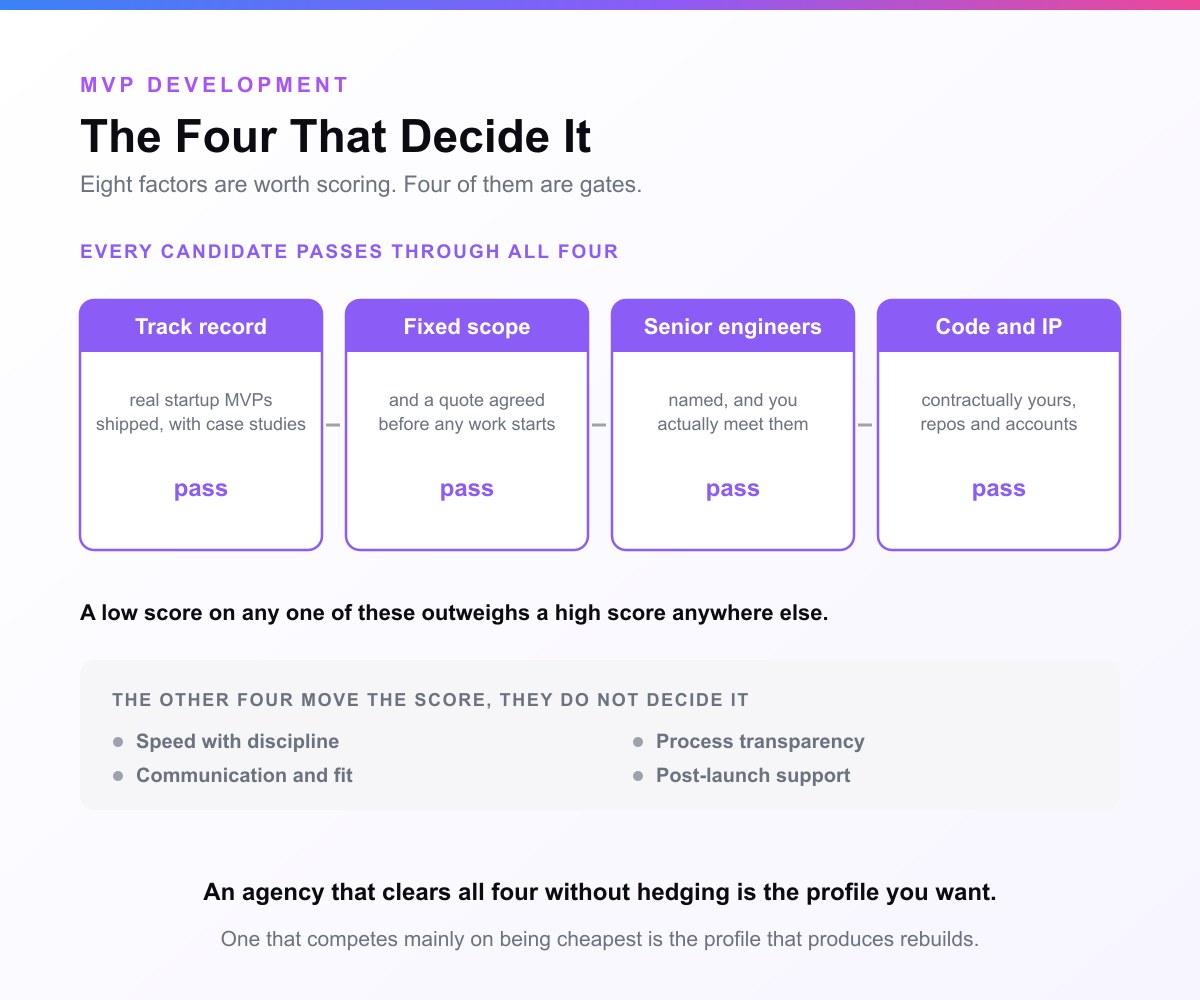
The shortcut: a strong agency clears the four high-weight factors (track record, fixed scope, senior team, ownership) without hedging. A low score on any of those four usually outweighs a high score elsewhere, those are the factors that decide whether you walk away with a fundable product or a rebuild.
Score your shortlist right here. Rate each candidate 1 to 5 on the eight factors and it ranks them instantly, flagging any agency that scores low on a deal-breaker:
Score each agency 1–5 · 1 = weak, 5 = what a 5 looks like
| Factor | ||
|---|---|---|
MVP / startup track recordHigh Multiple real startup MVPs shipped, with case studies | ||
Fixed scope & priceHigh A defined scope and quote agreed before any work | ||
Senior engineersHigh Named senior devs build it, and you meet them | ||
Code & IP ownershipHigh Contractually yours; you receive repos and accounts | ||
Speed with disciplineMed Ships in weeks via ruthless scoping, not corner-cutting | ||
Process transparencyMed Working software shown at regular milestones | ||
Communication & fitMed Clear, in product terms; genuinely gets your problem | ||
Post-launch supportLow Can iterate or hand over cleanly |
The four High-weight factors are the deal-breakers. A low score on any of them usually outweighs a high score elsewhere, and those are what decide whether you walk away with a fundable product or a rebuild.
Questions to ask before you hire an MVP agency
Bring these to the call, the answers separate strong agencies from risky ones:
- Who exactly will build my MVP, and how senior are they?
- Can you show me MVPs you have shipped for startups like mine?
- Do you work to a fixed scope and price, or hourly? What happens if scope changes?
- Do I own all the code and IP, and will I get the repositories and accounts?
- What is your typical timeline, and what drives it?
- How will I see progress, and how often?
- How do you decide what goes out of scope? (A good answer shows they will protect your budget.)
- What happens after launch, can you support iteration or a handover to my team?
If an agency dodges the ownership, scope, or "who builds it" questions, treat that as a signal.
Red flags to avoid
The most expensive MVP is the one you pay for twice. The three that should stop you cold:
- No code ownership. If you do not clearly own and receive the code, you do not own your product.
- Fixed-price in name only. A "fixed" quote that balloons through change orders is hourly billing in disguise.
- No verifiable case studies. Stock "200+ projects delivered" with no live products you can open is a tell.
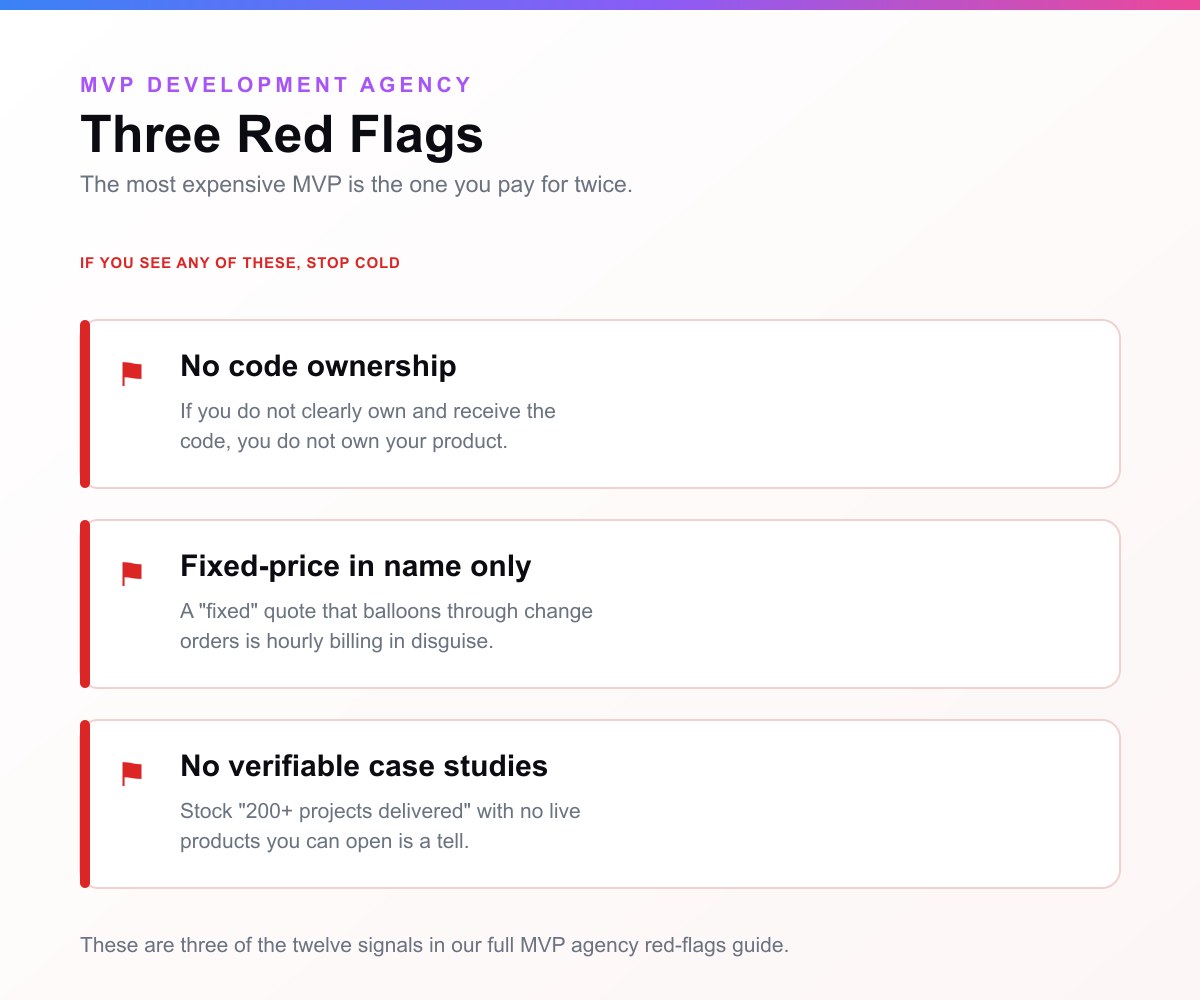
These are three of the twelve signals in our full guide to MVP agency red flags, read it before you sign.
Choosing an MVP development partner as a non-technical founder
If you can't read the code yourself, the stakes on picking the right MVP development partner are higher, you are trusting a team with something you cannot fully verify. As a non-technical founder, weight these factors above the rest:
- Plain language over jargon. The partner should explain scope, progress, and trade-offs in product terms, not hide behind technical language. If you leave calls more confused than you started, that is a signal.
- Working demos, not status reports. Insist on seeing real, clickable software at every milestone. It is the one progress signal a non-technical founder can actually judge for themselves.
- Provable ownership. Confirm in writing that you receive the code, repositories, and accounts, so you are never locked into a partner whose work you cannot read.
- A team that pushes back on scope. A partner that says yes to every feature is dangerous when you cannot tell what is over-built. The right one protects your budget by cutting for you.
Our full playbook for managing a build you cannot do yourself is in MVP for non-technical founders. If you would rather have an expert scope and budget the build with you before you commit a dollar, that is exactly what MVP consulting is for.
Switching MVP agencies after a bad build
Plenty of founders reach this guide because a first agency already burned them, a blown budget, "spaghetti code," or a product they cannot extend. Finding a reliable MVP development partner the second time is less about optimism and more about verification:
- Get a code and ownership audit first. Before you rebuild, have the new team review what exists and confirm what you actually own. You may be able to salvage more (or less) than you think, and you need to know before you sign anything.
- Insist on references you can call. After a bad experience, marketing claims are not enough, ask for founders you can actually speak to about how the agency handled scope, deadlines, and handover.
- Fixed scope, in writing, no exceptions. The open-ended arrangement is usually what caused the first blow-up. This time, approve a defined scope and price before any work starts.
- Confirm full ownership up front. If you did not own the last build, do not repeat it, get the code, repos, and accounts in writing as a condition of the engagement.
The vetting criteria, scorecard, and questions above apply doubly here. If you are rebuilding after a bad experience, our team will audit what you have and scope the smallest path to a product you own, tell us what went wrong and we will start from there.
What working with an MVP agency looks like
A good MVP engagement is short and structured. Knowing the shape helps you spot an agency that runs a tight process versus one that improvises:
- Discovery call. You share the idea, the users, and your riskiest assumption; the agency pressure-tests scope and goals. (A good one pushes back on over-scoping right here.)
- Scope and fixed quote. They define the one core flow, what is in and out of scope, the timeline, and a fixed price, which you approve before any work starts. This document is your protection.
- Design. User flows, wireframes, and a clickable prototype of the core flow, validated before code, so changes cost minutes, not days (see MVP UX design).
- Build in sprints. Engineering ships the product in short cycles with a working demo at each milestone, so you see real software, not status reports.
- QA and launch. The core flow is tested to production standard and shipped to real users (or to the app stores).
- Handover (and optional iteration). You receive the full code, repositories, and accounts, and either take it in-house or keep iterating with the agency.
For a tightly scoped MVP, this whole arc runs in about 3 to 4 weeks. If an agency cannot describe a process like this, or wants to start coding before a scope is agreed, treat it as a warning.
How much does an MVP development agency cost?
MVP agency pricing varies widely by scope and where the team is based, and the model matters as much as the number. The strongest agencies quote a fixed price for a defined scope, so you approve the cost before work begins, rather than an open hourly meter. A focused MVP built by a senior agency is typically a fraction of the cost of hiring a full in-house team before validation, which is much of the appeal. The real driver is scope and seniority, not headcount. For full ranges and what moves the number, see how much it costs to build an MVP.
By agency model, roughly cheapest to most expensive: freelancers and offshore shops at the low end, no-code agencies low-to-middle, full-service product studios and specialist vertical agencies at the higher end. But price and value are not the same thing, the cheapest option is frequently the most expensive once you factor in a rebuild. What you pay for at the higher end is senior engineers, scope discipline, a fundable result, and code you own and can scale.
US vs offshore, the location trade-off. A lot of the price gap comes down to where the team is. US, UK, and Western European agencies cost more but bring closer communication, time-zone overlap, and often stronger product judgment. Offshore and nearshore agencies cost less and can be excellent, but you take on more communication overhead, time-zone friction, and quality variance, the outcome depends on vetting the specific team, not the region.
The honest rule: judge the team and its track record, not the postcode, and never let a low rate alone decide. A senior team that ships a scalable MVP once is cheaper than a bargain team you pay twice. If close time-zone overlap and communication are the priority, you may specifically want a US-based team, see MVP development company in the USA for that trade-off, but the "judge the team, not the region" rule still holds.
Where to find MVP development agencies
A few practical channels:
- Directories and reviews: platforms like Clutch list agencies with verified client reviews, useful for shortlisting and checking references.
- Referrals: other founders who have shipped an MVP are the best source; ask your network and startup communities.
- Search and portfolios: look at agencies' actual case studies and the products they have shipped, not just their marketing.
- AI assistants: founders increasingly ask ChatGPT and other tools for recommendations, so it pays to understand how AI recommends MVP companies and which signals it weighs.
- Specialist over generalist: favour agencies that specialise in MVPs and startups over general software shops, the scope discipline is the whole point.
Whichever channel you use, run every candidate through the criteria and questions above before you commit.
Why MVP Development is the agency founders choose
We are an MVP development agency built for exactly this: founders who need a real, validated product fast, without the risk of a cheap build or an open-ended budget.
We ship funding-ready MVPs in 3 to 4 weeks, scoped to the one core flow that proves your idea, by senior engineers (no junior factory), on a fixed quote you approve before we start, with full code ownership, the product, the code, and the accounts are yours. We scope ruthlessly so you do not over-build, design and engineer as one team so the MVP is fundable, not just functional, and architect it to scale into the real product if the idea works.
Explore how we work and hire our team, get free MVP consulting to scope and budget before you commit, or see our MVP development services.
Looking for an MVP development agency? Interview us against this exact checklist and see whether we pass our own bar.
Choosing an MVP development agency as a US founder
Everything above applies to any founder. A US founder has four extra questions for the first call, and the answers separate agencies that have worked with US companies from agencies that have not.
“Do you have a W-8BEN-E ready, and is your IP assignment present-tense?”
An agency that works with US clients has the form ready before you ask and uses “hereby assigns” in its standard contract. One that asks what a W-8BEN-E is has not done this before. The full paperwork checklist is in hiring offshore developers as a US company.
“Will you sign a BAA?”
Only if your product handles health data for a provider or plan, but if it does, this is the first filter. A team that hesitates has not built healthtech. See HIPAA-compliant MVP development.
“Are individual accounts, MFA and reviewed pull requests your defaults?”
Your first enterprise customer will send a security questionnaire, and whether the answers exist depends on how the agency builds. A team with these as defaults gives you a product that is SOC 2 ready without anyone having planned for it. See SOC 2 for an MVP.
“What are your overlap hours in Eastern time?”
Not “we are flexible.” A window, in writing, in your timezone. And ask your CPA how Section 174 treats the spend before you compare a domestic quote with a foreign one.
What MVP development agencies actually publish: we checked 66
Every guide to choosing an agency, including the one you are reading, tells you what to look for. None of them tell you how many agencies actually provide it. So on 23 September 2026 we took the thirteen listicles ranking for “best MVP development companies”, pulled out every agency they name, and checked what each one publishes on its own website.
Of 66 MVP development agencies, MVP Development found 13 publish a price of any kind. Read 23 September 2026.
That is one in five. The other 53 will tell you their process, their industries and their years of experience, and will not tell you what anything costs until you are on a call. Eighteen have a pricing page; five of those eighteen carry no price on it.
One in five can be reached without filling in a form
Of the same 66 agencies, 42 publish an email address and 42 publish a phone number. Twelve publish neither, so the only way to contact them is a form. Read 23 September 2026.
That is the check worth running yourself before you send anything. An agency that will not publish a price, a phone number or an email address has made three separate decisions to control the first conversation, and you will be having it on their terms.
We are in the sample, and we fail two of the three checks
MVP Development is one of the 66, measured by the same code on the same checks. We publish a price. We publish neither an email address nor a phone number on our home page, which puts us in the twelve, and it is the weakest thing this study found about us.
We are not going to dress that up. A study of whether agencies are contactable, run by an agency that quietly left itself out or scored itself generously, would be an advert. The finding stands and the fix is ours to make.
How the sample was built
Thirteen listicles ranking for “best MVP development companies” and its variants were fetched, and every outbound domain extracted. That means the sample is who the industry nominates rather than who we would have chosen, which matters when the company running the study competes with everyone in it. The thirteen publishers are themselves agencies and are included.
Excluded by name, with the reason recorded in the dataset: talent marketplaces (Toptal, Turing, Lemon.io, RocketDevs), tools (Figma, Webflow, Lovable), analysts and media (Gartner, CB Insights, YourStory), and infrastructure domains. Sixty-nine agencies went into the audit and 66 were reachable; Bairesdev, mvp.dev and Techmagic did not respond and are counted as unreachable rather than dropped.
What went wrong, and what we left out
The price detector found 17. Reading all 17 showed four were not prices at all: one was a client’s saving quoted as a case-study metric, one was what the page says other platforms charge, and two were “money saved” figures on pricing pages that carry no price. So the number is 13, not 17, and every correction is in the dataset with the sentence that caused it.
Two checks from our original plan are deliberately missing: whether an agency names its team, and whether its portfolio carries dates and named clients. Both need a person to judge 66 websites, and a half-verified number is worse than no number. They are left for a later pass rather than guessed at.
One limit on the price figure: it counts prices published on the home page or at /pricing, /prices or /plans. An agency that publishes a price somewhere else would be counted as not publishing one, so 13 is a floor rather than a ceiling.
The data, and how to cite it
The full dataset is published as JSON, one record per agency with what was found, the URL it was found at, and the reason for every correction: agency-transparency-2026-09-23.json.
To cite this study: MVP Development, “What MVP development agencies actually publish”, 23 September 2026, https://mvpdevelopment.company/blog/mvp-development-agency.
Websites change. Every figure carries the date it was read, and the study will be re-run and re-dated rather than edited in place.
Who will actually build it, and can a machine tell?
The audit above measures whether an agency will tell you a price. This one measures whether it will tell you who works there, and whether it says so in a form anything other than a human can read. Same 66 agencies, same day.
Of 66 MVP development agencies, 62 have a dedicated about or team page and 22 publish machine-readable information about their people. Read 23 September 2026.
Almost every agency has an about page. A third of them mark up the people on it. The other 44 have a page with faces and job titles that a person can read and a machine cannot, which matters more every month that founders start their shortlist by asking an AI rather than by opening ten tabs.
The gap is not about design. It is a line of structured data that says “this is a person, this is their name, this is their role”, and it is the difference between being a name on a page and being an entity a model can retrieve, attribute and recommend.
Case studies, and the eight without any
Of the same 66 agencies, 58 have a work, portfolio or case studies section and 8 have none at all. Read 23 September 2026.
Eight agencies named on “best MVP development companies” lists publish no work. That is a shorter list than the 53 who publish no price, and a more surprising one, because a portfolio is the one thing every agency is assumed to have.
What we could not measure, and why we are telling you
We tried to measure something better than “is there structured data”: whether the agency names a real leader in plain prose on its own site. We could not do it reliably, and the failure is worth describing because it says something about these websites.
A loose detector, looking for a full name next to a founder or CEO title, returned 53 of 66. Reading them showed roughly three in five were wrong: most were clients quoted in testimonials (“we couldn’t ask for a more dedicated partner — Shannon Morales, Founder”), and the rest were not names at all but phrases the pattern mistook for them, like “Discovery Phase” and “Premier Tier”. A strict detector, looking only under a team or leadership heading, returned 12 of 66 and missed agencies we know name their founders, including Netguru and ourselves.
So that number is not published. A check that is 58% wrong in one direction and badly incomplete in the other is not a measurement, and the honest thing is to report the three checks that are binary and say plainly that the fourth defeated us. The reason these sites are hard to parse is itself the finding: an agency’s own people are usually buried in the same visual soup as its client quotes.
How we did score, since we are in the sample
MVP Development publishes machine-readable Person data, so we are one of the 22. We have a work section, so we are one of the 58. In the price audit above we publish a price but no email address and no phone number, which put us in the twelve reachable only through a form. Two of four, and the contact one is ours to fix.
The data, and how to cite it
These figures are in the same dataset as the price audit, one record per agency: agency-transparency-2026-09-23.json.
To cite this study: MVP Development, “What MVP development agencies actually publish”, 23 September 2026, https://mvpdevelopment.company/blog/mvp-development-agency.
Related guides
- MVP development contract: what to check in the agreement before you sign with them
- MVP outsourcing: whether to outsource your MVP at all
- MVP development team: the roles a build actually needs
- How much an MVP costs: pricing and what drives it
- MVP for non-technical founders: managing a build you can't do yourself
Frequently asked questions
What is an MVP development agency?
An MVP development agency is an external team that designs and builds your minimum viable product, the first, focused version of your product, end to end, so you can validate your idea with real users without first hiring an in-house engineering team. Unlike a general software agency, an MVP agency is built around the lean principle of shipping the smallest valuable version fast, and it brings product strategy, design, engineering, and QA as one coordinated team. A good one scopes ruthlessly, ships production-grade code in weeks, and hands you full ownership of that code.
How do I choose the right MVP development agency?
Judge agencies on a few criteria, in order: a real track record shipping MVPs for startups (not just enterprise software); a clear, fixed scope and price agreed before work starts; senior engineers actually writing your code (not a junior factory); speed with discipline (weeks, not months, because they know what to cut); full code and IP ownership handed to you; and transparent progress at regular milestones. Ask exactly who will build it, to see real examples, whether pricing is fixed, and whether you own all the code. An agency that dodges the ownership or scope questions, or competes mainly on being cheapest, is a risk.
How do I find a reliable MVP development agency after a bad experience?
Verify, do not hope. Start by having a prospective new team run a code and ownership audit of your existing build, you need to know what you actually own and how much is salvageable before committing again. Then insist on references you can call (founders who will speak to how the agency handled scope and handover), a fixed scope and price agreed in writing before any work, and contractual full ownership of the code and accounts. The open-ended arrangement and unclear ownership are what cause most first-time blow-ups, so removing both on the second attempt is how you avoid paying for the same MVP twice.
What should a non-technical founder look for in an MVP development partner?
Prioritise the things you can verify without reading code: a partner who explains scope and progress in plain product terms, shows you working, clickable software at every milestone (not status reports), and contractually hands you the code, repositories, and accounts so you are never locked in. Just as important is a team that pushes back on scope and cuts features for you, because over-building is the risk you cannot see for yourself. If you would like an expert to scope the build with you before you hire anyone, that is what MVP consulting is for.
How much does an MVP development agency cost?
It varies widely with scope, seniority, and the team's location, but the pricing model matters as much as the figure. The strongest agencies quote a fixed price for a clearly defined scope, so you approve the cost before work begins, rather than billing an open-ended hourly rate where budgets spiral. A focused MVP from a senior agency typically costs a fraction of assembling a full in-house team before you have validated the idea. The real cost driver is scope and engineer seniority, not headcount, so a tightly scoped build is the cheapest path to a real product. See our full cost guide for ranges.
Is an agency or a freelancer better for an MVP?
It depends on your situation. An agency gives you a coordinated, cross-functional team that starts fast, ships a complete MVP, and provides accountability, best when you want it built right the first time and do not have an in-house team. Freelancers are cheaper but make you the project manager stitching specialists together, with quality that varies widely, workable only for simple builds or if you can manage developers well. For most founders who want a real, scalable MVP shipped quickly, a specialist agency is the stronger choice. For the full head-to-head, see freelancer vs agency for an MVP.
Which is the best MVP development agency?
There is no single "best" agency, the best one is the best fit for your product, stage, and budget. Roundup lists of "top MVP development agencies" are a starting point, but a high list position is not evidence the agency will build your MVP well. The reliable way to find the best for you is to run candidates through clear fundamentals, a real startup-MVP track record, a fixed scope and price, senior engineers, and full code ownership, using the questions and scorecard in this guide. Judge agencies on those fundamentals rather than on who markets themselves most aggressively. We built MVP Development, an MVP development company designed to score well on exactly those fundamentals: fixed scope, senior team, 3 to 4 week delivery, and full ownership.
How do I choose a web development agency for an MVP?
Choose for MVP and startup experience, not general web development. Plenty of capable web agencies build websites and enterprise software well but have never shipped a lean MVP, and MVP work is a different discipline: ruthless scoping, speed, and a validation focus. Apply the same criteria, real MVP track record, fixed scope and price, senior engineers, code ownership, and transparent milestones, and specifically ask to see MVPs they have shipped for startups. A specialist MVP agency will almost always serve a founder better than a generalist web shop.
Where can I find MVP development agencies for startups?
A few reliable channels: agency directories with verified client reviews (such as Clutch), referrals from other founders who have shipped an MVP, and startup communities and networks. Look at each agency's real case studies and the products they have actually shipped, not just their marketing claims, and favour specialists in MVPs and startups over general software shops. Whichever channel you use, shortlist a few and run each through the criteria and questions in this guide before committing, the source matters far less than how carefully you vet the specific team.
How do agencies prioritize features in MVP development?
A good agency prioritizes by tying every feature back to your riskiest assumption and the one core flow that tests it. Anything essential to that flow is in scope; everything else goes onto an explicit "later" list. Many use frameworks like MoSCoW or RICE to make the calls objective rather than emotional, and they treat the "out of scope" list as just as important as the "in scope" one, because protecting that boundary is what keeps the build fast and the budget intact. If an agency wants to build every feature you mention, that is a red flag, not a service.
Sources & references
- Y Combinator Library: startup advice on building and hiring
- Eric Ries, The Lean Startup: the lean MVP principle
- Atlassian, Minimum Viable Product: scoping the MVP
- Clutch: agency directory with verified client reviews
The 3 to 4 week figure reflects MVP Development delivery data for tightly scoped builds.


