


TL;DR
It costs $15k-$150k+ to build an MVP. The number depends on three things: your stack, your team, and how much surface area you're shipping. A lean 2-founder team building a SaaS MVP with Node + PostgreSQL on AWS lands around $25k-$50k (mostly time, not cloud). A full-stack team with design, marketing, and compliance can hit $100k+. The gap isn't the code, it's scope and speed.
The outlier: at MVP Development we ship a complete, funding-ready MVP for a clear, scoped quote you approve before we start, with no loss of quality. It's not offshore juniors cutting corners; it's senior developers leaning on modern frameworks, AI, and automation to do in days what used to take months. We break down exactly how at the end of this guide.
💡 Want a number for your MVP? Try our free MVP Cost Calculator: pick your platform, features, and team, and get an instant cost range and timeline. No signup required.
Key Takeaways
- An MVP typically costs $15k-$150k+ to build.
- The price is driven by three things: your stack, your team, and how much surface area you ship.
- A lean two-founder SaaS build lands around $25k-$50k; a full team with design, marketing, and compliance can pass $100k.
- The gap is not the code, it is scope and speed.
- Most of the spend is time, not cloud infrastructure.
More data: these ranges come from 2026 cost surveys, compiled with sources in our MVP statistics for 2026.
Jump to a real example: Lean, $30k · Seed-stage, $80k · Well-funded, $150k+
How much does it cost to build an MVP? (the real numbers)
Here's what it actually costs to build an MVP across the three paths founders typically take:
| Category | Lean | Standard | Full-Stack |
|---|---|---|---|
| Timeline | 3-4 months | 4-6 months | 6-9 months |
| Team size | 2 engineers | 2-3 eng + designer | 4+ (eng, design, product, ops) |
| Monthly burn | $8k-$12k | $15k-$25k | $30k-$50k |
| Total cost | $25k-$50k | $60k-$100k | $120k-$200k+ |
| Stack | Node/Next.js, Postgres, AWS | Node/Next.js, Postgres, Vercel | Same, but fuller services |
| What you ship | Core feature (no design polish) | Core + secondary features | Core + UX, marketing, onboarding |
The "lean" path assumes founders taking salary from runway or external funding. The "standard" path is a typical startup post-seed. "Full-stack" includes hired designers, full compliance, and marketing tooling.
Estimate your MVP
Three taps for a ballpark, using the same model as our full calculator.
Platform
Scope
Who builds it
Ballpark
$10,300–$39,000
2–7 weeks · The flow, plus billing and email
Or skip the estimate: a working AI prototype of your idea for $350 in 7 days, fixed. See what it includes
A ballpark, not a quote. Want the detailed version with every feature? Open the full calculator.
Where your MVP budget actually goes
Four line items account for nearly every dollar of an MVP budget. Get these right and your estimate will be close.
Engineering time (50-70% of budget)
The biggest line item. A mid-level engineer costs $100-$150/hour as a fully-loaded rate. For a 6-month MVP:
- 2 full-time engineers = 4,000 billable hours, about $400k-$600k in labor cost
- But founders usually take below-market salaries or equity, so the real cash outlay is $80k-$150k
The constraint isn't the budget, it's focus. Every scope creep (integrations, analytics, admin dashboard) adds 2-4 weeks and $20k-$40k.
Infrastructure, tools & services ($5k-$20k first year)
At launch your traffic is low, so cloud is cheap. Costs spike only after you find traction.
- Compute: AWS, Vercel, or DigitalOcean = $500-$5k/month at launch
- Database: Supabase, PlanetScale, or managed PostgreSQL = $100-$1k/month
- APIs & services: Stripe, SendGrid, auth providers = $200-$500/month
- Design & ops tools: Figma, Sentry, monitoring = $150-$500/month
Here's the line-by-line for the SaaS tools most MVPs actually run:
| Tool | Category | Cost |
|---|---|---|
| Vercel | Hosting | $0-$100/month |
| Supabase | Database | $0-$100/month |
| Stripe | Payments | 2.9% + 30¢ per transaction |
| SendGrid | $0-$100/month | |
| Auth0 | Authentication | $0-$100/month |
| Figma | Design | $12/user/month |
| GitHub | Code repository | $0-$21/month |
| Sentry | Error tracking | $0-$100/month |
| PostHog | Analytics | $0-$100/month |
| Google Workspace | Email + docs | $6/user/month |
| Monthly total | All tools | $400-$1,200 |
Key insight: almost every tool here has a generous free tier. You can launch an MVP at roughly $0/month in tooling. The $400-$1,200 only kicks in once you have customers and need scale.
Design ($0-$60k)
This is where teams diverge most:
- No designer = $0 (use component libraries like shadcn/ui or Tailwind UI)
- Freelance designer (part-time, logo + 5 pages) = $10k-$20k
- Full-time junior designer = $50k-$80k/year
- Senior designer = $100k+/year
Most lean MVPs use templates or skip custom design entirely. It's the fastest way to ship.
Legal, compliance & accounting ($5k-$15k)
Small individually, painful when ignored. This is the one place to not cut every corner.
- Entity formation (LLC, C-Corp) = $500-$2k
- Terms of Service & Privacy Policy = $1k-$3k
- Tax accounting (first year) = $2k-$5k
- GDPR / privacy: not just policy text but technical implementation = $2k-$10k
- Payment compliance: Stripe handles PCI for you, but know the fees (2.9% + 30¢)
- SOC 2 / security audit (only if selling to enterprises) = $5k-$20k
Most MVPs defer SOC 2 and GDPR engineering until a customer asks, then it becomes an emergency rewrite. Budget a little buffer if you're targeting regulated buyers.
"If you're not embarrassed by the first version of your product, you've launched too late."
Reid Hoffman, co-founder of LinkedIn
That instinct is what keeps a budget honest. Almost every dollar spent above the lean band goes into making version one less embarrassing, not more valuable. The cost question and the scope question are the same question.
Real-world MVP cost examples
Example 1: Lean SaaS (2 founders, $30k budget)
- Timeline: 4 months
- Team: 2 engineers, no designer, no marketer
- Stack: Next.js + Supabase + Stripe on Vercel
- What ships: Core product, basic auth, payment flow, docs
- Cost breakdown:
- Engineering (4 months × $8k/month salary each) = $32k
- Infrastructure + tools (first 4 months) = $2k
- Total: $34k
- What's missing: UI polish, marketing site, compliance framework, analytics
This is the Y Combinator path. It works if your co-founders are willing to take reduced salaries and move fast.
Example 2: Seed-stage startup ($80k budget)
- Timeline: 5 months
- Team: 2 engineers + 1 designer + 1 ops person
- Stack: Node + React + PostgreSQL on AWS + Figma
- What ships: Polished product, marketing site, basic analytics, support system
- Cost breakdown:
- Engineering (salaries, 5 months) = $50k
- Designer (contract, part-time) = $15k
- Infrastructure + tools (first 5 months) = $8k
- Legal + compliance = $7k
- Total: $80k
- What's missing: Customer research budget, paid marketing, dedicated support
This is typical post-seed. The designer makes the difference, users perceive it as a real product, not an MVP.
Example 3: Well-funded startup ($150k+ budget)
- Timeline: 6-9 months
- Team: 3 engineers + 1 designer + 1 product lead + 1 ops person
- Stack: Full infrastructure (managed databases, CDN, observability)
- What ships: Complete product experience, marketing site, analytics, onboarding, compliance
- Cost breakdown:
- Engineering (salaries, 7 months) = $90k
- Design (full-time contract) = $25k
- Product & ops = $15k
- Infrastructure + tools (first 7 months) = $15k
- Legal + compliance = $10k
- Total: $155k
- What's included: Fully branded, tested, documented product ready for investor demos
Speed here comes from headcount, not from cutting scope.
Quick answers
Can you build an MVP for less than $10,000? Yes, but only two ways: a scoped, AI-accelerated build from a productized studio, or a Tier 3 offshore team ($10k-$25k) that you have the technical skill to manage and review closely. Full answer
What is the most expensive part? Engineering, at 50-70% of the budget. Every feature you add costs another 2-4 weeks and $20k-$40k. Full answer
What does it cost after launch? Plan for 2-3x your MVP budget in the first year. The MVP cost is a down payment, not the full bill. Full answer
Free: the MVP budget template
A spreadsheet with every line item on this page, so you can build your own number instead of trusting ours.
- Every line item from this guide, with its 2026 low/high range
- A column for your own numbers
- Post-launch and contingency rows most budgets forget
- Reference tables: cost by build type, and by region
No email required. Opens in Excel or Google Sheets.
Optional: we will send the template plus a one-page scoping checklist.
What changes the cost
Three levers move an MVP's price up or down before you've written a line of code. (Geography is the fourth and biggest, it gets its own section next.)
Stack choice
- Cheap: Next.js + Supabase + Vercel (all-in platform) = $500-$2k/month
- Mid: Node + React + PostgreSQL + AWS = $1k-$5k/month
- Expensive: Kubernetes, microservices, managed everything = $5k-$20k/month
For an MVP, cheaper stacks win because they handle scaling for you. You don't have the scale problems Kubernetes solves yet.
Outsourcing vs. in-house
- Full outsource (agency): $30k-$60k, slower, less control
- Hybrid: $50k-$80k, better quality, medium speed
- In-house: $60k-$150k, fastest, highest quality, highest ongoing cost
- Productized studio: a senior team running a proven, AI-accelerated process (the model we use at MVP Development) locks scope and timeline up front and removes the usual agency speed-vs-control trade-off
For an MVP, hybrid (freelance designer + in-house engineers) often wins, unless a productized studio team can deliver your core flow faster and cheaper, which is increasingly the case.
Scope
Scope is the single biggest cost multiplier you control. Every feature adds 1-2 weeks and $10k-$20k, so pick ruthlessly:
- Lean scope: user signup, one core action, payment
- Standard scope: above + onboarding, basic admin dashboard, email notifications
- Full scope: above + integrations/marketplace, advanced analytics, mobile app
Adding "nice-to-haves" can inflate cost and timeline 40-60% with zero additional learning, a trap we return to in the mistakes section below.
How geography changes the cost
The same MVP costs wildly different amounts depending on where your team sits. A $50k MVP in San Francisco can be a $15k MVP in Eastern Europe, or a $10k MVP in South Asia, with real tradeoffs.
Tier 1 (US, Canada, Western Europe)
- Senior engineer: $150k-$250k/year ($72-$120/hour)
- Mid engineer: $100k-$150k/year ($48-$72/hour)
- Designer: $80k-$150k/year
- 6-month team (2 eng + 1 designer): $90k-$150k
If you are hiring in this tier, MVP development in the US covers what American founders should expect from a 3-4 week build at these rates.
Tier 2 (Eastern Europe, Latin America, SEA)
- Senior engineer: $40k-$80k/year ($20-$40/hour)
- Mid engineer: $25k-$50k/year ($12-$25/hour)
- Designer: $15k-$40k/year
- Same team: $25k-$50k
Saves 50-70% on payroll. Tradeoff: timezone friction, hiring takes 2-4x longer, more communication overhead. Expect ~1.5x the calendar time.
Tier 3 (India, Pakistan, Philippines)
- Mid engineer: $10k-$25k/year ($5-$12/hour)
- Junior engineer: $5k-$15k/year
- 2 eng + designer: $10k-$25k
At $10k total you're competing on price, not speed or quality. You'll need a technical founder to manage and review closely, and communication is harder.
Timeline vs. cost trade-offs
One hidden variable: time is flexible, money is not. Each person you add saves ~2 months but costs $15k-$30k. Each month you cut off the timeline costs $5k-$10k in rush-premium salaries or extra headcount.
| Timeline | Team | Cost | Trade-off |
|---|---|---|---|
| 12 months | 1 founder | $0-$30k | Slow, solo risk, burnout |
| 6 months | 2 founders + freelancers | $30k-$50k | Medium pace, split risk |
| 3 months | 3 founders + designer + contractor | $60k-$100k | Fast, but rushed decisions |
| 6 weeks | 4+ team + contractor + agency | $100k-$200k | Very fast, high cost, over-building risk |
There's no universally right answer, it depends on your market window (if a competitor is closer, speed beats cost), your funding (investor money rewards speed), and how proven your idea is (unvalidated ideas should take longer and spend less).
Want a real number for your build? Our free MVP Cost Calculator turns your platform, features, and team into an instant cost range and timeline, with no signup. Or bring us your feature list and we will scope it with you on a free call.
How your funding source changes the budget
Where the money comes from quietly sets the size of the MVP you can afford, and the pressure you'll feel building it.
Bootstrapped ($0-$50k)
Your own savings plus revenue from consulting to pay yourself.
- Advantage: no dilution, no investors to answer to
- Disadvantage: slow, capital-constrained, high personal risk
- Typical spend: $20k-$50k over 6-12 months, solo or 2-founder team
Friends & family ($50k-$200k)
Informal money from people who know you, usually for 5-15% equity.
- Advantage: light due diligence, flexible terms
- Disadvantage: strains relationships if it fails; still capital-constrained
- Typical spend: $50k-$150k, 2-3 person team, 4-6 months
Accelerator (Y Combinator, 500 Global, etc.) ($50k-$150k)
Structured investment plus mentorship and network.
- Advantage: fast capital, credibility, founder network, milestones
- Disadvantage: equity dilution (3-10%), you work toward their metrics
- Typical spend: $50k-$150k, 2-4 person team, 3-4 months
Seed round ($250k-$1m+)
Professional investors. Requires a plan, projections, and a story.
- Advantage: real capital, guidance, ability to hire
- Disadvantage: dilution (20-30%), investor involvement, pressure to grow fast
- Typical spend: $300k-$500k on MVP + first-year operations, 4-6 person team
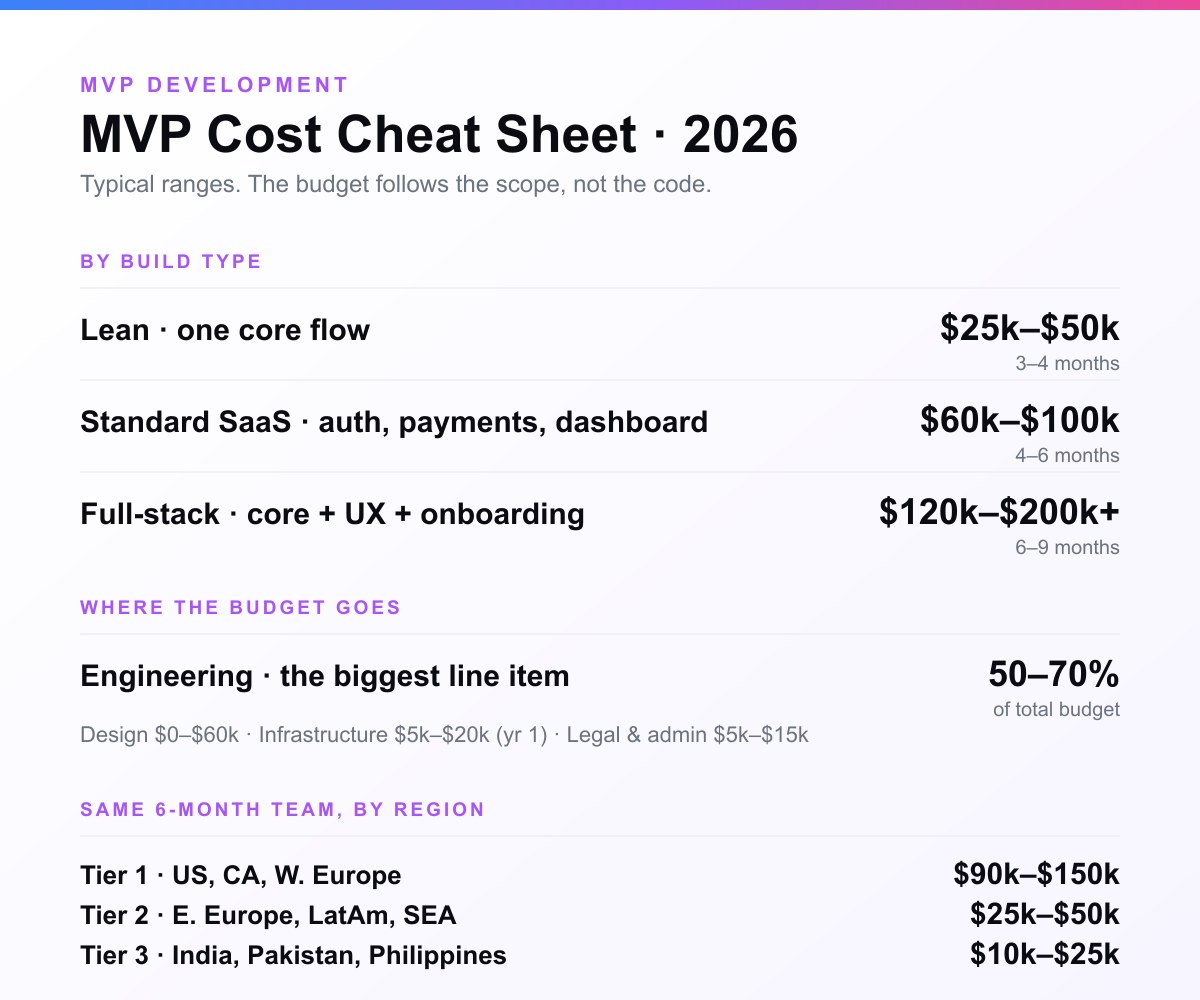
Everything above, in one image. Save it or send it to your co-founder.
Hidden MVP costs founders forget
Beyond engineering, infra, and design, these costs blindside first-time founders. (Compliance is covered in the budget section above.)
Marketing and customer acquisition
Your MVP needs users to validate it. Even a $0 budget costs time:
- Organic: social, content, community, free but time-intensive
- Paid: Google/Facebook ads = $500-$2k/month to start testing
- Sales (if B2B): founder time or a contractor = $2k-$5k/month
- First-user acquisition cost: typically $50-$500 per paying user
A $50k MVP with $0 marketing spend dies in silence. Budget 10-20% of your MVP cost for launch visibility.
Operational overhead
Costs that exist but aren't "product":
- Business formation & banking: $500-$2k + $50-$200/month
- Insurance: cyber + general liability = $300-$1k/year
- Domain + email: $50-$200/year
- Communication tools: Slack, etc. = $0-$500/month
Small individually, but $5k-$10k bundled.
Founder time (the real cost)
The invisible cost. If you walk away from a $150k/year job to bootstrap, that's a real $75/hour opportunity cost, plus burnout risk and the technical debt of rushing. Sweat equity isn't "$0 cost"; it's deferred cost you either recover via equity appreciation or never recover at all.
What happens after launch
The MVP cost is a down payment. Plan for 2-3x that budget in year one post-launch:
- Months 7-12: customer support, bug fixes, first scaling panic = $20k-$50k
- Year 2: more engineers, design refinement, marketing = $100k-$300k
- Year 3+: product complexity explodes, salaries rise = $500k+
Common MVP cost mistakes
1. Gold-plating the MVP. "Let's add mobile, dark mode, and integrations." No. An MVP is the smallest thing that tests your core hypothesis. Most "MVP" features never get used by paying customers.
2. Hiring too senior too early. At MVP stage you need generalists who move fast, not specialists. Hiring a $200k/year architect for a $50k MVP is like hiring an F1 pit crew to change a bicycle tire. Wait until $1m+ ARR.
3. Building "scalable" infrastructure from day one. Your MVP will have 10-100 users. A single Vercel deployment + Supabase handles 10,000 concurrent users. Premature optimization delays launch by 2-4 months.
4. Underestimating integration work. Each integration (Stripe, Auth0, SendGrid, Slack, Zapier) is 3-7 days of engineering and breaks when their API changes. Integrate only what's needed to validate the core.
5. A beautifully designed MVP nobody uses. Spending $20k on pixel-perfect design for a product 90% of founders kill within 12 months. Use templates until you have paying customers.
How to budget your MVP
Use this five-question framework to land on your own number:
- What's your validation hypothesis? (one sentence, e.g. "CTOs will pay $50/month for AI code review")
- What's your timeline? (3, 6, or 12 months?)
- How many people? (solo, 2-founder, team?)
- What's your geography? (Tier 1, remote mix, offshore?)
- Do you have revenue or funding? (bootstrapped, F&F, accelerator, seed?)
Or skip the math: our MVP Cost Calculator turns your feature list into a cost range and timeline in seconds.
Then map yourself to a scenario:
| Scenario | Timeline | Team | Cost |
|---|---|---|---|
| Lean | 6-12 months | Solo / 2-founder, no hires | $20k-$50k |
| Standard | 4-6 months | 2-3 engineers + 1 designer | $60k-$100k |
| Fast | 3-4 months | 3+ engineers + designer + PM | $100k-$150k |
| Very fast | 6-8 weeks | 4+ team + contractor support | $150k-$250k |
Your MVP cost is roughly baseline + (team size × salary × months) + infrastructure + compliance + marketing.
Six ways to push that number down: use all-in platforms (Vercel, Supabase) to skip infra complexity; use component libraries instead of custom design; trade co-founder sweat equity for cash (cuts costs 40-50%); cut every "nice-to-have"; hire engineers first and designers/ops later; and validate with a $2k landing page + ads before building, which can save $20k of wasted engineering.
There's also a seventh shortcut that collapses most of these at once: a scoped, AI-accelerated build. Instead of assembling a team and absorbing the budget math above, a productized studio like MVP Development, a company that builds MVPs on a fixed quote, can deliver a production-grade MVP for a small fraction of the figures above, often less than the validation experiments founders run before they even start building.
Spend more when your market window is closing, you have paying customers waiting, you're raising and need metrics, or your product requires compliance you can't fake. Spend less when your hypothesis is unproven, you have no revenue yet, you're solo and learning, or your market is patient. More money buys speed, lower risk, and higher quality, but it never buys product-market fit. That still takes talking to users.
The funding-ready MVP in 21 days (the MVP Development method)
Everything above is the market reality, $15k to $150k+. Here's the disruption: at MVP Development we ship a complete, funding-ready MVP in 21 days for a clear, scoped quote you approve before we start. Not a wireframe, not a throwaway prototype, a deployed, user-ready product you can put in front of investors and accelerators on day 28.
How is that possible when the market says $15k-$150k? Not by cutting quality or outsourcing to junior teams. By changing the method:
- Senior developers, not juniors. Every build is led by senior engineers who've shipped dozens of products, so the architecture is right the first time, no expensive rework, no fragile foundation.
- AI and automation as a force multiplier. We pair the latest frameworks with AI-assisted code generation and automated testing and deployment pipelines, compressing what used to take months into days, without compressing quality.
- A proven, productized process. Fixed scope, an agreed quote, fixed timeline. No discovery-phase bleed, no surprise invoices, no scope creep.
- Funding-ready by default. A clean UI, working auth, a real core flow, analytics, and a live production URL, exactly what an investor or accelerator expects to see in a demo.
The 3-4 week formula
- Week 1, ruthless scope. One core hypothesis, one user flow, one locked spec. Senior-led, so the estimate holds.
- Week 2, build core, AI-accelerated. Core API, database schema, auth, and a polished UI, built on modern frameworks with AI and automation doing the heavy lifting.
- Week 3, polish + test. Automated QA, edge cases, copy, staging review, and founder acceptance testing.
- Final week, deploy + hand off. Live on production, monitored, documented, and demo-ready for funding conversations.
When it fits (and when it doesn't)
Fits: B2B SaaS, internal tools, marketplaces, analytics dashboards, any product where one sharp core flow proves the hypothesis.
Doesn't fit: hardware + software, or heavily regulated products (healthcare, fintech, legal) where compliance genuinely can't be compressed. For those we scope a longer engagement rather than over-promise.
The honest tradeoff is scope, not quality: our engagement buys one core flow built to production standard, not ten features at once. You get fast validation (28 days vs. 4-6 months), near-zero financial risk, and a real product investors can fund, then you expand from a clean, senior-built, AI-accelerated foundation instead of refactoring cut-rate code.
Ready to build? Send us your feature list and we will come back with a scoped, honest quote against it.
What the internet actually claims an MVP costs: we counted
Every article answering this question gives you a price range, and almost none of them say where the range came from. Nobody had counted that, so we did. On 23 September 2026 we read 30 articles ranking for “how much does it cost to build an MVP”, “mvp development cost” and related queries, and recorded the cost each one claims, whether it cites a source, whether the publisher sells MVP development, and whether it says when the figures were checked.
Across 30 articles ranking for MVP cost queries, MVP Development found the claimed price of an MVP runs from $5,000 to $500,000 — a 100-fold spread for the same question. Read 23 September 2026.
The middle of the market is tighter than that spread suggests, and worth knowing on its own. Of the 27 articles that state an article-level range, the median claimed floor is $15,000 and the median claimed ceiling is $150,000. If you have read four of these pages and come away with “$15k to $150k”, you have correctly absorbed the consensus. The consensus is just not evidence.
Almost nobody shows their working
Of 30 articles quoting a price for an MVP, 2 carry an outbound link to a source in the same paragraph as a cost figure. Counting the two that name a source in the text without linking it, 4 of 30. Read 23 September 2026.
That is the finding that should change how you read every other page on this subject, including the parts of this one that are not this study. Twenty-six of thirty give you a number with nothing behind it.
Of the same 30 articles, 21 are published by a company that sells MVP development, and 7 say when the figures were last checked. So the typical article on this question is written by a supplier, quotes an unsourced range, and does not tell you how old it is.
We are a supplier too. That is exactly why this section counts other people’s pages rather than asserting a better number of our own, and why our own page is not in the sample.
The spread in full
The extremes are not outliers from strange publishers. The $5,000 floor and the $500,000 ceiling both come from established agency blogs ranking on page one. One article puts the whole answer at $5,000 to $12,000. Another puts it at $47,500 to $260,000. Both are answering the same question in the same month.
What this means in practice: a range you read on any single page tells you about that agency’s typical project, not about MVPs. The number is a description of who wrote it.
How we counted, including what went wrong
The first pass was automated, and it was wrong 11 times in 29. An extractor that takes the first dollar range near a cost phrase picks up line items, phase subtotals and single rows of tier tables: it read one article’s “Total Pre-Development: $3,000-$27,500” as the cost of an MVP, took another’s “UX flows & prototypes: $3,000 – $7,000” the same way, and on a third took $15,000-$50,000 that the article attributes to security work rather than to the build.
So every claim was then read by a person against its source sentence. Nine were corrected, two articles were excluded because they state only per-tier figures and no article-level range, and the excluded two are counted as excluded rather than quietly dropped. That is why the sample is 30 fetched and 27 claims.
One honest limit on the sample: the URLs came from five US search queries on 23 September 2026, not from one person’s personalised results page. Every URL was a real ranking result and none was guessed, but this is “30 articles ranking for these queries”, not “the top 30 in order”.
The data, and how to cite it
The full dataset is published as JSON, one record per article with the claimed range, whether it was extracted or hand-corrected, and the reason for every correction: mvp-cost-claims-2026-09-23.json.
To cite this study: MVP Development, “What the internet actually claims an MVP costs”, 23 September 2026, https://mvpdevelopment.company/blog/how-much-does-it-cost-to-build-an-mvp.
Prices move and articles get rewritten. Every figure above carries the date it was read, and the study will be re-run and re-dated rather than edited in place.
What agencies actually publish, as opposed to what articles claim
The study above counts claims. This one counts prices. On the same day we audited 66 MVP development agencies drawn from the “best MVP development companies” listicles, and 13 publish a price of any kind. Eight of those publish a figure in dollars for an MVP or a project build, which is a small sample and is the reason the number below carries its n.
Across 8 MVP development agencies that publish a starting price in dollars, MVP Development found the median published entry price is $15,000, ranging from $3,999 to $45,000. Read 23 September 2026.
The interesting part is that this matches. The 27 articles above put their median claimed floor at $15,000, and the agencies that actually publish a price start, at the median, at $15,000. The unsourced consensus turns out to be right about the floor.
Which moves the problem to the other end. The same articles put their median ceiling at $150,000 and their highest at $500,000, while the highest published entry price in the audit is $45,000. The floor is corroborated; the ceiling is the part nobody is showing you evidence for.
The eight, and the four we left out
The eight: HouseofMVPs from $3,999, Arounda from $6,000, Asper Brothers at $10,000, XB Software from $10,000, Upsilon from $20,000, RipenApps from around $20,000, Innowise from $30,000 and Purrweb from $45,000. Each figure was read from the agency’s own page and the sentence is in the dataset.
Four agencies publish a price that is not comparable and are excluded rather than forced into the median: Altar publishes project examples in euros, UI Top publishes an hourly rate with no project price, Wavespace publishes a monthly design subscription, and Phenomenon Studio publishes design-stage service prices rather than a build. Mixing a currency without a dated exchange rate, or an hourly rate with a fixed project price, would produce a tidier number and a wrong one.
For completeness, and because we are in the audit: our own published entry price for an investor-ready MVP is $1,450, which is below every agency in the sample. We are reporting that as a data point in our own study, so treat it with the scepticism that deserves and check the page.
The honest limit here is n. Eight agencies is a small sample, and it is small for the reason the audit found: 53 of 66 publish no price at all. A larger sample is not available without agencies publishing more, which is the finding.
Dataset: agency-entry-prices-2026-09-23.json, with the sentence behind every figure and the reason for each exclusion. The full 66-agency audit is in what MVP development agencies actually publish.
Related guides
- How AI recommends MVP companies: what ChatGPT and AI Overviews actually pull from when someone asks who should build their MVP
- What Is an MVP?: the minimum viable product, explained
- How to Build an MVP: the full step-by-step process
- MVP Validation: validate demand before you build
- MVP Metrics: how to measure whether your MVP works
- Benefits of an MVP: why building one first pays off
- SaaS MVP: what a SaaS MVP costs and how to build one
Frequently asked questions
How much does it cost to build an MVP in 2026?
Most MVPs cost between $15k and $150k+. A lean 2-founder team ships for $25k-$50k, a standard post-seed startup spends $60k-$100k, and a well-funded team building full design, onboarding, and compliance runs $120k-$200k+. With a productized, AI-accelerated studio, a focused single-flow MVP can ship for a small fraction of those figures.
How long does it take to build an MVP?
Typically 3-4 months for most MVPs, and as little as 4 weeks for a tightly scoped single-flow build. Timeline is a separate question from budget, see our full guide on how long it takes to build an MVP for the phase-by-phase breakdown.
Can you build an MVP for less than $10,000?
Yes. The most reliable path is a scoped, AI-accelerated build: a productized studio like MVP Development ships a production single-flow MVP for a fraction of the in-house figures above, with senior engineers protecting quality. A Tier 3 offshore team ($10k-$25k) is another option but needs a technical founder to manage scope and review code closely.
What is the most expensive part of building an MVP?
Engineering time, 50-70% of the budget. Two full-time engineers over six months represent $400k-$600k in fully-loaded labor, though founders usually take below-market salaries or equity, bringing the real cash outlay to $80k-$150k. Every added feature increases this by 2-4 weeks and $20k-$40k.
Is it cheaper to outsource MVP development or build in-house?
Outsourcing to an agency is cheaper up front ($30k-$60k) but slower and lower-control. In-house is fastest and highest-quality ($60k-$150k) but carries ongoing cost. For most MVPs a hybrid, in-house engineers plus a freelance designer ($50k-$80k), gives the best balance of speed, quality, and cost.
How much does it cost to maintain an MVP after launch?
Maintenance proper, meaning hosting, services, updates, bug fixes and monitoring, runs 15 to 20 percent of the build cost a year, so roughly $10,000 a year on a $50,000 MVP to keep it alive and $25,000 to $30,000 to keep it healthy with a small retainer. New features, growth and hiring are budgeted separately and are what push year-one totals to two or three times the build. The buckets, a worked year one and what pushes the bill up are in app maintenance cost.
How can a small studio ship a funding-ready MVP so fast?
By changing the method, not cutting quality. Senior developers lead every build, so the architecture is right the first time, and the latest frameworks plus AI-assisted code generation and automated testing and deployment compress months of work into days. A fixed scope, an agreed quote, and a fixed timeline remove the discovery-phase bleed that inflates traditional agency quotes. The result is a deployed, production-grade product, clean UI, working auth, a real core flow, and a live URL, ready to demo to investors on day 28.
Sources & references
This post is based on analysis of real market data, public pricing, and industry benchmarks from trusted sources:
- AWS Pricing Calculator, Infrastructure cost estimates for compute, databases, and storage
- Vercel Pricing, Hosting and deployment costs for modern applications
- Y Combinator Startup Resources, Startup funding benchmarks and typical MVP budgets
- Stack Overflow Developer Survey 2025, Salary and compensation data by region and experience level
- Stripe Pricing, Payment processing costs and transaction fees
- Supabase Pricing, Database and backend services pricing
All data reflects Q2 2026 market rates and typical startup structures. Regional salary data is sourced from public surveys and transparent salary platforms, supplemented by industry interviews with founders.


