


TL;DR
A custom MVP is a minimum viable product built with real, hand-written code by engineers, rather than assembled on a no-code platform or generated by AI tools. It is the most flexible and durable way to build a first version: you own clean, production-grade code with no platform ceiling, at the cost of needing engineering and, done naively, more time and budget than the no-code routes.
The decision is not "custom is best", it is "custom is right when." Build custom when your core is technically complex, regulated, performance-critical, or you already know you will scale; reach for no-code or AI tools when you are validating a standard idea cheaply. This guide covers what a custom MVP is, how it really compares to the alternatives, exactly when it is the right call (and when it is overkill), what it costs, the rebuild question, and how to build one without it turning into a bloated, slow project.
Key Takeaways
- A custom MVP is built with real, hand-written code by engineers, not assembled on a no-code platform or generated by AI tools.
- It is the most flexible and durable way to build a first version: clean, production-grade code with no platform ceiling.
- The cost is needing engineering and, done naively, more time and budget than the no-code routes.
- Build custom when your core is technically complex, regulated, performance-critical, or you already know you will scale.
- Reach for no-code or AI tools when you are validating a standard idea cheaply.
What is a custom MVP?
A custom MVP is a first version of your product written from scratch in real code, giving you full control over the architecture, the features, and the codebase you own. Unlike no-code (which assembles pre-built blocks on a platform you rent) or AI-built/vibe-coded MVPs (which generate code fast but often messy), a custom MVP is engineered deliberately, the same way the eventual full product would be, just scoped down to the one core flow that proves your idea.
The two defining traits are ownership and no ceiling:
- Ownership. You hold clean, production-grade source code with no platform lock-in. You can move it, extend it, hand it to investors' technical due diligence, and build a company on it.
- No ceiling. There is no built-in limit on custom logic, integrations, performance, or scale. The only constraints are your architecture and your budget, not a vendor's feature list.
That is the upside. The trade-off is that custom requires real engineering skill and, if you let scope sprawl, more time and money than dragging blocks on a canvas. The whole art of a custom MVP (as opposed to a custom product) is keeping it minimal so you get custom's durability at MVP speed.
Crucially, custom does not have to mean slow or expensive, a point worth dwelling on, because the assumption that it does sends many founders to tools they will outgrow in six months.
Custom vs no-code, low-code, and AI-built
Custom is one of four ways to build a first version. The table is the quick view; the paragraphs below are where the real decision lives.
| Approach | Speed | You own the code | Scales past validation | Best for |
|---|---|---|---|---|
| No-code | Fastest | Usually no (rented) | To a ceiling | Non-technical founder, standard logic |
| Low-code | Fast | Partly | Further than no-code | Mostly standard, a few custom needs |
| AI-built / vibe coding | Very fast | Yes, but messy | Only after cleanup | Prototypes, reviewed by a developer |
| Custom | Slower upfront | Fully, clean | As far as architecture allows | Complex, regulated, or scaling products |
Custom vs no-code. No-code (Bubble, Webflow, and friends) is faster and cheaper to a first draft, but you rent the platform, hit a ceiling on custom logic and scale, and own no portable code. Custom is slower to start but has no ceiling and produces owned code. The rule of thumb: no-code to validate a standard idea, custom when the product itself needs to be more than a platform allows.
Custom vs low-code. Low-code sits between the two, you build visually but drop into real code for the hard parts. It is a great middle path when your product is mostly standard with one or two custom needs. Custom is the right call when the custom needs are the majority of the product, not the exception.
Custom vs AI-built. Vibe-coded MVPs generate working code astonishingly fast, but it is frequently insecure and unmaintainable, a fast rough draft, not a foundation. Custom is slower but engineered to be secure, tested, and extensible. A common, sensible pattern is to prototype with AI, then build the real version custom.
The pattern across all of it: the no-code and AI routes optimize for speed to a first draft, while custom optimizes for a foundation you can build a company on. Custom is the only one with no ceiling and clean, fully-owned code, which is exactly why it is the right call for some products and overkill for others. The MVP tech stack guide covers the technologies a custom build uses.
When a custom MVP is the right call
Reach for custom when the thing that makes your product valuable is something the cheaper routes cannot do well:
- Your core is technically complex. Real-time systems, heavy data processing, custom algorithms, AI pipelines, or anything genuinely novel under the hood, things no-code platforms simply cannot express.
- You are in a regulated industry. Fintech, healthtech, and similar fields carry security, audit, and compliance requirements (KYC, HIPAA, data residency) that rented platforms make hard or impossible to meet.
- Performance is the product. If speed, scale, or reliability is your differentiator, you need control over the stack that a shared platform will not give you.
- You need deep, custom integrations. Connections a platform does not support natively become brittle, expensive workarounds, cheaper and cleaner to build right in custom code.
- You already know you will scale. If you have validated demand and funding, building on a foundation you would rip out in six months is false economy. Build it right once.
If several of those describe you, custom is not the expensive option, it is the one that avoids a far costlier rebuild later.
When custom is overkill
Honesty cuts both ways, and a guide that only sold custom would not be trustworthy. Custom is the wrong first move when:
- You are validating a standard idea. If the only question is "do people want this?", a no-code MVP answers it faster and cheaper. Custom-building a standard sign-up-and-list app to learn whether anyone cares is wasted effort.
- Your logic is common. Sign-ups, profiles, listings, forms, dashboards, and basic payments are exactly what no-code does well. Paying engineers to rebuild them from scratch buys you nothing at the validation stage.
- You are non-technical with a tight budget and no funding. Spend real money after demand is proven, not before. A validation tool gets you the answer for a fraction of the cost.
The smart play for many founders is a sequence: validate with no-code or a reviewed AI build, then go custom once the idea is proven, which is exactly the upgrade path covered in how to scale an MVP. Custom is the destination for a validated idea, not always the starting line.
The myths: "custom is slow and expensive"
Custom carries a reputation for taking months and costing a fortune. That reputation is real, but it is misattributed, the cause is almost always scope, not the custom approach itself.
- Myth: custom takes months. A custom MVP scoped tightly to one core flow, built by senior engineers on a stack they know cold, can ship in roughly 3 to 4 weeks. What takes months is a "custom MVP" that quietly grew into a small full product. Discipline, not the approach, sets the timeline.
- Myth: custom is unaffordable. Cost tracks scope. A minimal, single-flow custom build is far cheaper than the "cheap" no-code app whose ceiling forces a full rebuild a year later. For the full breakdown of what drives the number, see how much it costs to build an MVP.
- Myth: custom means over-engineering. A good custom MVP is not the full product built early. It is one core flow, built to a real standard, architected to extend, no gold-plating, no features you have not validated.
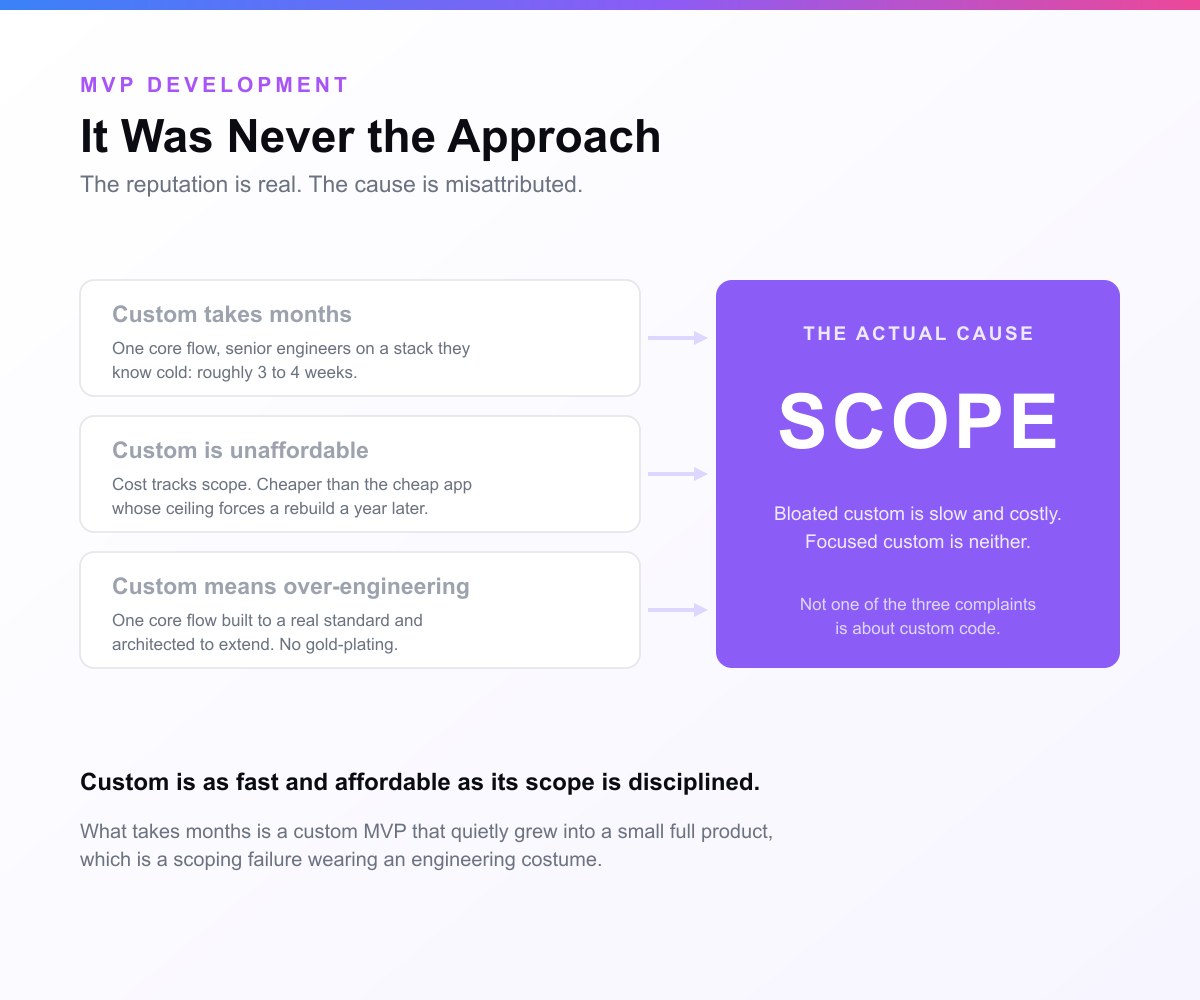
The honest version: custom is as fast and affordable as its scope is disciplined. Bloated custom is slow and costly; focused custom is neither.
Rebuild or extend? The question that decides your stack
The deeper reason how you build the MVP matters is what happens after it works. When a no-code or vibe-coded MVP finds traction, you usually face a rebuild, because you do not own portable, extensible code. When a custom MVP finds traction, you usually extend, because the foundation was built to grow.
So the real choice is between paying for quality now (custom) or paying for a rebuild later (no-code/AI, if you scale). The right call depends on confidence:
- Low confidence the idea is wanted → validate cheaply first (no-code/AI), accept a possible rebuild only if it works. Most of the time it does not, and you saved the custom budget.
- High confidence (validated demand, funding, known scale) → build custom now and skip the rebuild entirely.
A custom MVP is built for "validate now, extend later", scoped minimal to validate, architected so v2 grows from it rather than replacing it. That is the whole point of doing custom at the MVP stage rather than waiting.
What a custom MVP stack looks like
"Custom" does not mean exotic. Senior teams get custom speed precisely by using a small set of proven, scalable technologies they know cold, so the time goes into your product, not into learning tools. A typical modern custom MVP stack:
- Frontend + framework: a full-stack framework like Next.js, fast to build, scales for free at MVP traffic.
- Database + auth: a managed Postgres (e.g. Supabase) or similar, so there is no infrastructure to babysit.
- Payments: Stripe, hosted checkout, PCI handled.
- Infrastructure: managed hosting (Vercel and friends) with CI/CD, a live URL in minutes.
- Analytics: wired in from day one to measure activation and retention (see MVP metrics).
The point is that custom speed comes from familiarity and scope, not from cutting corners. The deeper stack decision is covered in the MVP tech stack guide.
How to build a custom MVP
The process is the standard MVP build, applied with custom engineering and the same scope discipline that keeps it fast:
- Validate first. Custom is the most expensive way to discover nobody wanted it, so confirm demand before building. See MVP validation.
- Scope to one core flow. The single discipline that keeps custom fast. Cut to the one flow that tests your riskiest assumption, and write down what you are not building. See MVP scope.
- Choose a proven, scalable stack. Speed comes from a team using technologies they know cold, not from corner-cutting.
- Build with senior engineers. Custom rewards seniority, experienced engineers know what to skip and how to architect for "validate now, extend later." See the MVP development team.
- Instrument and ship. Wire in analytics, deploy to a live URL, and get it in front of real users, the entire point of the exercise.
The goal is a clean, owned, production-grade product on one core flow, made fast through scope discipline, never through cutting engineering quality.
Products that needed custom from day one
Custom is the right first move more often than the "validate with no-code" advice implies, whenever the hard part is the product. A few patterns:
- A regulated fintech handling payments and KYC cannot meet its compliance and security needs on a rented platform; the core requires owned, audited code from the start.
- An AI product whose value is a real model, with metering, guardrails, and data pipelines, needs custom server-side engineering a no-code tool cannot express.
- A real-time or performance-critical app (live collaboration, low-latency data) where the experience is the differentiator must control its own stack.
In each, the thing that makes the product valuable is exactly the thing the cheaper routes cannot do, so custom is not premature; it is the only honest way to build the MVP at all.
Common custom MVP mistakes
- Going custom to validate a standard idea. Spending engineering budget to answer a question no-code could answer cheaply.
- Letting scope sprawl. The real reason custom builds run long and over budget. Keep it to one core flow.
- Hiring a full in-house team before validation. Carrying salaries and equity for an unproven idea. Use a build partner or validate first.
- Over-engineering for scale you do not have. Building for a million users at the MVP stage. Architect to extend, but build for the validation you need now.
- Choosing custom but cutting corners anyway. Custom's whole advantage is quality and ownership; a rushed, untested custom build throws that away and gives you the worst of both worlds.
Build it right, build it once
A custom MVP is the right call when your product's value depends on something the cheaper routes cannot deliver, a complex core, regulation, performance, deep integrations, or known scaling. Its advantages, clean owned code and no ceiling, are exactly what let you build once instead of rebuilding after a no-code wall. And with tight scope and senior engineers, custom does not have to mean slow or costly.
That is what we do at MVP Development. We ship custom, funding-ready MVPs in 21 days, scoped to one core flow, built by senior engineers on a proven, scalable stack, on a fixed quote you approve before we start, with 100% code ownership. You get the durability of custom without the bloat that gives it a bad name, and a foundation that scales when the idea is proven.
If your product needs custom, see our custom MVP development service. If you are not sure whether you need custom or could validate with no-code first, start with a free MVP consultation, we will tell you honestly.
Need a custom MVP built right? Walk us through the workflow off-the-shelf tools cannot handle and we will scope the custom build around it.
Related guides
- No-code MVP: the faster, cheaper route for standard ideas
- Vibe coding an MVP: AI-built MVPs and their ceiling
- How to scale an MVP: the path from a validated MVP to a scalable product
- MVP tech stack: the technologies a custom build uses
- Blockchain MVP: when the custom build runs on-chain
Frequently asked questions
What is a custom MVP?
A custom MVP is a minimum viable product built with real, hand-written code by engineers, rather than assembled on a no-code platform or generated by AI tools. It gives you full control over the architecture and features, clean code you own outright, and no platform ceiling on logic, integrations, performance, or scale. The trade-off is that it requires engineering skill and, if scope sprawls, more time and budget than no-code, though a tightly scoped custom MVP built by senior engineers can still ship in weeks. It is the most durable way to build a first version, ideal when the product needs to be more than the cheaper routes can deliver.
When should you build a custom MVP instead of using no-code?
Build custom when your product's value depends on something no-code cannot do well: a technically complex core (real-time, heavy data, custom algorithms, AI), a regulated industry with security and compliance needs, performance as the differentiator, deep custom integrations, or known plans to scale. Use no-code when you are simply validating a standard idea cheaply, sign-ups, listings, forms, and basic payments are exactly what no-code handles well. A common smart path is to validate with no-code, then go custom once the idea is proven, so you avoid building expensively before there is demand.
How much does a custom MVP cost?
It depends almost entirely on scope, not on the fact that it is custom. A tightly scoped custom MVP, one core flow, senior engineers, a proven stack, can ship in roughly 3 to 4 weeks for a modest budget, while a custom build that sprawls into many features, heavy integrations, or a regulated domain costs more and takes longer. The biggest cost driver is scope discipline: a minimal custom MVP is fast and affordable, and the "custom is expensive" reputation usually comes from scope creep rather than from custom development itself.
Is a custom MVP slow to build?
Not necessarily. The assumption that custom means months and a fortune usually comes from over-scoping, not from custom development. A custom MVP scoped tightly to one core flow, built by senior engineers on a stack they know well, can ship in about 3 to 4 weeks. Speed in custom builds comes from scope discipline and seniority, building fewer things, built by people who have shipped them before, rather than from cutting engineering quality. A bloated custom build is slow; a focused one is fast.
What is the difference between a custom MVP and an AI-built one?
A custom MVP is engineered deliberately by developers in clean, production-grade code, while an AI-built (vibe-coded) MVP is generated quickly from prompts and, while you technically own the code, it is often insecure and hard to maintain. Custom is slower upfront but gives you a foundation you can scale and pass due diligence on; AI-built is far faster to a first draft but usually needs an engineering review and cleanup before it can handle real users or scale. A common pattern is to use AI to prototype, then build the real version custom.
Do you have to rebuild a custom MVP to scale it?
Usually not, and that is a core advantage of building custom. Because a custom MVP is real, owned, well-architected code, you typically extend it as you scale rather than rebuilding from scratch. That is the opposite of a no-code or vibe-coded MVP, where scaling often means a full rebuild because you do not own portable, extensible code. A custom MVP is deliberately scoped minimal but architected so version two grows from it, which is exactly what makes the eventual scale-up incremental instead of a costly do-over.
Sources & references
This guide draws on lean-startup practice and current development approaches:
- Eric Ries, The Lean Startup: validating before committing to an expensive build
- Y Combinator, Startup Library: building a real product founders own
- Atlassian, Minimum Viable Product: scoping the MVP regardless of build approach
- Stack Overflow Developer Survey: the stacks and tools engineers build on
The 21-day figure reflects MVP Development delivery data for tightly scoped builds.


