


Most MVPs that balloon from a 6-week build into a 6-month one didn't fail at engineering, they failed at alignment. Nobody wrote down what was in scope, what was explicitly out, and what "done" meant, so every week added a feature nobody agreed to. An MVP requirements document (an MVP PRD) is the one-page-per-idea antidote: it aligns everyone on what you're building, for whom, and, most importantly, what you're not building. This guide covers exactly what to put in one, how long it should be, and includes a free copy-paste template at the end.
TL;DR
An MVP requirements document (MVP PRD) is a short document that defines your MVP's scope: the core problem, the target user, the essential feature set, what's explicitly out of scope, and how success is measured. Its single most important job is preventing scope creep, the non-goals list should be longer than the goals list. It defines what you're building and why, not how to build it (that's engineering's call). For an MVP, keep it to 3 to 8 pages; anything longer usually means the hard scoping decisions haven't been made yet. It matters most when someone else, an agency, an outsourced team, a new hire, is doing the building, because without it they'll build the product they imagined, not the one your users need.
Key Takeaways
- An MVP requirements document (PRD) defines your MVP's scope: the core problem, target user, essential features, what is out of scope, and how success is measured.
- Its single most important job is preventing scope creep; the non-goals list should be longer than the goals list.
- It defines what you are building and why, not how to build it (that is engineering's call).
- For an MVP, keep it to 3 to 8 pages; anything longer usually means the hard scoping decisions have not been made.
- It matters most when someone else (an agency, an outsourced team, a new hire) is doing the building.
At a Glance
| Section | Purpose |
|---|---|
| Core problem | Why you are building |
| Target user | Who it is for |
| Essential features | What is in scope |
| Non-goals | What is explicitly out (should be the longer list) |
| Success metrics | How you will measure it |
What is an MVP requirements document?
An MVP requirements document (also called an MVP PRD, product requirements document) is a concise written spec that aligns your team on the MVP's scope before a line of code is written. It answers four questions: who is this for, what core problem does it solve, which features are essential (and which are not), and how will you know it worked. Think of it as a contract between the person with the idea and the people building it. If you are not there yet, start with the one-page brief in how to explain an app idea to a developer; the PRD is what that conversation produces.
It is deliberately lean. A PRD for a full product might run 40 pages; an MVP PRD runs a handful, because the whole point of an MVP is a narrow scope, and a short document forces the scope decisions that a long one lets you dodge.
What a PRD is (and what it isn't)
A good MVP PRD stays in its lane. It defines:
- What you're building (the capabilities), who it's for, what success looks like, and what's explicitly out of scope.
It does not:
- Specify how to build it, the tech implementation is the engineering team's job (though you note constraints).
- Enumerate every edge case, that over-engineers the document and buries the decisions.
- Contain the final visual design, mockups and wireframes accompany the PRD; they don't replace it.
The most common way a PRD goes wrong is drifting into "how." A line like "use PostgreSQL" is an engineering decision, not a requirement. The PRD should say what the capability must enable; the team decides how.
Why an MVP PRD matters (especially with an outside team)
For a solo founder building alone, a PRD lives partly in your head. The moment anyone else is involved, it has to be written, and this is where it earns its keep:
- It's your scope firewall. When a stakeholder asks "why don't we add X?", you point to the non-goals list. Without one, everything is in scope, and scope is what kills MVP timelines. This is the same discipline as MVP scope, captured as a document.
- It's the contract for outsourced or agency builds. If the people building your MVP aren't the ones who conceived it, the PRD is what closes the gap. Without it, you get the product the engineers imagined, not the one your users need. Even a lean 3-page PRD dramatically cuts rework and misalignment, which is exactly why we ask for (or help write) one before we build.
- It forces decisions early. Writing the doc surfaces the vague spots, "who exactly is this for?", "what does 'done' mean?", while they're cheap to resolve, not mid-build.
The structure of an MVP PRD, section by section
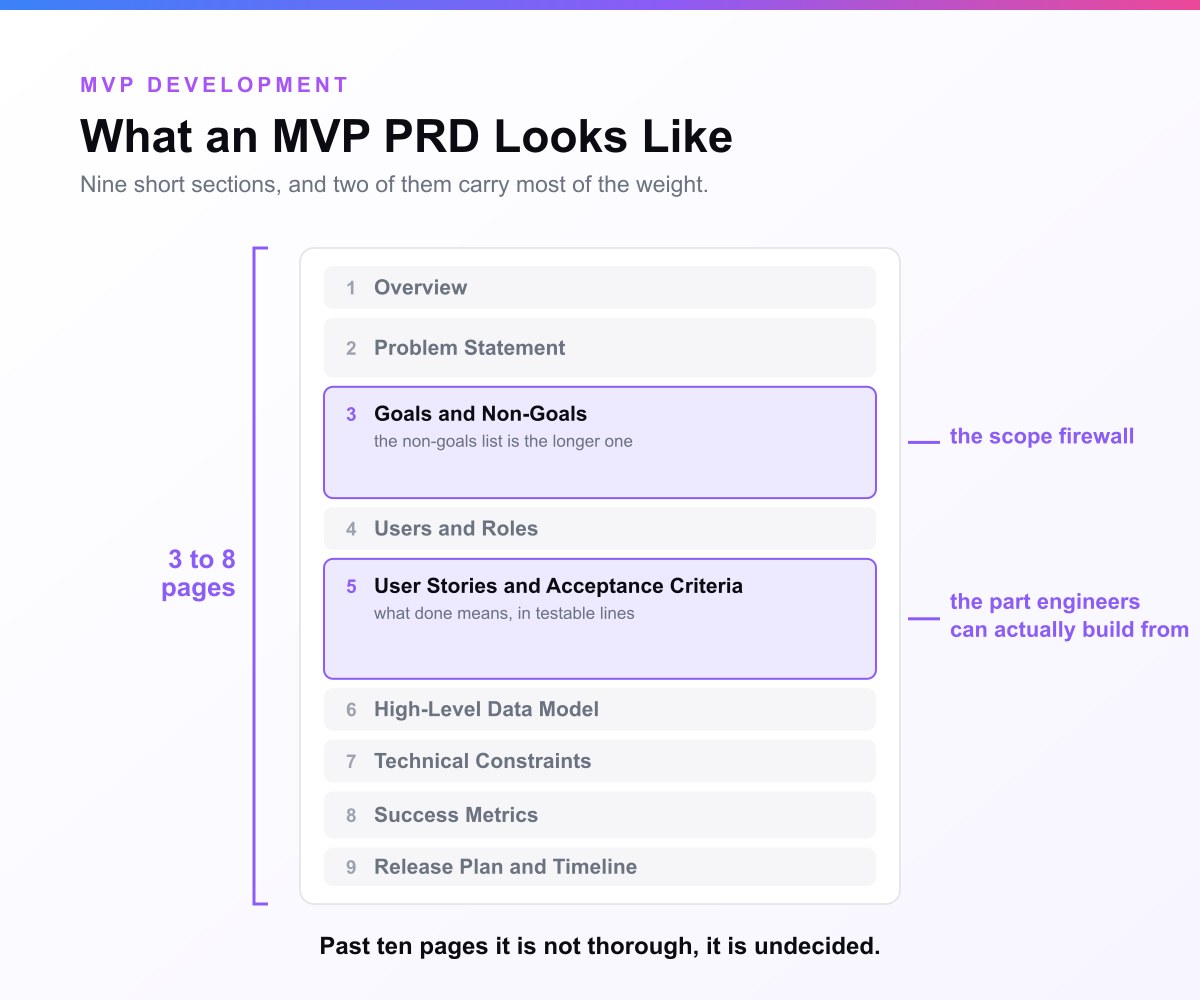
Nine short sections cover everything an MVP needs. Keep each tight.
1. Overview (one paragraph). What the product is, who it's for, and why it matters now. If you can't write this paragraph clearly, you're not ready to write the rest, that's a signal to go back to validation.
2. Problem statement. The specific problem, for whom, and why it matters, ideally grounded in real user interviews. Include the user and context, the friction, their current alternative, and the impact. Avoid vague lines like "the market needs a better solution."
3. Goals and non-goals. The most important section. List explicit goals and explicit non-goals, and for an MVP the non-goals list should be longer. Non-goals are your scope firewall, they're the features you're deliberately saving for after launch. Use a prioritization framework like MoSCoW to decide what's a true Must-have.
4. Users and roles. Who uses this and in what context. MVPs usually have just 1 to 2 user types; define each one's permissions and interaction pattern.
5. User stories and acceptance criteria. User stories define what users can do; acceptance criteria define what "done" means. Together they're the backbone of the engineering spec (more on the format below).
6. High-level data model. Name the core entities (User, Client, Invoice, Payment…) so engineers align before they start. Keep it high-level, not a full schema.
7. Technical constraints. Platform (web / iOS / Android), any required integrations, and any deliberate shortcuts (no-code tools, manual "wizard-of-oz" steps behind the scenes) meant to save time. The full stack choice follows the PRD, see our MVP tech stack guide.
8. Success metrics. Define success before you build. A primary metric (e.g. time-to-first-value), plus a few engagement, retention, and business metrics. See MVP metrics for what to track.
9. Release plan and timeline. A strict target window (e.g. 4 to 8 weeks) to avoid endless tooling. A deadline is itself a scoping tool.
User stories and acceptance criteria: the format
This is the part that makes a PRD executable. A user story is written as:
As a [user type], I want to [action] so that [outcome].
Each story gets acceptance criteria, the concrete, testable conditions that define "done." For example:
US-01: Create invoice
As a freelance designer, I want to create a new invoice so that I can bill for completed work.
Acceptance criteria:
- User can enter client name, email, invoice number, due date, and line items.
- Line items can be added/removed; the total calculates automatically.
- The invoice can be previewed and saved as a draft before sending.
Acceptance criteria are what stop engineers from filling ambiguity with a guess. A story without them will be built, just not the way you intended.
How long should an MVP PRD be?
3 to 8 pages. A PRD longer than 10 pages is a warning sign: it usually means the scope hasn't been cut and the decisions haven't been made. Long PRDs generate long arguments and long development cycles. If you can't get it under ~5 pages, the fix isn't a longer document, it's cutting more scope.
Common mistakes
- Too long. A 40-page MVP PRD means decisions are still being debated. Decisions belong in the PRD; debate belongs before it.
- Missing acceptance criteria. Engineers fill the gaps with their best guess, usually not what you meant.
- No non-goals. Without an explicit out-of-scope list, everything is in scope, and the MVP quietly becomes a full product.
- Product "what" vs technical "how." Writing "use React/PostgreSQL" instead of what the capability must enable. Leave the how to the builders.
Hand this to your build team, or let us write it with you
A tight MVP PRD is the single best thing you can hand a development team before the build starts, it's the difference between shipping the right thing in weeks and rebuilding the wrong thing for months. At MVP Development we start every engagement by aligning on exactly this: the one core flow, the non-goals, and what "done" means, then ship the MVP in about 3-4 weeks on a fixed scope you approve up front.
If you're scoping your MVP now, our MVP consulting will help you turn a fuzzy idea into a crisp, buildable PRD, before you spend a dollar on development.
Ready to build from your PRD? Send us your draft requirements and we will red-line them with you on a scoping call.
Free MVP PRD template
✨ Prefer to fill it in and download? Use our free interactive MVP PRD template: type your details into each field, watch a clean document build itself, and download it as a polished PDF. Or copy the plain template below.
Copy the template below into a doc and fill in the brackets. It's deliberately short, if a section runs long, that's usually a sign to cut scope, not to write more.
# [Product Name], MVP Requirements Document (PRD)

## 1. Overview
[One paragraph: what this product is, who it's for, and why it matters now.]

## 2. Problem Statement
- **User & context:** [who has the problem, and when]
- **The friction:** [the specific pain]
- **Current alternative:** [what they use today]
- **Impact:** [why solving it matters]

## 3. Goals & Non-Goals
**Goals (in the MVP):**
- [Goal 1]
- [Goal 2]

**Non-Goals (explicitly NOT in the MVP):**   ← keep this list longer
- [Deferred feature 1]
- [Deferred feature 2]
- [Deferred feature 3]

## 4. Users & Roles
- **[User type 1]:** [context, permissions, what they do]
- **[User type 2]:** [context, permissions, what they do]

## 5. User Stories & Acceptance Criteria
### US-01: [Title]
As a [user type], I want to [action] so that [outcome].
**Acceptance criteria:**
- [Testable condition 1]
- [Testable condition 2]

### US-02: [Title]
As a [user type], I want to [action] so that [outcome].
**Acceptance criteria:**
- [Testable condition 1]

## 6. High-Level Data Model
- **[Entity 1]:** [key fields]
- **[Entity 2]:** [key fields]

## 7. Technical Constraints
- **Platform:** [web / iOS / Android]
- **Required integrations:** [e.g. Stripe, email]
- **Deliberate shortcuts:** [no-code tools, manual steps behind the scenes]

## 8. Success Metrics
- **Primary:** [the one metric that defines success, e.g. time-to-first-value]
- **Engagement:** [e.g. % completing the core action]
- **Retention:** [e.g. % returning within 30 days]
- **Business:** [e.g. paying customers / MRR at 30-90 days]

## 9. Release Plan & Timeline
- **Target launch window:** [e.g. 4-8 weeks]
- **Milestones:** [optional, keep minimal]
If writing this document is the part you keep stalling on, product discovery produces it from customer interviews, a competitor teardown and core-flow wireframes rather than from a blank page, and hands it over as a costed delivery plan.
Related guides
- MVP Scope: the discipline of deciding what's in and out (the decisions the PRD records)
- MVP Feature Prioritization: MoSCoW/RICE for the goals-vs-non-goals call
- MVP Tech Stack: the technical choices that follow PRD sign-off
- What Is an MVP?: the underlying concept
- MVP Validation: confirm the problem before you write the PRD
Frequently asked questions
What should an MVP requirements document include?
An MVP PRD should include: a one-paragraph overview, a problem statement grounded in user context, explicit goals and non-goals, the user types and their roles, user stories with acceptance criteria, a high-level data model, technical constraints, and success metrics. For an MVP, the non-goals (out-of-scope) list should be longer than the goals list, scope discipline is the document's most important function.
How long should an MVP PRD be?
For an MVP, 3 to 8 pages is ideal. A PRD longer than 10 pages usually means the scoping decisions haven't been made, features haven't been cut or prioritized. Long documents produce long arguments and long build cycles. If you can't summarize it in about 5 pages, the answer is to cut more scope, not to write more.
What is the difference between a user story and acceptance criteria?
A user story describes what a user wants to accomplish, "As a designer, I want to create an invoice." Acceptance criteria define exactly what "done" means for that story: which fields must be fillable, what the system does on submit, what the user sees on completion. Acceptance criteria make a user story testable and remove the ambiguity engineers would otherwise fill with a guess.
Do you really need a PRD for an MVP?
Yes, especially when the MVP is built by an outsourced team, an agency, or a new hire rather than the person who conceived it. Without a written spec you get the product the builders imagined, not the one your users need. Even a lean 3-page PRD dramatically reduces misalignment, rework, and scope creep during the build. A solo founder building alone can keep it lighter, but the moment anyone else is involved, write it down.
Is an MVP PRD the same as an MVP scope document?
They overlap heavily. "MVP scope" is the discipline of deciding what's in and out; the MVP PRD is the document that records those decisions, plus the users, user stories, data model, and success metrics needed to actually build. In practice the PRD is where your scope decisions live alongside everything else the build team needs. See our MVP scope guide for how to make the cut in the first place.
Sources & references
- Eric Ries, The Lean Startup: the validated-learning framework behind the MVP
- Atlassian, Minimum Viable Product: a practical definition and scoping guidance
- Product requirements document: definition and standard structure


