


TL;DR
Most MVPs take 3 to 4 months, roughly 8 to 16 weeks, to go from idea to launched product. A simple, single-flow MVP ships in 6 to 8 weeks; a standard SaaS product takes 8 to 16 weeks; a complex or regulated build runs 4 to 6 months. The number is set less by your idea and more by three things: how tight your scope is, how senior your team is, and how many integrations you bolt on. Time, unlike cost, is mostly a discipline problem.
The compression nobody priced in: AI-assisted development now cuts the build phase by 40 to 60%, so the bottleneck has moved from coding to deciding. At MVP Development we exploit that shift to ship a funding-ready MVP in 3 to 4 weeks, senior-built, not no-code throwaway, on a clear, scoped quote you approve before we start. We break the math down at the end.
Key Takeaways
- Most MVPs take 3 to 4 months (roughly 8 to 16 weeks) from idea to launched product.
- A simple single-flow MVP ships in 6 to 8 weeks; a standard SaaS product takes 8 to 16 weeks; a complex or regulated build runs 4 to 6 months.
- Timeline is driven by scope tightness, team seniority, and integration count.
- Unlike cost, time is mostly a discipline problem.
- AI-assisted development now cuts the build phase by 40 to 60%, moving the bottleneck from coding to deciding.
More data: timeline figures and the AI-compression data, with sources, are in our MVP statistics for 2026.
How long does it take to build an MVP? (the real numbers)
Here's what an MVP actually takes across the four paths founders take in 2026:
| MVP type | Timeline | Features | What ships |
|---|---|---|---|
| Simple (single core flow) | 4 to 8 weeks | 3 to 5 | Auth + one core action + payment |
| Standard SaaS | 8 to 16 weeks (3 to 4 months) | Core + secondary | Dashboard, billing, onboarding |
| Complex / regulated | 4 to 6+ months | Many + compliance | Marketplace, fintech, healthcare |
| AI-accelerated single-flow | 3 to 4 weeks | One core flow | Deployed, investor-ready product |
Industry data backs this up: most well-scoped MVPs land in the 8 to 16 week range, with an average around four months and the most common timeline near three. The spread is wide because "MVP" covers everything from a landing page with one action to a two-sided marketplace.
This guide is about the clock, not the budget. If you want the dollar figures behind each path, read our companion piece on how much an MVP costs. Here we answer one question only: how long.
Want a number for your build? Pick your product type, features, integrations, and team, and get a realistic week range with a phase-by-phase breakdown:
What are you building?
How many features beyond the one core flow?
Third-party integrations (payments, email, CRM…)
Who is building it?
Estimates use the model in this guide: a product-type base range, plus 1 to 2 weeks per extra feature and per integration, adjusted for team and approach. A planning aid, not a quote.
The MVP timeline, phase by phase
Every MVP runs through the same four stages. We call them the MVP build clock, and most founders mis-estimate it by assuming the build phase is the whole clock. It isn't.
| Phase | What happens | Typical duration |
|---|---|---|
| 1. Discovery & scoping | Lock the hypothesis, the one core flow, the spec | 1 to 3 weeks |
| 2. Design (UX/UI) | Wireframes, flows, a usable interface | 2 to 4 weeks |
| 3. Build (engineering) | Core API, database, auth, the core flow | 6 to 14 weeks |
| 4. Test, QA & launch | Edge cases, fixes, deploy, soft launch | 1 to 3 weeks |
A few things this table hides:
- The phases overlap. Design starts before discovery fully ends; QA runs alongside the back half of the build. So the calendar time is shorter than the sum of the rows, a well-run team compresses a 12-week sum into 8 weeks of wall-clock.
- Discovery is the cheapest phase to do well and the most expensive to skip. Rushing it is the single most reliable way to add rework, and weeks, to the build.
- Build is the longest phase but the most predictable. When the spec is locked, engineering time is estimable. When it isn't, the build phase is where every unmade decision comes home to roost.
If you want a structured way to run these stages with explicit exit gates, that's exactly what an MVP roadmap is for. The roadmap is the how; this post is the how long.
MVP timeline by product type
The 8-to-16-week range shifts depending on what you are building, because different products carry different amounts of irreducible work.
- SaaS MVP: 8 to 12 weeks standard, or 3 to 4 weeks for a tightly scoped single-flow build. The core (auth, one workflow, billing) is well-understood, so a senior team moves fast. See SaaS MVP.
- Marketplace MVP: 10 to 16 weeks, because you are building two sides and a transaction loop with payments and a trust layer. The build is bigger, and seeding liquidity adds time beyond the code. See Marketplace MVP.
- AI MVP: 4 to 10 weeks. Because you call a foundation model rather than training one, the app layer is a normal web build; the extra time goes into prompts, guardrails, and evaluation. See AI MVP.
- Mobile app MVP: 10 to 16 weeks, longer than web because of app-store review, device testing, and two platforms if you go native. A cross-platform framework keeps it toward the lower end.
- Web app MVP: 6 to 12 weeks, often the fastest: no app-store review, instant deploys, one proven stack.
- Fintech or healthtech MVP: 4 to 6+ months, because compliance (KYC/AML, HIPAA) and security genuinely cannot be compressed; they are real work, not scope creep.
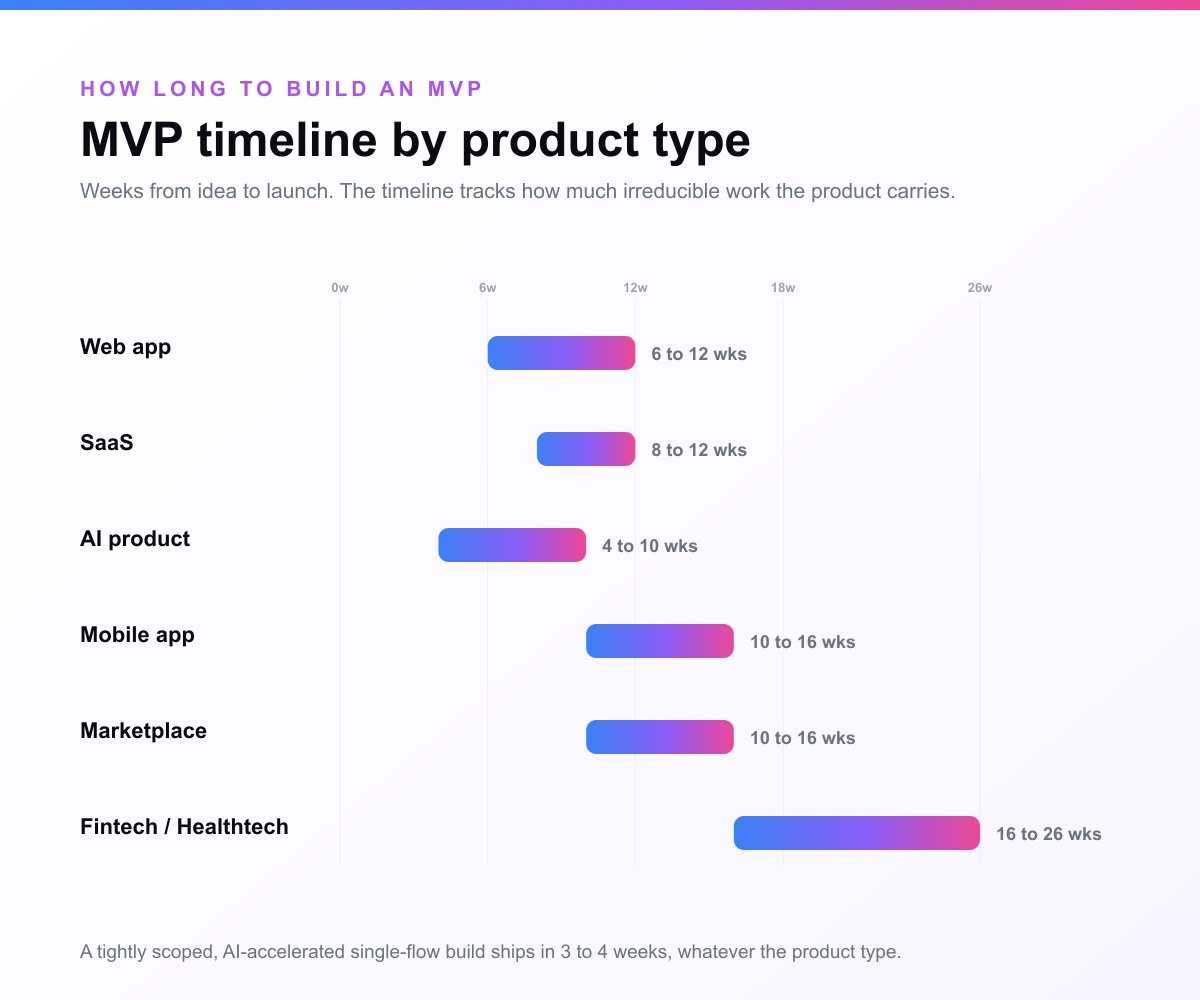
The pattern: the timeline tracks how much irreducible work the product carries. Regulation, two-sided complexity, and native platforms add real weeks, while a single-flow SaaS or web product compresses the most.
What makes an MVP take longer (or shorter)
Two MVPs with identical features can be 6 weeks apart. These are the levers that decide which side of the range you land on.
Scope (the biggest lever by far)
Every feature you add to the MVP adds 1 to 2 weeks. Every third-party integration, payments, auth, email, a CRM, adds 1 to 2 weeks each and a new thing that breaks. The fastest MVPs aren't built by faster engineers; they're built by founders who cut harder. One core flow, shipped, beats five half-flows in progress.
Team experience
An experienced team delivers 2 to 3x faster than an inexperienced one on the same spec. A solo non-technical founder stitching tutorials together might take three months for what a senior team ships in three weeks. Seniority isn't about typing speed, it's about not building the wrong thing twice.
Decision speed
The hidden timeline killer. Every "let me think about it" on a design choice, a copy change, or a feature cut stalls the build. MVPs don't usually slip because engineering is slow; they slip because decisions are. A founder who answers questions in hours instead of days can cut a week off the calendar without touching the code.
Technical approach
No-code, AI-assisted custom, and traditional custom sit at very different points on the speed curve, enough that the next section is just that comparison.
No-code vs custom vs AI-accelerated: speed compared
The build approach you pick can move your launch date by months. Here's the honest trade-off table:
| Approach | Time to launch | The trade-off |
|---|---|---|
| No-code (Bubble, Glide, Softr) | 3 days to 2 weeks | Fastest to launch; often needs a full rebuild once you outgrow the platform |
| AI-accelerated custom (senior dev + Cursor/Copilot) | 3 to 6 weeks | Owned, portable code at near-no-code speed; needs senior judgment to steer |
| Traditional custom (agency / in-house) | 3 to 6 months | Full control and scalability; slowest and most expensive path |
No-code can cut build time 50 to 90% and is unbeatable for validating a non-technical idea this week. The catch is the ceiling: the day you need a custom integration, real data ownership, or an investor's technical due diligence, a no-code MVP often becomes a rewrite.
The path that's quietly winning in 2026 is the middle one, a senior developer with AI tooling producing real, owned code in three to six weeks. You get most of no-code's speed without inheriting its ceiling. That's the model we run at MVP Development.
How AI is compressing MVP timelines in 2026
AI changed the timeline math, but not the way most headlines claim. The compression is real and it's specific:
- The build phase shrinks 40 to 60%. Tools like GitHub Copilot and Cursor turn a tight spec into working scaffolding fast. GitHub's own research found developers completed tasks ~55% faster with Copilot. Automated testing shrinks the painful QA tail.
- Discovery, design, and decisions don't shrink. Talking to users, choosing the one core flow, and saying "no" are still human-speed. AI writes code; it doesn't tell you which code is worth writing.
- So the bottleneck moved upstream. When building is fast, your timeline is set by how quickly you scope and decide. Founders who win in 2026 are the ones who got discovery right, because that's now the long pole.
The trap is using AI speed to build more in the same time instead of shipping the right thing sooner. AI lets you ship the core flow in days. It does not lengthen your attention or shorten your decisions, those are still on you.
A realistic 8-week MVP timeline (week by week)
Here's what a disciplined, AI-accelerated standard SaaS MVP looks like compressed into eight weeks. Use it as a planning template.
| Week | Focus | Outcome |
|---|---|---|
| Week 1 | Discovery + spec | Locked hypothesis, one core flow, written one-page spec |
| Week 2 | Design + architecture | Key screens designed, repo + database schema + auth scaffolded |
| Weeks 3 to 5 | Build the core flow | The single core flow working end-to-end on staging |
| Week 6 | Integrations | Payments, email, and any required third-party APIs wired in |
| Week 7 | QA + polish | Edge cases, real copy, performance pass, founder acceptance |
| Week 8 | Launch | Production deploy, analytics live, first users onboarded |
Two notes. Week 1 is load-bearing, every day saved here by locking scope pays back double in the build weeks. And integrations get their own week because they're the most underestimated line item on any MVP timeline.
What you can realistically ship in 4, 8, and 12 weeks
It helps to translate timelines into scope, what actually fits in each window.
In 4 weeks (the AI-accelerated, single-flow build): one core flow, end to end. Auth, the single feature that proves your idea, a payment path if needed, deployed to production, analytics live. It is investor-ready and real, but it does exactly one thing. This is the funding-ready MVP, and it works because the scope is ruthlessly cut to a single hypothesis.
In 8 weeks: the single core flow plus the supporting pieces that make it feel like a product, onboarding, a basic account area, one or two secondary features, and the integrations the core flow needs. Enough to run a real beta, not just a demo.
In 12 to 16 weeks: a fuller standard SaaS or a more complex product, multiple connected flows, richer UI, several integrations, and the polish a paying customer expects. This is where most "standard" MVPs land, and where scope discipline matters most, because every added week is usually an added feature.
The honest takeaway: you choose your timeline by choosing your scope. A 4-week MVP is not a worse MVP; it is a more focused one. If you want it faster, the lever is almost always cutting to a smaller core, not finding a faster team.
The cost of rushing your MVP timeline
There is a floor below which compressing a timeline stops saving time and starts costing it. Push a build too hard, and the corners you cut, skipped QA, no error handling, a confusing flow, come back as churned users, emergency fixes, and a product that teaches you the wrong lesson.
The distinction that matters is scope versus quality. Cutting scope to hit a deadline is healthy: fewer features, one core flow, ship sooner. Cutting quality is not: a core flow that breaks, loses data, or confuses users corrupts the very validation the MVP exists to produce. When users churn on a bug, you misread a quality failure as a lack of demand, and the rushed timeline costs you the answer you were paying for.
So the right way to go faster is to remove work, cut features, use managed services, lean on AI tooling, decide quickly, not to lower the bar on the work that remains. A 4-week MVP done this way is genuinely investor-ready; a 4-week MVP that skimped on the core flow is a liability dressed as a shortcut. Speed through subtraction, never through sloppiness.
How to build your MVP faster (without breaking it)
Speed comes from subtraction and good defaults, not from rushing engineers. The reliable accelerants:
- Cut to one core flow. The single biggest timeline decision you control. If removing a feature still lets you test the core hypothesis, cut it.
- Use managed platforms. Vercel, Supabase, Stripe, Clerk, skip the infrastructure you'd otherwise spend a week configuring.
- Use a component library. shadcn/ui or Tailwind UI instead of custom design. Pixel-perfect UI is a post-validation luxury.
- Put seniors on it. One senior engineer often out-ships three juniors and avoids the rework that quietly eats weeks.
- Lean on AI tooling. Let Copilot/Cursor handle boilerplate so humans spend time on the decisions that matter.
- Make decisions fast. Answer the team in hours. Indecision is slower than any framework.
MVP timeline mistakes that cause delays
The same handful of mistakes turns an 8-week MVP into a 5-month one:
1. Feature creep. The number-one timeline killer. "While we're at it, let's add…" is how a single-flow MVP quietly becomes a product. Every addition resets the finish line.
2. Skipping or rushing discovery. Saving a week on scoping to lose three on rework. Unmade decisions don't disappear, they reappear mid-build as expensive ones.
3. Underestimating integrations. Each one is 1 to 2 weeks and a new failure point. Wire in only what the core flow needs to function.
4. Gold-plating the design. Spending three weeks on a custom design system for a product you haven't validated. Use templates until users prove the idea.
5. Hiring mid-build. Adding people to a late MVP usually slows it down, onboarding cost outweighs the extra hands. Staff the team before the clock starts.
6. Treating "done" as "perfect." An MVP ships when the core flow works, not when every edge case is gold-plated. Perfectionism is just feature creep wearing a nicer suit.
The 3 to 4 week funding-ready MVP (the MVP Development method)
The market says 3 to 4 months. Here's the disruption: at MVP Development we ship a complete, funding-ready MVP in 3 to 4 weeks, a deployed, user-ready product you can demo to investors on day 28, not a wireframe or a no-code throwaway, on a clear, scoped quote you approve before we start.
How, when the market says months? Not by cutting quality, by changing the method:
- Senior developers, not juniors. The architecture is right the first time, so there's no rework eating your calendar.
- AI and automation as a force multiplier. Modern frameworks plus AI-assisted code generation and automated testing compress the build phase from weeks into days, the same 40 to 60% the data shows, applied by people who know how to steer it.
- A locked, productized process. Fixed scope, fixed timeline, an agreed quote. No discovery-phase bleed, no scope creep, no surprise delays.
- Owned code, not platform lock-in. Real, portable code that survives investor due diligence and scales past the MVP.
Why it's 3 to 4 weeks, not 4 months
The market's 3 to 4 months isn't mostly coding time, it's decision latency, hiring, discovery bleed, and rework. We remove those: senior-led scoping kills rework, a productized process removes hiring and discovery drift, and AI tooling compresses what's left. What remains is the irreducible work of building one core flow well, and that fits in 3 to 4 weeks.
The honest trade-off is scope, not quality: 3 to 4 weeks buys one core flow built to production standard, not ten features at once, which is what a good MVP should be anyway. You get validation in 28 days instead of a quarter, and a real foundation to expand from.
Ready to start the clock? Tell us your deadline and we will tell you what genuinely fits inside it.
How long the internet claims an MVP takes: we counted that too
The same 30 articles that quote a price also quote a timeline, and the timelines disagree with each other as badly as the prices do. We read the build times out of the same corpus on 23 September 2026, converting months at 4.345 weeks, and 17 of the 30 make a claim about how long a build takes.
Across 17 articles stating how long an MVP takes to build, MVP Development found the median claimed range is 8 to 12 weeks, with the fastest claim at 1 week and the slowest at 26. Read 23 September 2026.
A 26-fold spread, from the same page-one results, in the same month. If you have read three of these articles and come away thinking “two to three months”, you have absorbed the median correctly. You have also absorbed a number that 2 of 30 articles cite any source for, because this is the same corpus as our cost study and the sourcing is no better here.
Why the fast end and the slow end are both real
The one-week claims and the six-month claims are not people lying at each other. They are describing different things and calling both an MVP. At the fast end the scope is one workflow on one screen. At the slow end it is a multi-role platform with compliance work. Nobody says which one they mean in the headline, which is what makes the range useless as a planning number.
So the useful question is not how long an MVP takes. It is how much product you are calling an MVP. The 8-to-12-week median describes the middle of that distribution and nothing about your build.
How we counted, including what we threw out
This study cost no new requests: the corpus was already fetched for the cost study, and the same sentences were re-read for time ranges instead of dollar ranges. Every extracted range was then read against its source sentence, and four were rejected for the same reason the cost extractor kept failing: the first time range near a build word is often a phase or a tier rather than the build. One was a Market Research line item, one a discovery phase, one a Prototype/Wireframe tier, and one was a factory setup and logistics ramp-up that had nothing to do with software.
Thirteen of the 30 make no clear claim about build time at all, which is itself worth knowing on a page that ranks for the question.
The data, and how to cite it
The full dataset is published as JSON, with the claimed range and the source sentence for each of the 17, and the reason for each of the 4 rejections: mvp-timeline-claims-2026-09-23.json.
To cite this study: MVP Development, “How long the internet claims an MVP takes”, 23 September 2026, https://mvpdevelopment.company/blog/how-long-does-it-take-to-build-an-mvp. The companion cost study, on the same corpus, is what the internet claims an MVP costs.
Related guides
- What Is an MVP?: the minimum viable product, explained
- How to Build an MVP: the full step-by-step process
- MVP Validation: validate demand before you build
- MVP Metrics: how to measure whether your MVP works
Frequently asked questions
How long does it take to build an MVP?
Most MVPs take 3 to 4 months, roughly 8 to 16 weeks, from idea to launch. A simple single-flow MVP ships in 6 to 8 weeks, a standard SaaS product in 8 to 16 weeks, and a complex or regulated build in 4 to 6 months. A tightly scoped, AI-accelerated MVP can be deployed in as little as 4 weeks.
Can you build an MVP in a month?
Yes, if the scope is one core flow and the team is senior. A focused single-feature MVP built on managed platforms with AI-assisted development can ship in 3 to 4 weeks. It's not possible for multi-feature or regulated products, where compliance and integrations genuinely can't be compressed.
How long does a no-code MVP take?
A simple no-code MVP can be live in 3 to 7 days, and a more complex one with custom integrations in 1 to 2 weeks. No-code cuts build time by 50 to 90%, but the trade-off is a likely rebuild once you outgrow the platform or need investor-grade, owned code.
What's the longest phase of MVP development?
The build (engineering) phase, typically 6 to 14 weeks. It's the longest but also the most predictable once the spec is locked. The phase that most often blows up a timeline is discovery, not because it's long, but because skipping it pushes rework into the build.
Why do MVPs take longer than planned?
Almost always scope and decisions, not engineering. Feature creep, slow founder decisions, and underestimated integrations are the top three causes of delay. Locking a one-page spec and answering the team quickly does more for your timeline than any tool.
Does AI make MVP development faster?
Yes, for the build phase. AI tooling like Copilot and Cursor accelerates coding by 40 to 60%, and GitHub's research found developers completed tasks about 55% faster with Copilot. But discovery, design, and decision-making stay human-speed, so a tight scope matters more in 2026, not less.
How long does it take to build an MVP app (mobile)?
A mobile MVP with a backend typically takes 10 to 16 weeks, longer than a web MVP because of app-store review, device testing, and two platforms if you go native. A cross-platform framework (React Native, Flutter) and a single managed backend keep it toward the lower end.
How long does it take to build a SaaS MVP?
A standard SaaS MVP typically takes 8 to 12 weeks, and a tightly scoped single-flow SaaS MVP can ship in 3 to 4 weeks with a senior, AI-accelerated team. SaaS compresses well because the core, auth, one workflow, and a payment path, is well-understood and built on proven, managed components. The timeline grows with each secondary feature and integration you add, which is why scoping to the one core flow is the biggest lever. See our SaaS MVP guide for the full approach.
Does a bigger budget make an MVP faster?
Only up to a point. Money buys a senior team and good tooling, which genuinely speeds delivery, but beyond that, throwing more people or money at an MVP often slows it down through onboarding cost and coordination overhead. The real timeline levers are scope and decision speed, not budget. A well-scoped MVP with a small senior team and a decisive founder beats a big, well-funded team building an unfocused product. Time and cost are related but not interchangeable; see how much it costs to build an MVP.
Sources & references
This guide is based on current MVP delivery data and MVP Development project benchmarks:
- Netguru, How Long Does It Take to Build an MVP, phase durations and complexity ranges
- GitHub, Copilot productivity research, AI's measured effect on developer speed
- Y Combinator Startup Library, ship-fast, talk-to-users founder playbooks
- Stack Overflow Developer Survey, AI-tooling adoption among developers
Timeline ranges reflect Q2 2026 market practice; the 4-week figure reflects MVP Development delivery data for tightly scoped, single-flow builds.


