


TL;DR
An MVP launch strategy is the plan for putting your minimum viable product in front of real users so you can learn whether your idea works, as fast and cheaply as possible. It is not a product launch in the traditional sense. The goal is not maximum attention; it is maximum learning per user, which usually means launching small, to a focused audience, with sharp instrumentation, then iterating on what you see.
The mistake most founders make is treating an MVP launch like a finished-product launch: big announcement, broad audience, press push. That burns your one first impression on a product that is, by definition, incomplete. This guide covers what an MVP launch strategy actually is, soft launch versus hard launch, the full pre-launch to post-launch sequence, where to launch, the metrics that tell you it worked, and the mistakes that waste the launch. If you have not built the MVP yet, start with how to build an MVP.
Key Takeaways
- An MVP launch aims for maximum learning per user, not maximum attention.
- Launch small, to a focused audience, with sharp instrumentation, then iterate on what you see.
- The biggest mistake is treating an MVP launch like a finished-product launch and burning your one first impression on an incomplete product.
- A soft launch to a narrow audience beats a big hard launch for a product that is, by definition, unfinished.
- Success is measured by activation, retention, and learning, not signups or press.
What is an MVP launch strategy?
An MVP launch strategy is a deliberate plan for releasing your MVP to real users with the single goal of validated learning, not revenue or reach. It answers four questions: who you launch to, where you reach them, what you measure, and how you turn what you learn into the next version.
It differs from a normal product launch in one fundamental way: the product is intentionally incomplete. A full launch sells a finished thing to as many people as possible. An MVP launch exposes a deliberately minimal thing to enough of the right people to prove or disprove your core assumption. Reach is not the win; a clear answer is. That changes every decision, from audience size to which metrics matter.
This is why an MVP launch is best understood as the last step of validation rather than the first step of growth. You built the MVP to test a hypothesis (see MVP validation); the launch is how you run that test with real users instead of guesses. Get this framing right and the rest of the strategy follows naturally.
Soft launch vs hard launch for an MVP
The first strategic choice is how loud to launch. There are two modes, and for most MVPs the answer is clear.
| Soft launch | Hard launch | |
|---|---|---|
| Audience | Small, targeted group | Broad, public |
| Goal | Learn, fix, iterate | Awareness, adoption, scale |
| Risk | Low, mistakes seen by few | High, bugs hit your whole audience |
| Best for | Almost every MVP | Validated products ready to grow |
A soft launch releases the MVP quietly to a small, controlled group: an invite list, a beta cohort, one community, a waitlist segment. You watch closely, fix what breaks, and learn before anyone else sees it. A hard launch goes wide and public: Product Hunt, press, paid ads, a big announcement, and is built for awareness and adoption.
For an MVP, the soft launch is almost always the right move. Your product is incomplete and unproven; a broad launch spends your one first impression on a version that will embarrass you, and floods you with more feedback than you can act on. Launch soft, learn, iterate, and save the hard launch for when the product has earned it. The hard launch is a growth event; the MVP launch is a learning event, and confusing the two is the most common launch mistake there is.
The third mode: a silent launch
There is a quieter option than the soft launch, and for some MVPs it is the right one. A silent launch (sometimes called a dark launch) puts the product live with no announcement at all: no post, no email, no community thread. The only people who find it are the ones you send there one at a time, or the ones who arrive through search and referrals on their own.
It fits three situations. The product is in a category where a bad first impression travels fast and you want to fix the first week’s problems before anyone is watching. You are selling to a small B2B market where every prospect knows every other, so the “launch” is really ten private demos. Or you want to measure organic pull, whether people who were never told about the product find it and stay, before you spend anything on attention. The cost is that a silent launch produces very little data quickly; if the question you need answered is “does anyone want this”, it is the slowest way to ask. Use it for hardening, not for validation.
| Silent launch | Soft launch | Hard launch | |
|---|---|---|---|
| Who knows | Only people you contact directly | One community, a waitlist segment, a cohort | Everyone you can reach |
| Speed of signal | Slow | Days to a couple of weeks | Immediate, and noisy |
| Best question it answers | Is it stable, and does anyone find it unprompted | Do the right people want it | Can it grow |
| Right for an MVP | Sometimes, for the first week | Almost always | Rarely |
The MVP launch sequence: pre-launch, launch, post-launch
A good MVP launch is three phases, not one moment. Treating launch day as the whole event is how founders end up with a live product and no plan for what to do with it.
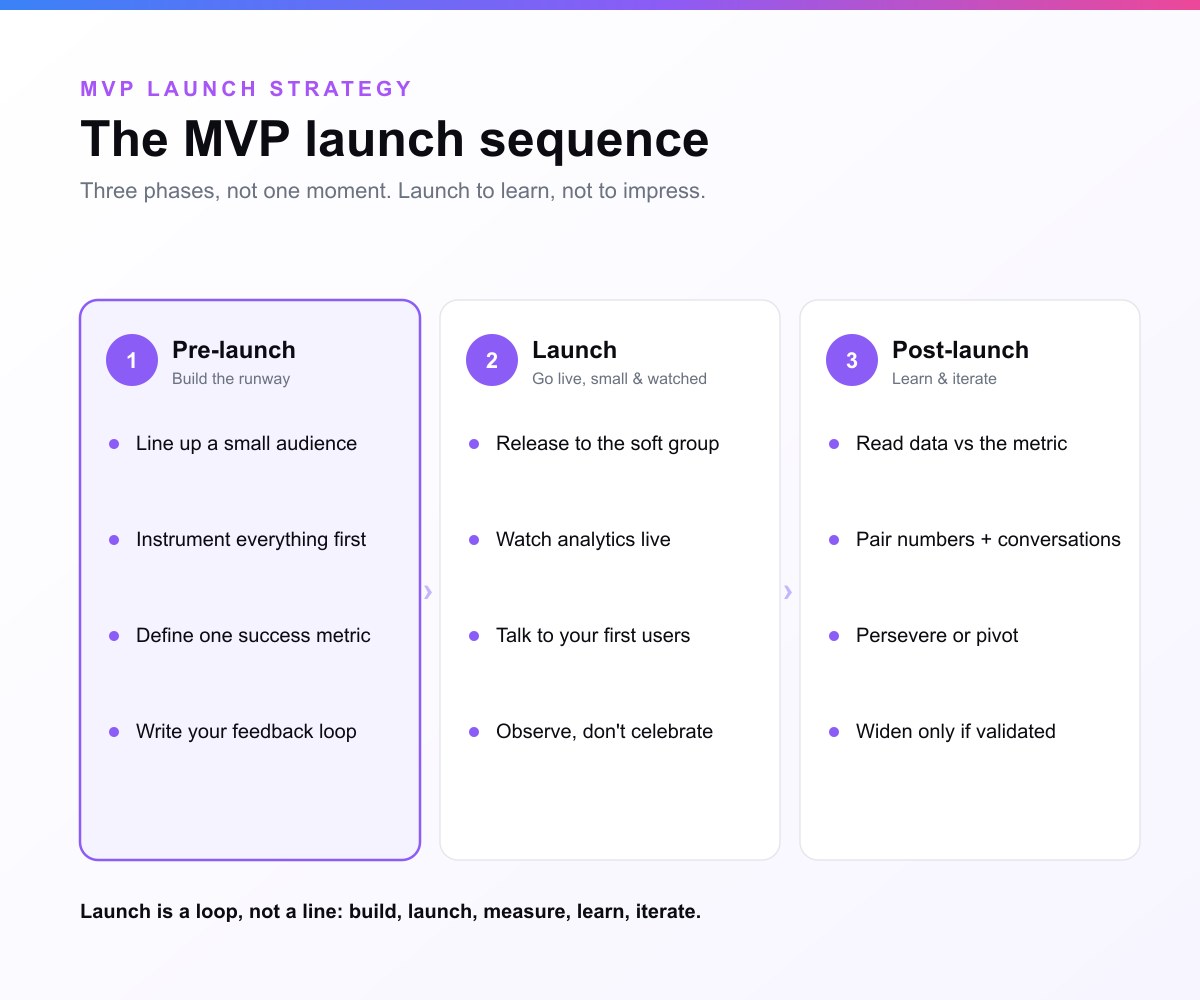
Pre-launch: build the runway
Before the MVP goes live, line up the people and the instruments:
- Build a small launch audience. A waitlist, an email list, a few engaged communities where your users already gather. You do not need thousands; you need enough of the right people to get signal. Fifty engaged target users beat five thousand random ones.
- Instrument everything first. Wire in analytics for activation, retention, and the core action before launch, not after. If you launch blind, you get opinions instead of data. See MVP metrics for what to track.
- Define your one success metric. Decide, in advance, the single number that means "this worked", activation rate, week-one retention, conversion to the core action. Pre-committing stops you from rationalizing a weak result later.
- Write your feedback loop. Know how you will collect qualitative feedback (interviews, a simple form, watching session recordings) alongside the numbers.
Launch: go live, small and watched
Release to your soft-launch group. Keep it small enough that you can personally watch what happens. Talk to early users directly, the first ten conversations teach you more than the first thousand sign-ups. Your job on launch day is not to celebrate; it is to observe.
Post-launch: learn and iterate
This is where the real value is, and where most founders drop the ball. Launching is not the finish line; it is the start of the loop:
- Read the data against your success metric. Did the one number you pre-committed to move?
- Combine numbers with conversations. Quantitative tells you what happened; qualitative tells you why.
- Decide: persevere or pivot. Iterate on the core flow, double down on what worked, or change direction based on what you learned.
- Then, if validated, widen the launch. Only after the small launch proves the idea do you scale up toward a hard launch.
The MVP launch is a loop, not a line. Build → launch → measure → learn → iterate, exactly the build-measure-learn cycle the launch exists to feed.
The MVP launch checklist
Use this as the actionable version of the sequence above, a tick-box MVP launch checklist to run before, during, and after launch day.
Before launch (pre-launch):
- A small launch audience is lined up (waitlist, email list, or communities where your users already gather).
- Analytics are instrumented for activation, retention, and the core action, and confirmed firing.
- Error tracking and uptime monitoring are live, so you hear about breakage before users do.
- Your one success metric is defined and written down in advance.
- A feedback loop is set up (a form, interviews, or session recordings) to capture the why.
- The onboarding flow gets a new user to the core action fast, tested as a stranger would experience it.
- The product is genuinely production-ready, real auth, payments, security, and a live URL, not a demo.
On launch day:
- Release to the small soft-launch group, not the whole world at once.
- Watch analytics and error alerts live, and be ready to fix breakage fast.
- Talk directly to your first users; the first ten conversations beat the first thousand sign-ups.
- Resist celebrating, your job today is to observe.
After launch (first 24 to 48 hours and beyond):
- Read the data against your pre-committed success metric, did the one number move?
- Pair the numbers with real conversations to understand why.
- Triage and fix the bugs real users surface, this is when they appear.
- Decide: iterate on the core flow, double down, or pivot.
- Only widen toward a hard launch once the small launch has proven the idea.
Tick the pre-launch boxes and you launch with instruments, not blind. Tick the post-launch boxes and you're running the build-measure-learn loop the launch exists to feed.
Where to launch your MVP
Channel choice follows from one rule: launch where your specific users already are, not where the most people are. A handful of targeted channels beats a broad blast.
- Niche communities. Subreddits, Discord and Slack groups, forums, and industry communities where your exact users gather. The highest-signal, lowest-cost channel for most MVPs.
- Your own audience. A waitlist, email list, or personal and professional network. Warm, engaged, and forgiving of rough edges.
- Product Hunt. Good for reaching early adopters, but treat it as a soft-to-medium launch, not the hard launch, and only when the product can survive scrutiny.
- Direct outreach. Personally inviting target users one by one. Slow, but it produces the richest feedback and your first real conversations.
- Content and SEO. Slower to pay off, but it brings users actively searching for what you solve. A long-term channel, not a launch-day one.
| Channel | Speed to launch | Audience quality | Cost |
|---|---|---|---|
| Niche communities | Same day | Highest, exact target users | Free |
| Your own audience | Same day | High, warm and engaged | Free |
| Direct outreach | Days | Highest, but slow to scale | Free (time-intensive) |
| Product Hunt | Days to prep | Medium, early adopters | Free |
| Content and SEO | Weeks to months | High but slow to build | Free (time-intensive) |
| Paid ads | Same day | Depends on targeting | Real budget required |
Save paid ads, press, and big public pushes for after validation. Spending money to drive traffic to an unvalidated MVP is paying to learn what a free, targeted soft launch would have told you.
The launch platforms in 2026, by what each one is good for
The channel ranking above is the principle. These are the specific places founders ask about, with the honest use for each. None of them is a strategy on its own; each is one day of attention, and what you do with the people it sends you is the strategy.
| Platform | Who is there | Good for | Not good for |
|---|---|---|---|
| Product Hunt | Early adopters, other founders, some press | A burst of signups and a badge for the deck; consumer and prosumer tools | Niche B2B; the traffic is broad and mostly leaves within a week |
| Hacker News (Show HN) | Engineers and technical founders | Developer tools, infrastructure, anything with a technical story; the most candid feedback you will get | Anything that reads as marketing; the thread will say so |
| Indie Hackers | Bootstrappers and solo founders | Small SaaS, a build-in-public thread that compounds over months | Venture-scale pitches; the audience is skeptical of them |
| BetaList and similar directories | People who sign up for betas as a hobby | Filling a waitlist quickly for a consumer product | Judging demand; these users try everything and keep almost nothing |
| Subreddits, Discord and Slack communities | Your actual users, if you pick the right one | The highest-signal launch for most MVPs; ask permission, then post as a member, not a marketer | Broad subreddits; the post is removed or ignored |
| AI tool directories | People hunting for AI products specifically | An AI-first MVP that needs its first hundred trials | Retention; the churn from directory traffic is severe |
| LinkedIn and X, from your own account | Your network and theirs | B2B, where a founder’s own post outperforms every platform above | Consumer products with no network overlap |
For a typical B2B MVP the order is: your own network and one community first, Show HN if the product is technical, and Product Hunt only once the onboarding survives strangers. For a consumer MVP, one subreddit and a directory to fill the waitlist, then Product Hunt as the soft-to-medium step. Whichever you choose, the platform launch is a single day; the iteration that follows is the month.
What you decide before launch day: the contingency plan
The launches that go badly are rarely undone by the bug itself. They are undone by nobody having decided, in advance, what happens when it appears. Five decisions, written down before the post goes up:
- The rollback. Who can revert the deploy, how long it takes, and whether you have actually tried it. If the answer is “we’d fix forward”, you do not have a rollback.
- The kill switch. Which features sit behind a flag you can turn off without a deploy: payments, signups, the one integration that is most likely to fail.
- The support inbox. One address, one person watching it for the first 48 hours, and a promised response time you can keep. Founders answering personally is the cheapest retention tool you will ever have.
- The stop condition. The error rate or the complaint that pauses the launch. Decide the number now; on launch day every number looks survivable.
- The status message. A pre-written line for “we know, we are on it”, so the first outage does not also produce your first bad tweet.
None of this takes more than an afternoon, and it is the difference between a rough launch you learn from and one that costs you the cohort you spent weeks assembling.
Metrics to watch at your MVP launch
An MVP launch is measured by learning, so vanity metrics will mislead you. Sign-ups and page views feel good and prove nothing. Watch the metrics that reveal whether people actually got value:
- Activation rate: what share of users complete the core action that delivers your value? This is the single most important MVP launch metric.
- Retention: do users come back? Week-one and week-four retention tell you whether the value was real or a one-time curiosity.
- Conversion to the core action: of the people who land, how many do the one thing the MVP exists to test?
- Qualitative feedback: what users say and do, from interviews and session recordings, gives the "why" behind the numbers.
Pre-commit to the one metric that means success before you launch, and judge the launch against it honestly. For the full picture of what to measure and why, see MVP metrics.
Common MVP launch mistakes
- Launching like it is a finished product. A big public splash for an incomplete MVP wastes your first impression and drowns you in feedback. Launch soft.
- Launching without instrumentation. Going live with no analytics means you launch blind and get opinions instead of data. Instrument first.
- Chasing vanity metrics. Optimizing for sign-ups and traffic instead of activation and retention tells you nothing about whether the idea works.
- Treating launch as the finish line. The launch is the start of the learning loop, not the end of the build. The value is in what you do after.
- Launching too broad, too soon. Going wide before the product is validated spends money and reputation on something unproven. Earn the hard launch.
- Waiting for perfect. The opposite failure: endlessly polishing instead of launching. If it tests the core assumption, it is ready. Ship and learn.
Launch your MVP the right way
An MVP launch strategy comes down to one discipline: launch to learn, not to impress. Launch small, to the right people, with sharp metrics, then iterate on what real users show you. Do that and the launch does its job, a clear answer about whether your idea works, which is the only thing an MVP launch is for.
That is what we do at MVP Development. We build funding-ready MVPs shipped in 3 to 4 weeks by senior engineers, scoped to the one core flow worth testing, instrumented from day one so your launch produces real data, and built on owned code that scales when the launch proves the idea. We help you launch to learn, then build the next version on what you learned.
Explore our MVP development services, or if you are still scoping the idea, start with a free MVP consultation.
Have an MVP to build and launch? Give us your launch date and we will work the plan backwards from it with you.
Related guides
-
MVP user feedback: what to collect from the users this launch puts in front of you
-
How to build an MVP, the full step-by-step build before you launch
-
MVP roadmap, how launch fits into the wider MVP plan
-
MVP metrics, the numbers that tell you the launch worked
-
MVP validation, validating demand before and through launch
Frequently asked questions
What is an MVP launch strategy?
An MVP launch strategy is a deliberate plan for releasing your minimum viable product to real users with the goal of validated learning rather than revenue or reach. It defines who you launch to, where you reach them, what you measure, and how you turn the results into the next version. Unlike a normal product launch, which aims for maximum awareness of a finished product, an MVP launch aims for maximum learning from a deliberately minimal one, which usually means launching small, to a focused audience, with careful instrumentation.
Should you do a soft launch or a hard launch for an MVP?
For almost every MVP, a soft launch is the right choice. A soft launch releases the product quietly to a small, targeted group so you can learn, fix problems, and iterate before a wider audience sees it. A hard launch goes broad and public and is built for awareness and adoption, which only makes sense once the product is validated and ready to grow. Launching an incomplete MVP with a big public push wastes your first impression and overwhelms you with feedback, so save the hard launch for after the idea is proven.
What should you measure when you launch an MVP?
Measure the metrics that reveal whether users actually got value, not vanity metrics. The most important is activation rate, the share of users who complete the core action your MVP exists to test. Also track retention (do users come back), conversion to the core action, and qualitative feedback from interviews and session recordings for the "why" behind the numbers. Decide your single success metric before launch and judge the result against it honestly. Sign-ups and page views feel good but tell you nothing about whether the idea works.
How do you launch an MVP, step by step?
Confirm the core flow works end to end, pick a small and specific first audience rather than "everyone," instrument the one metric that defines success before a single user arrives, launch quietly to that group, and read the results before deciding whether to widen the audience. The order matters: instrumentation goes in before launch, not after, or you learn nothing from the people who mattered most, your first users.
What is a good first launch channel for an MVP?
The channel where your specific first users already gather, not the channel with the most reach. A B2B tool launches to a handful of hand-picked prospects or a relevant Slack or LinkedIn community; a consumer product launches to a waitlist or a niche subreddit. Broad channels like a Product Hunt front page or a paid ad campaign are for the hard launch once the MVP is validated, not for the first one, because they bring volume before you can tell if the product works.
Do I need a formal launch plan or template for an MVP?
You need the short version: your audience, your channel, your single success metric, and your launch date, written down before you start. A multi-week marketing launch plan is overkill for a product nobody has validated yet. The MVP launch checklist above is the template; fill in those specifics and you have everything a first launch actually requires.
How do you quickly launch an MVP website for a new product?
Cut everything to the one core flow, deploy on infrastructure that requires no server setup (a platform like Vercel or Netlify paired with a managed backend like Supabase or Firebase), skip custom design in favor of a clean, functional UI, and point it at the one channel where your target users already gather. A tightly scoped MVP website can go from a working build to live in days, not weeks. The speed bottleneck is almost always scope creep, adding "just one more thing" before launch, not the technical work of getting it online.
What is the fastest way to get an MVP live?
Deploy on managed infrastructure so there is no server setup, ship with the single core flow only, and fake, defer, or handle manually anything that is not that flow. Most delay in an MVP launch comes from features, not from deployment, the fastest launches happen when a team refuses to add scope in the final week. If the core flow works end to end, that is enough to go live.
How soon after building should I launch my MVP?
As soon as the core flow works reliably end to end. Do not wait for polish, the value of an MVP comes entirely from real user data, and every day it sits unreleased is a day you are not learning. If the product is genuinely production-ready, ship it, fixing issues that real users actually hit is faster than trying to anticipate every issue in advance.
What if my MVP launch doesn't get any traction?
Low or no traction is data, not failure, if you launched to the right audience with real instrumentation. Check three things before concluding the idea is dead: did you reach genuinely targeted users rather than a cold, general audience, was the core value clear within seconds, and did you collect qualitative feedback alongside the numbers. If all three hold up and there is still no pull, that is a real signal to change the offer, the audience, or the price and re-test, exactly what the launch was designed to tell you.
Sources & references
This guide draws on established lean-startup and early-stage launch practice:
- Eric Ries, The Lean Startup, the build-measure-learn loop and validated learning the MVP launch exists to feed
- Y Combinator, Startup Library, pragmatic guidance on launching early and talking to users
- Atlassian, Minimum Viable Product, the MVP in agile product development
- Product Hunt, a common channel for reaching early adopters at launch
Our 3 to 4 week estimate reflects real delivery data from focused, tightly scoped MVPs.


