


TL;DR
MVP feature prioritization is the discipline of cutting your idea down from everything it could do to the single core flow it must do to test whether anyone wants it. It is the most important skill in building an MVP, because the "minimum" in minimum viable product is won or lost here, not in the code. Most MVPs that balloon into six-month builds failed at prioritization, not engineering.
The fastest way to do it well: prioritize by your riskiest assumption, not by what is easiest or loudest. Build only the features the core flow breaks without, defer everything else to a written "later" list, and use a framework, MoSCoW to sort, RICE to rank, Kano to balance, to keep the decision objective instead of emotional. This guide covers all three frameworks and exactly how to apply them to a startup MVP.
Want to sort your own features right now? Score each by impact vs effort and this tool sorts them into the Impact/Effort matrix, Quick Wins first, in seconds:
Your prioritized features (6)
User signup & login
Auth · impact 5 · effort 2
Core workflow (your main feature)
Core · impact 5 · effort 3
In-app notifications
Engagement · impact 3 · effort 3
Payments / checkout
Payments · impact 4 · effort 4
Dark mode
Nice-to-have · impact 2 · effort 1
Admin dashboard
Admin · impact 2 · effort 4
Key Takeaways
- MVP feature prioritization is cutting your idea from everything it could do to the single core flow it must do.
- It is the most important skill in building an MVP; the "minimum" is won or lost here, not in the code.
- Most MVPs that balloon into six-month builds failed at prioritization, not engineering.
- Prioritize by your riskiest assumption, not by what is easiest or loudest.
- Use a framework to stay objective: MoSCoW to sort, RICE to rank, Kano to balance.
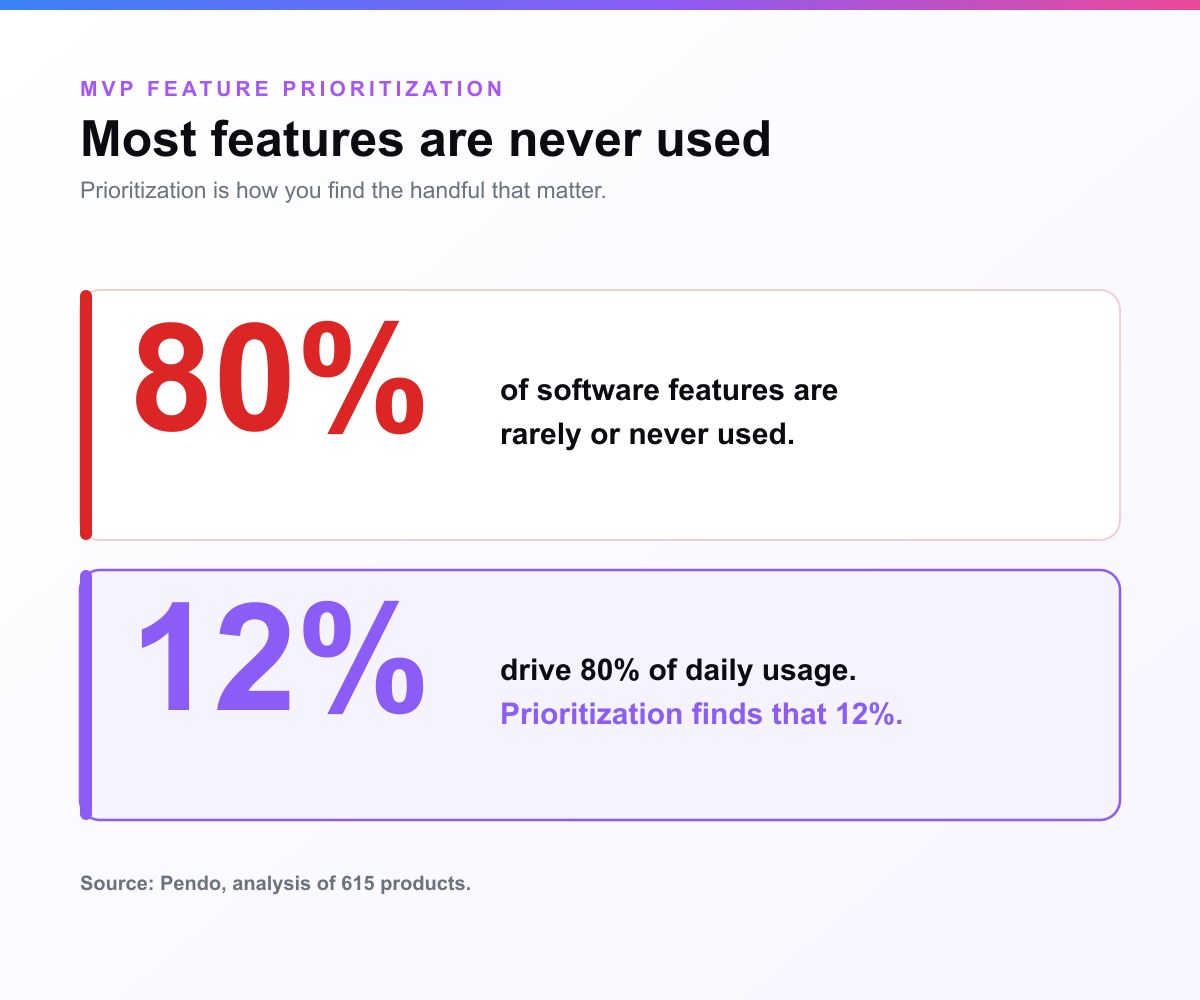
By the numbers: Pendo's analysis of 615 products found 80% of features are rarely or never used, while just 12% drive 80% of daily usage. Prioritization is how you find that 12%. More data in our MVP statistics for 2026.
Why feature prioritization is the core MVP skill
Every founder starts with a long list of things the product could do. Feature prioritization is the act of ruthlessly cutting that list to the few features that, together, deliver the one core value worth testing. It sounds simple; it is the hardest discipline in the whole process, because every feature feels essential when it is your idea.
This is where MVPs are won or lost. As we cover in why MVPs fail, the most common, most expensive failure is not a technical one, it is building too much: a "minimum" product that quietly grew into a small full product, burning the runway that should have funded learning. Good prioritization is the direct defense. Get it right and the build is fast and cheap; get it wrong and no amount of engineering speed saves you.
The reframe that makes prioritization easier: your MVP is not a small version of your product, it is an experiment. You are not deciding which features to "leave out", you are deciding the smallest set that runs one clean experiment. That shifts the question from "what would make this a good product?" (everything) to "what does this specific test require?" (very little).
The goal: one core flow, not a feature list
Before any framework, fix the target. The output of MVP prioritization is one core flow, the single path a user takes from entry to the moment they get the core value, delivered to a working standard. Not a list of features; a flow.
For example, an app that auto-writes product descriptions has a core flow of: sign up → connect a product → generate a description → publish it. That is the MVP. Team accounts, billing tiers, an analytics dashboard, profile customization, all of it waits, because none of it is required to learn whether sellers want and will pay for auto-generated descriptions. Everything you prioritize is judged against one question: does the core flow break without this? If not, it is not in the MVP.
Prioritize by your riskiest assumption
The single best prioritization lens for an MVP is not a scoring formula, it is your riskiest assumption, the belief that, if wrong, kills the idea. Prioritize the features that test that assumption, and defer everything else.
If the riskiest assumption is "people will pay," then a payment flow is a must-have even though it is work, while polish is not. If the riskiest assumption is "the core workflow actually saves people time," then that workflow must genuinely work and nothing else matters much. Naming the riskiest assumption (a habit from MVP validation) tells you what the MVP must nail and what it can fake, defer, or skip, which is most of the prioritization decision before you even open a framework.
Framework 1: MoSCoW (sort everything into four buckets)
MoSCoW is the fastest way to sort a feature list. Every feature goes into one of four buckets:
- Must-have: the core flow does not function without it.
- Should-have: important, but the flow works without it for now.
- Could-have: nice, low priority.
- Won't-have (this time): explicitly out of scope.
For an MVP, you build only the Must-haves. That is the whole trick. The hard part is honesty: founders label everything "must-have." The discipline is to challenge each one with "does the core flow literally break without this?" If the answer is no, it is a Should-have at best. A well-scoped MVP usually has only a handful of true Must-haves. If your Must-have list is long, you have not cut deeply enough.
Framework 2: RICE (rank when you have to choose)
MoSCoW sorts; RICE ranks. When you have competing features and need an objective order, RICE scores each one:
RICE score = (Reach × Impact × Confidence) ÷ Effort
- Reach: how many users it affects in a given period.
- Impact: how much it moves the core outcome (often scored 0.25 to 3).
- Confidence: how sure you are, as a percentage.
- Effort: person-time to build.
The score pushes high-impact, low-effort features that serve the core flow to the top, and sinks high-effort features that serve edge cases. RICE, popularized by Intercom, is most useful at the MVP stage for choosing between must-haves, or deciding which of two plausible core flows to test first, rather than for justifying a long list (a long list is the problem). Use it to break ties, not to rationalize scope.
Framework 3: Kano (balance basics and delight)
The Kano model sorts features by how they affect user satisfaction, which matters for deciding how good the MVP has to be, not just what is in it:
- Basic (must-be): expected; their absence frustrates, their presence is unremarkable (e.g., login works, data saves). The MVP must cover these for its core flow.
- Performance: more is better (speed, accuracy). Do enough to be credible.
- Delighters (attractive): unexpected features that create love. One well-chosen delighter on the core moment can differentiate an MVP in a crowded market.
For an MVP, Kano's lesson is: nail the basics of your one core flow, and consider a single delighter on the key moment, but do not chase delighters across a wide surface. This is the difference between a merely viable MVP and a lovable one, worth knowing when your market is crowded.
Which framework should you use?
You do not need all three on every project. For most MVPs:
- Start with the riskiest assumption to decide what the MVP must prove.
- Use MoSCoW to sort the feature list and isolate the true Must-haves for the core flow.
- Use RICE only if you still have to choose between Must-haves or between two candidate flows.
- Use Kano to decide how polished the core flow needs to be, and whether one delighter is worth it.
In practice, riskiest-assumption + MoSCoW gets 90% of MVPs scoped. The other frameworks are tie-breakers, not the main event.
A worked example
Take the auto-description app. Here is the feature list run through the lens:
| Feature | MoSCoW | On the core flow? | In the MVP? |
|---|---|---|---|
| User signup | Must | Yes | ✅ |
| Connect a product | Must | Yes | ✅ |
| Generate a description | Must | Yes | ✅ |
| Publish / export | Must | Yes | ✅ |
| Payment (if "will they pay" is the risk) | Must | Yes | ✅ |
| Profile customization | Could | No | ❌ |
| Admin dashboard | Should | No | ❌ |
| Team accounts | Won't | No | ❌ |
| Social sharing | Could | No | ❌ |
Five must-haves that form one clean flow; everything else parked. That is a scoped MVP. If this table had fifteen ticks, the scope is not minimal and the timeline and budget will show it.
The "not building" list
Prioritization is only half-done if you just pick what is in. The other half is writing down what is out, explicitly, and treating that list as sacred. A visible "not building (yet)" list does two things: it reassures stakeholders their pet feature is recorded, not rejected forever, and it gives you a place to send every "while we're at it" request instead of into the sprint. Every feature that goes to the parking lot instead of the build is a week of runway protected. This is the single most effective defense against the scope creep that sinks most MVPs.
Common MVP prioritization mistakes
- Everything is a "must-have." The most common error. If the core flow does not break without it, it is not a must. Be ruthless.
- Prioritizing by the loudest voice. Letting the most senior stakeholder or the squeakiest customer set scope, instead of the riskiest assumption.
- Confusing "easy" with "important." Building low-effort features because they are quick, even though they do not serve the core flow. Easy and irrelevant is still scope creep.
- No "not building" list. Picking what is in without recording what is out, so deferred features quietly creep back in.
- Prioritizing features over the flow. Optimizing individual features instead of the single end-to-end path that delivers value. Users experience the flow, not the feature list.
- Skipping the riskiest assumption. Prioritizing by gut instead of by what the MVP needs to prove, which is how you build a polished product that tests the wrong thing.
Prioritize ruthlessly, then build the core
MVP feature prioritization is not a product-management nicety, it is the decision that determines whether your MVP ships in weeks or drags for months. Name the riskiest assumption, cut to the one core flow with MoSCoW, break ties with RICE, judge polish with Kano, and write down everything you are not building. Do that and the build becomes the easy part.
That ruthless scoping is the first thing we do for founders at MVP Development. Before we write any code, we help you cut to the one core flow worth testing, then ship it as a funding-ready MVP in 3 to 4 weeks, on a fixed quote you approve before we start, with full code ownership. Most founders are surprised how much of their "must-have" list is actually a "later" list, and how much faster the build goes once it is.
Explore our MVP development services, or get a second opinion on your scope in a free MVP consultation.
Where the ranking keeps changing because the evidence is thin, product discovery settles it with real customer interviews before the backlog is written.
Not sure what to cut? Send us your unranked backlog and we will run this prioritization with you on a call.
Related guides
- MVP scope: the boundary your prioritization produces
- How to build an MVP: where prioritization fits in the full build
- MVP validation: finding the riskiest assumption to prioritize around
- Why MVPs fail: what happens when you do not cut scope
- MVP roadmap: sequencing what you deferred, after launch
- MVP Requirements Document: where your prioritized feature list becomes a buildable spec
Frequently asked questions
How do you prioritize features for an MVP?
Start by naming your riskiest assumption, the belief that, if wrong, kills the idea, then prioritize the features that test it. Sort your full feature list with MoSCoW (Must-have, Should-have, Could-have, Won't-have) and build only the Must-haves, the features the one core flow breaks without. If you still have to choose between Must-haves, rank them with RICE (Reach × Impact × Confidence ÷ Effort). Write down everything you are not building as a "later" list. The goal is one core flow delivered to a working standard, not a long feature list.
What is the MoSCoW method for an MVP?
MoSCoW sorts every feature into four buckets: Must-have, Should-have, Could-have, and Won't-have (this time). For an MVP, you build only the Must-haves, defined strictly as the features without which the core flow does not function. The discipline is honesty: founders tend to label everything a must-have, so challenge each one with "does the core flow literally break without this?" If not, it is a Should-have at best. A well-scoped MVP usually has only a handful of true Must-haves.
MoSCoW or RICE, which is better for an MVP?
They do different jobs, so use both. MoSCoW sorts features into priority buckets quickly and is the fastest way to isolate the must-haves for your core flow. RICE ranks features with a score (Reach × Impact × Confidence ÷ Effort) and is best when you have to choose between must-haves or between two candidate flows. For most MVPs, riskiest-assumption plus MoSCoW does 90% of the work, and RICE is a tie-breaker rather than the main tool.
What is the Kano model and does it apply to MVPs?
The Kano model sorts features by their effect on satisfaction: basics (expected; their absence frustrates), performance features (more is better), and delighters (unexpected features that create love). For an MVP, the lesson is to nail the basics of your one core flow and consider a single delighter on the key moment, without chasing delight across a wide surface. It is most useful for deciding how polished the MVP needs to be, especially in a crowded market where a merely functional product loses to one that feels good.
How many features should an MVP have?
As few as possible, only the must-haves that together deliver one core flow. There is no magic number, but in practice a well-scoped MVP is usually a handful of features (often three to six), not a dozen. If your must-have list runs long, you have not cut deeply enough, and the timeline and budget will reflect it. The test is not a feature count but a question: can you remove anything and still test your riskiest assumption? If yes, remove it.
Sources & references
This guide draws on established prioritization frameworks and lean-startup practice:
- Eric Ries, The Lean Startup: the riskiest-assumption mindset and minimal scope
- Intercom, RICE prioritization: the RICE scoring framework
- The MoSCoW method: Must/Should/Could/Won't prioritization
- Atlassian, Minimum Viable Product: scoping the MVP in agile product development
The 3 to 4 week figure reflects MVP Development delivery data for tightly scoped builds.


