


TL;DR
The right tech stack for an MVP is a proven, boring one your team already knows, chosen for speed and learning, not for scale you do not have yet. The goal of an MVP is to validate an idea fast, so the stack that ships the one core flow soonest beats the trendy one your developers are learning on the job. For most MVPs that means a modern, mainstream web stack: a React-based frontend, a Node or managed backend, a Postgres database, and managed services for the parts you should never build yourself (auth, payments, hosting).
The biggest MVP stack mistake is over-engineering, microservices, custom infrastructure, a hand-rolled auth system, or a fashionable framework, for a product with zero users. This guide covers how to choose your MVP tech stack: the decision factors that actually matter, the build approaches (no-code to custom), the stack layer by layer, a proven default stack, how it differs by product type, and the mistakes that quietly cost founders weeks. For the full build process, pair this with how to build an MVP.
Want a stack recommendation right now? Answer three questions, what you are building, what matters most, and what your team knows, and get a recommended stack in seconds. Then read on for the why behind each choice:
Pick your stack
Click any option to choose itFrontend
React framework with SSR, routing, and API routes built in.
- Full-stack in one
- Great SEO
- Vercel deploy
Full-stack React framework built on web standards.
- Excellent DX
- Fast by default
- Progressive enhancement
Svelte framework with routing and SSR built in.
- Smaller bundles
- Less boilerplate
- Fast
The intuitive Vue framework with SSR and file routing.
- Great for Vue teams
- SSR/SSG
- Big ecosystem
UI
Utility-first CSS for rapid, consistent UI.
- Fast to build
- Highly customizable
- Tiny production CSS
Copy-paste components on Radix + Tailwind. You own the code.
- Own your code
- Accessible
- Customizable
Component library with accessibility built in.
- Great accessibility
- Easy theming
- Good DX
Backend (BaaS / ORM)
Open-source Firebase alternative on Postgres, with auth and realtime.
- Generous free tier
- Auth included
- Real SQL/Postgres
Google’s BaaS with realtime DB, auth, and push — great for mobile.
- Realtime sync
- Mobile SDKs
- Auth + push built in
Type-safe ORM over your own Postgres — full control for scale.
- Type safety
- Own your DB
- Great migrations
Lightweight TypeScript ORM with SQL-like syntax.
- Very lightweight
- SQL-like queries
- Edge compatible
Full-stack frameworks
Alternative to a separate frontend + backend — ideal when your team knows the language.Convention-over-configuration full-stack framework.
- Fast to build
- Batteries included
- Mature ecosystem
Python full-stack framework with a killer admin panel.
- Free admin UI
- Python/AI ecosystem
- Secure defaults
The most productive PHP framework — SaaS tooling out of the box.
- SaaS starter kits
- Great DX
- Livewire/Filament
Modern, fast Python API framework — ideal for AI backends.
- Very fast
- Auto API docs
- Async + typed
Auth
Complete user management with pre-built components.
- Fast to add
- Beautiful UI
- Orgs built in
Built-in auth with social logins and magic links.
- Included with Supabase
- RLS integration
- Many providers
Open-source authentication, flexible and free.
- Free
- Flexible
- Many providers
Hosting
Zero-config hosting optimized for Next.js and frontend frameworks.
- Zero config
- Global edge
- Great DX
Deploy backends and databases with almost no config.
- DB included
- Good free tier
- Simple pricing
Run full-stack apps and containers globally, near your users.
- Global deploy
- Runs containers
- Built-in databases
Payments
Industry-standard payments with the best docs.
- Best docs
- Complete features
- Global
All-in-one payments + merchant of record — handles your taxes.
- Handles taxes
- Simple setup
- Great for digital
Merchant of record for SaaS — global tax and compliance handled.
- Handles taxes
- SaaS-focused
- Global compliance
Mobile
Build iOS and Android from one React codebase, with Expo for speed.
- One codebase
- Reuse React skills
- Expo tooling
Google’s toolkit for natively compiled cross-platform apps.
- One codebase
- Great performance
- Beautiful UI
No-code
For non-technical founders — ship a real product without engineers.No-code platform: frontend, backend, database, and hosting in one.
- No engineers needed
- All-in-one
- Fast to launch
Visual builder for marketing sites and simple web apps.
- Design freedom
- No code
- Fast, clean sites
Key Takeaways
- The right MVP tech stack is a proven, boring one your team already knows, chosen for speed and learning, not scale you do not have yet.
- The stack that ships the one core flow soonest beats the trendy one your developers are learning on the job.
- For most MVPs that means a React-based frontend, a Node or managed backend, a Postgres database, and managed services.
- Use managed services for the parts you should never build yourself: auth, payments, hosting.
- The biggest stack mistake is over-engineering (microservices, custom infrastructure, a hand-rolled auth system) for a product with zero users.
What is an MVP tech stack?
An MVP tech stack is the set of technologies, languages, frameworks, databases, and services, used to build a minimum viable product. It spans the whole product: the frontend the user sees, the backend that runs the logic, the database that stores the data, and the managed services that handle auth, payments, hosting, and analytics.
The word that matters here is minimum. An MVP stack is not the stack you would choose for a product with a million users; it is the stack that lets you ship the one core flow to real users as fast and cheaply as possible, while staying solid enough to build on if the idea works. It is a deliberately pragmatic choice, optimized for time-to-learning, not for theoretical scale.
That reframe changes every decision. You are not choosing the "best" technology in the abstract; you are choosing the one that gets a real, usable product in front of users soonest, with the least risk. The best MVP stack is almost never the newest or the most powerful, it is the most proven one your team can move fast on.
The golden rule: choose for speed and learning, not scale
Founders agonize over the MVP stack as if it were a permanent, irreversible decision. It is not. The MVP exists to answer one question, do people want this?, and the stack's only job is to get you that answer quickly. Optimize for speed to a working product and validated learning, not for handling traffic you do not have.
This is why the famous advice from experienced builders is to use boring technology. A mainstream, well-documented, widely-used stack ships faster because the problems are already solved, the libraries exist, the hiring pool is large, and your team is not debugging the framework instead of building the product. A trendy stack might be technically elegant, but if your developers are learning it as they go, every feature takes longer, and the MVP was supposed to save time, not spend it on a learning curve.
The corollary: do not build for scale you do not have. Designing a microservices architecture, sharding a database, or setting up elaborate infrastructure for an MVP with no users is the most common way founders waste their build budget. Build for your first hundred users, on a stack that can grow into more, and re-architect once you have product-market fit, which is what scaling your MVP is for. Premature optimization is the enemy of a fast MVP.
How to choose your MVP tech stack: the factors that matter
A handful of factors should drive the decision, in roughly this order of importance for an MVP.
1. Team familiarity. The single biggest factor. The stack your developers already know cold will always ship faster than a "better" one they have to learn. For an MVP, a team's existing expertise usually outweighs every other consideration. If you are hiring or outsourcing, pick a mainstream stack with a deep talent pool.
2. Speed to market. How fast can this stack get the one core flow live? Stacks with strong ecosystems, ready-made libraries, and managed services let you assemble an MVP instead of building everything from scratch. Favor stacks that hand you auth, payments, and hosting rather than making you build them.
3. A clean path to scale. Not scale itself, but the option to scale. Choose a stack that can grow with the product so version two extends the MVP instead of being a full rewrite. A mainstream, modular stack gives you that path; a no-code tool may hit a ceiling you cannot pass.
4. Cost. Most modern stacks have generous free tiers, so an MVP can run at near-zero infrastructure cost until you have traction. The real cost is engineering time, which loops back to team familiarity. See how much it costs to build an MVP for the full picture.
5. Product type. A SaaS, a mobile app, a marketplace, and an AI product have different needs. The stack shifts with the product, covered below.
Notice what is not on this list: how trendy the technology is, how it benchmarks at massive scale, or how elegant the architecture is. Those matter for a mature product. For an MVP, they are distractions from the only metric that counts, time to a validated product.
The build approaches: no-code, low-code, AI-assisted, and custom
Before picking specific technologies, choose your build approach, because it shapes the whole stack.
| Approach | What it is | Best for | Trade-off |
|---|---|---|---|
| No-code | Visual builders (Bubble, Webflow) | Non-technical founders, standard logic | Fast, but hits a ceiling |
| Low-code | Visual plus custom code | Some dev help, custom pieces needed | More flexible, needs skill |
| AI-assisted | AI-generated code, reviewed by devs | Fast first drafts with engineering oversight | Speed, but needs hardening |
| Custom | Code written from scratch | Complex core, regulated, scaling | Full control, slower to start |
For many MVPs, especially validation-stage ones, a no-code MVP is the fastest, cheapest way to get a real product live, and the right call when your logic is standard and your goal is to validate demand. The catch is the ceiling: no-code is a starting line, not a finish line, and you may need to move to custom once you find traction.
For most MVPs that are meant to scale into a real product, a custom build on a proven, modern stack is the move, and increasingly, that build is AI-assisted: senior engineers using AI tooling to ship faster, with the output reviewed and hardened before it touches production. The rest of this guide focuses on that custom stack, which is what most fundable MVPs are built on.
The MVP stack, layer by layer
A modern custom MVP stack has a handful of layers. Here is what each does and the pragmatic choices for an MVP.
Frontend. What the user sees and interacts with. For web, React (usually via Next.js) with TypeScript is the mainstream default, fast, component-based, SEO-friendly, and backed by a huge ecosystem. For mobile, React Native or Flutter lets one codebase target iOS and Android.
Backend. The logic and APIs. Node.js (often with a framework like NestJS or Express) pairs naturally with a React frontend and a single language across the stack. Other solid choices: Python (Django, FastAPI) or Ruby on Rails, both excellent for shipping fast. Pick what your team knows.
Database. Where data lives. PostgreSQL is the safe, powerful default for almost any MVP, relational, reliable, and scalable. A managed option like Supabase (Postgres plus auth and storage) removes most of the setup. Use a NoSQL database only if your data genuinely calls for it.
Auth. User accounts. Do not build this yourself. Use an auth provider, Supabase Auth, Clerk, or Auth0, that handles sign-up, login, password resets, and security for you. Rolling your own identity system is a classic MVP time sink.
Payments. If your MVP charges money, Stripe is the default, it handles checkout, subscriptions, and PCI compliance so you do not have to. One simple plan is enough for an MVP.
Hosting and infrastructure. Where it runs. Vercel for the frontend (especially Next.js) and managed hosting for the backend mean you spend zero time on ops. Containerization with Docker keeps the build portable. Lean on managed infrastructure, not a self-run server.
Analytics. How you measure. Instrument activation and retention from day one with a tool like PostHog or Mixpanel. An MVP you cannot learn from is not finished; see MVP metrics.
AI (if needed). If your product is AI-powered, use a foundation model API (OpenAI, Anthropic) rather than training your own, covered in our AI MVP guide.
The pattern across every layer is the same: use managed services for everything that is not your core differentiator, so your build time goes into the one workflow that proves the business.
MVP system design: how the pieces fit together
Choosing the tools is only half the job; the other half is system design, how those pieces connect. For an MVP the architecture should be deliberately simple: a client (web or mobile) talks to a single backend API, which reads and writes to one database, while auth, payments, and analytics are handled by managed services the app calls out to. That is the entire diagram, and for an MVP it should stay that simple.
Three design decisions carry most of the weight:
- Keep the data model small. Model only the entities the one core flow actually needs, and resist adding tables for features you have not validated. A lean schema is faster to build and far easier to change when user feedback contradicts your plan.
- Design a thin API around the core flow. A handful of well-named endpoints for the one workflow that proves the idea, not a sprawling API surface for features nobody has asked for yet.
- Let auth and payments sit at the edges. Your auth provider and Stripe are their own systems your app calls, not logic you weave through the core code. That keeps the part you actually own, the core flow, clean and legible.
The one system-design decision founders get wrong is reaching for microservices too early; for an MVP the answer is almost always a single monolith, covered in the monolith vs microservices section below. The guiding principle is the same as for the stack: architect it to extend, not to scale. A simple, well-structured monolith on a mainstream stack grows remarkably far, and you re-architect the specific bottlenecks only once real usage tells you where they are.
Frontend choices: web, mobile, or both
Your first stack decision is where the MVP lives, and it shapes the frontend.
Web first is the right call for most MVPs. It is the fastest to ship and reach users, no app-store review, instant updates, reachable from a link, and the proven default is Next.js with React and TypeScript. Next.js gives you server rendering, routing, and SEO out of the box, on the most mainstream frontend ecosystem there is. For most SaaS, marketplace, and AI products, web is where the MVP belongs.
Mobile makes sense when the product is fundamentally a phone experience, push notifications, camera, location, offline use. For an MVP, React Native or Flutter lets one codebase target both iOS and Android, which is far cheaper than two native apps. React Native pairs naturally if your team already knows React; Flutter is excellent for polished, consistent UI.
Both is usually a mistake at the MVP stage. Building web and native apps at once doubles the work for a product with no validated demand. Pick the one platform where your core flow lives, prove it, and add the other after. The exception is when the value genuinely requires both from day one, which is rarer than founders assume.
Each of these frontend choices is worth a closer look on its own, see our guide to building a Next.js MVP, but the rule that unites them is simple: pick one platform and one proven framework, and ship.
Backend and database choices for an MVP
The backend runs your logic and serves your data, and for an MVP the goal is the same as everywhere: proven and fast, not clever.
For the backend language and framework, the pragmatic options are Node.js (with NestJS or Express), Python (Django or FastAPI), or Ruby on Rails, all mature, all fast to ship, all with huge ecosystems. Node has the advantage of one language across frontend and backend if you are using React. Rails and Django are famously productive for getting a CRUD-heavy product live quickly. The best choice is the one your team knows; there is no wrong answer among these for an MVP.
An increasingly popular MVP shortcut is a managed backend like Supabase or Firebase, which bundle the database, auth, storage, and APIs into one service. For many MVPs, especially solo or small teams, this removes most of the backend setup and lets you focus entirely on the product.
For the database, PostgreSQL is the default and the safe answer for almost any MVP, relational, reliable, powerful, and scalable far beyond what an MVP needs. Use a NoSQL database only when your data is genuinely document-shaped; reaching for it by default adds complexity most MVPs do not need. A managed Postgres (via Supabase, Neon, or a cloud provider) means you never touch database administration. The thread, again: proven tools, managed services, effort on the product, not the plumbing.
A proven default MVP stack
If you want a single, battle-tested answer, here is a modern default stack that ships fast and scales cleanly, the one most fundable web MVPs are built on:
- Frontend: Next.js + React + TypeScript + Tailwind
- Backend: Node (NestJS) or a managed backend like Supabase
- Database: PostgreSQL (or Supabase)
- Auth: Supabase Auth / Clerk
- Payments: Stripe
- Hosting: Vercel + managed backend hosting
- Analytics: PostHog
- AI (optional): OpenAI / Anthropic API
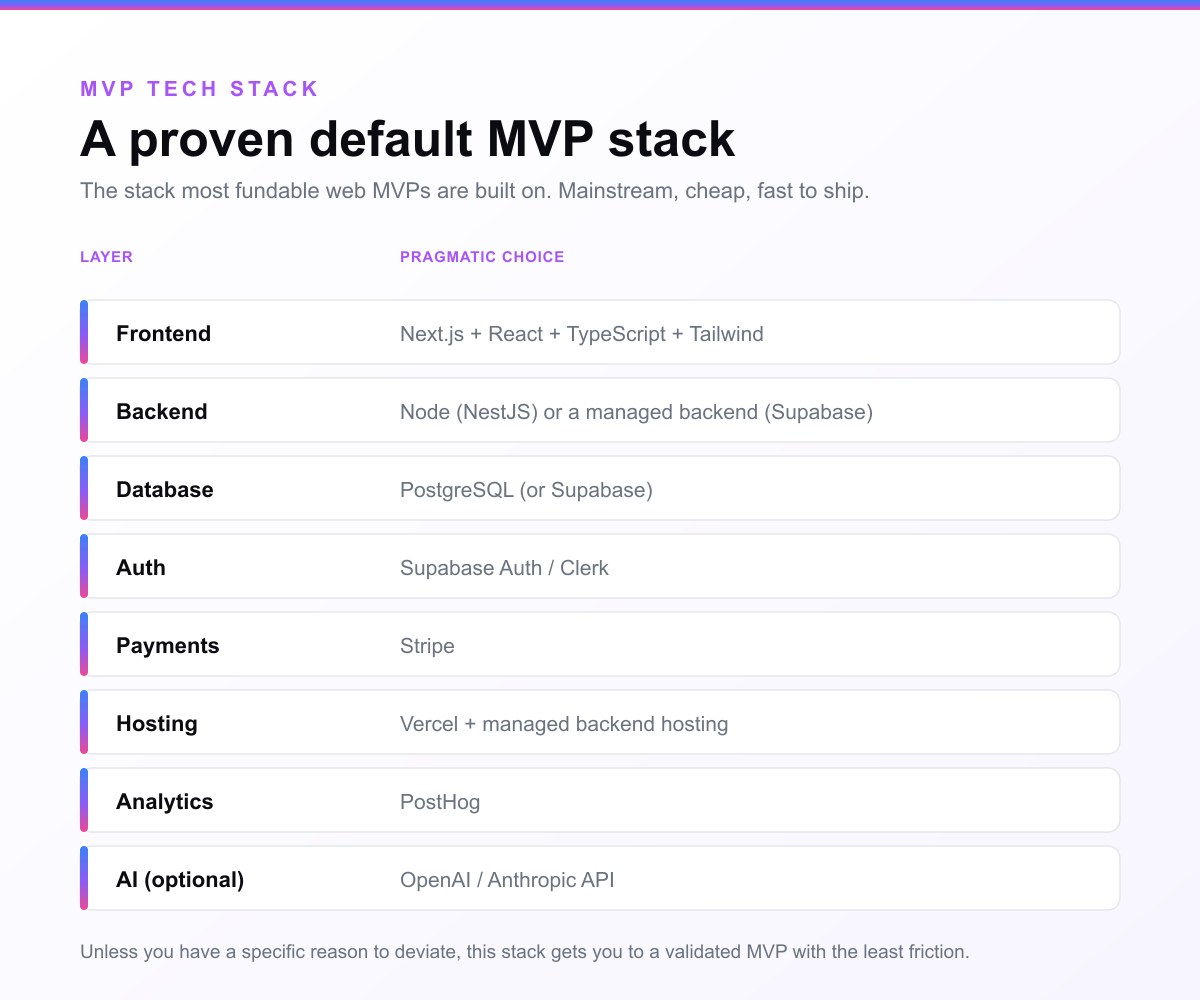
This stack is not the only good one, but it is a safe default: mainstream, well-documented, fast to build on, cheap to run, and easy to hire for. Unless you have a specific reason to deviate, team expertise, an unusual product, a regulated industry, a stack like this gets you to a validated MVP with the least friction. It is exactly the kind of stack we use to ship web app MVPs in 3 to 4 weeks. Want the version tailored to your product and team? Run it through our MVP Tech Stack Picker.
MVP stack by product type
The default shifts with what you are building. Each product type has a stack profile, and a deeper guide.
- SaaS MVP: a web stack (Next.js + Node + Postgres) with auth and a payment path is the heart of it. The core flow is sign-up to first value. See SaaS MVP.
- AI MVP: the same web stack wrapped around a foundation-model API, plus guardrails and evaluation. You buy the intelligence, not build it. See AI MVP.
- Marketplace MVP: a web stack with payments (Stripe Connect for splits), a trust layer, and the transaction loop. Liquidity matters more than the stack. See Marketplace MVP.
- Mobile app MVP: React Native or Flutter for one codebase across iOS and Android, with a managed backend. Tuned for day-7 retention.
- Web app MVP: the proven default stack above, responsive and SEO-friendly. See web app MVP development.
Whatever the product, the principle holds: pick a proven stack, lean on managed services, and build the one core flow well. The stack serves the MVP, not the other way around.
Monolith vs microservices: start with a monolith
A surprising number of MVPs are slowed by one system-design decision made far too early: splitting the product into microservices. It is the biggest architecture call you make at this stage, and for an MVP the answer is almost always a monolith, a single, unified codebase, and it is not a compromise, it is the correct choice.
Microservices solve problems that large, scaled organizations have: independent team deployment, scaling individual components, isolating failure domains. An MVP has none of those problems. What it has is one small team trying to ship one core flow fast, and a monolith is dramatically faster to build, deploy, and debug. Splitting an MVP into services adds network calls, deployment complexity, and coordination overhead in exchange for benefits you will not use until you have real scale.
The modern, well-architected monolith scales remarkably far, many large products still run one, and when you genuinely need to extract a service later, you do it with real usage data telling you which part to break out. Build the monolith, validate the idea, and let scale force the architecture, not the other way around. Premature microservices are the backend equivalent of building a stadium for a band that has not played its first gig.
A concrete example: choosing a stack
To make the decision tangible, take a founder building a SaaS tool that turns spreadsheets into shareable dashboards. How do they choose the stack?
Start with the factors. The team is two engineers who know React and Node well, team familiarity points to a JavaScript stack. The product is web-based (dashboards in a browser), so web-first. They need accounts, data storage, and a subscription. They have no users yet, so scale is irrelevant; speed is everything.
The stack falls out almost automatically: Next.js + TypeScript frontend, Node backend (or Supabase to skip backend setup), PostgreSQL database, Clerk or Supabase Auth for accounts, Stripe for the subscription, Vercel for hosting, PostHog for analytics. No decision took more than a minute, because each one followed the rule: proven, familiar, managed where possible.
That is the whole point. When you choose for speed and learning rather than scale and novelty, the stack stops being an agonizing debate and becomes an obvious, fast set of choices, which is exactly what an MVP needs. The hours saved on the stack decision go into building the one core flow that actually proves the idea.
The MVP stack for non-technical founders
If you cannot code, your stack decision is different, and the right answer is usually one of two paths.
The first is no-code: build the MVP yourself on a visual platform like Bubble, Webflow, or FlutterFlow. This removes the single biggest blocker, needing an engineer, and gets a real, usable product live in days for the cost of a few subscriptions. It is the right call when your logic is standard and your goal is to validate demand. The trade-off is the ceiling: no-code tools cannot do everything, and you may need to rebuild custom once you find traction. We cover the tools and limits in the no-code MVP guide.
The second is partnering with a team that handles the stack for you, a technical co-founder, an agency, or an MVP development studio, so you do not make these decisions at all. The right partner chooses a proven stack, builds the core flow, and hands you production-grade code you own. For a non-technical founder who wants a fundable, scalable product rather than a no-code prototype, this is usually the faster path to a real MVP.
The wrong move is to over-research stacks you will never touch. Either build it yourself on no-code to validate, or hand the stack decision to people who make it every day. Your job is the idea, the users, and the funding, not the framework.
Common MVP tech stack mistakes
Most MVP stack errors come from optimizing for the wrong thing. Avoiding these saves weeks.
Over-engineering for scale you do not have. Microservices, Kubernetes, sharded databases, and elaborate infrastructure for an MVP with zero users is the defining mistake. Build a simple monolith for your first hundred users; re-architect after product-market fit.
Choosing a trendy stack your team does not know. A fashionable framework your developers are learning on the job makes every feature slower. The MVP was supposed to save time. Use boring, proven technology your team knows cold.
Building things you should rent. Hand-rolling auth, payments, or infrastructure wastes the build budget on solved problems. Use providers (Auth0/Clerk, Stripe, Vercel) and spend your time on the core flow.
Picking NoSQL or exotic databases by default. PostgreSQL handles almost any MVP. Reaching for a specialized database without a specific reason adds complexity you do not need.
Ignoring the path to scale entirely. The opposite error: choosing a stack (or a no-code tool) that cannot grow, so version two becomes a full rewrite. Pick a stack that can extend.
Letting the stack debate delay the build. The stack matters less than founders think. A proven default and a fast start beat a perfect stack chosen after three weeks of deliberation. Decide, then build.
AI-assisted development: building MVPs faster in 2026
The MVP stack conversation has shifted in one important way: how the code gets written. AI coding tools, Cursor, GitHub Copilot, and prompt-to-app builders like Lovable and Bolt, now let teams produce working code dramatically faster than a few years ago, and that changes the economics of building an MVP.
Used well, AI tooling compresses the build. Senior engineers use it to scaffold features, write boilerplate, and move through the repetitive parts in a fraction of the time, then review and harden the output before it ships. This is why a tightly scoped MVP that once took months can now ship in three to four weeks, the stack is the same proven default, but the build is AI-accelerated.
The trap is treating AI-generated code as finished. Prompt-to-app tools produce impressive first drafts, but the output is frequently insecure, hard to maintain, and not production-ready, especially for anything touching auth, payments, or user data. The right model is AI as a fast junior pair, not an autonomous engineer: it accelerates a senior developer, who stays responsible for architecture, security, and quality. An MVP built by AI with no engineering oversight is a liability, not a shortcut.
The practical upshot for your stack: choose a mainstream, well-documented stack (which AI tools handle best, since they were trained on it), use AI to build faster, and keep a senior engineer in the loop to review what ships. The stack does not change; the speed does.
Does your MVP stack need to scale?
A frequent worry: "what if we pick a stack and outgrow it?" For an MVP, this concern is usually backwards. The far more common outcome is not outgrowing your stack, it is never finding product-market fit because you spent too long building. Optimize for getting to validated learning; scale is a problem you earn the right to have.
That said, a good MVP stack should be architected to extend, not rewritten. A mainstream stack (Next.js, Node, Postgres) scales remarkably far before you need to do anything special, and when you do, you optimize the parts that actually become bottlenecks, with real usage data telling you where they are. You build the MVP to validate, then grow it into the full product on the same foundation, which is exactly the posture our scale your MVP service is built around.
The honest rule: build the MVP on a stack that can grow, but do not spend a day building for scale until you have users who demand it. The MVP that ships and validates beats the perfectly-architected one that never launches.
Build your MVP on the right stack
Choosing the stack is one decision; building the MVP well on it is another. The hard part is the discipline, picking a proven stack, leaning on managed services, resisting the urge to over-engineer, and putting the build effort into the one core flow that proves the idea. That is exactly what we do.
- We build on a proven, modern stack. Next.js, Node, PostgreSQL, Stripe, the default above, that we know cold, so no time is lost choosing or learning tools.
- We ship in 3 to 4 weeks. A complete, deployed, investor-ready MVP, built by senior engineers, accelerated by AI tooling, on a scoped, fixed quote.
- You own production-grade code, architected to scale. Version two grows from the MVP instead of being rewritten. Already have a stack? We build in yours.
Explore our MVP development services, or if you are unsure which stack or approach fits, start with a free MVP consultation.
Have an idea worth building? Pick your stack with us and every choice will come with a reason tied to your roadmap.
Related guides
- How to build an MVP, the full step-by-step process
- No-code MVP, the fastest build approach and its limits
- SaaS MVP, AI MVP, and Marketplace MVP, the stack by product type
- How much it costs to build an MVP
- MVP metrics, instrumenting the stack to learn
Frequently asked questions
What is the best tech stack for an MVP?
The best tech stack for an MVP is a proven, mainstream one your team already knows, chosen for speed and learning rather than scale. For most web MVPs that means Next.js and React with TypeScript on the frontend, Node (or a managed backend like Supabase) with a PostgreSQL database, and managed services for auth (Clerk or Supabase Auth), payments (Stripe), and hosting (Vercel). This stack ships fast, runs cheaply, scales cleanly, and is easy to hire for. The "best" stack is rarely the newest, it is the most proven one you can move fastest on.
Should I use no-code or custom code for my MVP?
Use no-code when your goal is to validate demand fast, your logic is standard, and you are non-technical, it is the cheapest, fastest way to a live product. Use a custom build (on a proven modern stack) when your core is complex, you are in a regulated space, or you intend to scale the MVP into the full product, since no-code tools hit a ceiling. Many founders start no-code to validate, then rebuild custom once they have traction. The decision comes down to whether you are validating or scaling.
Does my MVP tech stack need to scale to millions of users?
No, and building for that scale is a common mistake. An MVP needs to handle your first users and prove the idea, not millions you do not have yet. Choose a mainstream stack that can grow (Next.js, Node, PostgreSQL all scale very far), but do not spend time on microservices, sharding, or elaborate infrastructure until real usage demands it. Optimize for getting to validated learning quickly; scaling is a problem you earn the right to have once you have product-market fit.
How much does the MVP tech stack cost to run?
Very little to start. Most modern stack components, Vercel, Supabase, PostHog, auth providers, have generous free tiers, so an MVP can run at near-zero infrastructure cost until you have real traffic. Payments (Stripe) cost a percentage per transaction, and tooling typically runs a few hundred dollars a month only once you have customers and need scale. The real cost of an MVP is engineering time, not infrastructure, which is why a stack your team knows well is the cheapest choice.
Can I change my MVP tech stack later?
Yes, though it is easier to extend a good stack than to switch entirely. If you build the MVP on a mainstream, modular stack, version two usually grows from it rather than requiring a rewrite. The cases where teams do switch are usually moving off a no-code tool that hit its ceiling, or replacing a specific component (a database, a service) that became a bottleneck, guided by real usage data. Choosing a proven, extensible stack up front minimizes the chance you will need a full re-platform.
What backend should I use for an MVP?
For an MVP, use a backend your team already knows, the mature, fast options are Node.js (NestJS or Express), Python (Django or FastAPI), or Ruby on Rails. Node shares one language with a React frontend, which is convenient. Alternatively, a managed backend like Supabase or Firebase bundles the database, auth, and APIs so you skip most backend setup, ideal for small teams. The best choice is the one that lets you ship the core flow fastest, not the most powerful one in the abstract.
Should an MVP use microservices?
No. An MVP should almost always be a single monolith, one unified codebase, because it is far faster to build, deploy, and debug. Microservices solve problems of large, scaled teams (independent deployment, scaling components separately) that an MVP does not have. A modern monolith scales very far, and you can extract a service later, with real usage data showing which part needs it, once you have product-market fit. Splitting an MVP into microservices adds complexity for benefits you will not use yet.
Does an AI product need a different MVP tech stack?
Mostly no. An AI MVP uses the same proven web stack (Next.js, Node, Postgres) wrapped around a foundation-model API like OpenAI or Anthropic, plus guardrails and a way to evaluate output quality. You do not train your own model for an MVP; you call an existing one and build the product around it. The app layer is a normal MVP stack; the AI is one component. We cover this fully in the AI MVP guide.
Can AI tools build my MVP for me?
AI tools can build parts of your MVP much faster, scaffolding, boilerplate, and first drafts, but they should not build the whole thing unsupervised. Prompt-to-app tools produce impressive demos, yet the code is often insecure and hard to maintain, particularly for auth, payments, and data. The reliable approach is a senior engineer using AI tooling to ship faster while staying responsible for architecture, security, and quality. AI accelerates a good developer; it does not replace one for a production MVP.
Do I need to know how to code to choose an MVP stack?
No. If you are non-technical, you choose an approach, not the specific stack. Either build on a no-code platform (Bubble, Webflow) to validate the idea without engineers, or partner with a technical co-founder, agency, or MVP studio that makes the stack decision for you and hands you production-grade code. The stack details are a job for whoever builds it; your job as a non-technical founder is the idea, the users, and the funding.
What is the most important factor when choosing an MVP tech stack?
Team familiarity. The stack your developers already know cold will ship faster than any "better" one they have to learn, and for an MVP, speed to a validated product beats every other consideration. After familiarity come speed to market, a clean path to scale, and cost, but if you are choosing between a stack your team knows and a theoretically superior one they do not, pick the one they know. The MVP exists to learn fast, and a learning curve on the framework is exactly the time the MVP was meant to save.
Should I build my MVP on the same stack I will scale on?
Ideally yes. If you build on a mainstream, extensible stack (Next.js, Node, PostgreSQL), version two grows from the MVP instead of requiring a rewrite, which saves significant time and cost later. That is different from building for scale up front: you choose a stack that can scale, but you do not architect for millions of users you do not have. The exception is a no-code MVP, which often does get rebuilt custom once you find traction, a deliberate, accepted trade-off for the speed no-code gives you early.
Sources & references
This guide draws on established lean-startup practice and developer tooling data:
- Eric Ries, The Lean Startup, validated learning and building for speed over premature scale
- Stack Overflow Developer Survey, the popularity and ecosystem strength of mainstream stacks
- Y Combinator, Startup Library, pragmatic advice on building and shipping early-stage products
- Atlassian, Minimum Viable Product, the MVP in agile product development
The 3 to 4 week figure reflects MVP Development delivery data for tightly scoped builds on a proven stack.


