


TL;DR
Scaling an MVP means turning a validated first version into a production-grade product that can handle real growth, across the technology, the product, the team, and the infrastructure, and the first rule is not to start until you actually have product-market fit. An MVP is built for speed and learning, with deliberate shortcuts; scaling is where you replace those shortcuts with the robustness, performance, and depth that growth demands.
The two failure modes are opposite and both fatal: scaling too early (the single most common startup killer, you pour money into growth before the product is proven) and scaling by rewriting from scratch (slow, risky, and usually unnecessary). The right approach is to scale after the fit signals appear, and to do it by re-architecting incrementally on the validated foundation, not throwing it away. This guide covers when to scale, what changes, and how.
Key Takeaways
- Scaling an MVP means turning a validated first version into a production-grade product that can handle real growth.
- It spans the technology, the product, the team, and the infrastructure.
- The first rule is not to start until you actually have product-market fit.
- The two fatal failure modes are opposite: scaling too early, and scaling by rewriting from scratch.
- The right approach is to re-architect incrementally on the validated foundation, not throw it away.
At a Glance
| Question | Answer |
|---|---|
| When to scale | Only after product-market fit |
| What changes | Technology, product, team, infrastructure |
| Failure mode 1 | Scaling too early (a top startup killer) |
| Failure mode 2 | Rewriting from scratch |
| Right approach | Re-architect incrementally on the validated base |
What does scaling an MVP mean?
Scaling an MVP is the post-MVP work of evolving a validated, minimal product into one that can serve many more users reliably, profitably, and with the depth a real market expects. The MVP proved people want the product; scaling is about meeting that demand without the whole thing buckling.
It is a genuine shift in goals. The MVP optimized for learning fast and cheap, so it intentionally cut corners: one core flow, a simple architecture, manual processes behind the scenes, "good enough" on everything but the core. Scaling reverses the priority, from "what is the least we can build to learn?" to "what does this need to be to grow?" That means hardening the technology, broadening the product, building the team, and shoring up the infrastructure, deliberately, in that order of evidence.
Crucially, scaling is not "build all the features now." It is a controlled expansion off a proven base, guided by the same data discipline that got you to fit. Done well, you grow on the foundation the MVP validated; done badly, you either scale something unproven or tear up something that was working.
The gate: do not scale before product-market fit
The most important thing about scaling an MVP is when not to. Startup Genome found that premature scaling, expanding faster than the product justifies, is one of the leading causes of startup failure. Hiring a sales team, pouring money into ads, and building the full product before retention proves the value just makes you run out of runway faster.
So scaling has a gate: the product-market-fit signals. You are ready to scale when retention has flattened into a stable plateau, growth is increasingly organic, and roughly 40% or more of users would be "very disappointed" without the product. Until those signals are real, you are still in the search for fit, which means iterating or pivoting, not scaling. Scaling is the reward for proven fit, not a shortcut to it.
A simple test: if you are not sure whether you have product-market fit, you do not have it yet, and you should not be scaling. Keep iterating until the signals are unambiguous.
What changes when you scale an MVP
Scaling touches four dimensions at once. Knowing them keeps the effort deliberate instead of reactive.
1. Technology and architecture
The MVP's simple, fast-to-build architecture, the one that got you to market in weeks, will start to strain under real load and a growing feature set. Scaling means hardening it: improving performance, removing the deliberate technical debt you took on for speed, adding the reliability and security a larger user base requires, and re-architecting the parts that genuinely bottleneck. This is the heart of scaling, and the next section covers whether it means a rewrite (usually not).
2. Product scope
The MVP was one core flow. A scaling product earns the right to broaden, carefully, into the features real usage data shows users actually want. This is the move from a minimum viable product toward a minimum marketable product and beyond: more of the surface a market expects, but still added by evidence, not by guesswork or the old pre-launch wishlist.
3. Team and process
A two-to-five-person MVP team optimized for speed gives way to a structure that can sustain a growing product: more specialists, real process (code review, QA, on-call), and the coordination a bigger codebase needs. The trick is adding process to enable scale without killing the velocity that made you fast.
4. Infrastructure and operations
Manual processes that were fine at MVP scale (hand-holding onboarding, manual ops, a single server) have to become automated and resilient: monitoring, CI/CD, scalable hosting, support systems. The "Wizard of Oz" shortcuts behind the MVP get replaced with real systems.
Do you have to rebuild your MVP to scale it?
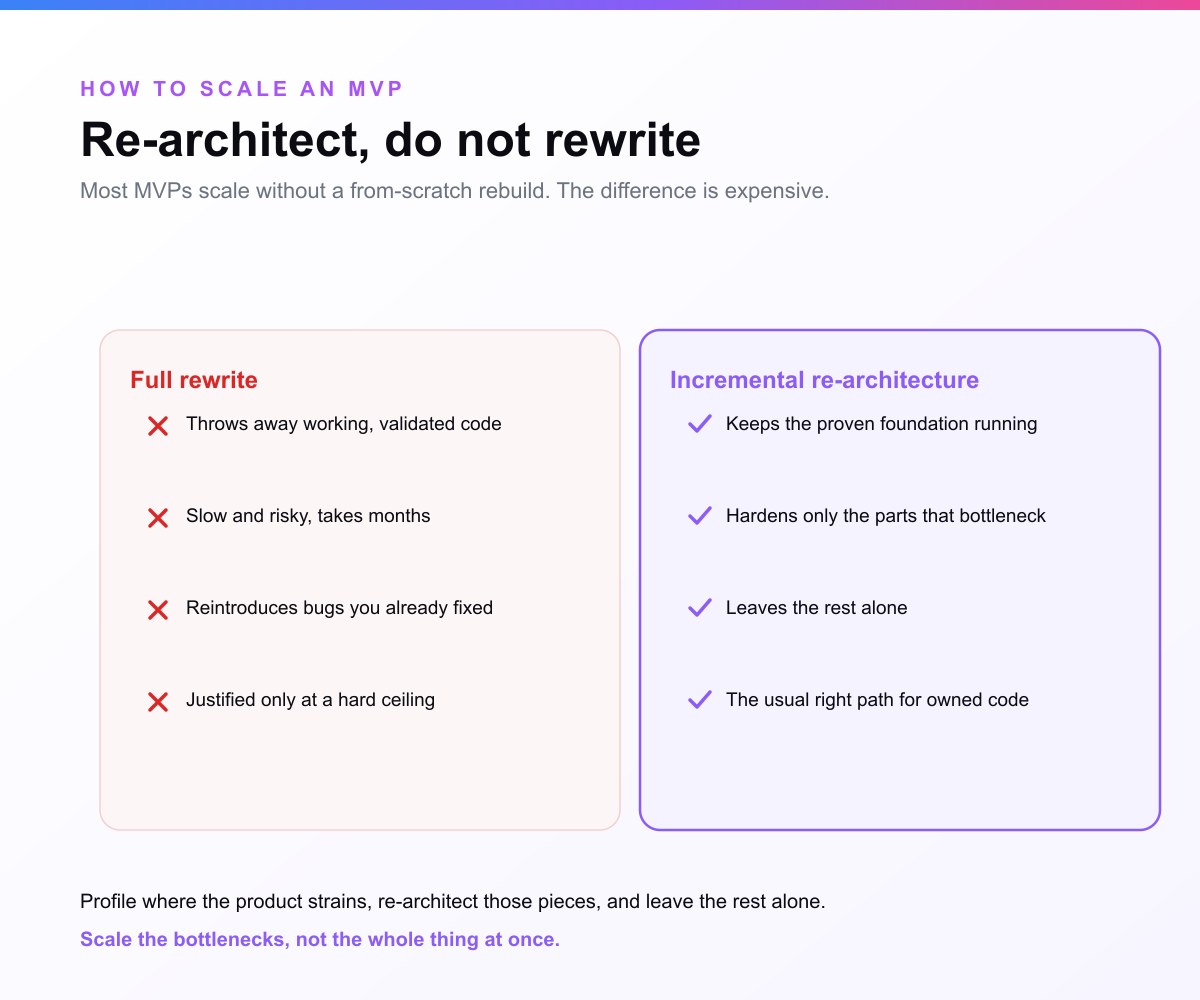
This is the question founders dread, and the honest answer is usually no, not from scratch. A full rewrite is slow, risky, and throws away working, validated code and the lessons baked into it. Most MVPs scale by incremental re-architecture: you harden and replace the specific parts that bottleneck, while keeping the proven foundation running.
A full rewrite is only justified when the MVP was built on something with a hard ceiling, a no-code tool you have outgrown, or a genuinely throwaway prototype, where extending it costs more than replacing it (the full rebuild versus iterate decision is its own guide). This is exactly why how you build the MVP matters: an MVP built on production-grade, owned code (rather than a rented platform or disposable hack) can be scaled and extended, while one built as a pure throwaway often cannot. Building for "validate now, extend later" from the start is what makes scaling affordable.
The pragmatic path: profile where the product actually strains under growth, re-architect those pieces deliberately, and leave the rest alone. Scale the bottlenecks, not the whole thing at once.
Common MVP scaling mistakes
- Scaling before product-market fit. The number-one killer, investing in growth and headcount before retention proves the value. Earn the fit signals first.
- Rewriting from scratch unnecessarily. Throwing away working, validated code for a "clean" rebuild that takes months and reintroduces risk. Re-architect incrementally instead.
- Adding features by wishlist, not data. Reaching for the pre-launch backlog instead of broadening by what real usage shows users want.
- Letting process kill velocity. Over-engineering team structure and bureaucracy so the speed that made you fast disappears.
- Ignoring tech debt until it breaks. Never paying down the deliberate shortcuts, then hitting a wall when load arrives. Pay it down where it bottlenecks.
- Scaling everything at once. Trying to harden tech, broaden product, grow the team, and automate ops simultaneously, instead of in the order the evidence demands.
How to scale your MVP the right way
The clean version: validate first, scale second, and re-architect rather than rewrite. Confirm product-market fit with real retention and the 40% signal, then expand deliberately, hardening the technology where it bottlenecks, broadening the product by data, and adding team and process to sustain growth without losing speed, all on the foundation the MVP validated.
That transition is exactly what we handle at MVP Development. We build MVPs on production-grade, fully-owned code so they are ready to scale when fit arrives, not a throwaway you have to rebuild, and our scale your MVP work turns a validated MVP into a robust, scalable product without a from-scratch rewrite. You keep the velocity and the foundation; we harden what growth demands.
Explore our MVP development services, or if your MVP is hitting fit and starting to strain, start with a free MVP consultation.
Reaching fit and ready to grow? Show us what is straining first and we will sequence the scaling work in the order that pays.
Related guides
- Post-MVP: the stage scaling is one path of
- Product-market fit: the gate you must clear before scaling
- MVP vs MMP: the marketable product an MVP scales toward
- Scale your MVP (service): turning a validated MVP into a scalable product
Frequently asked questions
How do you scale an MVP?
You scale an MVP by evolving a validated first version into a production-grade product across four dimensions: hardening the technology and architecture for load and reliability, broadening the product scope by real usage data, growing the team and adding process, and automating the infrastructure and operations. The essential rule is to do this only after you have product-market fit, and to re-architect incrementally on the proven foundation rather than rewriting from scratch. Scale the parts that actually bottleneck under growth, in the order the evidence demands, not everything at once.
When should you scale your MVP?
Only after you have clear product-market-fit signals: retention that flattens into a stable plateau, increasingly organic growth, and roughly 40% or more of users who would be "very disappointed" without the product. Before those signals are real, you are still searching for fit, which means iterating or pivoting, not scaling. Premature scaling, investing in growth and headcount before the product is proven, is one of the most common causes of startup failure. A useful test: if you are unsure whether you have fit, you do not, and you should keep iterating before scaling.
Do you have to rebuild an MVP to scale it?
Usually not from scratch. A full rewrite is slow, risky, and throws away working, validated code, so most MVPs scale by incremental re-architecture: hardening and replacing the specific parts that bottleneck while keeping the proven foundation running. A complete rebuild is only justified when the MVP was built on something with a hard ceiling, like a no-code tool you have outgrown or a throwaway prototype. This is why building the MVP on production-grade, owned code matters: it can be extended and scaled, whereas a disposable build often has to be replaced.
What is the difference between building an MVP and scaling it?
An MVP is optimized for learning fast and cheap, so it deliberately cuts corners: one core flow, a simple architecture, manual processes, and "good enough" on everything but the core. Scaling reverses the priority, from "what is the least we can build to learn?" to "what does this need to be to grow?", by hardening the technology, broadening the product, building the team, and automating operations. The MVP proves people want the product; scaling is about meeting that demand reliably and profitably. They are different jobs with different goals, separated by the product-market-fit milestone.
What happens if you scale an MVP too early?
You usually run out of money. Scaling too early means spending on growth, hiring, paid acquisition, and a full product build before retention proves the value is real, so you amplify a product that does not yet keep users, burning runway faster without the fit that would justify it. Startup Genome identifies premature scaling as a leading cause of failure. The fix is sequencing: keep iterating until the fit signals are unambiguous, then scale on a foundation you have proven people want.
Sources & references
This guide draws on lean-startup practice and scaling research:
- Startup Genome: premature scaling as a leading cause of startup failure
- Eric Ries, The Lean Startup: validated learning before scaling, and the engines of growth
- Y Combinator, Startup Library: finding fit before scaling
- Atlassian, Minimum Viable Product: the MVP as the validated base you build on
The 3 to 4 week figure reflects MVP Development delivery data for tightly scoped builds.


