


TL;DR
Investors do not evaluate an MVP on how polished it is. They evaluate it on the evidence it produces: that real people want the product, that they keep using it, and that the founding team can actually build and ship. A "fundable" MVP is one that turns the riskiest question about your startup, will anyone want this?, from a claim in a deck into a fact backed by real user behaviour.
The short version: in today's market a working MVP with early traction has become close to the price of entry for raising, even at pre-seed. But not every MVP is fundable. Investors look past vanity numbers (sign-ups, downloads, page views) to the signals that actually de-risk an investment, retention, engagement, and evidence of real demand. This guide covers what investors actually evaluate in an MVP, the difference between traction and vanity metrics, what a fundable MVP proves, what each funding stage expects, and how to present yours, so you build the artifact that moves a round forward.
Key Takeaways
- Investors evaluate an MVP on the evidence it produces, not on how polished it is.
- A fundable MVP proves that real people want the product, keep using it, and that the team can build and ship.
- In today's market, a working MVP with early traction is close to the price of entry for raising, even at pre-seed.
- Investors look past vanity metrics (sign-ups, downloads, page views) to retention, engagement, and real demand.
- The job of the MVP is to turn "will anyone want this?" from a claim into a fact backed by user behavior.
More data: the sourced figures on startup failure and product-market fit are in our MVP statistics for 2026.
Does an MVP actually help you raise?
Yes, and increasingly it is expected. A decade ago a credible deck and a strong founder could raise on a plan. Today, even pre-seed investors increasingly want to see a real product with real usage, because the bar has risen and capital is more selective. An MVP is how you clear that bar: it converts "we think people want this" into "we know, here is the usage data." In practice, the MVP stage of a startup, a live product with early traction, is now where most pre-seed conversations begin.
But it is worth being precise about why an MVP helps, because it is not the product itself investors care about. It is the evidence the product generates. A live MVP lets you point to real behaviour, sign-ups that convert to use, users who come back, sometimes early revenue, and that evidence is what de-risks the bet. It also proves something a deck never can: that you can ship. We cover the broader case for this in the benefits of an MVP; here we focus specifically on the investor's lens.
What investors actually evaluate in an MVP
When an investor looks at your MVP, they are not grading the UI. They are looking for evidence on a handful of specific risks. Understanding each one tells you what your MVP needs to show.
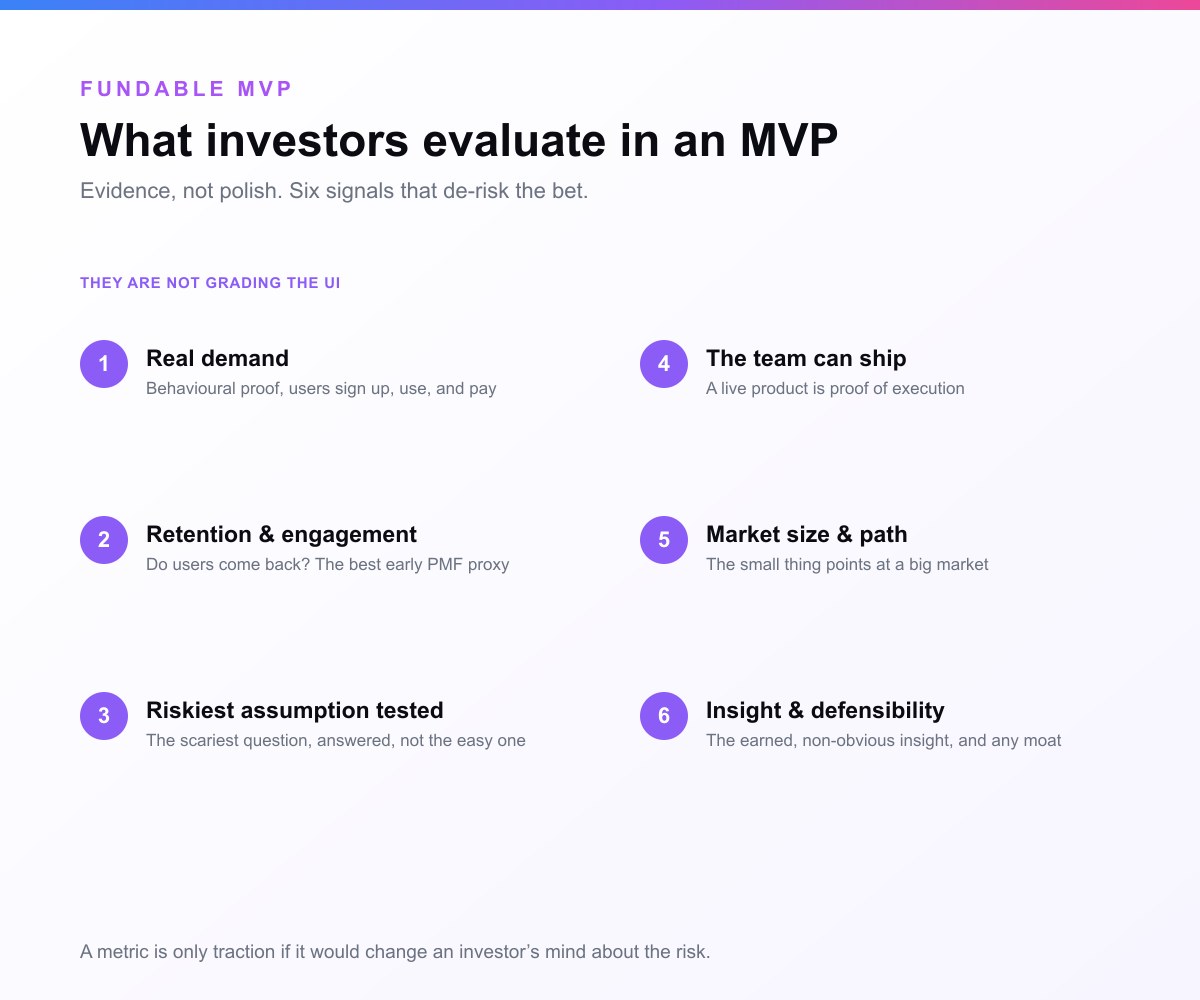
1. Evidence of real demand. The single biggest thing. Do real users in your target market actually want this? An investor wants behavioural proof, people signing up, using the core flow, paying, not survey responses or friends-and-family enthusiasm. This is the output of genuine MVP validation, and it is the first thing a good investor probes.
2. Retention and engagement. Demand that does not stick is a mirage. Investors look hard at whether users come back, because retention is the closest early proxy for product-market fit. A flat retention curve that levels off (rather than decaying to zero) is one of the most persuasive things an MVP can show.
3. The riskiest assumption, tested. A sophisticated investor wants to see that your MVP deliberately tested the most uncertain thing about your business, not just the easiest thing to build. An MVP that answers your scariest question is far more valuable than a feature-rich one that dodged it.
4. That the team can ship. A live, working MVP is proof of execution. It says the founders can take an idea to a real product, recruit or write the engineering, and make decisions under constraint. Investors back people, and a shipped MVP is evidence about the people, not just the idea.
5. Market size and the path beyond the MVP. The MVP is narrow by design, but investors are underwriting the big outcome. They want to see that the small thing you validated points at a large market, and that you have a credible view of how the MVP grows into it (the post-MVP path).
6. Insight and defensibility. Why you, why now, why this approach? The MVP often reveals a non-obvious insight about the customer that you learned by building and shipping. That earned insight, and any early signal of a moat, is what separates a fundable startup from a feature.
How does your own MVP score against these signals? Rate it below and get a fundability score, plus the weakest areas to fix before you pitch:
Rate your MVP against what investors actually weigh
Real demand, behavioural
Users sign up, use the core flow, and pay, not surveys or friends-and-family enthusiasm
Retention
Users come back (week 4 and beyond); the curve flattens rather than decaying to zero
Riskiest assumption tested
The MVP deliberately tested your scariest question, not the easiest feature to build
The team shipped it
A live, working product is deployed, proof you can execute, not a mockup
Instrumented
You can actually show activation and retention numbers from day one
Traction, not vanity
You lead with retention and revenue, not sign-ups, downloads, and page views
Market and path
The small win points at a large market, with a credible path beyond the MVP
Insight and defensibility
An earned, non-obvious insight about the customer, and any early sign of a moat
A self-assessment to size your fundability story, not investment advice. Honesty here beats a flattering score.
Traction vs vanity metrics: the numbers that actually move a round
This is where most founders lose investors. They present big, flattering numbers that signal nothing about the business. Investors have seen it all, and they mentally discount vanity metrics instantly.
| Vanity metrics (weak signal) | Traction metrics (strong signal) |
|---|---|
| Total sign-ups / downloads | Retention (do users come back, week 4 and beyond) |
| Page views / impressions | Activation (do users reach the core value) |
| Social followers | Engagement depth / frequency |
| Cumulative "users" (ever) | Active users (weekly/monthly) |
| Waitlist size alone | Conversion (waitlist → active → paying) |
| App-store ranking spikes | Revenue / paid conversion, even small |
The rule: a metric is only traction if it would change an investor's mind about the risk. Ten thousand sign-ups with 2% week-four retention is a worse signal than two hundred users with 40% retention, because the second one suggests something people genuinely need. The numbers that move a round are the ones that demonstrate durable demand, which is exactly what your MVP metrics should be built to capture from day one.
What a fundable MVP proves that a hobby project doesn't
Two products can look identical and one is fundable while the other is not. The difference is what they are designed to prove:
- A hobby MVP is built to be impressive, lots of features, a polished demo, a long roadmap shipped early.
- A fundable MVP is built to be evidential, narrow, focused on one core flow, instrumented to measure demand and retention, and deliberately aimed at the riskiest assumption.
Investors can tell the difference in minutes. A fundable MVP comes with a story: here is the risk we tested, here is what real users did, here is what that tells us about the opportunity. That narrative, grounded in real behaviour, is worth more than any amount of polish. This is why scoping the MVP tightly is itself a fundability decision: a focused MVP produces a clean signal, a bloated one buries it.
What investors expect at each stage
The bar shifts with the round you are raising:
- Pre-seed. Often the MVP is the traction. Investors expect a working product and early signal, initial users, engagement, maybe a little revenue, plus a strong founder narrative and insight. You are selling evidence that the dog will eat the dog food. (For the full breakdown, see how much traction you need to raise a pre-seed round.)
- Seed. The bar rises to repeatable signal: meaningful retention, a sharpening view of product-market fit, early unit-economics hints, and a credible plan to scale the MVP into a real product. The MVP is no longer the headline; what it has learned is.
- Beyond. By Series A the MVP itself is old news, investors underwrite growth and economics. But the MVP's job was done earlier: it bought you the data and the credibility to get here.
Matching your MVP's evidence to the stage you are raising is half of looking fundable. Showing pre-seed evidence in a seed conversation reads as not having progressed.
How to present your MVP to investors
Even a strong MVP needs framing. The narrative investors respond to is simple and evidence-led:
- The problem and your insight, the non-obvious thing you understand about the customer.
- The riskiest assumption, what you most needed to find out.
- The MVP, the focused thing you built to test it (briefly, do not dwell on features).
- The evidence, the real-user behaviour, retention, and any revenue, presented honestly, with the metrics that matter, not the vanity ones.
- The opportunity and the ask, how this points at a large market and what you will do with the capital.
Honesty is leverage here. Presenting modest-but-real retention with a clear-eyed read of it builds more credibility than inflated numbers a sharp investor will see through. The MVP plus an honest interpretation of its data is the most persuasive thing a pre-seed founder can bring.
Common mistakes founders make with a fundable MVP
- Leading with vanity metrics. Big sign-up numbers with no retention actively hurt credibility with experienced investors.
- Over-building to impress. A feature-rich MVP that dodged the real risk is less fundable than a focused one that tested it.
- No instrumentation. If you cannot show retention and activation because you never measured them, you have no traction story, wire in analytics from day one.
- Testing the easy question. Building the part you knew how to build instead of the part that was actually risky.
- Mismatching evidence to stage. Bringing thin pre-seed signal to a seed raise reads as a lack of progress.
Build a fundable MVP with us
A fundable MVP is not the most polished one, it is the one engineered to produce evidence: a focused core flow, instrumented for retention and activation, aimed squarely at your riskiest assumption, shipped fast enough to generate real data before your runway runs out.
That is exactly what we build at MVP Development. We ship funding-ready MVPs in 3 to 4 weeks, scoped to the one core flow that tests your riskiest assumption, instrumented for the traction metrics investors actually weigh, by senior engineers, on a fixed quote you approve before we start, with full code ownership. A deployed product with a working core flow and real usage is the artifact that turns an investor conversation from "we think" into "we know."
Explore our MVP development services, or see how to build an MVP for the full process.
Raising on an MVP? Show us your traction story so far and we will help you assemble the evidence investors actually check.
Related guides
- MVP validation: producing the demand evidence investors want
- MVP metrics: the traction numbers that matter
- The benefits of an MVP: including fundability
- Product-market fit: what retention is really pointing at
Frequently asked questions
What do investors look for in an MVP?
Investors look for evidence, not polish. The main things they evaluate are: real demand (behavioural proof that target users actually want and use the product), retention and engagement (do users come back, the best early proxy for product-market fit), whether the MVP tested your riskiest assumption rather than the easiest feature, proof that the team can ship, a large market the MVP points toward, and an earned insight or early sign of defensibility. A working MVP that demonstrates durable demand de-risks the investment in exactly the way investors care about, which is why it has become close to a requirement for raising.
Does an MVP make you more fundable?
Yes, significantly, in today's market. Even pre-seed investors increasingly expect a real, working product with early usage rather than just a pitch deck and a plan. An MVP produces the one thing a deck cannot: real user behaviour that proves demand, plus evidence that the founders can execute. But the MVP itself is not what makes you fundable, the evidence it generates is. A focused MVP with strong retention is far more fundable than a feature-rich one with thousands of sign-ups but no one coming back.
What traction does an MVP need to raise?
There is no universal number, because traction is about signal quality, not size. Investors care far more about retention, activation, and engagement than raw sign-ups or downloads. A small user base with strong, durable retention (users still active weeks later) is a better fundraising signal than a huge user base that churns immediately. Early revenue, even modest, is also powerful. The right benchmark depends on your market and stage, but the principle holds: show metrics that prove people genuinely need the product and keep using it, not vanity numbers that look big but signal nothing.
Traction vs vanity metrics, what's the difference?
Vanity metrics are numbers that look impressive but do not indicate a healthy business, total sign-ups, page views, downloads, social followers, or cumulative "users ever." Traction metrics indicate durable demand, retention (do users return), activation (do they reach the core value), active users (weekly/monthly, not cumulative), conversion (to active and to paying), and revenue. The test: a metric is only traction if it would genuinely change an investor's view of the risk. Experienced investors discount vanity metrics instantly, so leading with them can actively hurt your credibility.
What should an MVP pitch deck show?
The product working, not described: a two-minute demo or a short recording, followed by the numbers the MVP produced (users, retention, revenue or signed pilots) and what you learned that changed the plan. Investors read an MVP slide as evidence of execution and of learning; a feature list reads as neither. Put the traction slide immediately after the demo and keep the roadmap to one slide.
Sources & references
- Y Combinator Library: startup fundraising and traction guidance
- Eric Ries, The Lean Startup: validated learning and actionable vs vanity metrics
- First Round Review: operator and investor perspectives on early traction
- Atlassian, Minimum Viable Product: scoping the MVP
The 3 to 4 week figure reflects MVP Development delivery data for tightly scoped builds. This guide is general guidance, not investment advice.


