


TL;DR
Product-market fit (PMF) is the point at which you have built something a market genuinely wants, so much that demand starts to pull the product out of you rather than you pushing it onto people. It is the single most important milestone for an early-stage startup, and almost everything before it, including building your MVP, exists to find it.
The key relationship to understand: your MVP is not the goal; product-market fit is. The MVP is the engine you use to search for it. You ship the smallest real product, measure how people respond, learn, and iterate, until the signals say a market truly wants what you have built. This guide covers what PMF actually is, the qualitative and quantitative signs that you have it (and the false signals that fool founders), how to measure it, and how to use your MVP to reach it.
Key Takeaways
- Product-market fit is the point where a market wants your product so much that demand pulls it out of you rather than you pushing it onto people.
- It is the most important early-stage milestone; almost everything before it, including your MVP, exists to find it.
- Your MVP is not the goal; product-market fit is. The MVP is the engine you use to search for it.
- Real PMF shows in retention and pull; false signals like vanity metrics and forced growth fool founders.
- You reach PMF by shipping the smallest real product, measuring response, and iterating until the signals hold.
More data: for the sourced benchmarks on product-market fit and startup failure, see our MVP statistics for 2026.
At a Glance
| Aspect | Product-market fit |
|---|---|
| What it is | The market pulls the product out of you |
| Why it matters | The most important early-stage milestone |
| Your MVP | The engine you use to search for it |
| Real signal | Retention and organic pull |
| False signal | Vanity metrics and forced growth |
What is product-market fit?
Product-market fit is being in a good market with a product that can satisfy that market. The phrase was popularized by Marc Andreessen, who, in his essay the only thing that matters, argued that PMF is the one thing that determines a startup's success, more than the team, the product, or the timing on their own.
The most useful way to feel the difference: before PMF, you are pushing, chasing users, begging for meetings, explaining why people should care, and growth is a grind. After PMF, the market pulls, users sign up faster than you can handle, they tell their friends, servers fall over, and your problem shifts from "does anyone want this?" to "can we keep up?" Andreessen's vivid description is that "the customers are buying the product just as fast as you can make it, money from customers is piling up in your company checking account, you are hiring sales and customer support staff as fast as you can."
PMF is not a vanity milestone or a marketing claim. It is a felt change in how the business behaves, backed by measurable signals. And critically, it is the thing your whole early process, validation, MVP, iteration, is built to find.
Why product-market fit matters more than anything else
Andreessen's argument is blunt and worth taking seriously: in a great market, a mediocre product still finds fit because the market pulls it forward, and in a bad market, even a brilliant product and team fail because there is no demand to satisfy. The implication is that the early startup's entire job is to find a market that wants the product, not to perfect the product in a vacuum.
This reframes everything an early founder does. Features, design polish, and scaling all come after PMF, not before. Before fit, the only question that matters is "are we getting closer to a market that genuinely wants this?" Spending on growth, hiring a big team, or polishing a product before fit is the classic way startups burn their runway, building beautifully for a market that was never there. Startup Genome's research on premature scaling makes the same point: scaling before fit is one of the most common ways startups die.
So PMF is the line that divides the two halves of a startup's early life: the search for fit (validate, build an MVP, iterate) and the scaling of fit (growth, team, optimization). Knowing which side you are on tells you what to work on.
The MVP and product-market fit: the engine and the destination
Here is the relationship that ties this whole topic together: your MVP is the engine you use to search for product-market fit, and PMF is the destination.
An MVP is the smallest real product you can put in front of users to learn whether they want it. You do not build an MVP to "have an MVP", you build it to start the loop that hunts for fit: ship the minimal product, measure how real users respond, learn what is working and what is not, and iterate. That is the build-measure-learn loop, and PMF is what you are running the loop to find.
This is why an MVP that ships without measurement is wasted: with no instrumentation, you cannot tell whether you are getting closer to fit. It is also why the MVP must be viable, not broken: a too-rough build produces a false "no demand" signal and can hide a fit you actually could have reached. The discipline is to keep the MVP small but real, instrument it, and read the signals honestly.
The practical sequence: validate demand before building, build the MVP scoped to one core flow, launch it to learn, measure the right metrics, then iterate, repeating until the fit signals appear. Most startups do not hit PMF on the first MVP; they hit it after several iterations, and sometimes a pivot.
The signs you have product-market fit
PMF shows up as a cluster of signals, some you feel, some you measure. No single one is proof, but together they are unmistakable.
Qualitative signs (what it feels like):
- Pull, not push. Users find you and adopt without heavy convincing. Word of mouth starts to drive growth on its own.
- Users would be upset to lose it. People react with genuine disappointment at the idea of the product disappearing, a sign it has become part of how they work or live.
- Usage outpaces your effort. Sign-ups, usage, or sales grow faster than your ability to keep up, and your problems become operational (scaling, support) rather than existential (does anyone care?).
- Customers pull the roadmap. Users ask for more, refer others unprompted, and tell you what to build next.
Quantitative signs (what the data shows):
- Strong retention that flattens. Cohorts keep coming back and the retention curve levels off rather than decaying to zero, the clearest data signal of real value.
- The 40% test. When you ask users how they would feel if they could no longer use the product, roughly 40% or more say "very disappointed."
- Organic and referral growth. A meaningful share of new users arrives through word of mouth, not paid acquisition.
- Healthy unit economics. Users are worth more than they cost to acquire, and that gap widens as you grow.
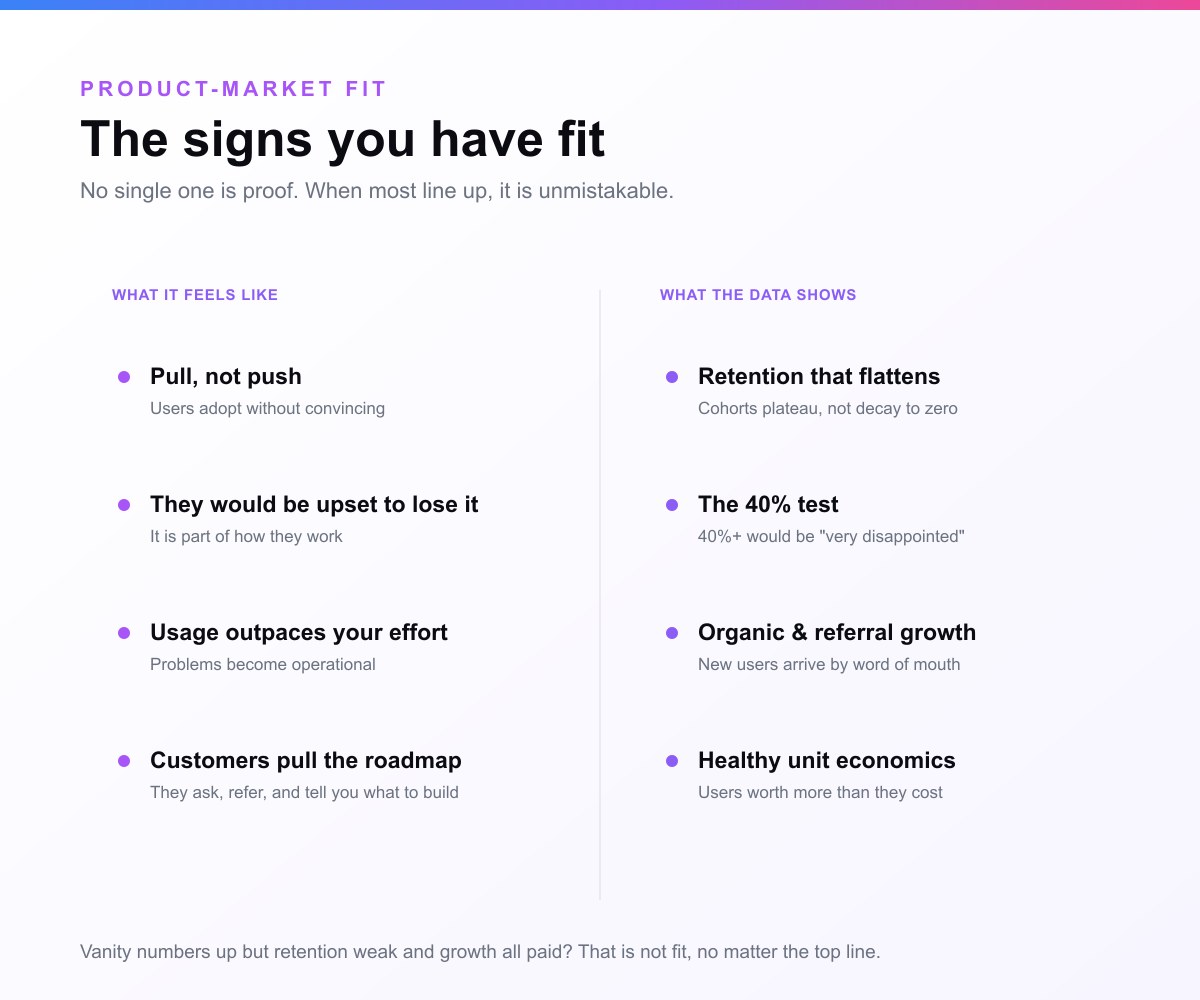
When most of these line up, you have fit. When only the vanity numbers (total signups, downloads) are up but retention is weak and growth is all paid, you do not, no matter how good the top-line looks.
| Signal type | What it looks like | Reliable? |
|---|---|---|
| Retention curve flattening | Cohorts plateau instead of decaying to zero | Yes, the strongest signal |
| 40% "very disappointed" test | 40%+ of active users say they'd be very disappointed to lose it | Yes, a widely used benchmark |
| Organic and referral growth | New users arrive without paid acquisition | Yes |
| Total signups or downloads | High raw numbers alone | No, a vanity metric |
| Launch-week spike | A traffic surge from press or a Product Hunt feature | No, unless it sustains after |
| Paid growth that stops at breakeven | Growth halts the moment ad spend stops | No |
How to measure product-market fit
You cannot manage what you do not measure, and PMF is measurable enough to track deliberately. The main instruments:
- Retention cohorts. Group users by when they joined and track what share are still active over time. If the curve flattens to a stable plateau, value is recurring, the strongest evidence of fit. If it decays toward zero, you do not have fit yet.
2. **The Sean Ellis “very disappointed” test.** Survey active users with one question: “How would you feel if you could no longer use this product?” Sean Ellis’s [PMF survey benchmark](https://pmfsurvey.com/) holds that around **40% answering “very disappointed”** indicates product-market fit. It is the most widely used single proxy for PMF.
3. **Net Promoter Score and referral behavior.** Whether users would recommend you, and whether they actually do.
4. **Engagement depth.** How often and how deeply active users use the core feature, not just whether they signed up.
For the full treatment of which numbers to track and the benchmarks for each, see our guide to MVP metrics, which covers activation, retention, the AARRR funnel, and the 40% test in detail. The PMF-specific point is this: measure value and recurrence (retention, the 40% test), not vanity (signups, downloads), because only the former tells you whether a market actually wants the product.
The Superhuman example
Email client Superhuman turned PMF measurement into a repeatable engine. As recounted in First Round Review's account of how Superhuman built an engine to find product-market fit, founder Rahul Vohra used the 40% test as a north star: he segmented the users who would be "very disappointed," studied what they loved, and systematically improved the product for them until the "very disappointed" share climbed well past 40%. The lesson for any MVP team: PMF is not a coin flip you wait on, it is a number you can deliberately move by iterating toward the users who already love the core.
How to reach product-market fit with your MVP
Reaching fit is a loop, not a single launch. The repeatable path:
- Validate the problem first. Confirm real people have the problem before you build. The cheapest fit is the one you do not waste a build chasing. See MVP validation.
- Build a minimal, real MVP. Scope to the one core flow that delivers the value, built to a working standard, and instrument it from day one. See how to build an MVP.
- Launch to learn, not to impress. Get the MVP in front of real users and watch how they behave. See MVP launch strategy.
- Measure the fit signals. Track retention and run the 40% test on active users. Read the data honestly.
- Talk to the users who love it. Find the segment that would be "very disappointed" and learn exactly why. Their reasons are your roadmap.
- Iterate toward that segment, or pivot. Improve the core for the users who already value it. If no segment loves it after honest effort, change direction, a pivot is a normal part of the search, not a failure.
Repeat until the signals say a market truly wants the product. Most startups iterate several times before fit, and the founders who reach it are usually the ones who measured honestly and iterated fast, exactly what a well-built MVP makes possible.
Common product-market-fit mistakes
- Mistaking traction for fit. A spike of signups from a launch or a press hit is not fit if those users do not stick. Retention, not a launch bump, is the test.
- Chasing vanity metrics. Total downloads and registered users feel like progress and prove nothing about whether a market wants the product.
- Scaling before fit. Hiring a sales team and pouring money into ads before retention is healthy just burns runway faster. Find fit first, then scale.
- Polishing instead of validating. Adding features and design polish to a product no segment loves yet. Fit comes from the right core for the right users, not from more.
- Declaring fit too early. One enthusiastic cohort or a friendly investor's praise is not fit. Hold yourself to the data.
- Refusing to pivot. Treating the first idea as sacred when the signals say no market wants it. The MVP exists precisely so you can change course cheaply.
What to do after product-market fit
PMF is the dividing line: before it, you search; after it, you scale. Once the signals are real, the job changes from finding fit to building on it, hardening the product, investing in growth, and turning a validated MVP into a production-grade product that can handle the demand. That transition, from a validated MVP to something built to scale, is its own discipline, and it is exactly what our scale your MVP work handles. The mistake to avoid is scaling before the fit signals are genuinely there; the opportunity, once they are, is to pour fuel on a fire that is already lit.
Find your product-market fit, faster
Product-market fit is the goal; the MVP is how you search for it. The startups that reach it are the ones that get a real, instrumented product in front of users quickly, then iterate honestly on what the data shows, rather than spending a year building in the dark.
That is the loop we are built to accelerate at MVP Development. We ship a funding-ready MVP in 3 to 4 weeks, scoped to the one core flow that tests your idea, instrumented from day one to measure activation, retention, and the fit signals that matter, on a fixed quote you approve before we start, with full code ownership. You get to the part that actually matters, real users and real data, in weeks instead of quarters, so your search for product-market fit starts sooner.
Explore our MVP development services, or if you are still scoping the idea, start with a free MVP consultation.
Ready to start the search for fit? Show us your retention curve and we will tell you what it is really saying about your fit.
Related guides
- What is an MVP?: the product you use to search for fit
- MVP validation: confirm demand before you build
- MVP metrics: the numbers that prove (or disprove) fit
- MVP launch strategy: get the MVP in front of users to learn
Frequently asked questions
What is product-market fit?
Product-market fit is the point at which you have built a product that a market genuinely wants, enough that demand begins to pull the product forward rather than you having to push it onto people. The term was popularized by Marc Andreessen, who described it as being in a good market with a product that can satisfy that market. In practice it shows up as strong retention, organic word-of-mouth growth, and users who would be genuinely disappointed to lose the product. It is the most important early milestone for a startup, because almost everything before it exists to find it.
How do you measure product-market fit?
The two most reliable measures are retention and the "very disappointed" test. Retention cohorts show whether users keep coming back; a curve that flattens to a stable plateau is the strongest data signal of fit. The Sean Ellis test asks active users how they would feel if they could no longer use the product, and roughly 40% or more answering "very disappointed" indicates product-market fit. Net Promoter Score, referral behavior, and engagement depth support the picture. Avoid vanity metrics like total signups and downloads, which feel like progress but say nothing about whether a market actually wants the product.
How does an MVP help you reach product-market fit?
An MVP is the engine you use to search for product-market fit. You build the smallest real product that delivers your core value, put it in front of users, measure how they respond, and iterate, repeating the build-measure-learn loop until the fit signals appear. The MVP keeps the search cheap and fast: instead of spending a year building a full product for a market that may not exist, you test the idea in weeks and learn what to change. Most startups reach fit after several MVP iterations, and sometimes a pivot, which the MVP makes affordable.
What are the signs of product-market fit?
The qualitative signs are that growth feels like pull rather than push: users adopt without heavy convincing, word of mouth drives new users, and demand outpaces your ability to keep up, so your problems become operational rather than existential. The quantitative signs are strong retention that flattens over time, roughly 40% or more of users saying they would be "very disappointed" without the product, a meaningful share of organic and referral growth, and healthy unit economics. No single signal is proof, but when most of them line up, you have fit.
How long does it take to reach product-market fit?
There is no fixed timeline; it depends on the market, the idea, and how fast you can iterate. Some startups find fit within months, others take a year or more, and many pivot at least once along the way. What consistently shortens the path is iteration speed: getting a real, instrumented MVP in front of users quickly and reading the data honestly, rather than building in the dark for a long time before testing. The faster your build-measure-learn loop, the faster you converge on fit, which is the main reason to keep the MVP small and ship it early.
Can you lose product-market fit?
Yes. Product-market fit is not permanent. Markets shift, competitors raise the bar, customer needs evolve, and a product that fit a market two years ago can drift out of fit if it stops improving. This is why retention and the fit signals are worth tracking continuously, not just once. The same discipline that found fit, measuring value and iterating on what users actually need, is what keeps it.
What are false signs of product-market fit?
A launch spike from press or a Product Hunt feature that doesn't sustain, a small group of extremely enthusiastic users who don't represent your broader target market, total signups or downloads that look impressive alongside weak retention, and growth that only continues because you keep paying for it through ads. All four feel like progress and prove nothing. The only signals that count are the ones tied to genuine, unpaid, repeated use.
Do you need product-market fit before raising funding?
Not always. Pre-seed and seed investors often fund before full PMF, betting on the team and early signal. But every stage after that increasingly wants evidence: strong retention, organic growth, or a "very disappointed" score moves a pitch from "we think" to "we know." The earlier you are, the more a validated MVP and early signals can substitute for full PMF; the later you are, the more investors expect to see the real thing.
What's an example of a startup finding product-market fit?
Superhuman is the clearest documented case. Founder Rahul Vohra used the Sean Ellis "very disappointed" survey as a north star, segmented the users who already loved the product, studied exactly what they valued, and iterated specifically for that segment until the score climbed well past the 40% benchmark. The lesson generalizes: PMF is not luck, it is a number you can deliberately move by narrowing focus toward the users who already get the most value.
Can you test for product-market fit before you have many users?
Yes, with a small group the signal is qualitative more than statistical. Watch whether a handful of real users come back unprompted, refer others, or would be genuinely upset to lose the product, these are strong directional signs even with 20 or 30 users. The Sean Ellis 40% test technically needs a reasonable sample to be statistically meaningful, but the qualitative pull described above is often visible well before you have enough users to run it formally.
Sources & references
This guide draws on the foundational writing and benchmarks on product-market fit:
- Marc Andreessen, The Only Thing That Matters: the definition of product-market fit and why it is the one thing that matters
- Sean Ellis, the PMF Survey: the "very disappointed" test and the 40% benchmark
- First Round Review, How Superhuman Built an Engine to Find Product-Market Fit: turning the 40% test into a repeatable PMF engine
- Eric Ries, The Lean Startup: the build-measure-learn loop the MVP runs to find fit
- Y Combinator, Startup Library: pragmatic guidance on finding fit before scaling
The 3 to 4 week figure reflects MVP Development delivery data for tightly scoped builds.


