


"Minimum viable" was the right advice for a world with fewer apps and lower expectations. Today, a product that merely works gets deleted after one session, because three competitors do the same thing with a nicer experience. That's the argument behind the MAP, the Minimum Awesome Product: ship the smallest thing that doesn't just function, but delights. This guide compares MVP vs MAP honestly, shows how a MAP differs from the closely-related MLP, and helps you decide which bar your first version should clear.
TL;DR
An MVP (Minimum Viable Product) is the least you can ship to learn whether your idea works. A MAP (Minimum Awesome Product) is the least you can ship that makes users say "awesome," not just "okay." The MVP optimizes for validated learning at the lowest cost; the MAP optimizes for delight on the one flow that matters, on the theory that in a crowded market, viability is the floor, not the goal. They are not opposites: a MAP is a narrow MVP with the core experience polished until it delights, instead of merely functioning.
The honest answer to "which do I need?" is: an MVP when your biggest risk is demand (does anyone want this?), and a MAP when demand is plausible but the market is crowded and experience is the differentiator.
Key Takeaways
- An MVP is the least you can ship to learn whether your idea works.
- A MAP (Minimum Awesome Product) is the least you can ship that makes users say "awesome," not just "okay."
- The MVP optimizes for validated learning at the lowest cost; the MAP optimizes for delight on the one flow that matters.
- Build an MVP when your biggest risk is demand, a MAP when demand is plausible but the market is crowded and experience is the differentiator.
MVP vs MAP: the difference that matters most
The one-line version: an MVP asks "what's the least we can ship to learn?", a MAP asks "what's the least we can ship that people will love on first use?"
An MVP is happy to be rough. Its job is to answer a question cheaply, so a clunky, bare-bones version is a feature, not a bug, because it gets you to the answer faster. A MAP accepts that in 2026 a rough experience answers the wrong question: users won't tell you whether they'd love the polished version, because they never make it past the rough one. So a MAP keeps the scope just as narrow, but spends its effort making the single core flow genuinely delightful.
What is an MVP?
A minimum viable product is the smallest version of a product that lets you test your riskiest assumption with real users, for the least time and money. Its purpose is validated learning: ship the core, measure how people respond, and decide whether to persevere or pivot before you over-invest. The MVP deliberately cuts polish, secondary features, and edge cases, because none of those change the answer to "do people want this at all?"
What is a MAP (Minimum Awesome Product)?
A Minimum Awesome Product is the smallest version of your product that delivers the core value and delights, so a new user's first reaction is "awesome," not "it's fine." The term was popularized by Carlos Beneyto's essay "The MVP is dead, long live the MAP," and the logic is simple: user expectations have risen, and a barely-functional experience now reads as "broken" rather than "early." A MAP sits at the intersection of functionality, reliability, and delight, minimal in scope, but excellent in the scope it keeps.
Crucially, a MAP is not a bigger product. It has just as few features as an MVP. The difference is where the effort goes: instead of spreading thin polish across many rough features, a MAP puts all of it into making the one core experience feel crafted, fast, and delightful.
MVP vs MAP: side-by-side comparison
| MVP (Minimum Viable Product) | MAP (Minimum Awesome Product) | |
|---|---|---|
| Core question | Does anyone want this? | Will people love this on first use? |
| Optimizes for | Validated learning, lowest cost | Delight on the core flow |
| The bar | It functions | It delights |
| Polish | Deliberately cut | Concentrated on the one core flow |
| First impression | "Okay, I see the idea" | "Oh, that's nice" |
| Best when | Demand is the risk | Demand is plausible, experience is the differentiator |
| Risk if misused | Rough experience buries a good idea | Polishing something nobody wants |
What makes a product "awesome" (not just viable)
"Awesome" sounds subjective, but at MAP scope it's concrete. It comes from three things, none of which require more features:
- One genuine "wow" moment. A single, memorable beat in the core flow, an instant result, a delightful animation, an insight the user didn't expect. You need one, not ten.
- A core flow that's fast and frictionless. The main action happens in as few steps as possible, with no rough edges on the path that matters. Everything off that path can stay minimal.
- Reliability on the thing that counts. Awesome dies the moment the core action fails or feels janky. Delight is fragile; it has to work every time on the one flow you chose to make great.
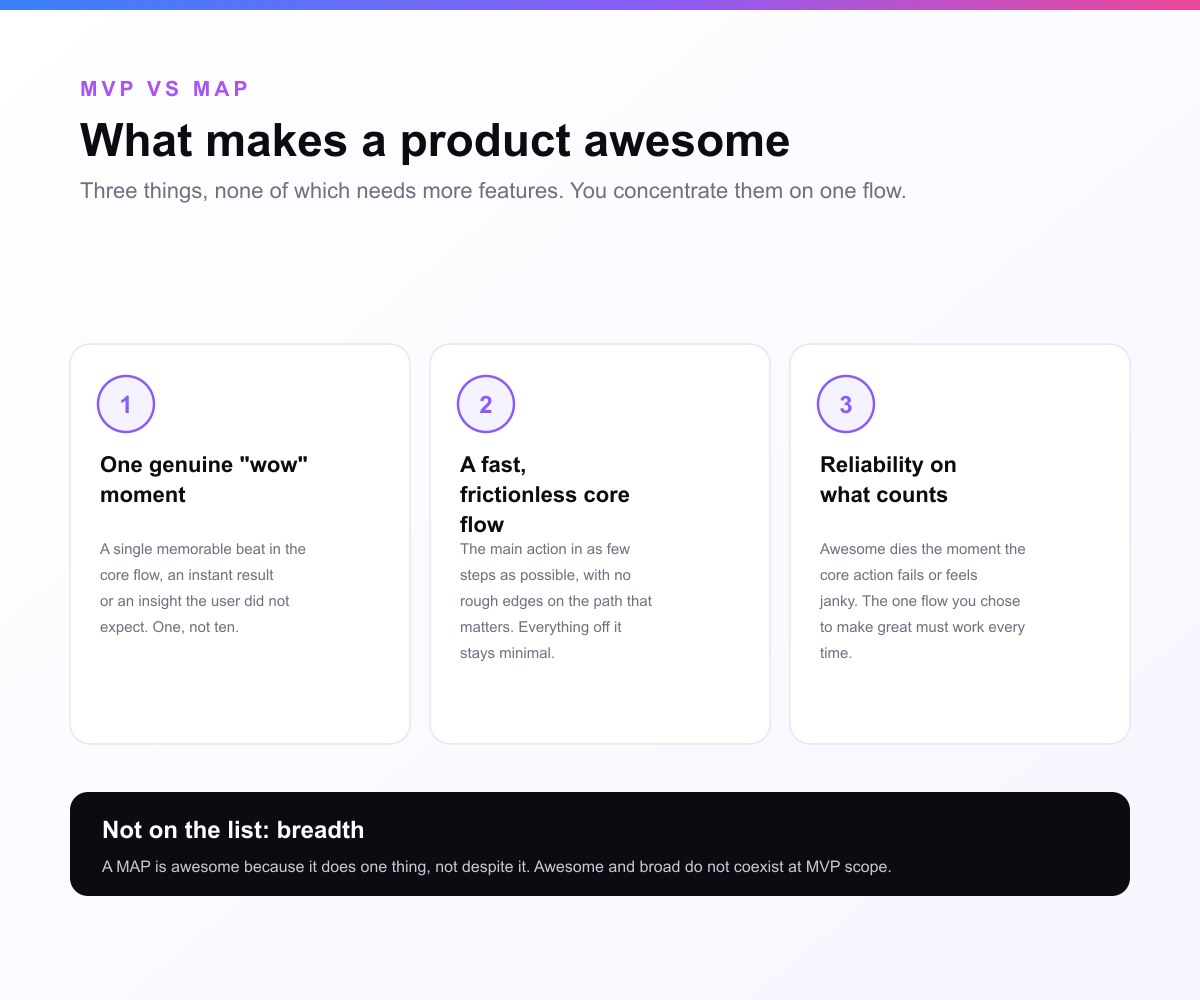
Notice what's not on the list: breadth. A MAP is still ruthless about scope. It's awesome because it does one thing, not despite it.
MVP vs MAP: the comparison categories that matter
- Goal, viable vs awesome. The MVP wants proof the idea works; the MAP wants proof people will love the experience. Different questions, different bars.
- Where effort goes, spread vs concentrated. The MVP spreads a thin layer of "just enough" across the whole flow. The MAP concentrates all its polish on the single core interaction and lets the rest stay bare.
- The first-run experience, tolerated vs wowed. MVP users tolerate rough edges because they're testers. MAP users are treated like real customers from minute one, because the experience is what's being tested.
- The risk each retires. An MVP retires market risk ("does anyone care?"). A MAP retires experience risk ("is our version good enough that people will choose and keep it?"), which only matters once market risk is largely gone.
MAP vs MDP vs MLP vs SLC: the "beyond-viable" family
Here's where founders get tangled, because MAP is one of several "make it more than viable" concepts, and they're close cousins, so close that the label matters far less than the emphasis. Knowing the emphasis keeps you from building the wrong bar:
- MAP (Minimum Awesome Product): the broadest "wow": functionality, reliability, and delight combined into a first-impression "awesome."
- MDP (Minimum Delightful Product): MAP's closest cousin, the emphasis narrowed specifically to delight. In practice MAP and MDP are near-interchangeable. See MVP vs MDP.
- MLP (Minimum Lovable Product): emphasis on emotional love and retention: the least people would be sad to lose. See MVP vs MLP.
- SLC (Simple, Lovable, Complete): emphasis on completeness: a small thing that is whole and finished rather than a fragment. See MVP vs SLC.
- MMP (Minimum Marketable Product): emphasis on being ready to sell: the least you can charge for and market. See MVP vs MMP.
- EVP (Exceptional Viable Product): the outlier: it's willing to delay launch to ship something polished and market-ready, rather than shipping minimal-but-great. See MVP vs EVP.
- MVE (Minimum Viable Experience): emphasis on the whole user journey feeling smooth for a broad audience, rather than a single delightful moment. See MVP vs MVE.
They overlap heavily in practice, an awesome product is usually delightful and lovable, and vice-versa. Don't agonize over which word you pick. The useful distinction is simply: MVP proves the idea; MAP, MDP, MLP, and SLC raise the quality bar; MMP readies it to sell. Match the emphasis to your real risk and move on.
Is a MAP a stage after the MVP, or a better MVP?
Both framings are used, and both are defensible:
- "A better MVP": if your market is crowded and experience is the whole battle, skip the deliberately-rough version and make your first release a MAP. A rough MVP in a polished category can answer the wrong question, users reject the roughness, not the idea.
- "A stage after": if demand itself is unproven, validate cheaply with a plain MVP first, then invest in a MAP once you know people want it. Polishing an experience nobody wants is the most expensive way to learn you were wrong.
The deciding factor is which risk is bigger right now: unknown demand → MVP first; known demand in a crowded market → go straight to MAP.
A worked example: an expense-tracker app
Say you're building a personal expense tracker. The core action is "log an expense."
- The MVP: a form to add an expense, a list of what you've logged, and a monthly total. It works. A tester can confirm the concept. But it looks like fifty other apps, and a real user logs two expenses and forgets it exists.
- The MAP: same scope, no extra features, but the one core action is awesome. Adding an expense takes two taps and a satisfying micro-animation, and the instant it's saved you see a single, delightful insight: "You're £40 under your dining budget this week." Same features. But the core loop delivers a tiny hit of awesome every time, so people come back.
The MAP didn't add a budget module, reports, or bank sync. It took the one thing the product does and made that one thing delightful. That's the whole discipline.
How to make your MVP awesome without bloating it
- Pick one flow to make great, and only one. Usually the core action users repeat. Everything else stays MVP-rough.
- Add one delightful beat, not ten. A single memorable moment on the core flow beats scattered polish everywhere.
- Spend the polish budget you'd have spent on features. A MAP isn't more expensive because it has fewer features than a bloated MVP, you're trading breadth for depth on the one thing that matters. Good UX design is the lever here.
- Cut ruthlessly to afford it. The only way to make one thing awesome on an MVP budget is to do fewer things. Awesome and broad don't coexist at MVP scope.
When a plain MVP is the right call (and when a MAP is)
Build a plain MVP when your biggest unknown is demand, you're in a new or underserved category, your early users are design partners who tolerate roughness, or your budget only stretches to answering "do they want it?" In those cases, polish is premature, spend it after you have a yes.
Aim for a MAP when the category is crowded and experience is the differentiator, first impressions decide retention (most consumer apps), you're launching to real users rather than friendly testers, or a rough version would get you rejected for the wrong reason. Here, "viable" isn't enough to learn anything true.
Common mistakes founders make
- Gold-plating everything. A MAP makes one flow awesome, not the whole app. Polishing every screen turns a MAP back into a slow, expensive full build.
- Reaching for a MAP before proving demand. If you don't yet know people want it, an awesome experience just makes an expensive way to find out they don't.
- Confusing "awesome" with "more features." Delight comes from craft on the core flow, not breadth. Adding features is the opposite of a MAP.
- Treating "viable" as an excuse for "broken." Even a plain MVP shouldn't ship a core action that fails. Viable still has to work.
Build your MVP (or MAP) with us
At MVP Development we help founders pick the right bar, a lean MVP when demand is the question, or a Minimum Awesome Product when experience is the battle, and then build it, scoped to the one flow that matters, delightful where it counts, shipped in about 3-4 weeks on a fixed quote you approve up front.
If you're not sure which bar your idea needs, our MVP consulting will help you decide before you spend, and our UX design is where "viable" becomes "awesome."
Building your first version? Name your riskiest assumption and we will design the smallest build that tests it.
Related guides
- MVP vs MDP: Minimum Delightful Product, MAP's closest cousin
- MVP vs MLP: the "lovable" cousin (emotional love vs first-impression awesome)
- MVP vs SLC: Simple, Lovable, Complete
- MVP vs MMP: when it's ready to sell, not just delight
- Types of MVP: the 8 MVP approaches and when to use each
- MVP UX Design: how to add delight without bloat
Frequently asked questions
What is the difference between an MVP and a MAP?
An MVP (Minimum Viable Product) is the smallest version you can ship to learn whether your idea works, and it's deliberately rough because its job is validated learning at the lowest cost. A MAP (Minimum Awesome Product) is the smallest version that delights, it keeps the scope just as narrow but makes the one core flow genuinely great, on the theory that in a crowded market a merely-functional experience gets deleted. In short: an MVP proves the idea; a MAP proves people will love the experience.
What does MAP stand for?
MAP stands for Minimum Awesome Product. It's the smallest, most focused version of a product that doesn't just function but delivers a genuinely delightful core experience, the least you can ship that makes users say "awesome," not "okay."
Is a MAP the same as an MLP (Minimum Lovable Product)?
They're very close cousins and overlap heavily. The difference is emphasis: a MAP stresses delight and UX craft, the first-impression "wow", while an MLP stresses emotional love and retention, the product people would be sad to lose. (An even closer cousin is the MDP, Minimum Delightful Product, which is near-interchangeable with MAP.) In practice a delightful product is usually lovable and vice-versa, so don't agonize over the label; pick the emphasis that matches your risk. See our MVP vs MLP comparison for the lovable angle in full.
Should I build an MVP or a MAP first?
It depends on your biggest risk. If demand is unproven, build a plain MVP first, it's the cheapest way to find out if anyone wants the idea, and polishing an experience nobody wants is expensive. If demand is already plausible but the market is crowded and experience is the differentiator (most consumer apps), skip the deliberately-rough version and make your first release a MAP, because a rough product there gets rejected for the wrong reason.
Does a MAP cost more than an MVP?
Not necessarily. A MAP has just as few features as a good MVP, it trades breadth for depth. You spend the effort you'd have spent on extra features on making the one core flow delightful instead. It costs more than a bad, over-scoped MVP, and about the same as a lean one, with the polish concentrated where it matters. See how much an MVP costs for the ranges.
How do I make my MVP "awesome" without turning it into a full product?
Pick one flow, the core action users repeat, and make only that one great. Add a single memorable, delightful moment (an instant result, a satisfying interaction, an unexpected insight) rather than scattering polish everywhere, keep everything off that core path minimal, and cut features ruthlessly to afford the depth. Awesome comes from craft on one thing, not from breadth, which is why a MAP stays as small as an MVP.
Sources & references
- The MVP is dead, long live the MAP: the original minimum awesome product argument
- Eric Ries, The Lean Startup: the validated-learning framework behind the MVP
- Y Combinator Library: founder guidance on building and launching early


