


TL;DR
The core difference in MVP vs MDP: an MVP (minimum viable product) is the smallest version you build to test whether your idea works and is wanted, while an MDP (minimum delightful product) is the smallest version that people genuinely enjoy, not just tolerate. An MVP optimizes for learning with the least effort and accepts rough edges. An MDP keeps the scope just as small but raises the bar from "it works" to "it feels great," because in crowded markets a product that merely functions loses to one people enjoy using.
Worth knowing up front: MDP is largely interchangeable with the more common MLP, the minimum lovable product. Both make the same argument, that a minimal product should still delight, and differ mainly in the word (delightful versus lovable). If you want the deeper treatment of that "make the minimum something people love" philosophy, read our MVP vs MLP comparison; this page focuses on the MVP-versus-MDP framing specifically.
Key Takeaways
- An MVP is the smallest version built to test whether your idea works and is wanted, accepting rough edges.
- An MDP (minimum delightful product) is the smallest version people genuinely enjoy, not just tolerate.
- An MDP keeps scope just as small but raises the bar from "it works" to "it feels great."
- MDP is largely interchangeable with the more common MLP (minimum lovable product); both argue a minimal product should still delight.
MVP vs MDP: the difference that matters most
Strip both terms down and the difference is the bar you hold a minimal product to. An MVP answers to a single standard, viability: it has to function, run the experiment, and bring back truthful evidence of demand. An MDP is held to the bar of delight: does the small thing you shipped feel good enough that people enjoy it, come back, and tell others.
That single difference changes how you spend the same small budget. Both ship narrow. The MVP puts its budget into covering the core function quickly, and accepts some awkwardness along the way. The MDP spends that same effort going deeper on a smaller surface, so the one thing it does feels polished and genuinely enjoyable.
The reason the MDP idea exists is a real failure mode of the MVP. A too-bare MVP can produce a false negative: you ship something so rough that people bounce off the experience, you read the weak numbers as "no demand," and you kill a good idea that was only ever tested in a joyless form. The MDP is the correction, keep it minimal, but make the minimum something people actually enjoy.
What is an MVP?
An MVP (minimum viable product) is the smallest version of your product that is genuinely functional and built to test a hypothesis, usually whether real people want what you are making enough to use it and pay. It delivers one central capability that genuinely works, goes out to real users, and its whole job is cheap, honest learning. Eric Ries made the idea famous in The Lean Startup, framing it as the quickest entry into the build-measure-learn cycle.
What defines an MVP is the presence of a big open question, most often whether anyone actually wants the thing. You are not polishing a proven winner; you are testing a bet. That is why an MVP can be narrow, and in the classic framing even rough, without failing at its job, because its job is learning, not winning hearts. For the full walkthrough, see what an MVP is and how to build one.
What is an MDP?
An MDP (minimum delightful product) is the smallest version of your product that customers genuinely enjoy, built so the narrow slice it delivers is not just usable but delightful, the interaction feels good, the core moment produces a small "wow," and people want to come back. Where a plain MVP minimizes effort to learn whether the idea is viable, the MDP keeps the scope minimal but raises the standard to: the least you can build that people will actually enjoy.
The defining trait of an MDP is that it treats emotion as part of the product, not a polish step for later. The bet is simple: in most markets, customers have alternatives and short patience, so a product that merely works loses to one that feels great. Crucially, an MDP is not a bigger product with more features. Delight is depth, not breadth, a smaller surface done so well that it pleases, not a wider surface done adequately. (You will also see "MDP" expanded as minimum desirable product; the intent is the same, a minimal product people actively want, not just tolerate.)
MVP vs MDP: side-by-side comparison
| Category | MVP | MDP |
|---|---|---|
| What it is | The smallest build that tests an idea | The smallest version people genuinely enjoy |
| Primary goal | Validated learning, reduce uncertainty | Adoption through delight, win users early |
| Core question | "Does this work and do people want it?" | "Will people actually enjoy this?" |
| The bar it must clear | Viable: functional and useful | Delightful: enjoyable and emotionally resonant |
| Scope | Minimal, often rough at the edges | Just as minimal, but polished on the core |
| Treatment of emotion | Optional, often deferred | Central, designed in from the start |
| Primary metrics | Activation, retention, willingness to pay | Retention, referral, "very disappointed" %, NPS |
| Risk it reduces | "Are we building something nobody wants?" | "Are we killing a good idea by shipping it joyless?" |
The table is the fast answer. The real decision is whether your market rewards a higher emotional bar, which the sections below unpack.
Is the MDP the same as the MLP?
Mostly, yes, and it is worth being honest about that. MDP (minimum delightful product) and MLP (minimum lovable product) are near-synonyms. Both push back on the bare-bones reading of the MVP and argue that a minimal product should still make people feel something good. The difference is emphasis: "delightful" leans on the quality of the interaction and the core moment, while "lovable" leans on the emotional attachment and advocacy that follow. In practice teams use them interchangeably.
The useful framing across the whole family, popularized by designer Jussi Pasanen, is the product-quality stack: build a thin slice through every layer, functional, reliable, usable, and delightful, on a tiny scope, rather than a thick slab of bare function. An MDP is that thin, full-height slice with the top layer, delight, deliberately included.
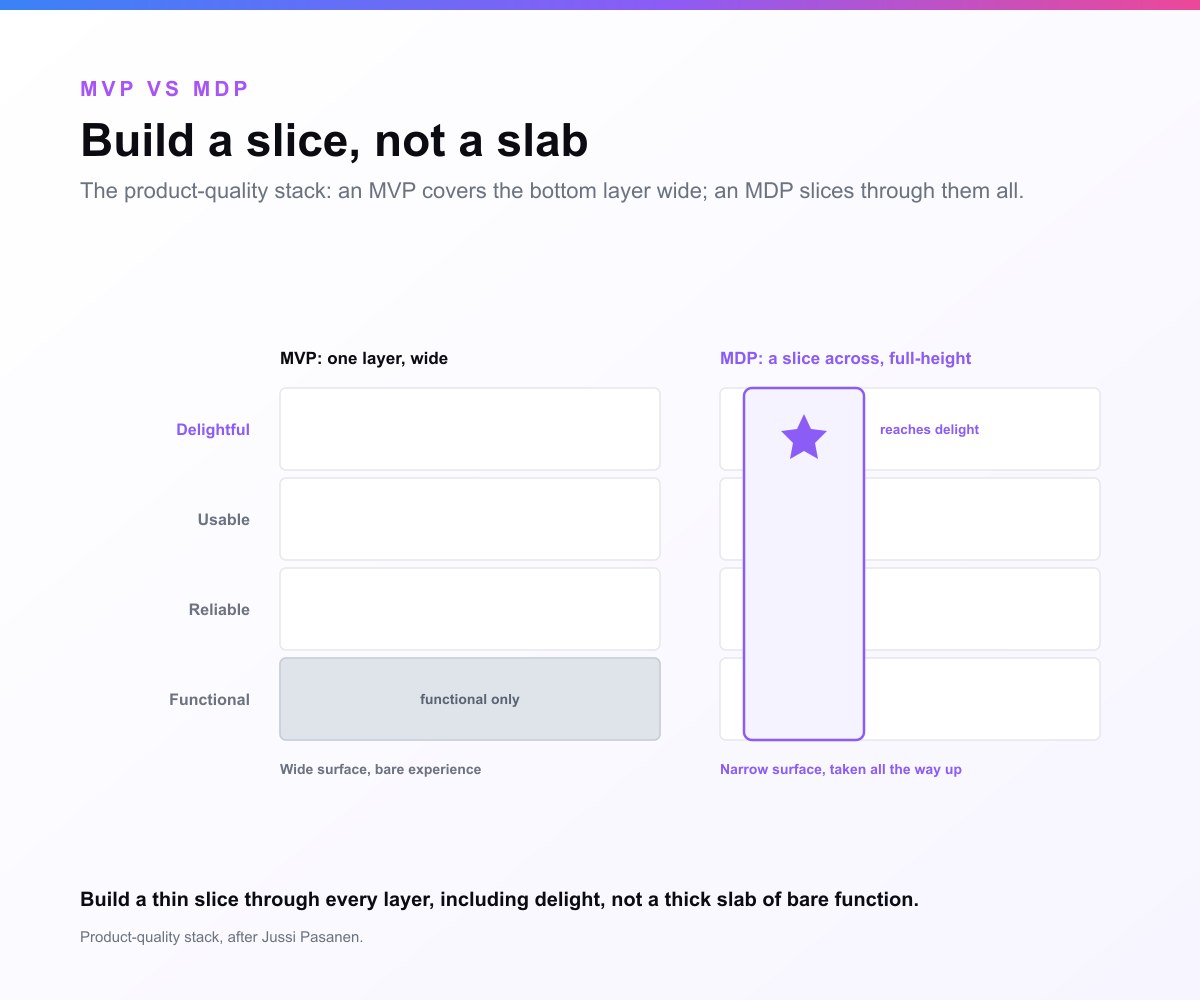
Notice the shape: an MVP tends to be wide and shallow, a lot of surface covered at only the functional layer, while an MDP is narrow and full-height, a small surface taken all the way up to delight.
Because the concepts overlap so heavily, we keep the deep treatment in one place: see MVP vs MLP for the full argument, the metrics that prove delight, and worked examples like the original iPhone and Superhuman. Everything there applies to the MDP too.
Which one do you actually need?
Neither option is simply "better." The real question is whether your market, and the risk that worries you most, pays you back for raising the emotional bar.
- A plain MVP is enough when you are in a genuinely novel category with little competition, when your users are tolerant (early B2B buyers, internal tools), or when your single biggest unknown is feasibility or raw demand and a rough version answers it honestly. Here, speed of learning beats polish.
- You should aim for an MDP when your market is crowded and users compare you against polished incumbents, when you are building a consumer product where feel drives adoption, or when your growth depends on retention and word of mouth. Here, a joyless MVP risks a false negative, and delight is the thing actually being tested.
A useful gut check: ask what happens if a real user's first impression is "it works, but it is clunky." If they will give you a pass because nothing else exists, a plain MVP is fine. If they will leave and never return, you need an MDP, because in your market the first impression is the experiment.
The MVP Development take
Most founders we work with are building into crowded, choice-rich markets where a charmless first version quietly fails. The hardline "it is only a test, roughness is fine" reading of the MVP belonged to an era when getting anything live was hard and users had few alternatives. In today's market people abandon products in seconds, so a functional-but-unmemorable release can hand you a false negative and quietly bury an idea that deserved better.
That is why our default is to build a minimal product that is delightful on its one core flow, not rough across many. Our approach: one core experience built to production quality, engineered to delight exactly where the value lands, live for real users within 3 to 4 weeks, on a fixed scope you sign off before work begins. Keeping the surface deliberately tiny is precisely what makes that level of finish affordable. Whether you call the result an MDP, an MLP, or simply a well-built MVP, the discipline is the same: small scope, high bar on the one thing that matters.
Not sure whether your market needs a viable MVP or a delightful one? Tell us where delight matters in your product and we will show you where scrappy still wins.
Related guides
- MVP vs MAP: Minimum Awesome Product, MDP's near-interchangeable cousin
- MVP vs MLP: the closely related minimum lovable product, in depth
- MVP vs MMP: minimum viable vs minimum marketable product
- What Is an MVP?: a clear definition of the minimum viable product
- Types of MVP: the full set of MVP approaches and when to use each
Frequently asked questions
What is the difference between an MVP and an MDP?
An MVP (minimum viable product) is the leanest build that can tell you whether the idea works and is wanted; rough edges are acceptable so long as the learning is real. An MDP (minimum delightful product) keeps the scope just as small but raises the bar from usable to delightful, because the goal is the smallest version people genuinely enjoy rather than merely tolerate. In short, an MVP optimizes for viability and learning, while an MDP optimizes for delight on a deliberately narrow scope.
What does MDP stand for?
MDP stands for minimum delightful product, the smallest version of your product that customers genuinely enjoy, built so the narrow slice it delivers is delightful rather than just functional. Some teams expand it as minimum desirable product instead, but the intent is the same: a minimal product people actively want, not one they merely put up with.
Is an MDP the same as an MLP?
They are near-synonyms. Both the minimum delightful product and the minimum lovable product argue that a minimal product should still make people feel something good, rather than shipping the bare functional minimum. The difference is emphasis, "delightful" stresses the quality of the interaction, "lovable" stresses the attachment and advocacy that follow, and teams use the terms interchangeably.
Is an MDP just an MVP with more features?
No. An MDP is not wider, it is deeper. The feature list stays short, and the effort saved goes into a core interaction that feels refined, obvious, and genuinely enjoyable. One interaction that feels effortless is worth more than ten that feel like homework. Adding features in the name of "delight" produces bloat, which is the opposite of the MDP's intent.
When should I aim for an MDP instead of a plain MVP?
Aim for an MDP when your market is crowded and users compare you against polished incumbents, when you are building a consumer product where feel drives adoption, or when growth depends on retention and word of mouth. In those cases a joyless MVP risks a false negative, where users reject a rough experience rather than the underlying idea. Stick with a plain MVP when the category is new and thinly competed, when your early buyers forgive rough edges, or when the one thing you truly do not know is whether it can be built at all.
Sources and references
This comparison draws on established product and design frameworks:
- Aha!, The Minimum Lovable Product: the argument for aiming at delight rather than mere tolerance
- Jussi Pasanen, Build a slice across instead of one layer at a time: the functional, reliable, usable, delightful product stack
- Eric Ries, The Lean Startup: the origin of the MVP and build-measure-learn
- Wikipedia, Minimum viable product: the MVP definition and validated-learning purpose
The 3 to 4 week figure reflects MVP Development delivery data for tightly scoped, single-flow MVP builds.


