


TL;DR
Pivot or persevere is the decision you face every time your MVP produces real data: keep the current direction and improve it (persevere), or change a fundamental element of the strategy (pivot). It is the central judgment call of the post-MVP stage, and the entire reason you built a minimal product first, so you could face this decision cheaply, before betting years on an unproven bet.
The decision is made by the signals, not by hope or ego: if a segment is genuinely retaining and the fit signals are climbing, you persevere and sharpen; if no version of the current direction retains after honest effort, you pivot. The two most expensive mistakes are opposite, pivoting too soon (abandoning something that was working) and persevering too long (polishing something the data already killed). This guide covers what each means, the types of pivot, the signals, and how to make the call.
Key Takeaways
- Pivot or persevere is the decision you face every time your MVP produces real data: improve the current direction, or change a fundamental element of the strategy.
- It is the central judgment call of the post-MVP stage, and the reason you built a minimal product first.
- The decision is made by the signals, not by hope or ego.
- Persevere if a segment is genuinely retaining and fit signals are climbing; pivot if no version of the current direction retains after honest effort.
- The two most expensive mistakes are opposite: pivoting too soon and persevering too long.
At a Glance
| Signal | Decision |
|---|---|
| A segment genuinely retains, fit signals climbing | Persevere and sharpen |
| No version of the current direction retains | Pivot |
| Abandoning something that was working | Pivoting too soon (costly) |
| Polishing something the data killed | Persevering too long (costly) |
What "pivot or persevere" means
The term comes from Eric Ries's The Lean Startup, where the output of every build-measure-learn loop is exactly this decision. You ran an experiment (your MVP), you measured how real users responded, and now you must decide: did the evidence validate your direction enough to persevere, or does it tell you to pivot?
- Persevere means keeping your core strategy, the user, the problem, the solution, and improving on it. You iterate, double down on what is working, and run the loop again in the same direction.
- Pivot means making a structured change to one fundamental element of the strategy while keeping one foot in what you have learned. It is not starting over from scratch; it is a course correction grounded in evidence.
The reason this is the post-MVP decision is that everything downstream depends on it. Persevere when you should pivot, and you burn runway polishing a dead idea. Pivot when you should persevere, and you throw away something that was quietly working. Getting this call right, repeatedly, is most of what separates startups that find a product from those that do not.
Persevere: when to keep your course
You persevere when the data says the direction is working, or could be with refinement. The signals:
- A segment is retaining. Even if overall numbers are modest, if a clear group of users keeps coming back, you have something to build on. Flattening retention in any segment is the strongest "persevere" signal.
- The 40% test is climbing. A rising share of users who would be "very disappointed" without the product means you are getting warmer.
- Users pull you forward. They ask for more, refer others, or get frustrated when it breaks, all signs the value is real.
Persevering does not mean standing still. It means keeping the strategy and iterating the execution: fix what blocks activation, deepen what drives retention, sharpen the core flow for the users who already love it. Most post-MVP time, correctly, is spent persevering, because pivots should be rare and deliberate.
Pivot: when (and how) to change direction
You pivot when, after honest effort, the current direction is not producing the signal, no segment retains, the 40% test stays stuck, the core assumption proved wrong. A pivot keeps what you learned and changes one major variable. It is structured, not random.
Crucially, a pivot is not a failure, it is the loop doing its job. Some of the biggest companies are pivots: Slack began as a feature inside a failed game; Instagram started as a cluttered check-in app called Burbn and pivoted to the one feature people actually used (photos). In each case, the team persevered on the learning and pivoted the product. The MVP exists precisely to make this affordable, you change course having spent weeks, not years.
The mistake to avoid is the "reset" disguised as a pivot, throwing away everything, including the hard-won learning, and starting a brand-new idea from zero. A real pivot is anchored: you keep the validated part and change the invalidated part.
The types of pivot
Naming the kind of pivot keeps the change surgical instead of chaotic. The common types (from the lean-startup taxonomy):
- Zoom-in pivot. A single feature becomes the whole product (Instagram from Burbn).
- Zoom-out pivot. The whole product becomes one feature of a bigger one.
- Customer-segment pivot. The product is right, but for a different audience than you targeted.
- Customer-need pivot. The audience is right, but they have a different, bigger problem worth solving.
- Platform pivot. Switching from an app to a platform, or vice versa.
- Business-model pivot. Changing how you capture value (e.g., high-touch to self-serve, or free to paid).
- Channel pivot. Reaching the same customers a fundamentally different way.
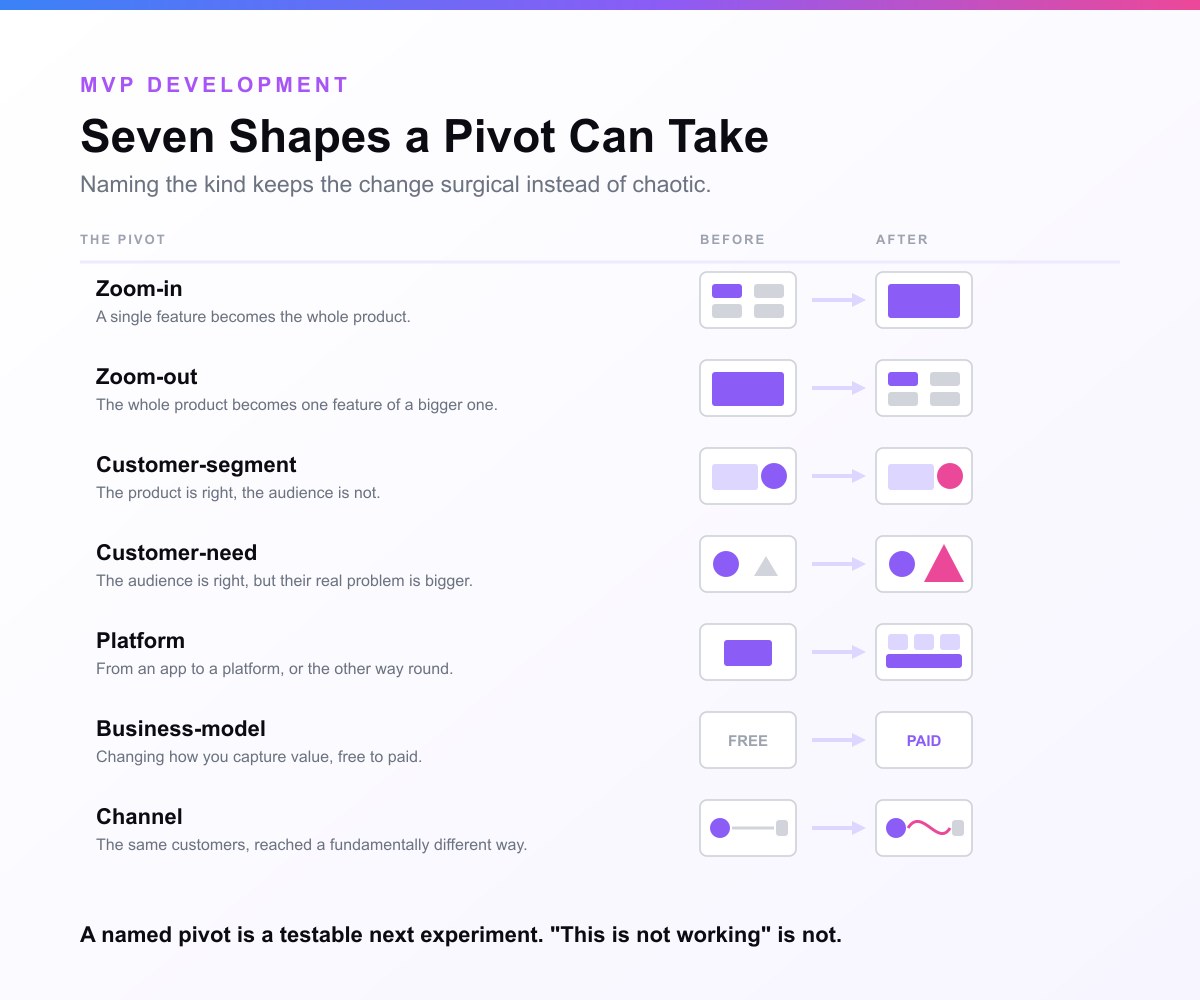
Identifying which type fits your evidence turns "this isn't working" into a specific, testable next experiment, which is the whole point.
How to decide: signals over ego
The decision should be driven by evidence you committed to in advance, not by whatever you already wanted to do. A simple way to make the call honest:
- Pre-commit the criteria. Before launch, write down what result would make you persevere versus pivot (e.g., "if week-4 retention in any segment is below X after two iterations, we pivot"). Deciding the rule before you see the data removes the ego.
- Separate execution failure from idea failure. Low numbers from a broken onboarding are an iterate problem, not a pivot signal. Fix the obvious execution leaks first, then judge the idea.
- Read the cohort, not the average. A flat overall line can hide a segment that loves the product. Look for the pocket of retention before you conclude there is none.
- Talk to the users who stayed and the ones who left. The qualitative "why" usually reveals whether a pivot (and which type) is warranted, or whether one more iteration gets you there.
- Give it enough turns, but not too many. One bad week is not a pivot signal; six months of flat retention is. Persevere through normal noise, pivot on a clear, sustained pattern.
These are the same signals covered in MVP metrics and product-market fit, the pivot-or-persevere call is just the decision those signals feed.
The four outcomes: pivot, persevere, scale, or kill
“Pivot or persevere” is a two-way question, and the meeting that answers it usually has four exits. Naming all four in advance stops the two ugly ones from hiding inside the polite ones.
| Outcome | What the evidence looks like | What you do next |
|---|---|---|
| Persevere | The core metric is moving toward the threshold you set, and the last two iterations each moved it | Keep the strategy, keep iterating, book the next review |
| Pivot | The metric is flat, but a segment, a feature or a channel inside the data is working far better than the whole | Keep what works, change one fundamental (customer, problem, channel or model) and reset the threshold |
| Scale | The threshold is met and the unit economics hold at the current spend | Stop testing and start funding growth; this is the exit most teams forget to define |
| Kill | The metric is flat, nothing inside the data is working, and two pivots have not changed that | Stop, write up what was learned, and reuse the team and the code on the next idea |
Most founders only prepare for the first two. “Scale” without a definition means teams keep running experiments long after they have won; “kill” without a definition means they keep pivoting long after they have lost. The metrics you chose for the MVP should make each of these four readable from a single dashboard.
The pivot-or-persevere meeting: cadence and agenda
Eric Ries’s advice in The Lean Startup is that the meeting should be regular and rare: less than a few weeks apart is too often to have new evidence, more than a few months apart is too slow. For a product in its first six months, every four to six weeks is the cadence that fits an MVP’s iteration cycle. The agenda is short, and every line of it is written before the meeting, not during it.
| Line | Example |
|---|---|
| The one metric | Week-4 retention of paying accounts |
| The threshold, written before launch | 25% or above means persevere; below 10% after two iterations means pivot |
| The reading today | 14%, up from 9% at the last meeting |
| What changed since last time | Onboarding rebuilt; the two churned segments named |
| The decision and its owner | Persevere, one more iteration on onboarding; next review in five weeks |
The table is deliberately boring. The moment a meeting starts with a narrative instead of the reading, the ego is back in the room. If the reading and the threshold disagree with what you want to do, the reading wins, and the only legitimate way to change that is to change the threshold at the next meeting, in writing, with a reason.
Three famous pivots that started with a failed first version
Every well-known pivot is, on inspection, an MVP that failed its own test and a team that read the data instead of arguing with it.
- Slack, 2012. Tiny Speck spent three years on Glitch, an online game. After a brief launch in 2011 it went back to beta, and in 2012 Stewart Butterfield concluded the game would not work. The internal chat tool the team had built to coordinate between its offices was the part with real usage, and it became Slack; Salesforce bought it for $27.7 billion in 2021.
- Instagram, 2010. Burbn was a check-in app with photos, points and plans. The usage data showed people ignoring everything except photo sharing and filters, so Kevin Systrom and Mike Krieger cut every other feature and relaunched as Instagram.
- YouTube, 2005. The founders launched a video dating site. Nobody uploaded dating videos, but people uploaded everything else, so the scope was widened to all video. Google paid $1.65 billion for it the following year.
Notice what each pivot kept: the team, the code, and the one thing inside the data that was working. That is the difference between a pivot and starting over, and it is why the decision gets easier when the MVP was small enough to read. A sprawling first build hides the working part; a focused one exposes it. If you are past the point where a pivot can save the build, the question becomes when to rebuild instead.
Common pivot-or-persevere mistakes
- Persevering too long. The most common and expensive error, polishing and adding features to a product the data already said no to, because admitting it is hard. Refusing to pivot is a top reason MVPs fail.
- Pivoting too soon. Abandoning a direction after one bad week or one harsh piece of feedback, before the experiment had a fair run. Pivots should be rare.
- The false pivot. Calling a random new idea a "pivot" when it keeps none of the learning. That is a restart, and it resets your runway clock to zero.
- Pivoting on the average. Concluding "nobody wants this" from a flat overall metric while a loyal segment hides in the data.
- Serial pivoting. Changing direction every few weeks so no experiment ever gets a clean read. Each pivot needs enough loops to actually learn.
- Deciding by ego or sunk cost. Persevering because you love the idea, or pivoting because you are bored, instead of following the evidence you pre-committed to.
Make the call on evidence, not emotion
Pivot or persevere is the decision your MVP was built to let you make, cheaply, with real data, before the stakes get high. Persevere when a segment is genuinely retaining and the fit signals are climbing; pivot, surgically and by type, when honest effort produces no signal; and decide by criteria you set in advance, not by ego or sunk cost.
That evidence-first loop is what we build into every engagement at MVP Development. We ship a funding-ready MVP in 3 to 4 weeks, instrumented from day one so your pivot-or-persevere decision rests on real retention and activation data, not a hunch, on a fixed quote you approve before we start, with full code ownership. And if the call is to pivot, a lean, owned codebase makes the next experiment cheap to run.
Explore our MVP development services, or if you are staring at your MVP data trying to make this call, start with a free MVP consultation.
Stuck on whether to pivot or push on? Put your numbers on the table with us and we will help you make this call with clear eyes.
Related guides
- Post-MVP: the stage this decision sits inside
- Build-measure-learn: the loop whose output is pivot-or-persevere
- Product-market fit: the signal that says persevere (and eventually scale)
- MVP metrics: the data that decides the call
Frequently asked questions
What does "pivot or persevere" mean?
It is the decision, from the lean startup method, that you face after each build-measure-learn loop: based on the real data your MVP produced, do you keep your current direction and improve it (persevere) or change a fundamental element of the strategy (pivot)? Persevere means iterating on the same user, problem, and solution; pivot means a structured change to one of those while keeping the learning you have gathered. It is the central judgment call of the post-MVP stage, and the reason you build a minimal product first, to face it cheaply.
When should you pivot versus persevere?
Persevere when the data shows the direction is working or could be with refinement: a segment is retaining, the 40% "very disappointed" test is climbing, and users pull you forward by asking for more. Pivot when, after honest effort and a fair number of loops, no segment retains, the 40% test stays stuck, or the core assumption proved wrong. Decide by criteria you set before launch, separate execution failures (fixable by iterating) from idea failures, and read cohorts rather than averages so a loyal segment is not hidden in the data.
Is pivoting a sign of failure?
No. A pivot is the build-measure-learn loop doing its job, changing course based on evidence before you waste years on the wrong bet. Many major companies are pivots: Slack came from a failed game, and Instagram pivoted from a cluttered check-in app to the photo feature people actually used. The key is that a real pivot keeps the learning and changes only the invalidated part; it is a structured course correction, not starting over from scratch. The MVP exists precisely to make pivoting cheap.
What are the types of pivot?
Common pivot types from the lean-startup taxonomy include: zoom-in (one feature becomes the whole product), zoom-out (the product becomes one feature of a larger one), customer-segment (right product, different audience), customer-need (right audience, different problem), platform (app to platform or vice versa), business-model (changing how you capture value), and channel (reaching the same customers a different way). Naming which type fits your evidence turns "this isn't working" into a specific, testable next experiment.
How long should you persevere before pivoting?
Long enough to get a fair read, but not so long that you burn the runway on a dead idea. One bad week is normal noise, not a pivot signal; a clear, sustained pattern over several loops (often a few months of flat retention despite honest iteration) is. The trap on one side is serial pivoting, changing every few weeks so no experiment ever gets a clean read; on the other side is persevering for a year out of attachment. Pre-committing your criteria before launch is the best defense against both.
Sources & references
This guide draws on the lean-startup framework and well-known pivot stories:
- Eric Ries, The Lean Startup: the pivot-or-persevere decision and the pivot taxonomy
- Lean startup (overview): the methodology and types of pivot
- Y Combinator, Startup Library: iterating, pivoting, and finding product-market fit
- Sean Ellis, the PMF Survey: the 40% test that informs the decision
- CB Insights, From Instagram To Slack: 9 Successful Startup Pivots, the Slack, Instagram and YouTube accounts above
The 3 to 4 week figure reflects MVP Development delivery data for tightly scoped builds.


