


TL;DR
MVP scope is the boundary that defines exactly what your first version will and will not do, the line between the one core flow you build now and everything you defer. Defining it well is the single most decisive act in building an MVP, because the "minimum" is set here, not in the code. A clear, written scope is what keeps a six-week build from quietly becoming a six-month one.
The fast method: anchor scope to your riskiest assumption, reduce the product to the one core flow that tests it, draw an explicit in-scope / out-of-scope line, and write it into a short scope document you treat as the source of truth. This guide covers what MVP scope is, how to define it step by step, what goes in the scope document (with a template), a worked example, and how to defend it against scope creep.
📊 Prefer to do this interactively? Our free Feature Prioritization Tool scores each feature by impact vs effort and sorts your list into Quick Wins, Major Projects, Fill-ins, and Avoid, in seconds.
Key Takeaways
- MVP scope is the boundary that defines exactly what your first version will and will not do.
- The "minimum" in an MVP is set in the scope, not in the code.
- Anchor scope to your riskiest assumption, then reduce the product to the one core flow that tests it.
- Draw an explicit in-scope and out-of-scope line, and write it into a short scope document you treat as the source of truth.
- A clear written scope is what keeps a six-week build from quietly becoming a six-month one.
By the numbers: Pendo found 80% of software features are rarely or never used, and cloud companies spent an estimated $29.5 billion building features that went unused. Tight scope is how you avoid joining them. See our MVP statistics for 2026.
At a Glance
| Step | What you do |
|---|---|
| Anchor | Start from your riskiest assumption |
| Reduce | Cut to the one core flow that tests it |
| Draw the line | Explicit in-scope vs out-of-scope |
| Write it down | A short scope document as the source of truth |
| Defend it | Say no to scope creep |
What is MVP scope?
MVP scope is the defined set of features, flows, and constraints that make up your minimum viable product, plus an explicit statement of what is left out. It is the answer to "what exactly are we building first, and what are we deliberately not building yet?"
Scope is different from a feature list. A feature list is what the product could include; scope is the decision about where to draw the line for version one. Two products with the same long-term vision can have completely different MVP scopes depending on which assumption each one is testing first. Scope is also distinct from feature prioritization: prioritization is the technique you use to rank and choose features; scope is the boundary those choices produce. You prioritize in order to scope.
Getting this right is what separates a real MVP from a small full product. As Atlassian and the broader lean tradition stress, the MVP is the smallest thing that delivers value and produces learning, and "smallest" is a scope decision before it is an engineering one.
Why scope is where MVPs are won or lost
The most expensive MVP failures do not happen in the build, they happen in the scoping. A team that never drew a tight boundary ends up building everything, burning the runway that should have funded learning, and shipping so late that the market has moved. As we cover in why MVPs fail, "built too much" is one of the most common, most avoidable killers, and it is a scoping failure, not a coding one.
Tight scope buys three things at once: speed (less to build means you ship in weeks), clarity (when a narrow MVP succeeds or fails, you know what drove the result), and runway (every feature cut is budget preserved for iteration). Loose scope loses all three. This is why the discipline of defining and defending scope is the highest-leverage work a founder does before launch, and the defining task of the MVP stage of a startup.
How to define your MVP scope, step by step
1. Anchor to the riskiest assumption
Before you list a single feature, name the one belief that, if wrong, kills the idea, your riskiest assumption. Scope exists to test that. If the risk is "people will pay," payment is in scope and polish is not. If the risk is "the core workflow saves real time," that workflow is in scope and everything around it can wait. This single anchor decides most of your scope before any framework. (It comes straight from MVP validation.)
2. Reduce to one core flow
Define the single path a user takes from entry to the moment they get the core value, sign up → do the one key thing → reach the outcome. That flow is your MVP. Everything not on it is a candidate for "out." Scoping to a flow, rather than a pile of features, is what keeps the MVP coherent: users experience a journey, not a feature list.
3. Draw the in-scope / out-of-scope line
Now make the boundary explicit. For every feature, ask the one question that defines MVP scope: does the core flow break without it? If yes, it is in scope. If no, it goes out, onto a recorded "later" list, not into the build. Use MoSCoW or RICE to make these calls objective rather than emotional. The output is two short lists: in and out.
4. Add the non-feature scope
Scope is not only features. Decide, and write down, the boundaries on:
- Platforms (web only? one mobile OS first?)
- User types (one persona, not three)
- Integrations (the one that is essential vs the five that can wait)
- Quality bar (which parts must be production-grade vs "good enough to test")
- What you will measure (the success metric the scope must support)
These constraints are where scope quietly expands if you leave them undefined.
5. Write it into a scope document
Finally, put it in writing. An unwritten scope is not a scope, it is a memory that drifts. The scope document is the source of truth everyone points to when a new request appears. The next section covers exactly what it contains.
The MVP scope document (template)
A good MVP scope document is short, one to three pages, and contains:
- Problem & riskiest assumption: the one problem and the belief you are testing.
- Target user: the single persona the MVP serves.
- The core flow: the end-to-end path, step by step.
- In scope: the must-have features that deliver the flow.
- Out of scope (for now): the explicit "later" list (this section is as important as "in scope").
- Constraints: platform, integrations, quality bar.
- Success metric: the one number that says the experiment worked.
- Timeline & budget: the box the scope must fit inside.
The two sections founders skip, out of scope and success metric, are the ones that protect you most: the first stops scope creep, the second keeps the scope honest about what it is for. If your scope document has no "out of scope" section, it is not finished.
The MVP canvas: a one-page alternative
If you prefer a visual format to a written document, the MVP canvas is a popular one-page template that captures the same scoping decisions in a grid. Originating from the Lean Inception approach, it typically maps a few boxes, the vision and the problem you are solving, the target personas, the core features (the one or two that deliver the value), the journeys or outcomes you expect, the metrics that prove it worked, the cost and schedule, and the result you are betting on. Teams often fill it in collaboratively on a whiteboard during a kickoff workshop.
A canvas and a scope document are not rivals; they are two formats for the same thinking. The canvas is faster to fill in as a group and great for alignment; the written scope document is better for the precise "in scope vs out of scope" boundary that actually stops scope creep. Many teams use the MVP canvas to align in a workshop, then write the boundary down in a scope document. Whichever you use, the discipline is identical: name the riskiest assumption, the one core flow, and the explicit "not now" list.
An MVP scope example
For an app that auto-writes product descriptions:
- Riskiest assumption: sellers will pay for auto-generated descriptions.
- Target user: solo Shopify sellers with 10 to 100 products.
- Core flow: sign up → connect a product → generate a description → publish it.
- In scope: signup, product connect, generation, publish, payment.
- Out of scope (for now): team accounts, bulk generation, analytics dashboard, profile customization, multi-platform, A/B testing of copy.
- Constraints: web only, Shopify integration only, production-grade on the generate-and-publish path.
- Success metric: % of signups who generate and publish, then return within 7 days.
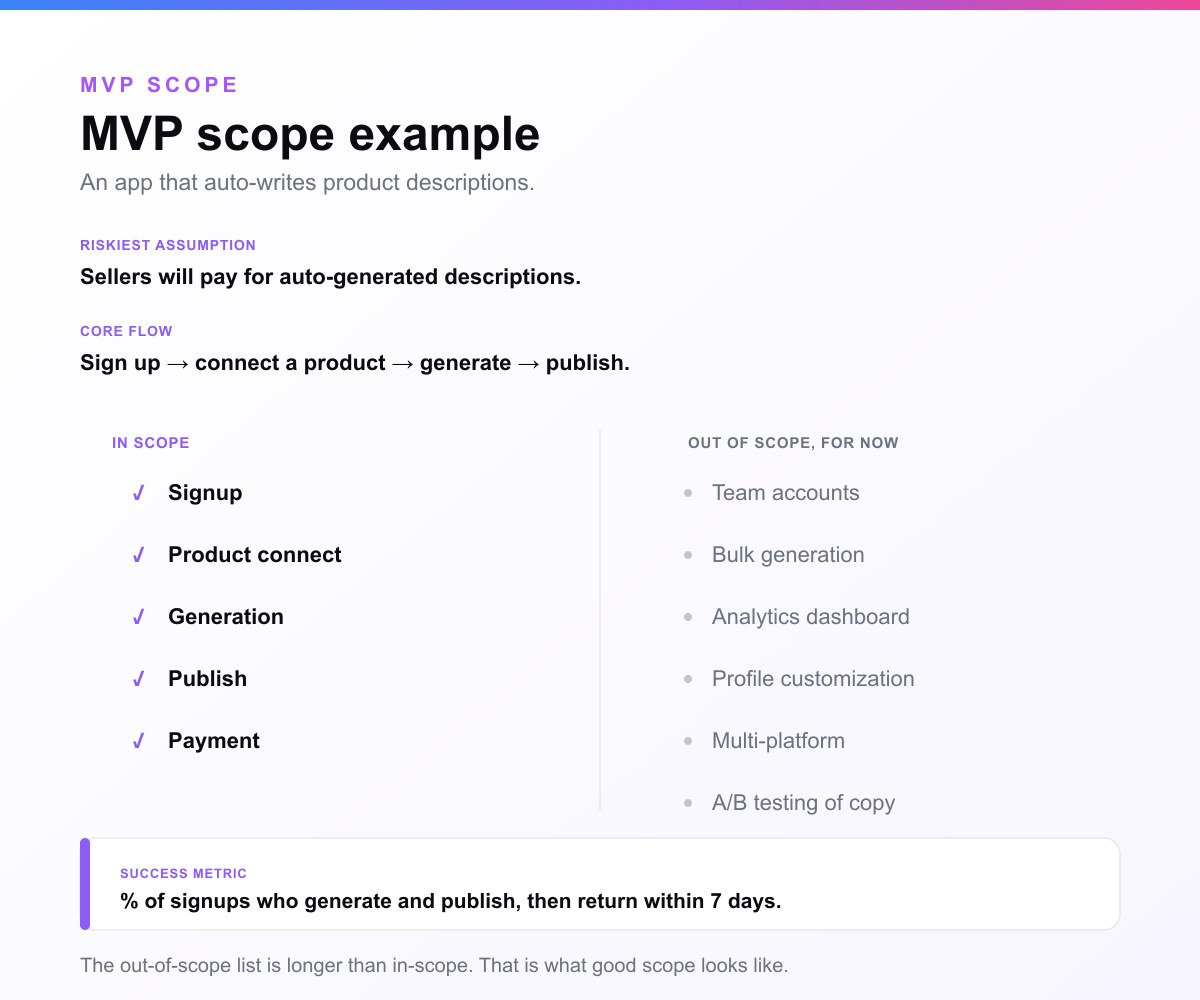
That is a complete, defensible MVP scope on one page. Notice the "out of scope" list is longer than the "in scope" list, that is what a well-scoped MVP looks like.
Scope creep: the main threat to your scope
Defining scope is half the job; defending it is the other half. Scope creep is rarely one big decision, it is a steady drip of reasonable-sounding additions ("while we're at it, let's also…"), each easy to justify, that together blow the timeline. It is the single most common reason MVP builds slip.
The defenses are simple but require discipline:
- The "out of scope" list is a parking lot, not a graveyard. Every new request goes there, recorded for later, not into the current build. This satisfies the stakeholder without expanding scope.
- Re-quote, don't absorb. If scope genuinely must change, change it deliberately, with a new timeline, rather than silently absorbing it.
- Point to the document. A written scope turns "can we just add…" from a debate into a decision against an agreed baseline.
This is also why a fixed, scoped quote beats open-ended hourly work: it aligns everyone on the boundary before the build starts. We go deeper on the surrounding traps in MVP development challenges.
How scope connects to prioritization and the roadmap
Three related ideas, cleanly separated:
- Feature prioritization is the technique (MoSCoW, RICE, Kano) for deciding which features matter most.
- MVP scope is the boundary those decisions produce, the in/out line for version one.
- The MVP roadmap is what happens to everything you scoped out, sequenced for after launch.
So you prioritize to decide, scope to draw the line, and roadmap to plan the rest. The "out of scope" list from your scope document becomes the raw material for your post-launch roadmap, nothing is lost, just sequenced. Scope is also the input the rest of the build depends on; see where it sits inside the full MVP development process.
Common MVP scoping mistakes
- No written scope. Relying on a shared understanding that quietly drifts. Write it down.
- No "out of scope" section. Listing what is in without explicitly recording what is out, so deferred features creep back.
- Scoping by feature, not by flow. Producing a feature list instead of one coherent core journey.
- Ignoring non-feature scope. Leaving platforms, integrations, and the quality bar undefined, where scope silently expands.
- Scoping to comfort, not risk. Building what is easy or familiar instead of what tests the riskiest assumption.
- Treating scope as permanent. Refusing to deliberately re-scope when validated learning says to, scope should change with evidence, just not by accident.
Scope tight, build fast
MVP scope is the highest-leverage decision in your entire build: get the boundary right and the MVP ships in weeks and gives you a clean answer; get it wrong and it drags for months and tells you nothing useful. Anchor to the riskiest assumption, reduce to one core flow, draw an explicit in/out line, write it down, and defend it.
That ruthless scoping is the first thing we do for founders at MVP Development, before any code. We help you draw the boundary, capture it in a scope document, and then ship inside it: a funding-ready MVP in 3 to 4 weeks, on a fixed quote you approve before we start, with full code ownership. Most founders discover their real scope is half what they thought, and the build goes twice as fast because of it.
Explore our MVP development services, or get a second opinion on your scope in a free MVP consultation.
When the scope will not settle because nobody has spoken to the customer yet, that is what product discovery is for: interviews, a competitor teardown and wireframes, ending in a spec any team can quote from.
Not sure where to draw the line? Bring us the scope you cannot bring yourself to cut and we will find the version that ships in weeks.
Related guides
- MVP feature prioritization: the technique for deciding what makes the cut
- How to build an MVP: where scoping fits in the full process
- MVP roadmap: sequencing everything you scoped out
- Why MVPs fail: what loose scope does to a build
- MVP Requirements Document: the PRD that records your scope decisions
Frequently asked questions
What is MVP scope?
MVP scope is the boundary that defines exactly what your minimum viable product will and will not do: the specific features, the one core flow, and the constraints (platforms, integrations, quality bar) that make up version one, plus an explicit list of what is deliberately left out. It is the decision about where to draw the line for the first version, anchored to the one assumption you most need to test. A clear scope is what keeps an MVP minimal and keeps the build from sprawling into a full product.
How do you define the scope of an MVP?
Start by naming your riskiest assumption, the belief that, if wrong, kills the idea, because scope exists to test it. Reduce the product to the single core flow that tests that assumption, then draw an explicit in-scope / out-of-scope line by asking, for each feature, "does the core flow break without it?" Add the non-feature boundaries (platforms, user types, integrations, quality bar, success metric), and write all of it into a short scope document. Use MoSCoW or RICE to keep the feature calls objective.
What is in an MVP scope document?
A good MVP scope document is one to three pages and includes: the problem and riskiest assumption, the target user, the core flow step by step, the in-scope must-have features, an explicit out-of-scope ("later") list, constraints (platform, integrations, quality bar), the success metric, and the timeline and budget the scope must fit. The two sections founders most often skip, out-of-scope and success metric, are the ones that protect you most, the first against scope creep, the second by keeping the scope honest about what it is for.
What is the difference between MVP scope and feature prioritization?
Feature prioritization is the technique you use to rank and choose features, with frameworks like MoSCoW, RICE, and Kano. MVP scope is the boundary those choices produce: the in/out line that defines version one. You prioritize in order to scope. Prioritization answers "which features matter most?"; scope answers "so what exactly are we building first, and what are we deferring?" The output of prioritization (the must-haves) becomes the in-scope list of your scope document.
How do you prevent MVP scope creep?
Treat the out-of-scope list as a parking lot: every new request gets recorded there for later rather than added to the current build, which satisfies the stakeholder without expanding scope. If scope genuinely must change, do it deliberately with a re-quoted timeline rather than silently absorbing it. And point every "can we just add…" back to the written scope document, which turns a debate into a decision against an agreed baseline. A fixed, scoped quote up front helps, because it aligns everyone on the boundary before the build starts.
Sources & references
This guide draws on lean-startup practice and established MVP scoping guidance:
- Atlassian, Minimum Viable Product: scoping the MVP to the smallest valuable version
- Eric Ries, The Lean Startup: minimal scope and the riskiest-assumption mindset
- Minimum viable product (overview): the MVP definition and minimal-scope principle
- Y Combinator, Startup Library: keeping the first version small and shipping fast
The 3 to 4 week figure reflects MVP Development delivery data for tightly scoped builds.


