


TL;DR
The Uber MVP was one button, in one city, that did one thing: summon a black car in San Francisco. It deliberately skipped the marketplace, driver app, and everything else, testing whether people wanted on-demand rides at a tap before expanding city by city.
Today Uber is a global machine: rides, food, freight, scooters, dozens of countries, a public company worth tens of billions. It is easy to forget that the whole thing started as one button, in one city, that did exactly one thing: summon a black car in San Francisco.
That narrowness was not a limitation, it was the strategy. This is the story of the Uber MVP, and why "one feature, one city" is one of the most under-used moves in product.
Key Takeaways
- Uber started as one button, in one city, that did exactly one thing: summon a black car in San Francisco.
- It deliberately did not build the marketplace, the driver network, or the many features that came later.
- The single-feature MVP tested whether people wanted on-demand rides at the tap of a button.
- Only after that proof did it expand city by city and feature by feature.
- Today it is a global, public company worth tens of billions.
At a Glance
| The Uber MVP | Detail |
|---|---|
| MVP type | Single-feature |
| What they built | One button to summon a black car in San Francisco |
| What they cut | Marketplace, driver app, everything else |
| Lesson | Prove one flow in one city before expanding |
A cold night and an expensive idea
The origin is almost a cliché of startup stories: a frustrating night trying, and failing, to get a ride. Garrett Camp, who had founded StumbleUpon, was tired of how hard and expensive it was to get a car in San Francisco. The vision he and co-founder Travis Kalanick sketched was simple and slightly luxurious: what if you could push a button on your phone and have a private black car show up?
Notice what the vision was not, at the start. It was not "disrupt the global transportation industry." It was not a cheap ride for everyone, not food delivery, not self-driving cars, not a two-sided gig-economy marketplace spanning continents. All of that came later. The starting point was deliberately, almost absurdly, narrow.
The genius of the Uber MVP was not how big the idea was. It was how small the first version was allowed to be.
The MVP: one feature, one city, a few black cars
What launched in San Francisco around 2010, first called UberCab, was a stripped-down product that did a single thing well: let you request a black car from your phone and watch it arrive on a map. Tap, and a premium town car comes to you.
Everything about it was scoped to the minimum:
- One feature. Request a ride and track it. No ride-sharing, no carpooling, no scheduling, no fare-splitting, just summon-a-car.
- One city. San Francisco only. They did not try to launch nationally, let alone globally. One market, learned deeply.
- One segment. Premium black cars, not the mass-market cheap rides Uber is known for now. Starting at the high end let them launch with a small number of professional drivers instead of building a giant supply network first.
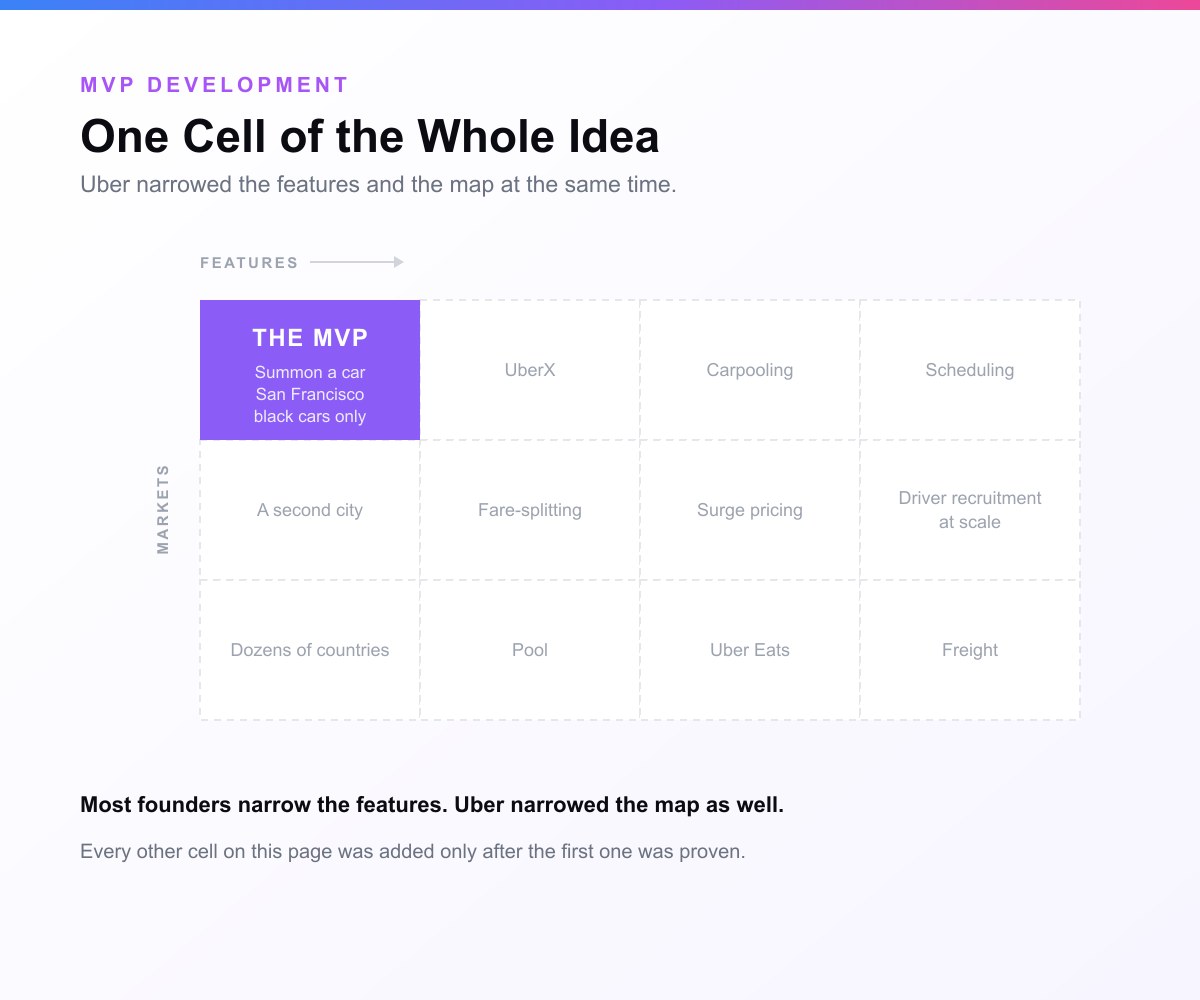
They began with a handful of cars and drivers, enough to make the core experience real for early users in one city, and no more. The product was minimal, the market was tiny on purpose, and that is exactly why they could ship it and learn fast.
What they deliberately didn't build
The list of what Uber left out of its MVP is, in hindsight, staggering, and instructive.
No UberX (the lower-cost everyday rides that later drove mass adoption). No second city. No driver-recruitment platform at scale. No surge-pricing algorithms, no pool, no Eats, no global operations. The founders did not build the company Uber became; they built the smallest thing that could test whether people would summon a car with an app at all. Every one of those famous features was added after the core behaviour was proven, one expansion at a time.
By the numbers
- 1 core feature: push a button, get a black car
- 1 city to start: San Francisco
- 1 premium segment, so they could launch with a few drivers, not a fleet
- ~$80 billion+ valuation when Uber later went public
- Everything else, food, pool, freight, dozens of countries, added only after the core was proven
Why this is the textbook single-feature MVP
Most founders narrow their MVP by features. Uber's lesson is that you can also narrow by market, and that doing both is even more powerful. The Uber MVP is the canonical example of a single-feature MVP launched in a single market:
- It tested the riskiest assumption, in real conditions. Would people actually pull out a phone and summon a car instead of hailing a cab or calling a dispatcher? You cannot answer that with a survey, you need real riders, real cars, real streets. So they built exactly enough to find out, and no more.
- It used geography as scope. Launching in one city kept the operational problem, drivers, supply, support, small enough to actually solve. A nationwide launch would have buried them in logistics before they had learned anything.
- It started premium to start small. Beginning with black cars meant they needed only a few professional drivers to make the experience real, sidestepping the chicken-and-egg supply problem a cheap, mass-market launch would have faced on day one.
- It earned each expansion with proof. New cities, new tiers, and new products were all added on top of a validated core, not bet on up front.
The lessons you can steal
You are not building a ride-hailing giant, but the Uber MVP's moves transfer to almost any ambitious idea:
- Narrow the market, not just the features. One city, one niche, one segment. A huge vision is best tested in a tiny arena where you can actually learn and operate.
- Use geography or a niche as your MVP boundary. "Everywhere" is not a launch plan. Pick the one place or one group where you can win first, then expand from strength.
- Sometimes start premium, not cheap. A higher-end first version can be easier to launch (fewer customers and suppliers needed to make it real) before you chase scale and low prices.
- Build only the one feature that tests the core behaviour. Uber's MVP was "summon a car." Everything else was a later feature waiting for proof.
- Expand from a proven core, one step at a time. Each new city, segment, and product came after the last was validated, not as a simultaneous moon-shot.
From one city to the world
Once the San Francisco experiment worked, once people really were pulling out their phones to summon cars, Uber did what a validated MVP earns the right to do: it expanded, deliberately and aggressively. New cities followed, each a repeatable version of the first. The lower-cost UberX tier eventually opened the product to a mass market. Then came pooled rides, Uber Eats, freight, and operations across dozens of countries, culminating in a public listing that valued the company in the tens of billions.
But the global empire was built on a foundation laid by the narrowest possible start. The company did not begin by trying to be everywhere; it began by proving one feature, in one city, with one kind of car, and let the proof carry it outward.
How would you run the Uber MVP today?
The "one feature, one city" play is more available than ever:
- Pick a single feature that captures your core value, and build only that. If you cannot describe your MVP as one sentence and one action, it is too big.
- Pick one market and dominate it, a single city, campus, industry, or community, small enough that you can operate it by hand and learn from every user.
- Consider starting at the premium or high-intent end, where a small number of customers and suppliers can make the experience real, before you chase scale.
- Expand only when the core is undeniable. Resist adding the second city or the second feature until the first is genuinely working.
The Uber MVP proves that the way to build something enormous is often to start almost embarrassingly small, and let validated demand, not ambition, decide what you build next.
Start small on purpose
The reason the Uber story matters is that the instinct it fights is so common. Founders with big visions want to launch big, everywhere, with everything. Uber did the opposite: it shrank the vision down to one feature in one city, proved the core behaviour was real, and only then unleashed the ambition. That discipline, think huge, launch tiny, is the whole point of an MVP.
That is exactly how we approach a first build at MVP Development. We help founders cut a big idea down to the one core flow worth testing, and ship a funding-ready MVP in 3 to 4 weeks, by senior engineers, on a fixed quote you approve before we start, with full code ownership.
See more famous first versions in our MVP examples roundup, or read the Airbnb and Dropbox case studies for two more ways the same discipline plays out.
UberCab launched in one city with the smallest possible loop. See the other famous starts in our MVP examples roundup, or Pitch us your on-demand idea and we will scope the one-city, one-service version that proves it.
Related guides
- Foodtech MVP: the same one-city discipline applied to food delivery
- The Airbnb MVP: the concierge case study
- The Dropbox MVP: the explainer-video case study
- Single-feature MVP: the one-feature approach Uber used
- Marketplace MVP: building the kind of two-sided market Uber became
Frequently asked questions
What was Uber's MVP?
Uber's MVP, launched in San Francisco around 2010 under the name UberCab, was a stripped-down app that did one thing: let you request a black car from your phone and track it as it arrived. There was no UberX, no second city, no food delivery, no carpooling, just the single core feature of summoning a premium car. The founders, Garrett Camp and Travis Kalanick, started with a handful of professional drivers in one city and one premium segment, deliberately keeping both the product and the market tiny so they could prove the core behaviour, that people would summon a car with an app, before building anything bigger.
Why is Uber a single-feature MVP example?
Because the first version did exactly one thing, request and track a car, and nothing else. A single-feature MVP strips a product down to the one capability that delivers and tests its core value, leaving every other feature for later. Uber went further than most by also narrowing the market: one city and one premium segment, not a nationwide, mass-market launch. That double narrowing, one feature plus one small market, is what let a tiny team ship a real product, operate it by hand, and learn fast, which is exactly what an MVP is for.
What can founders learn from the Uber MVP?
The key lessons: narrow your MVP by market, not just by features (one city, one niche, one segment); use geography or a niche as a scope boundary so the operational problem stays solvable; consider starting at the premium or high-intent end, where fewer customers and suppliers are needed to make the experience real; build only the single feature that tests your core behaviour; and expand only once that core is proven. The deeper lesson is "think huge, launch tiny", Uber became a global giant precisely because it began as one button, in one city, doing one thing.
Sources & references
- Eric Ries, The Lean Startup: the MVP and validated-learning principles
- Y Combinator Library: startup growth and early-stage strategy
- Atlassian, Minimum Viable Product: what an MVP is and is for
The Uber founding story is widely documented; details here reflect the commonly reported account.


