


TL;DR
A crowdfunding MVP validates an idea by asking people to pay for it before it exists. You publish a campaign that describes the product, sets a funding goal, and offers it for pre-order, usually on a platform like Kickstarter or Indiegogo. If enough people back it with real money, you have proof of demand and the funds to build it. It is the strongest demand signal of any MVP type, because money is the highest form of commitment a person can give. It is also the most demanding to run, because the moment you take money, you owe people a product.
Where it fits: the crowdfunding MVP is the high-commitment member of the demand-validation family, alongside the landing page and fake door approaches. They escalate by commitment: a landing page asks for an email, a fake door asks for a click, and crowdfunding asks for a payment. It suits physical products, hardware, and creative projects far more than software services. At MVP Development we help founders validate the digital side of a campaign and then build the product, often a software or app component, funding-ready in 3 to 4 weeks once the money is in. This is the full playbook: how it works, the platforms, the steps, the famous wins, and the delivery trap that sinks campaigns. It is one of the eight types of MVP in our wider map.
Key Takeaways
- A crowdfunding MVP validates an idea by asking people to pay for it before it exists.
- You publish a campaign with a funding goal and pre-orders, usually on Kickstarter or Indiegogo.
- If enough people back it with real money, you have proof of demand and the funds to build it.
- It is the strongest demand signal of any MVP type, because money is the highest form of commitment.
- It suits physical products, hardware, and creative projects far more than software services, and you owe a product the moment you take money.
What is a crowdfunding MVP?
A crowdfunding MVP is a minimum viable product where the validation experiment is a public funding campaign. Instead of building the product and hoping people buy it, you describe the product as a compelling campaign, a page, a video, a set of reward tiers, and a funding goal, and ask people to pledge money to make it real. The product does not exist yet. What exists is a credible plan and a promise, and the backers are buying into that promise.
The defining trait is the commitment level. Other demand tests ask for low-cost signals: an email on a landing page, a click on a fake door. A crowdfunding MVP asks for money, upfront, for something the backer will not receive for months. That makes the signal extraordinarily strong. When tens of thousands of people pre-pay for a product that does not exist, you are no longer guessing whether there is demand. You have measured it in the only currency that fully counts.
Crowdfunding validates three things at once, which is what makes it special. It proves demand (people want it), it proves willingness to pay (they will pay this price, the strongest validation there is), and it provides funding to actually build the thing. As a bonus, a campaign builds an early community of backers who are invested, literally, in your success and who become your first evangelists. No other MVP type bundles validation, capital, and audience into a single experiment.
The trade-off is that crowdfunding is the least forgiving MVP type. The other demand tests cost you a little time and traffic. A crowdfunding campaign is a public commitment: if you take money, you owe a product, on a timeline, to people who can and will hold you accountable. The validation is real, but so is the obligation that comes with it.
Crowdfunding MVP vs landing page and fake door
All three are demand-validation MVPs, and the cleanest way to see the difference is as a ladder of commitment.
| MVP type | What you ask for | Strength of signal | Best for |
|---|---|---|---|
| Landing page | An email or signup | Curiosity and interest | Validating a new product idea |
| Fake door | A click on a feature | Feature-level intent | Prioritizing a live product's roadmap |
| Crowdfunding | A payment or pledge | Willingness to pay (strongest) | Physical products that need capital and proof |
A landing page MVP asks the least: an email is cheap to give, so it proves curiosity, not commitment. A fake door MVP asks for a click on a specific feature inside a product people already use. A crowdfunding MVP asks for the most: a payment, in public, months before delivery. Each step up the ladder produces a stronger, truer signal, and demands more from both you and the backer.
That is why crowdfunding is not simply "a better landing page." The higher commitment is a feature and a cost. The signal is stronger, but the audience is smaller (far fewer people will pay than will give an email), the campaign is much harder to run, and the obligation that follows is real. You choose crowdfunding when you specifically need proof that people will pay, capital to build, or both, and when your product is the kind that backers fund.
It also differs from the manual-validation types. A concierge or Wizard of Oz MVP delivers a service by hand to learn how to build it. Crowdfunding delivers nothing yet; it sells a promise of a future product. The two can pair: validate willingness to pay with a campaign, then use manual methods to learn how to deliver while you build.
When to use a crowdfunding MVP
Crowdfunding is a specialized tool. It shines for a specific shape of product and founder, and it is the wrong choice for many others. Use it when:
- You are building a physical product. Hardware, gadgets, games, gear, and consumer goods are the heart of crowdfunding. Backers love to fund a tangible thing they will receive.
- You need capital to build, not just proof. Crowdfunding uniquely funds the build, which matters most when the product requires real upfront money (tooling, manufacturing, inventory) that you do not have.
- The product photographs and demos well. Campaigns live and die on a compelling video and visuals. A product you can show beats one you can only describe.
- You want a community, not just customers. Backers become invested early adopters and evangelists. If word-of-mouth and community matter to your launch, crowdfunding builds them in.
- A pre-order at a real price is the validation you need. When the open question is specifically "will people pay this much for this," nothing answers it like thousands of people paying that much.
It is the wrong tool in several cases. B2B software and services rarely crowdfund well, because the audience is not on these platforms and businesses do not buy software this way. Pure digital products and apps are a weak fit, since backers prefer a physical reward. If you cannot deliver, crowdfunding is dangerous: taking money for a product you cannot ship is how founders end up in legal and reputational trouble. And if you need a quiet, private test, crowdfunding is the opposite: it is loud, public, and permanent. For a typical software MVP, a landing page or fake door is faster, cheaper, and lower-risk. Crowdfunding earns its place when the product is tangible, the capital matters, and a public pre-sale is exactly the proof you need.
What a crowdfunding MVP actually proves
The reason crowdfunding is the strongest demand test is that it collapses several questions into one event.
- Demand: people want the product enough to act. The same as any demand test, but at a higher bar.
- Willingness to pay, at a price: because backers choose a reward tier at a set price, you learn not just that they will pay, but how much, and which configuration they prefer. The tiers are a live pricing experiment.
- Funding: unlike every other MVP type, the validation produces capital. You finish the test with the money to build.
- Community: you finish with a list of paying, emotionally-invested backers who will give feedback, spread the word, and forgive early imperfection because they helped make it happen.
No other MVP type bundles these. A landing page gives you a list; a fake door gives you a click rate; a crowdfunding MVP gives you proof, money, and an audience in one campaign. That bundle is the entire reason to take on the much greater difficulty and risk.
Platforms and funding models
Where and how you run the campaign shapes the validation.
- Kickstarter (all-or-nothing): the best-known platform, built on an all-or-nothing model. If you do not reach your funding goal within the time limit, no money changes hands and no one is charged. This is a clean validation mechanism: hitting the goal is an unambiguous pass, missing it is an unambiguous (and consequence-free) fail. It suits creative and hardware products.
- Indiegogo (flexible or fixed): offers both all-or-nothing (fixed) funding and flexible funding, where you keep whatever you raise even below goal. Flexible funding muddies the validation signal (you can "succeed" without real demand) but gives more financial flexibility. Indiegogo also supports ongoing "InDemand" sales after a campaign.
- Equity crowdfunding (Crowdcube, Republic, Wefunder): backers receive equity rather than a product. This is a financing mechanism more than a product-demand test, and it carries securities regulation. Useful for raising capital, weaker as a pure demand signal for the product itself.
- Your own pre-order page: you can run a crowdfunding-style pre-sale on your own site with a payment processor. You keep more control and margin, but you lose the built-in audience, trust, and discovery of a platform, which is often the hardest part to replace.
For pure validation, the all-or-nothing model is the cleanest: it gives you a binary, honest verdict tied to a real funding threshold you set in advance.
How to run a crowdfunding MVP: a step-by-step playbook
A crowdfunding campaign is itself the MVP, and the most common myth is that you "launch and see what happens." Successful campaigns are built and pre-sold before they go live. Here is the disciplined version.
Step 1: Confirm the product is fundable
Before anything, sanity-check that your product fits crowdfunding: tangible, demonstrable, and aimed at consumers who back these platforms. If it is B2B software, stop and use a landing page instead. Crowdfunding only works for the right shape of product.
Step 2: Set a goal that is a real validation threshold
Your funding goal should represent the minimum it genuinely takes to deliver, and serve as your pass/fail line. With all-or-nothing funding, hitting it is your validation and missing it is your answer. Set it honestly: a goal set artificially low to "guarantee success" turns the test into theater and can leave you underfunded to deliver.
Step 3: Build the campaign as a story
The campaign page and video are your product for now. Lead with the problem and the promise, show the product (prototype, renders, demo), and tell a story people want to be part of. Pebble's campaign succeeded partly by keeping the pitch simple and the product tangible. The video is the single most important asset.
Step 4: Design reward tiers as a pricing experiment
Tiers are where you test willingness to pay. Offer a clear early-bird price, a standard price, and a few higher tiers (bundles, limited editions). What backers choose teaches you about price sensitivity and product configuration, the same insight Buffer got from its pricing page, but with real money.
Step 5: Build a pre-launch audience first
This is the step amateurs skip and professionals obsess over. Before you launch, build an email list and a community of people ready to back on day one. Campaigns that hit a large share of their goal in the first 48 hours signal momentum to the platform's algorithm and to other backers, which compounds. The pre-launch list is built with, fittingly, a landing page.
Step 6: Launch hard, then sustain
Launch to your pre-built list to drive a fast start, then sustain momentum with updates, press, stretch goals, and engagement. A campaign is a marketing sprint, not a passive listing. Communicate constantly with backers throughout.
Step 7: Plan delivery before you take a cent
Decide, before launch, how you will actually build and ship if you succeed. The campaign is the easy part; fulfillment is where most funded projects struggle. Know your manufacturing, timeline, and unit economics so that "success" does not become a trap. More on this below.
The crowdfunding toolkit
A campaign pulls together a few categories of tools:
- Platforms: Kickstarter or Indiegogo for the campaign itself; GoFundMe is for donations, not product pre-sales; Crowdcube, Republic, or Wefunder for equity.
- Pre-launch list building: a landing page builder (Carrd, Framer) plus an email tool (Mailchimp, ConvertKit) and a referral waitlist (getwaitlist, KickoffLabs, Viral Loops) to build day-one momentum.
- Campaign video: the highest-leverage asset; many founders hire a videographer because the video drives conversion more than anything else.
- Marketing and ads: Meta and other ad platforms to drive traffic to the pre-launch list and the live campaign.
- Fulfillment and backer management: tools like BackerKit or Crowdox to manage pledges, surveys, add-ons, and shipping after a successful raise.
The center of gravity is not the platform; it is the pre-launch audience and the video. Those are what separate funded campaigns from quiet ones.
What to measure, and what "validated" looks like
The headline metric is binary and brutal: did you hit your funding goal? With all-or-nothing funding, that is your pass/fail. But several signals tell you more.
- Percentage of goal in the first 48 hours. Strong campaigns front-load. Hitting a large share of the goal in the first day or two predicts success and signals momentum to backers and the platform.
- Pledge velocity and tier mix. How fast money comes in, and which tiers backers choose, tells you about demand intensity and price sensitivity.
- Backer count vs amount. Many small backers is a broad consumer signal; a few large ones is narrower. Both can be valid, but they mean different things.
- Conversion from your pre-launch list. What share of your email list actually backed reveals how real the interest was, and calibrates your audience-building.
For context, across all Kickstarter projects historically, roughly 42 percent succeed in reaching their goal, and success rates vary widely by category. So crowdfunding is genuinely hard: more than half of campaigns fail to fund. That difficulty is part of why a successful raise is such strong validation. "Validated" looks like clearing your honest funding goal, with healthy day-one velocity and a tier mix that confirms people will pay your intended price. A campaign that limps to its goal in the final hours is a weaker signal than one that funds in two days, even though both technically "succeed."
Real crowdfunding MVP examples
The technique is best understood through the campaigns that proved demand before the product existed.
Pebble
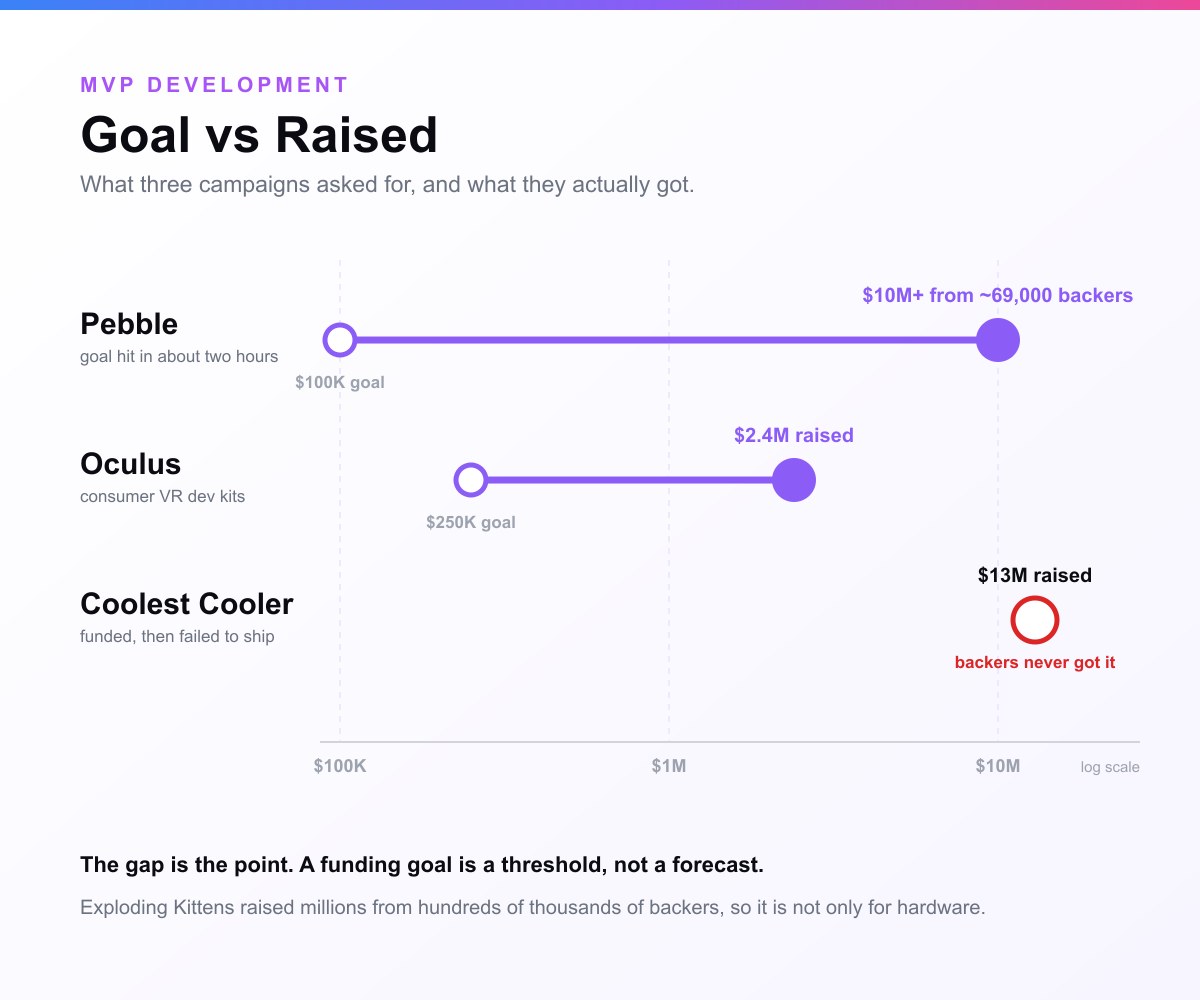
Pebble is the archetypal crowdfunding MVP. Founder Eric Migicovsky had been through Y Combinator but struggled to raise traditional funding, and was nearly out of money. So he put the Pebble smartwatch on Kickstarter with a modest goal of 100,000 dollars. The campaign hit that goal in about two hours, crossed a million dollars in a single day, and finished with more than 10 million dollars from roughly 69,000 backers, a record at the time. Pebble did not just validate demand; it pre-sold tens of thousands of watches and funded the entire build. Its later Pebble Time campaign went on to raise around 20 million dollars. The product was tangible, the video was clear, and the pitch was simple, the textbook recipe.
Oculus
Before Facebook acquired it for around 2 billion dollars, Oculus validated demand for consumer virtual reality on Kickstarter, raising roughly 2.4 million dollars against a 250,000 dollar goal. The campaign sold development kits to an enthusiastic early community, proving there was real appetite for affordable VR and seeding the developer ecosystem that made the platform valuable. The crowdfunding MVP both validated the market and built the community that followed.
Exploding Kittens
The card game Exploding Kittens showed how far a tangible, fun product with a strong creative team can go, raising millions from hundreds of thousands of backers. It proved that crowdfunding is not only for hardware: games and creative products, where the reward is delightful and shippable, are among the strongest categories.
Coolest Cooler, the cautionary tale
Not every funded campaign ends well. The Coolest Cooler raised around 13 million dollars, one of Kickstarter's biggest campaigns, then struggled badly with manufacturing costs and fulfillment, leaving many backers without the product they paid for. It is the essential counter-example: a crowdfunding MVP validates demand, but funding is not the same as delivering. The hard part starts after you succeed.
The delivery trap: the risk no one mentions
Every other MVP type ends when you learn the answer. A crowdfunding MVP ends with an obligation: you have taken money from thousands of people for a product that does not exist, and now you have to make and ship it. This is where many funded projects fail, and it is the single most important thing to understand before you run one.
The trap has a few shapes. Underpricing: founders set tiers too low to drive funding, then discover the unit economics do not cover manufacturing and shipping, so every order loses money. Underestimating manufacturing: turning a prototype into a mass-produced product is a different, harder problem than the campaign suggests, full of tooling, sourcing, and quality surprises. Underestimating timelines: delivery dates set optimistically during the excitement of a launch slip by months or years, eroding backer trust. Scaling shock: a campaign that raises ten times its goal sounds like a triumph, but now you must manufacture ten times the volume you planned, often before you are ready.
Avoiding the trap is mostly about preparation. Set your funding goal to reflect what delivery genuinely costs, not the minimum that looks achievable. Price tiers so that each order is profitable after manufacturing and shipping. Validate your manufacturing path before you launch, not after. Set timelines with generous buffers and communicate honestly when they slip. And resist the temptation to treat the raised money as profit; it is pre-paid product you still owe. The campaigns that deliver are the ones that respected fulfillment as the real project, with the campaign as merely the validation that earned the right to start it.
Crowdfunding MVPs and software in 2026
Most crowdfunding is for physical products, but software increasingly rides along. Many hardware campaigns in 2026 are really hardware-plus-software: a gadget with a companion app, a device with a cloud service, a product with AI features. The crowdfunding MVP validates demand for the whole package, and then the software has to be built to match the hardware timeline.
This is also where the lines between MVP types blur productively. A founder might validate willingness to pay with a crowdfunding campaign, build a landing page to grow the pre-launch list, and use a Wizard of Oz approach to deliver the software experience by hand to the first backers while the real system is built. The campaign proves the market and funds the work; the software gets built against a real, paid order book rather than a guess. For founders whose crowdfunded product has a meaningful digital component, the validation and the build are two distinct projects, and the second one starts the moment the campaign closes.
Pros and cons of the crowdfunding MVP
Pros:
- The strongest demand signal. People paying real money is the highest form of validation there is.
- It funds the build. Uniquely among MVP types, the validation produces capital to actually make the product.
- It tests price directly. Reward tiers are a live willingness-to-pay experiment.
- It builds a community. You finish with paying, invested early adopters and evangelists.
- It creates momentum and press. A strong campaign generates attention that money cannot easily buy.
Cons:
- It is hard and public. More than half of campaigns fail to fund, and they fail in the open.
- It creates a real obligation. Taking money means you owe a product, on a timeline, with legal and reputational stakes.
- Fulfillment is the real risk. Funding is not delivering, and delivery is where many projects collapse.
- It suits few product types. Great for physical and creative products, poor for B2B software and services.
- It demands marketing skill. Success depends heavily on a pre-launch audience, a great video, and sustained promotion.
Common mistakes founders make
- Launching without a pre-launch audience. Going live with no list and hoping for organic discovery. Campaigns are won before they launch, with an audience built in advance.
- Setting the goal as theater. Picking an artificially low goal to "guarantee" success, then being underfunded to actually deliver.
- Underpricing the tiers. Pricing to drive pledges rather than to cover real costs, so every order loses money.
- Treating funding as the finish line. Celebrating the raise and underestimating that delivery is the actual project, and the harder one.
- A weak video. Skimping on the single highest-leverage asset. The video drives conversion more than anything else on the page.
- Optimistic timelines. Promising delivery dates set in launch-day excitement, then losing backer trust as they slip.
- Ignoring unit economics at scale. Failing to plan for the manufacturing and shipping reality of succeeding ten times over.
Signs your crowdfunding MVP is working (and when to stop)
A campaign is validating strongly when it front-loads: hitting a large share of the goal in the first 48 hours, with healthy pledge velocity, a tier mix that confirms people will pay your intended price, and an engaged backer community responding to updates. A fast, broad-based raise is the clearest possible proof of demand and willingness to pay.
The signal is weak, even in "success," when the campaign only crawls to its goal in the final hours, when nearly all pledges cluster at the cheapest tier (interest, but thin willingness to pay), or when funding stalls the moment your initial list is exhausted. And if the campaign fails to fund, that is not a disaster; with all-or-nothing funding, no one is charged, and you have learned, cheaply and clearly, that demand at this price is not there yet. The honest move then is to treat the failure as data: rethink the product, the price, the audience, or the pitch, rather than relaunching the same campaign and hoping.
How to graduate from a crowdfunding MVP to a real product
A funded campaign is the most demanding "graduation" of any MVP type, because you owe a product. The path:
- Lock the real scope and economics. Use the tier data to finalize exactly what you are shipping and confirm each order is profitable after manufacturing and fulfillment.
- Build against the order book. You now have paid orders, so build the smallest version that delivers the promise to backers, the physical product and any single-feature software it needs.
- Communicate relentlessly. Backers forgive delays they are told about and resent silence. Update often and honestly, especially when things slip.
- Deliver, then expand. Ship to backers first, learn from their real use, and only then open broader sales. The backer community becomes your launch engine.
The discipline is to treat the campaign as the validation and the funding, and the fulfillment as the actual business, planned and resourced as seriously as the launch was.
A worked example
Imagine a founder with an idea for a smart, app-connected water bottle that tracks hydration. Building it means tooling, sensors, manufacturing, and a companion app, real upfront money she does not have, and a real risk that the market is smaller than she hopes.
So the crowdfunding campaign is her MVP. First, months ahead, she builds a landing page and runs ads to gather an email list of a few thousand people interested in fitness gadgets. She sets an honest funding goal that covers a first manufacturing run, not an artificially low number. She produces a crisp two-minute video showing a working prototype, and designs tiers: an early-bird bottle, a standard bottle, and a two-pack, each priced to be profitable after costs.
She launches to her pre-built list, which drives 60 percent of the goal in the first two days, momentum that pulls in new backers and a bit of press. The campaign finishes at 180 percent of goal from a few thousand backers, with most choosing the standard and two-pack tiers, confirming people will pay her intended price.
She has validated demand and willingness to pay, funded the first production run, and gathered a community, all at once. Now the real work begins: manufacturing the bottle, building the companion app, and shipping to backers on a timeline she communicates honestly. The crowdfunding MVP did its job, proving the market and funding the build, and handed her a paid order book to deliver against.
How MVP Development helps
Crowdfunding is mostly a path for physical and creative products, and the campaign itself is something founders usually run with a marketing and video team. Where we help is the digital side. Many crowdfunded products are really hardware-plus-software: a device with a companion app, a gadget with a cloud service, a product with AI features. That software still has to be built, on the hardware's timeline, once the money is in.
We help in two places: building the landing page and pre-launch funnel that grow your day-one audience before the campaign, and building the software your product needs after it funds, typically a single-feature MVP, shipped funding-ready in 3 to 4 weeks by senior engineers, scoped around what your backers actually bought, on a clear, scoped quote you approve before we start. You validate and fund with the campaign; we build the digital product you now owe your backers.
Funded your campaign and need the app or software built? Tell us what your backers were promised and we will scope the build that delivers it on time.
Related guides
- Pre-Sales MVP: the private, non-campaign version of taking money before you build
- What Is an MVP?: the full definition of a minimum viable product, and what makes one work
- MVP Examples: 15 Famous MVPs: see these MVP types in action at Airbnb, Dropbox, Uber, and more
- How to Build an MVP: the step-by-step process from idea to launch
Frequently asked questions
What is a crowdfunding MVP?
A crowdfunding MVP is a way to validate a product idea by asking people to pay for it before it exists, usually through a campaign on a platform like Kickstarter or Indiegogo. You publish a page, a video, reward tiers, and a funding goal, and backers pledge real money. If enough people back it, you have proof of demand, validation of price, and the funds to build the product. It is the strongest demand signal of any MVP type because money is the highest form of commitment.
How is a crowdfunding MVP different from a landing page MVP?
Commitment level. A landing page MVP asks for an email, which proves curiosity. A crowdfunding MVP asks for a payment, which proves willingness to pay, the strongest possible signal. Crowdfunding also funds the build and creates a community, which a landing page does not. The trade-off is that crowdfunding is far harder to run, suits a narrower range of products, and creates a real obligation to deliver once you take money.
What is an example of a crowdfunding MVP?
Pebble is the classic example: the smartwatch raised over 10 million dollars from roughly 69,000 backers on Kickstarter against a 100,000 dollar goal, pre-selling the product and funding the build before it existed. Oculus validated consumer VR by raising about 2.4 million dollars on Kickstarter before its acquisition by Facebook, and Exploding Kittens showed the power of crowdfunding for creative products by raising millions for a card game.
What types of products work best for crowdfunding?
Physical and creative products: hardware, gadgets, games, gear, and consumer goods. Backers like to fund a tangible thing they will receive, and a product that photographs and demos well converts best. Crowdfunding works poorly for B2B software, services, and pure digital products, because the audience is not on these platforms and backers prefer a physical reward. For a software MVP, a landing page or fake door is a better fit.
How much of my funding goal do I need on day one?
As much as you can. Strong campaigns front-load, often hitting a large share of the goal in the first 48 hours, because early momentum signals credibility to other backers and to the platform's algorithm, which compounds. That is why building a pre-launch email list and community before you go live is the single most important predictor of success. Campaigns that launch to an existing audience tend to fund fast; those that launch cold tend to stall.
What percentage of crowdfunding campaigns succeed?
Historically, roughly 42 percent of Kickstarter projects reach their funding goal, though success rates vary widely by category. So more than half of campaigns fail to fund. That difficulty is part of why a successful raise is such strong validation: clearing an honest funding goal is a hard, meaningful bar that many products cannot reach.
What is the all-or-nothing funding model?
On Kickstarter, projects use all-or-nothing funding: if the campaign does not reach its goal within the time limit, no money changes hands and no backer is charged. This makes for a clean validation test, hitting the goal is a clear pass, missing it is a consequence-free fail. Indiegogo also offers flexible funding, where you keep whatever you raise even below goal, but that weakens the validation signal because you can "succeed" without proving real demand.
What is the biggest risk of a crowdfunding MVP?
Delivery. A crowdfunding MVP validates demand, but funding is not the same as fulfilling. The hardest part starts after you succeed: turning a prototype into a manufactured product, on the timeline and at the price you promised, to thousands of backers who paid in advance. Many funded campaigns, including very large ones, have failed at fulfillment. The way to avoid it is to set an honest goal, price tiers to be profitable after real costs, validate manufacturing before launch, and plan delivery as the serious project it is.
Can a software product use crowdfunding?
Rarely on its own, but often as part of a hardware-plus-software product. A pure app or SaaS is a weak crowdfunding candidate because backers want a physical reward and the audience is not there. But many crowdfunded gadgets include a companion app or cloud service, and that software has to be built once the campaign funds. For pure software validation, a landing page or fake door is faster, cheaper, and lower-risk than a campaign.
What comes after a successful crowdfunding campaign?
The real work: building and shipping the product you pre-sold. You finalize the scope and unit economics using your tier data, build against the paid order book (the physical product and any single-feature software it needs), communicate relentlessly with backers about progress and any delays, and ship to backers first before opening wider sales. The campaign validated demand and funded the build; fulfillment is the actual business, and it deserves to be planned and resourced as seriously as the launch.
Where does the crowdfunding MVP fit among the other MVP types?
It is the highest-commitment of the three demand-validation types, with the landing page and fake door, in the broader map of MVP types. They form a ladder: email, click, payment. Demand validation asks "do people want this?" Manual types like concierge and Wizard of Oz ask "can we deliver it?" Product types like the single-feature MVP ask "does the built product get used?" Crowdfunding is the demand test for tangible products that need both proof and capital.
Sources and references
This guide draws on documented campaign histories and crowdfunding data:
- Statista, Kickstarter project funding success rate the share of projects that reach their goal
- The Week, Pebble's record Kickstarter campaign the 10 million dollar raise and its story
- Kickstarter, fulfillment the realities of delivering a funded project
- Indiegogo flexible and fixed funding models
- The Lean Startup the validated-learning principles behind pre-selling an MVP


