


TL;DR
The Zappos MVP faked an online shoe store: founder Nick Swinmurn photographed shoes in local stores, posted them online, and bought and shipped each pair only after an order came in. This Wizard of Oz test proved people would buy shoes online with almost no upfront investment, and Zappos later sold to Amazon for around $1.2 billion.
In 1999, a simple question had no obvious answer: would anyone buy shoes online, sight unseen, without trying them on? The common wisdom was a flat no. Shoes were too personal, too fit-dependent, too risky to buy from a screen. Nick Swinmurn disagreed, but instead of betting millions on building a real online shoe store to find out, he did something far cleverer: he faked one.
That fake store became Zappos, which sold to Amazon a decade later for around $1.2 billion. This is the story of the Zappos MVP, the most famous "Wizard of Oz" test in startup history.
Key Takeaways
- In 1999, no one knew whether people would buy shoes online without trying them on.
- Instead of building a real store, Nick Swinmurn faked one.
- He photographed shoes in local stores and posted them online; when an order came in, he bought the pair and shipped it.
- This Wizard of Oz MVP tested real demand with almost no upfront investment.
- It proved people would buy shoes online, and Zappos later sold to Amazon for around $1.2 billion.
At a Glance
| The Zappos MVP | Detail |
|---|---|
| Year | 1999 |
| MVP type | Wizard of Oz |
| What they built | Photos of local-store shoes; bought and shipped after each order |
| Result | Proved online shoe demand; later sold to Amazon (~$1.2B) |
| Lesson | Fake the backend to test demand for almost nothing |
The question nobody could answer
The idea came from an ordinary frustration. Swinmurn went looking for a specific pair of shoes at a mall, the right style in the right size and colour, and could not find them. It struck him that an online store could carry every style, size, and colour without the limits of physical shelf space.
But there was a brutal unknown sitting underneath the idea. Building a real online shoe retailer in 1999 meant inventory, warehouses, supplier deals, logistics, and a lot of capital, all bet on an assumption everyone doubted: that customers would actually buy footwear they could not touch or try on. If that assumption was wrong, every dollar spent on infrastructure was gone.
The riskiest assumption was not "can we build an online store?" It was "will people buy shoes online at all?" And you do not need a warehouse to answer that.
The MVP: a store with no inventory
Here is the move that made Zappos a textbook MVP. Rather than buy inventory, Swinmurn walked into local shoe stores, photographed the shoes on their shelves, and posted those photos on a simple website as if they were for sale.
When a customer placed an order, there was no warehouse, no automated fulfilment, no stock. Swinmurn would go back to the store, buy the shoes at full retail price, and ship them to the customer himself. Sometimes he made no margin at all. On some sales he may even have lost money. That was fine, because money was never the point of the experiment. The point was a single piece of information: would the order come in at all?
To the customer, it looked like a normal online shoe store. Behind the curtain, it was one person running to the mall and to the post office. That gap, a real, automated-looking experience on the front, a completely manual hack on the back, is exactly what makes it a Wizard of Oz MVP.
Behind the curtain
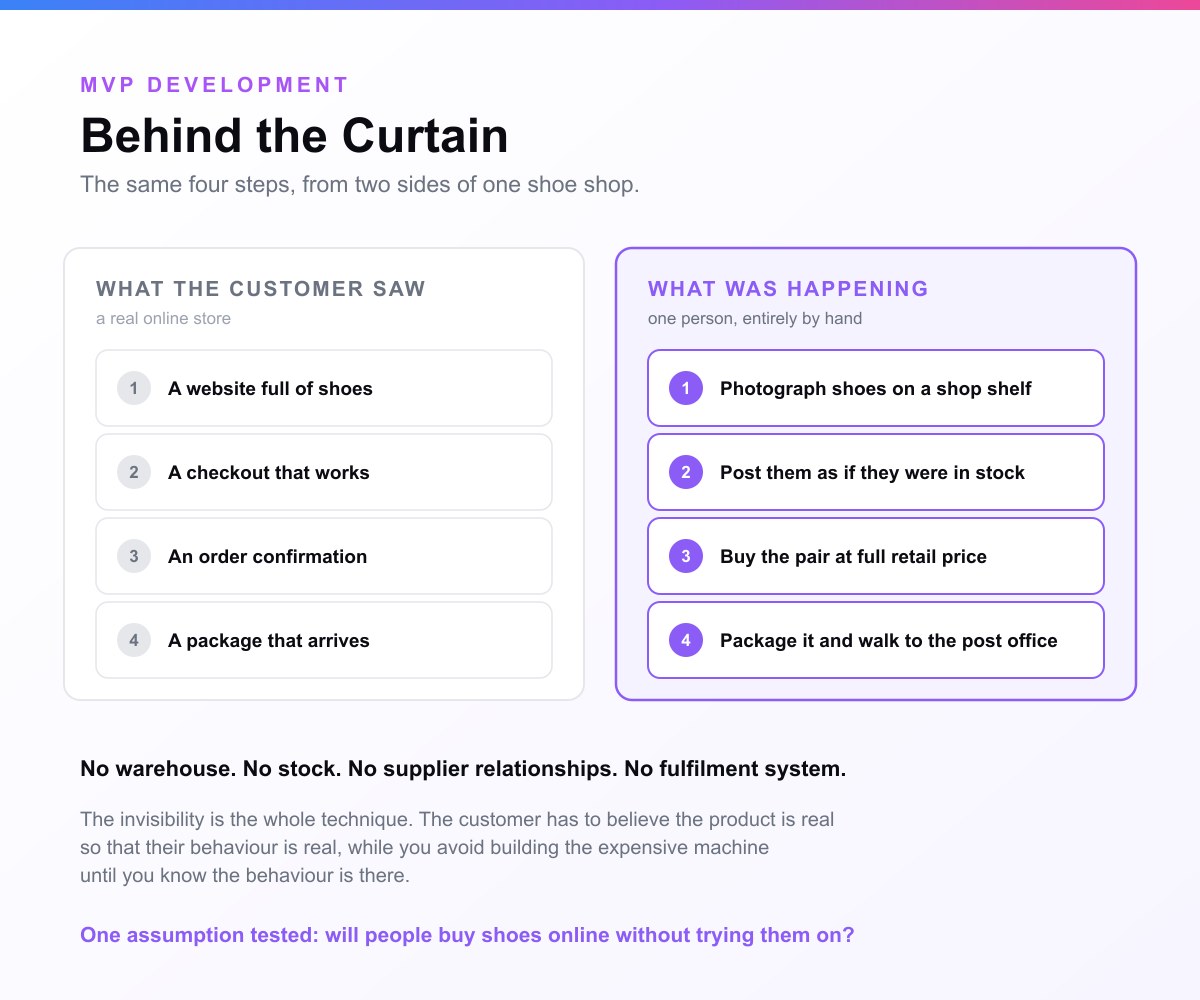
What the customer saw: a website with shoes, a checkout, an order confirmation, and a package that arrived. A real store.
What was actually happening: no inventory to speak of, no supplier relationships, no fulfilment system. Each order triggered a manual scramble, buy the item retail, package it, post it. The "system" was a human doing things by hand, deliberately invisible to the buyer.
That invisibility is the whole technique. The customer needs to believe the product is real so their behaviour is real, while you avoid building the expensive machine until you know the behaviour is there.
By the numbers
- $0 spent on inventory or warehousing before demand was proven
- Full retail price paid for each pair, sometimes at a loss, the cost of the experiment
- 1 assumption tested: will people buy shoes online without trying them on?
- ~$1.2 billion Amazon acquisition roughly a decade later
Why this is the textbook Wizard of Oz MVP
Strip it down and the Zappos MVP is a near-perfect demonstration of testing an operationally heavy business without building the operations:
- It tested the riskiest assumption with real money. Not "would you buy shoes online?" in a survey, but actual purchases from actual customers. Behaviour, not opinion, the strongest possible signal.
- It faked the costly part. The hard, expensive piece of a shoe retailer is the supply chain. Zappos faked it entirely with manual effort, so the test cost almost nothing.
- The customer experience was real. People received real shoes. The MVP was minimal in infrastructure, never in the quality of what the customer actually got, which is why the demand signal was trustworthy.
- It bought permission to build. Once orders proved people would buy shoes online, investing in real inventory and logistics was a justified bet instead of a hopeful gamble.
Concierge vs Wizard of Oz, the one-word difference
People often confuse the Zappos approach with Airbnb's concierge MVP, because both deliver value by hand. The difference is transparency:
- In a concierge MVP, the customer knows a human is doing the work (Airbnb's founders openly cooked breakfast).
- In a Wizard of Oz MVP, the customer thinks it is automated or a normal product, the manual effort is hidden behind the curtain, exactly as Zappos hid the trips to the mall.
Zappos is the canonical Wizard of Oz because the manual hack was deliberately invisible. (We cover the full distinction in the Wizard of Oz MVP guide.)
The lessons you can steal
You are not selling shoes, but the Zappos play transfers to almost any operationally heavy idea:
- If the expensive part is the operations, fake the operations. You do not need a warehouse, a fleet, or an algorithm to learn whether people will buy. Fake the back end manually and keep the front end real.
- Test with real money where you can. A completed purchase is the strongest demand signal there is, far stronger than interest, sign-ups, or "I'd use that."
- Be willing to lose money on the experiment. Swinmurn paid retail and sometimes lost on sales, because the data was worth more than the margin. The cost of a few unprofitable orders is trivial next to the cost of building the wrong company.
- Keep the customer experience genuinely real. The shoes had to actually arrive. A faked back end is fine; a faked experience produces a false signal.
- Only build the machine once the behaviour is proven. Inventory and logistics came after the orders, not before.
From a faked store to a $1.2 billion business
The orders came in. People did buy shoes online, the assumption everyone doubted turned out to be true, and Swinmurn had proof, not a hunch. From there, the company, originally ShoeSite.com and soon renamed Zappos (from zapatos, Spanish for shoes), raised funding, built real inventory and the logistics to back it, and grew, eventually under Tony Hsieh, into a retailer famous for its customer service and culture. In 2009, Amazon acquired it in a deal valued at roughly $1.2 billion.
The entire business stood on a foundation laid by a man photographing shoes in a mall and buying them by hand when orders came in. The expensive machine was built only after the cheapest possible test had already answered the one question that mattered.
How would you run the Zappos MVP today?
The Wizard of Oz play is, if anything, easier now:
- Build a real-looking front end fast with a no-code store, a landing page, or a simple checkout, so the customer experience feels legitimate.
- Fulfil manually behind the scenes. Take real orders, then do the work by hand, source, make, or deliver, without any of the automated infrastructure yet.
- Charge real money and measure purchases, the truest signal of demand. Be willing to run the early orders at a loss.
- Build the back-end machine only when orders prove the demand, and not a day before.
The Zappos MVP proves that even a capital-intensive, operations-heavy business can be validated for almost nothing, as long as the customer's experience is real and the expensive part is faked until the demand is undeniable.
Fake the machine, not the value
The reason the Zappos story endures is that it solved a problem most "just build an MVP" advice ignores: what do you do when the smallest real version of your product still costs a fortune to build? The answer is to fake the costly back end manually while keeping the value to the customer completely real, and let actual purchases tell you whether the expensive build is worth it.
That is exactly the kind of thinking we bring to a first build at MVP Development. We help founders find the cheapest honest test of the riskiest assumption, and, once demand is proven, ship a funding-ready MVP in 3 to 4 weeks, by senior engineers, on a fixed quote you approve before we start, with full code ownership.
See more famous first versions in our MVP examples roundup, or read the Airbnb, Dropbox, and Uber case studies for three more ways the same discipline plays out.
Zappos validated an entire business with photos and a manual back end. More famous first versions are in our MVP examples roundup, and if your own wizard-of-oz test has proven demand, Tell us the demand you want to test before building and we will design the storefront experiment.
Related guides
- Wizard of Oz MVP: the faked-back-end approach Zappos used
- The Airbnb MVP: the concierge case study (manual, but in the open)
- The Dropbox MVP: the explainer-video case study
- The Uber MVP: the one-feature, one-city case study
Frequently asked questions
What was Zappos's MVP?
Zappos's MVP, around 1999, was a website that looked like a real online shoe store but had no inventory behind it. Founder Nick Swinmurn photographed shoes on the shelves of local stores and posted the pictures for sale. When a customer ordered, he went back to the store, bought the shoes at full retail price, and shipped them himself, sometimes losing money on the sale. The point was not profit; it was to test the one assumption everyone doubted, that people would buy shoes online without trying them on. They did, which validated the idea before a cent was spent on warehouses or inventory.
Why is Zappos a Wizard of Oz MVP?
Because the customer-facing experience looked like a real, automated online store, while the back end was entirely manual and hidden. In a Wizard of Oz MVP, you fake the automation behind the curtain, the user believes they are using a finished product, but a human is doing the work invisibly. Zappos is the canonical example: customers thought they were buying from a normal retailer, not from a founder running to the mall for each order. This differs from a concierge MVP (like Airbnb's), where the customer openly knows the service is being delivered by hand.
What can founders learn from the Zappos MVP?
The central lesson: if the expensive part of your idea is the operations, infrastructure, inventory, logistics, you can fake that part manually while keeping the customer experience completely real, and test demand for almost nothing. Test with real money where possible, since a purchase is the strongest demand signal; be willing to run early orders at a loss because the data is worth more than the margin; keep the customer's actual experience genuine so the signal is trustworthy; and only build the costly machine once real orders prove people will buy. Zappos shows that even a capital-heavy business can be validated cheaply before you commit.
Sources & references
- Eric Ries, The Lean Startup: which popularised the Zappos Wizard of Oz MVP
- Y Combinator Library: early-stage validation and startup strategy
- Atlassian, Minimum Viable Product: what an MVP is and is for
The Zappos founding story is widely documented; details here reflect the commonly reported account.


