


TL;DR
A piecemeal MVP is a working product assembled from existing tools, no-code platforms, and APIs, instead of being built from scratch. You wire together off-the-shelf software, a form here, a spreadsheet there, an automation in between, plus a little manual glue, to deliver the real value to real users without writing much (or any) custom code. It is one of the fastest, cheapest ways to put a functioning product in front of users, because you are buying the building blocks rather than building them.
Where it fits: the piecemeal MVP sits in the product-validation family with the single-feature and prototype approaches. Like a single-feature MVP, it delivers real value to users; unlike it, the value is stitched from existing tools rather than purpose-built. It answers "does the product, as a working thing, get used?" without the cost of custom engineering. At MVP Development we help founders run a piecemeal MVP and then, when it validates and hits the limits of off-the-shelf tools, build the real custom product, often a single-feature MVP, funding-ready in 3 to 4 weeks. This is the full playbook: the toolkit, the steps, the famous duct-taped examples, and when to replace the glue with real code. It is one of the eight types of MVP in our wider map.
Key Takeaways
- A piecemeal MVP is a working product assembled from existing tools, no-code platforms, and APIs instead of built from scratch.
- You wire together off-the-shelf software plus a little manual glue to deliver real value without writing much custom code.
- It is one of the fastest, cheapest ways to put a functioning product in front of users, because you buy the building blocks.
- It answers "does the product, as a working thing, get used?" without the cost of custom engineering.
- When it validates and hits the limits of off-the-shelf tools, you replace the glue with real code.
What is a piecemeal MVP?
A piecemeal MVP is a minimum viable product built by assembling existing pieces rather than engineering new ones. Instead of writing custom software to power your product, you connect tools that already exist, a form builder for input, a spreadsheet or database for storage, an automation tool to move data between them, a website builder for the front end, a payment processor for transactions, and you cover whatever gaps remain with manual work. The result is a real, functioning product that delivers genuine value, held together with the software equivalent of duct tape.
The name captures the method: you build the product piece by piece from parts you did not make. The user experiences a working product. Behind it, instead of a custom codebase, there is a constellation of off-the-shelf services wired together, plus some human glue filling the seams. The classic line, often credited to the lean and startup-accelerator world, is "do things that do not scale": a piecemeal MVP embraces exactly that, trading scalability and elegance for speed and cheapness, because at the validation stage those are the right things to trade.
The purpose is product validation without the build cost. Like a single-feature MVP, it puts a real working product in front of users to learn whether the thing gets used. But it skips the engineering: rather than building the software, you rent it, in pieces, and connect it. That makes a piecemeal MVP dramatically faster and cheaper to stand up than custom code, at the cost of being limited by the tools, awkward at the seams, and unable to scale far. It is a way to test the whole product as a working system before committing to building any of it for real.
A piecemeal MVP is not the same as a no-code prototype or a pretty mockup. It actually works: real users do real things and get real value, even if the machinery behind the curtain is a tangle of third-party tools and manual steps. That is what distinguishes it from a prototype, which only simulates the experience.
Piecemeal MVP vs single-feature and prototype
All three are product-validation MVPs, but they differ in how the product is built and how real it is.
| MVP type | How it is built | What it proves |
|---|---|---|
| Piecemeal | Assembled from existing tools, no-code, and APIs | The working product gets used, without custom code |
| Single-feature | Purpose-built custom software for one core feature | The built core gets used and can scale |
| Prototype | A clickable, non-functional model | The experience and flow resonate before building |
A single-feature MVP writes real, production-grade code for one core feature: it is custom, scalable, and takes engineering time. A piecemeal MVP delivers a working product without writing that code, by stitching tools together: it is faster and cheaper, but limited by what the tools can do and hard to scale past early traction. The trade is clear: single-feature is built to last and grow; piecemeal is assembled to validate fast and is meant to be replaced.
A prototype MVP is different again: it does not function as a real product, it only models the experience. A piecemeal MVP genuinely works. So among the product types, the spectrum runs from prototype (looks real, is not), to piecemeal (works, but stitched), to single-feature (works and is purpose-built).
Piecemeal also overlaps with the manual-validation types, and the line is worth drawing. A concierge or Wizard of Oz MVP delivers the value primarily through human effort, you, doing the work by hand. A piecemeal MVP delivers it primarily through stitched-together software, with humans only filling small gaps. In practice they blend: Groupon's piecemeal MVP automated the deal page with WordPress but emailed coupon PDFs by hand. The useful distinction is the center of gravity: manual types lean on people to deliver the value; piecemeal leans on tools, with people as glue.
When to use a piecemeal MVP
A piecemeal MVP is the right choice when you want a real, working product fast and cheap, and existing tools can plausibly deliver your core value. Use it when:
- Your product is mostly workflow, not novel technology. If the value is moving information through a process, collecting, storing, transforming, notifying, existing tools can usually do it. Piecemeal shines for workflow products.
- You want to validate the whole product, not just one feature. Where a single-feature MVP proves one core action, a piecemeal MVP can stand up the entire user journey, stitched together, to see if the whole thing works.
- Speed and cost matter more than scale. At validation stage, you want to learn fast and cheap. Piecemeal trades scalability you do not need yet for speed you do.
- You are not sure the product is worth building. Why write custom code for something unproven? Assemble it from tools first; build it for real only once it works.
- You have little or no engineering capacity. A founder without a developer can stand up a real piecemeal product using no-code tools alone.
It is the wrong tool in several cases. If your core value is novel technology, a custom algorithm, real-time performance, heavy data processing, an AI model, no stitched-together tools will deliver it, and you need to build. If you already know the product works and need to scale, piecemeal will buckle, and custom software is the answer. And if the seams would create a bad or untrustworthy experience (think anything handling sensitive data or money at volume), the duct tape is a liability. Piecemeal is for validating workflow-shaped products fast; once the value is proven or the technology is genuinely the point, you build.
The piecemeal MVP toolkit
The toolkit is the method. A piecemeal MVP is, essentially, a well-chosen set of building blocks wired together. The common categories:
- Front end / app shell: Webflow, Carrd, Framer, Softr, or Bubble give you a real, public-facing site or app without writing front-end code. Bubble in particular can build surprisingly capable apps with no code.
- Forms and input: Typeform, Tally, or Google Forms collect what users submit, the entry point of many workflows.
- Database / storage: Airtable, Google Sheets, or Notion act as your backend data store. A spreadsheet is a perfectly good database for an MVP.
- Automation / glue: Zapier or Make connect everything, when a form is submitted, add a row, send an email, trigger a workflow. This is the connective tissue that makes the pieces behave like one product.
- Payments: Stripe payment links, Gumroad, or Lemon Squeezy take real money without a custom checkout.
- Communication: email tools, SMS via simple APIs, or even a shared inbox to talk to users and deliver outputs.
- Manual glue: you. The steps no tool covers, you do by hand, on purpose, at small scale.
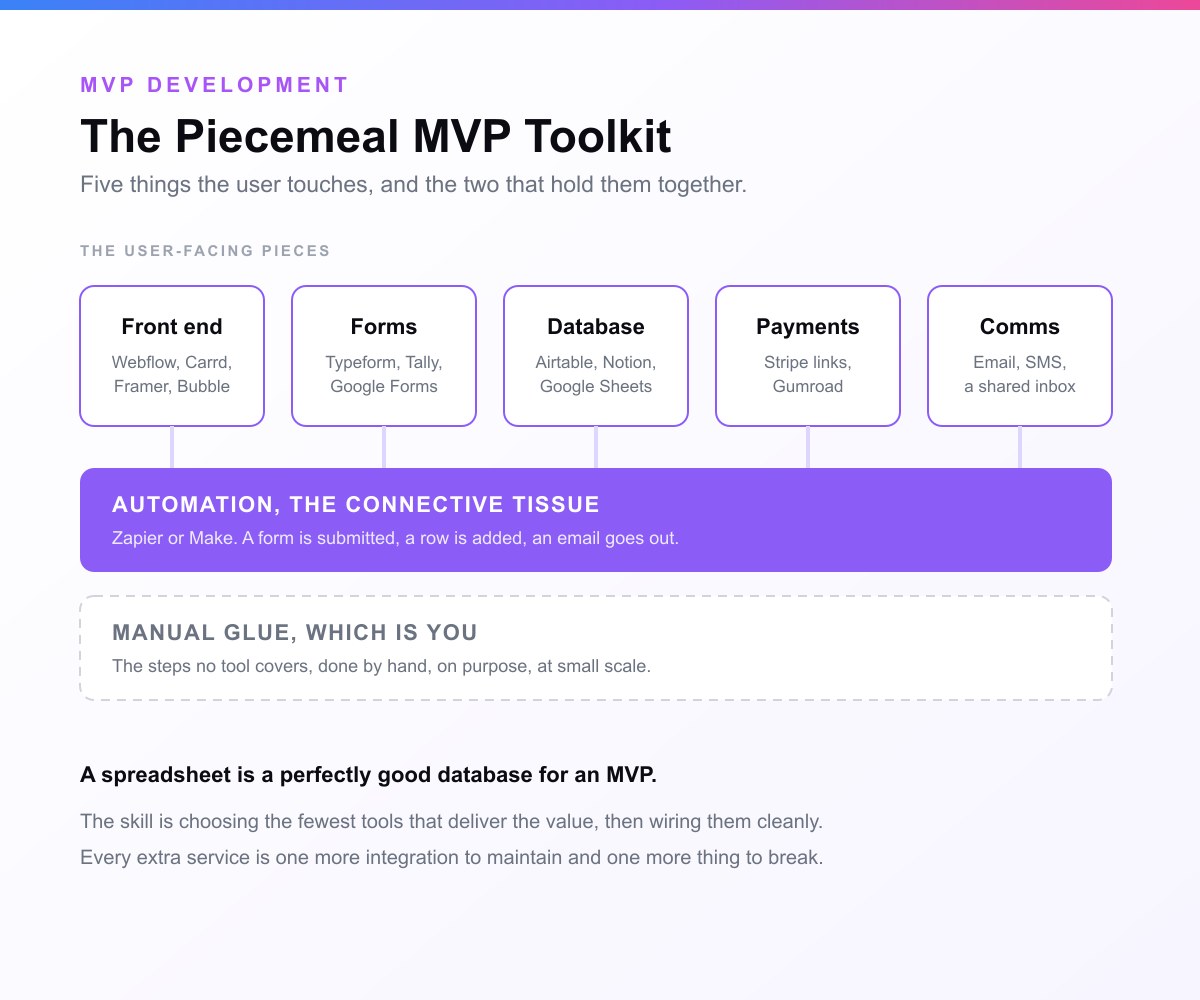
The skill is selecting the smallest set of tools that delivers the value and connecting them cleanly. The art of a piecemeal MVP is less engineering and more clever assembly, knowing which tool does which job and how to make them talk.
How to build a piecemeal MVP: a step-by-step playbook
Assembling a piecemeal MVP is fast, but a thoughtless tangle of tools produces a fragile mess. Here is the disciplined approach.
Step 1: Map the user journey end to end
Write down every step a user takes, from first touch to receiving value. This map is your blueprint: each step will be handled by a tool or by you. You cannot assemble a product you have not mapped.
Step 2: Assign each step to a tool or a human
Go step by step and decide what handles it: a form, a database, an automation, a payment link, or a manual action. Aim to cover as much as possible with tools, and be honest about which seams you will fill by hand at first.
Step 3: Choose the fewest tools that do the job
Resist collecting tools. Every additional service is another integration to maintain and another thing to break. Pick the minimal set, often just a front end, a database, an automation tool, and payments, that covers the journey.
Step 4: Wire the pieces together
Connect the tools with your automation layer (Zapier or Make), so data flows through the journey without manual copying where possible. Test the full path end to end as a real user would, because the seams between tools are where piecemeal MVPs break.
Step 5: Embrace the manual glue
Wherever a tool does not reach, do it by hand, deliberately. Groupon emailed coupon PDFs manually; that was a feature, not a failure, at their stage. Manual steps let you launch now and learn what actually needs automating later. Just keep them small enough to sustain.
Step 6: Put it in front of real users and watch the seams
Launch to real users and watch two things: whether they use it and get value (the product question), and where the assembly strains, the slow steps, the breakages, the manual work that does not scale. Both are valuable learning.
Step 7: Decide what to keep, replace, or build
From real use, you learn which parts of the stitched product are validated and which seams are now the bottleneck. That tells you exactly what to build for real first, usually the part where the duct tape is failing under real demand.
Doing things that do not scale
The defining feature of a piecemeal MVP, and the thing founders resist most, is that it is held together with manual work and fragile connections that absolutely will not scale. This is not a flaw to apologize for. At the validation stage, it is the entire point.
The logic is simple: scalable systems are expensive and slow to build, and you should not build them for a product you have not proven. So you deliberately do the unscalable thing, email the PDFs by hand, copy the data manually, personally onboard each user, because it lets you have a working product today instead of in three months. Groupon's founder described the early product as totally improvised: a hacked WordPress blog and coupons generated in a database tool and emailed manually, selling hundreds of vouchers a day by hand. It worked precisely because it did not wait for scale.
The discipline is to know that the duct tape is temporary, and to read the strain as data. Every manual step that becomes painful, every seam that breaks under load, is the product telling you exactly what to build for real. The manual glue is not just a stopgap; it is an instrument that shows you where the real demand and the real bottlenecks are, so that when you do build, you build precisely the right thing. Founders who refuse to do unscalable things at the start often spend months building scale for demand that never materializes. The piecemeal MVP inverts that: prove it works, by hand if necessary, then build only what the strain tells you to.
What to measure in a piecemeal MVP
Because a piecemeal MVP is a real working product, the core question is the same as a single-feature MVP: does it get used and kept? So the primary metrics are about behavior.
- Usage and retention: do people complete the workflow, get value, and come back? As with any product-validation MVP, repeated use is the signal that matters most.
- Workflow completion: because the product is stitched together, watch whether users get all the way through the journey or drop at a particular seam. A break between two tools shows up as a drop-off.
- Manual load: how much hand-work does each user require? This is unique to piecemeal, and it is a key signal. Rising manual load as usage grows is the product telling you what to automate or build next.
- Where the seams strain: which connections break, slow down, or require babysitting. The failing seam is your build priority.
- Qualitative pull: do users value the outcome enough to tolerate the rough edges? Strong pull through a clunky experience is powerful validation, because they are returning despite the friction.
A piecemeal MVP is validated when real users complete the workflow, return for the value, and would miss it if it vanished, even though it is held together with tools and manual steps. At that point, the manual load and straining seams tell you precisely what to build for real.
Real piecemeal MVP examples
The technique is best seen in products that began as a tangle of existing tools.
Groupon
Groupon is the archetypal piecemeal MVP. After his first venture, The Point, failed to gain traction, Andrew Mason needed to test a daily-deals idea fast. So he did not build a deals platform; he assembled one. He took a WordPress blog, changed the branding to Groupon, and posted a new deal each day as a blog post. When people bought, the coupons were generated by hand in a database tool (FileMaker) and emailed out as PDF attachments through Apple Mail, hundreds a day, manually. It was, in Mason's own words, totally improvised. But it worked: he validated the entire daily-deals model in about a month, versus the ten months he had sunk into The Point, and only built real software once the stitched-together version proved the demand. Groupon is the definitive lesson that you can validate a whole business by assembling tools and doing things by hand.
Product Hunt
Product Hunt began not as a website but as an email list. Founder Ryan Hoover wanted to test whether a community for discovering new products had legs, so he used an existing tool called Linkydink to create a daily email digest, invited a few dozen hand-picked product people, and collected their recommendations. The whole thing was stood up in a matter of minutes from off-the-shelf parts. The email list validated the appetite for product discovery before a single line of the eventual platform was written. It is a perfect small-scale piecemeal MVP: existing tools, a tiny audience, real value, no build.
Foursquare and many quiet others
Many products begin piecemeal even when it is not famous. Early location and social products leaned on existing platforms and manual data entry before building their own systems. Countless B2B tools start life as a Typeform feeding an Airtable, glued by Zapier, with a founder manually handling the parts the tools cannot, delivering real value to early customers while the real product is still just a plan. The pattern is always the same: assemble, deliver, learn, and only then build.
Piecemeal MVPs, no-code, and AI in 2026
Piecemeal MVPs have never been more powerful, because the building blocks have never been better. The no-code ecosystem in 2026 can assemble genuinely capable products: tools like Bubble build real apps, automation platforms connect almost anything, and the catalog of services for payments, auth, messaging, and data is vast. A founder can now stitch together a product that would have required a full engineering team a decade ago.
AI has supercharged this further. AI-powered no-code and app builders can generate much of the assembly from a prompt, and AI model APIs let a piecemeal product include real intelligence, summarization, classification, generation, by calling a model rather than building one. This means more of the product can be assembled rather than built, and the manual glue can increasingly be automated with AI. The paradox is that as assembly gets more powerful, the judgment about when to stop assembling and start building matters more. A piecemeal MVP can now carry a product surprisingly far, which makes it tempting to never replace the duct tape, right up until it breaks under real scale. The skill in 2026 is using the powerful new blocks to validate fast, while knowing the moment the stitched product needs to become real software.
Pros and cons of the piecemeal MVP
Pros:
- Extremely fast and cheap. You assemble from existing tools instead of building, so a real product can be live in days.
- No or little engineering needed. A non-technical founder can stand up a working product with no-code tools.
- It is a real, working product. Unlike a prototype, users get genuine value, so you learn whether the thing actually gets used.
- It validates the whole workflow. You can test the entire user journey, not just one feature.
- The strain tells you what to build. Failing seams and manual load point precisely at what to engineer first.
Cons:
- It does not scale. Stitched tools and manual glue break under real growth; it is meant to be replaced.
- It is limited by the tools. If existing services cannot deliver your core value, piecemeal cannot either.
- The seams are fragile. Integrations break, and the experience can be rough where tools meet.
- It carries hidden costs. Many tool subscriptions plus manual labor can add up, and the manual work consumes founder time.
- Wrong for novel technology. If the value is custom algorithms, performance, or a real model, assembly will not cut it.
Common mistakes founders make
- Treating the duct tape as permanent. Riding a stitched product past the point where it should have become real software, until it breaks under load and takes customers down with it.
- Collecting too many tools. Every extra service is another integration to break and another bill. Use the fewest that do the job.
- Hiding the manual work from yourself. Not tracking how much hand-labor each user takes, so you miss the signal of what to automate, and quietly burn out.
- Building piecemeal when the value is technology. Stitching tools for a product whose whole point is a custom algorithm or model, which the tools fundamentally cannot deliver.
- Polishing the seams instead of validating. Spending time making the assembly elegant rather than learning whether the product gets used. The point is the learning, not the craftsmanship of the duct tape.
- Mistaking it for a prototype. Building something that only looks like it works instead of a product that actually delivers value. If users do not get real value, it is not a piecemeal MVP.
Signs it is working (and when to replace the duct tape)
A piecemeal MVP is working when real users complete the stitched workflow, return for the value, and tolerate the rough edges because the outcome is worth it. Strong retention through a clunky, manual experience is, if anything, more convincing than smooth retention, because users are pushing past friction to get the value.
The time to replace the duct tape with real software is when the strain becomes the constraint: when manual load grows faster than you can handle, when the seams break often enough to threaten the experience, when the tools hit a ceiling your product needs to pass, or when scale is now the goal rather than validation. That is not a failure; it is graduation. The piecemeal MVP has done its job, proving the product works and showing exactly which parts need to become real. The mistake is to ignore the strain and keep stitching, until the fragile assembly fails publicly under the very demand you worked to create. Read the strain as a signal, and replace the glue with code deliberately, starting with the seam that is failing hardest.
How to graduate from piecemeal to a real product
A validated piecemeal MVP is a precise blueprint for what to build. The strain has already told you which parts matter and which break. Graduating:
- Find the failing seam. Identify where the assembly strains hardest under real use, the manual step you cannot sustain, the integration that keeps breaking, the tool hitting its ceiling. That is what to build first.
- Build the bottleneck as real software. Replace the worst seam with custom code, often a single-feature MVP that automates the one part where the duct tape is failing, while leaving the rest stitched for now.
- Replace the glue incrementally. You rarely rebuild everything at once. Move piece by piece from assembled tools to real software, in the order the strain dictates, keeping the product live throughout.
- Keep what works. Some stitched pieces (payments via Stripe, email via an existing tool) never need replacing. The goal is a real product, not custom code for its own sake. Build what must be built, keep buying what is fine to buy.
The discipline is to let the validated piecemeal MVP, and the places it strains, dictate exactly what gets engineered, so you build precisely the right thing instead of guessing.
A worked example
Imagine a founder with an idea for a service that reviews freelancers' contracts and flags risky clauses. The expensive risk is whether people will actually use such a service and find it valuable, and building a custom platform with document parsing and analysis would take real engineering she does not want to spend before knowing.
So she builds it piecemeal. The front end is a simple Carrd page describing the service with a Stripe payment link. Submission is a Typeform that takes the contract and the customer's email, feeding an Airtable. A Zapier automation notifies her on each new submission. For the actual review, the supposedly automated core, she reads each contract herself at first, with help from an AI model she prompts manually, and emails back a one-page risk summary by hand. To the user, it is a working service: pay, upload, get a professional review. Behind it is a stitch of Carrd, Stripe, Typeform, Airtable, Zapier, and her own labor.
In the first weeks, dozens of freelancers pay and submit, many come back with a second contract, and several refer friends, real usage and retention through a deliberately manual product. The strain is obvious too: the manual review does not scale past a few a day. That is her exact build signal. She validated the whole product and its willingness to pay for the cost of some tool subscriptions and her time, and now knows precisely what to build first: the automated contract analysis that is currently her by hand. The piecemeal MVP proved the product and handed her a blueprint, and the failing seam, for the real build.
How MVP Development helps
A piecemeal MVP is often something a founder can assemble alone, and we encourage it: there is no faster, cheaper way to put a real working product in front of users and learn whether it gets used. Where we come in is the graduation, the moment the stitched product validates and starts straining against the limits of off-the-shelf tools and manual work.
That is the signal to build for real, and it is what we do best. We help you read where the assembly is failing, then replace the worst seam, usually the core that the tools cannot deliver or your manual glue cannot sustain, with real, production-grade software: a single-feature MVP, built funding-ready in 3 to 4 weeks by senior engineers, on a modern, AI-accelerated stack, on a clear, scoped quote you approve before we start. You keep what still works (payments, email, the parts that are fine to buy) and build only what must be built, so you move from a validated tangle to a real product without losing momentum or over-engineering.
Validated a piecemeal MVP and hitting the limits of your tools? List the tools currently duct-taping your product together and we will plan which piece to replace first.
Related guides
- What Is an MVP?: the full definition of a minimum viable product, and what makes one work
- MVP Examples: 15 Famous MVPs: see these MVP types in action at Airbnb, Dropbox, Uber, and more
- How to Build an MVP: the step-by-step process from idea to launch
Frequently asked questions
What is a piecemeal MVP?
A piecemeal MVP is a working product assembled from existing tools, no-code platforms, and APIs, rather than built from scratch. You connect off-the-shelf services, a form, a spreadsheet or database, an automation tool, a payment link, and fill any gaps with manual work, to deliver real value to real users without writing custom code. It is one of the fastest and cheapest ways to put a functioning product in front of users, because you are renting the building blocks instead of building them.
What is an example of a piecemeal MVP?
Groupon is the classic example: after his first startup failed, Andrew Mason validated the daily-deals model by running a rebranded WordPress blog, generating coupons by hand in a database tool, and emailing them as PDFs, hundreds a day, manually. He proved the whole business in about a month before building real software. Product Hunt began as a curated email list assembled from an existing tool, validating demand for product discovery before any platform was built.
How is a piecemeal MVP different from a single-feature MVP?
A single-feature MVP writes real, production-grade code for one core feature: it is custom-built, scalable, and takes engineering time. A piecemeal MVP delivers a working product without that code, by stitching existing tools together: it is faster and cheaper, but limited by the tools and not built to scale. Single-feature is built to last and grow; piecemeal is assembled to validate fast and is meant to be replaced once the product is proven.
Is a piecemeal MVP the same as a no-code MVP?
They overlap heavily. A no-code MVP is built with no-code tools, which is the most common way to build a piecemeal MVP. The "piecemeal" idea is slightly broader: it emphasizes stitching together multiple existing services and filling gaps with manual work, which often but not always means no-code. In practice, most piecemeal MVPs are built largely with no-code tools plus some manual glue.
Does a piecemeal MVP scale?
No, and it is not meant to. Stitched-together tools, fragile integrations, and manual steps break under real growth. That is by design: a piecemeal MVP trades scalability you do not need yet for speed and low cost you do. When it starts straining under real demand, that is the signal to replace the duct tape with real software, not a flaw to apologize for. It is a temporary tool for validating the product fast.
When should I replace a piecemeal MVP with custom software?
When the strain becomes the constraint: when manual work grows faster than you can handle, when the seams between tools break often enough to threaten the experience, when a tool hits a ceiling your product must pass, or when scaling, not validating, is now the goal. The failing seam tells you exactly what to build first. You usually replace the glue incrementally, starting with the part that is failing hardest, while keeping what still works.
What tools do I use to build a piecemeal MVP?
A typical stack includes a no-code front end (Webflow, Carrd, Framer, Bubble, or Softr), a form tool (Typeform, Tally), a database (Airtable, Google Sheets, Notion), an automation layer to connect them (Zapier or Make), a payment method (Stripe links, Gumroad), and email or messaging tools, plus your own manual effort for the gaps. The skill is choosing the fewest tools that deliver your value and wiring them together cleanly.
What should I measure in a piecemeal MVP?
The same core question as any product-validation MVP: does it get used and kept? Measure whether users complete the workflow and return for the value (usage and retention), where they drop off (often at a seam between tools), and how much manual work each user requires. Rising manual load and straining seams are unique, valuable signals that tell you exactly what to automate or build next. Validation looks like real users returning for the value despite the rough edges.
How is a piecemeal MVP different from a concierge or Wizard of Oz MVP?
The center of gravity. A concierge or Wizard of Oz MVP delivers the value primarily through human effort, you doing the work by hand. A piecemeal MVP delivers it primarily through stitched-together software, with humans only filling small gaps. In practice they blend, Groupon automated the deal page but emailed coupons by hand, so the difference is whether tools or people do most of the delivering.
Can a piecemeal MVP include AI?
Yes, easily, by calling an AI model's API rather than building a model. A piecemeal product can summarize, classify, or generate using an existing model as one of its stitched-together pieces, and AI-powered no-code tools can assemble much of the rest. Increasingly, the manual glue in a piecemeal MVP can itself be automated with AI. The judgment is knowing when the assembled, AI-assisted product needs to become real, purpose-built software, which is usually when it strains under scale.
Where does the piecemeal MVP fit among the other MVP types?
It is one of the three product-validation types, with the single-feature and prototype approaches, in the broader map of MVP types. Demand types (landing page, fake door, crowdfunding) ask "do people want this?" Manual types (concierge, Wizard of Oz) ask "can we deliver it by hand?" Product types ask "does the built product get used?" The piecemeal MVP answers that last question by assembling the product from existing tools rather than building it.
Sources and references
This guide draws on documented startup histories and lean-product practice:
- Alex Ponomarev, how Groupon built an MVP without tech the WordPress-and-manual-PDF story in detail
- Mixergy, the story of Groupon with Andrew Mason the founder's own account of the improvised early product
- Userpilot, types of minimum viable product the piecemeal MVP and the broader taxonomy
- The Lean Startup validated learning and doing things that do not scale


