


TL;DR
The Amazon MVP sold exactly one thing at launch in 1995: books, from a garage. The everything store was always the plan, but starting deliberately narrow, with an easy-to-ship category and no fit or quality risk, let it prove online retail before expanding category by category.
Amazon is the everything store: hundreds of millions of products, a cloud-computing empire, Prime, devices, groceries, one of the most valuable companies on Earth. Yet when it launched in 1995, it sold exactly one kind of thing, books, from a garage. The "everything" was always the plan. The MVP was deliberately almost nothing.
This is the story of the Amazon MVP, and why starting with a single category was not a lack of ambition but the cleverest possible expression of it.
Key Takeaways
- Amazon launched in 1995 selling exactly one kind of thing: books, from a garage.
- The "everything store" was always the plan; the MVP was deliberately almost nothing.
- Books were the ideal wedge: a huge catalog, easy to ship, with no fit or quality risk.
- Starting narrow let it prove online retail before expanding category by category.
- The lesson is deliberate narrow scope, not a small ambition.
At a Glance
| The Amazon MVP | Detail |
|---|---|
| Year | 1995 |
| MVP type | Single-category wedge |
| What they built | An online store selling only books, from a garage |
| Why books | Huge catalog, easy to ship, no fit or quality risk |
| Lesson | Deliberate narrow scope, not small ambition |
A giant vision, on purpose narrow
Jeff Bezos did not stumble into books. He left a comfortable Wall Street career in the early 1990s because he saw how fast the internet was growing and did not want to spend the rest of his life regretting that he had not tried to build something on it, the "regret minimization" reasoning he is famous for.
His vision was enormous from the start: an online store that could sell, eventually, almost anything. But he understood something most ambitious founders miss. You do not launch the whole vision. You find the single best wedge into it, the one product category that lets you prove the model with the least risk, and you start there.
Amazon's MVP question was not "can we build the everything store?" It was "what is the smartest single thing to sell first?" The answer was books.
Why books?
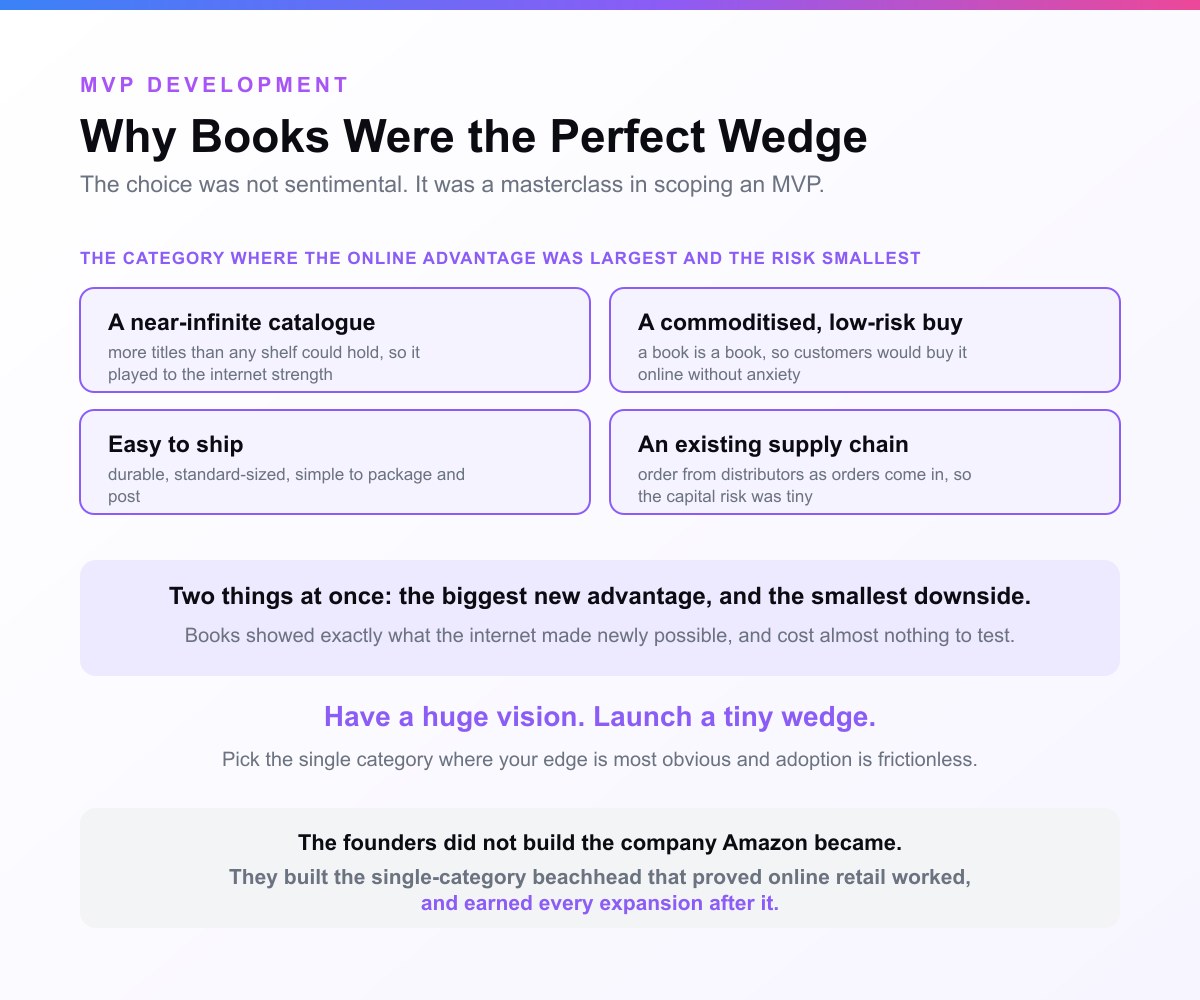
The choice of books was not sentimental, it was strategic, and the reasoning is a masterclass in scoping an MVP. Bezos reportedly evaluated a list of possible product categories and chose books for a specific set of reasons:
- A near-infinite catalog. There were millions of books in print, far more than any physical bookstore could ever stock on its shelves. An online store had no shelf-space limit, so it could offer a selection no physical competitor could match. The product played to the internet's unique strength.
- A commoditized, low-risk product. A book is a book, the same copy everywhere. Customers did not need to touch or try it, so they would buy it online without anxiety, exactly the doubt that made other categories risky.
- Easy to ship. Books are durable, standard-sized, and simple to package and post.
- An existing supply chain. Large book distributors already held vast inventories, so Amazon could order titles as orders came in, rather than buying and warehousing millions of books up front. The capital risk was tiny.
Books were the category where the online advantage was largest and the risk was smallest. That combination is what makes them the perfect MVP wedge.
The MVP: a bare website and a garage
What launched in 1995 was unglamorous: a plain website where people could browse and order books, run by a tiny team out of a garage in Washington state. There was no recommendation engine as we know it, no Prime, no warehouses spanning continents, no marketplace of third-party sellers, no cloud platform. There was a site, a catalogue sourced largely from distributors, and a scrappy operation packing and shipping orders by hand.
It was, in MVP terms, the smallest real version of the everything-store idea: one category, sold online, fulfilled simply. The point was to prove that people would buy online at all, and that the model worked, before pouring capital into scale.
What they deliberately didn't build
The list of what Amazon was not, in 1995, is the whole lesson. No electronics, toys, or groceries. No giant fulfilment network. No Prime membership, no Kindle, no Alexa, no Amazon Web Services (which would not arrive for another decade). The founders did not build the company Amazon became; they built the single-category beachhead that proved online retail worked. Every famous Amazon business was added later, on top of a validated core, one expansion at a time.
By the numbers
- 1 product category at launch: books
- Millions of titles available, more than any physical store, the internet's edge
- ~0 warehoused inventory at first, titles ordered from distributors as sold
- 1 garage, where it started
- ~$1 trillion+ eventual market value of the company that grew from it
Why this is a textbook beachhead MVP
Amazon is the canonical example of launching a huge vision through a single, well-chosen category:
- It tested the core model with minimal risk. Would people buy online, and could the operation work? Books answered that for the least possible capital and downside.
- It chose the category where the new advantage was biggest. Unlimited online shelf space mattered most for a product with a near-infinite catalogue, so books showcased exactly what the internet made newly possible.
- It used an existing supply chain to stay light. Ordering from distributors meant Amazon did not have to bet on inventory before demand, the same "fake the expensive part" instinct behind other great MVPs.
- It earned every expansion. Music, electronics, and eventually everything, plus Prime and AWS, were added only after the model was proven, never as a simultaneous moon-shot.
The lesson you can steal
You are not building the everything store, but the Amazon wedge transfers to any large ambition:
- Have a huge vision, launch a tiny wedge. Pick the single category, segment, or use case that proves your model with the least risk, and start there. The big vision can wait in your head.
- **
Most wedges sit on one axis. Amazon found the category that scored on both at once.
Choose the wedge where your advantage is strongest.** Amazon picked books because that is where "unlimited online selection" mattered most. Find the niche where your edge is most obvious.
3. Pick the lowest-risk entry point. A commoditized, easy-to-deliver product that customers will buy without hesitation lets you test the model cleanly, without fighting adoption friction at the same time.
4. Stay light on what you can borrow. Amazon used existing distributors instead of building inventory. Lean on existing infrastructure so your MVP risks as little capital as possible.
5. Expand category by category, from proof.
Each new market should sit on top of a validated one, not be launched on hope alongside everything else.
From books to everything
Once books proved that people would buy online and that the model worked, Amazon did what a validated wedge earns: it expanded, relentlessly. Music and DVDs came next, then electronics, then category after category, until "the everything store" was simply true. Later came the businesses that redefined the company, Prime, the Kindle, and Amazon Web Services, each built on the foundation, and the cash flow, that the original retail model had proven.
But all of it grew from a deliberately narrow start: one category, chosen because it carried the biggest online advantage and the smallest risk. Bezos thought in decades and launched in books.
How would you run the Amazon MVP today?
The beachhead strategy is as powerful now as in 1995:
- Write down the huge vision, then ignore most of it. Identify the single category, niche, or use case that is the smartest first wedge into it.
- Pick the wedge where your unfair advantage is largest and where customer risk is smallest, so the model is tested cleanly.
- Borrow infrastructure instead of building it. Use existing suppliers, platforms, or no-code tools so your first version risks almost no capital.
- Only expand once the wedge is proven, then add the next category or segment from a position of strength, not hope.
The Amazon MVP proves that the way to build something almost unimaginably large is to start with one carefully chosen small thing, and earn the right to the rest.
Think in decades, launch a wedge
The reason the Amazon story matters is the gap between the size of the vision and the size of the start. Bezos was never only building a bookstore, but a bookstore was exactly the right thing to build first: the lowest-risk, highest-advantage wedge into an enormous idea. That is the discipline behind every great MVP, think huge, launch tiny, and let proof, not ambition, decide what you build next.
That is how we approach a first build at MVP Development. We help founders cut a big vision down to the smartest single wedge worth testing, and ship a funding-ready MVP in 3 to 4 weeks, by senior engineers, on a fixed quote you approve before we start, with full code ownership.
See more famous first versions in our MVP examples roundup, or read the Uber and Airbnb case studies for two more ways the same discipline plays out.
Amazon's lesson is scope: one category, done completely. For more famous first versions, browse our MVP examples roundup, and when you're ready to pick your own one category, Tell us the niche you want to own and we will scope the single category to prove it in.
Related guides
- The Uber MVP: another huge vision launched through a tiny wedge
- Single-feature MVP: the narrow-scope approach behind beachhead launches
- MVP examples: 15 famous MVPs and what they teach
- MVP scope: choosing the one thing to build first
Frequently asked questions
What was Amazon's MVP?
Amazon's MVP, at its 1995 launch, was a simple website that sold only one kind of product, books, run from a garage by a small team. Founder Jeff Bezos had the vision of an "everything store" from the start, but deliberately launched with a single category to prove the model with minimal risk. He chose books because there were millions of titles (far more than any physical store could stock, playing to the internet's unlimited shelf space), because books are a low-risk, commoditized product people would buy online without hesitation, and because existing distributors meant Amazon could order titles as orders came in rather than warehousing inventory up front. Only after that model was proven did Amazon expand, category by category, into everything.
Why did Amazon start with only books?
Strategy, not sentiment. Bezos reportedly evaluated several product categories and chose books because they combined the biggest online advantage with the smallest risk. Books had a near-infinite catalogue, so an online store could offer a selection no physical bookstore could match, the internet's unlimited shelf space mattered most here. They were also a standardized, commoditized product customers would buy unseen, easy to ship, and supplied by large existing distributors, so Amazon could stay light on inventory. That made books the perfect "wedge": the lowest-risk way to prove online retail worked before expanding to other categories.
What can founders learn from the Amazon MVP?
The core lesson is "think huge, launch tiny." Have an enormous vision if you want, but launch through a single, carefully chosen wedge, the one category, segment, or use case that proves your model with the least risk and the biggest advantage. Pick the lowest-risk entry point so adoption is easy, borrow existing infrastructure (as Amazon used distributors) so your MVP risks little capital, and expand category by category only after the core is proven. Amazon shows that the path to something almost unimaginably large often begins with one deliberately small, well-chosen thing.
Sources & references
- Eric Ries, The Lean Startup: the MVP and validated-learning principles
- Y Combinator Library: startup strategy and growth
- Atlassian, Minimum Viable Product: what an MVP is and is for
The Amazon founding story is widely documented; details here reflect the commonly reported account.


