


TL;DR
The Buffer MVP was two web pages and a pricing table for a product that did not exist yet. Founder Joel Gascoigne tested willingness to pay before writing any code: real clicks on the paid plans proved demand first, making it the textbook landing-page MVP.
Most founders build a product, launch it, and then find out whether anyone will pay. Joel Gascoigne did it backwards. Before he wrote a single line of Buffer, he tested whether people would pay for it, using nothing but a couple of web pages and a pricing table for a product that did not exist.
That tiny experiment became Buffer, a profitable, well-known social-media tool. This is the story of the Buffer MVP, and why a fake pricing page is one of the most honest tests a founder can run.
Key Takeaways
- Joel Gascoigne validated Buffer before writing a single line of code.
- He tested willingness to pay with nothing but a couple of web pages and a pricing table for a product that did not exist.
- A first page pitched the product; a click led to a pricing page that captured emails.
- Real clicks on the paid plans proved demand before any build.
- It is the textbook landing-page MVP: test payment intent, then build.
At a Glance
| The Buffer MVP | Detail |
|---|---|
| MVP type | Landing page |
| What they built | Two pages and a pricing table for a product that did not exist |
| Signal | Clicks on the paid plans (real payment intent) |
| Lesson | Test willingness to pay before writing code |
The idea, and the usual expensive mistake
In 2010, Gascoigne wanted to build a simple tool to schedule and space out posts to Twitter, what became Buffer. The normal path would have been to spend weeks or months building it, launch, and hope. He had learned the hard way, from earlier projects, that building first and validating later is how founders waste their time.
So he asked a sharper question than "can I build this?" He asked, "will anyone actually pay for this?", and he decided to answer it before building anything. The crucial insight: interest is cheap, but payment is the real signal, and you can test for payment without a product.
Plenty of people will say a product sounds nice. Far fewer will click "buy." The Buffer MVP was designed to measure the second group, not the first.
The MVP: a landing page, then a pricing page
Gascoigne's first version was a minimal landing page. It explained what Buffer would do, "a smarter way to share on Twitter", and had a button to find out more.
When visitors clicked, they were asked for their email to be notified. That tested one thing: are people interested enough to act?
The signups were encouraging, but Gascoigne knew interest is not the same as willingness to pay. So he ran a second, smarter version. He added a "Plans and Pricing" page. Now the flow was: see the value proposition, click through to pricing, and choose a plan, including paid tiers.
When someone clicked a paid plan, they did not reach a checkout, because there was no product. They reached a short message explaining that Buffer was not quite ready yet, with a field to leave their email. The genius is in what that click measured. A visitor who clicked a paid plan was not just curious, they had signalled, with their behaviour, a willingness to pay real money. That is a far stronger signal than a newsletter signup.
What the pricing page revealed
The two-step test gave Gascoigne layered evidence:
- People landed and clicked through, demand existed.
- Some of those people clicked paid plans, not just the free option, willingness to pay existed.
That second data point is the one most validation skips. Lots of MVPs prove that people are interested; the Buffer pricing page proved that people would consider paying, before a product had been built. Armed with that, Gascoigne knew not only that Buffer was wanted, but that it could be a business.
By the numbers
- 2 pages in the core MVP: a landing page and a fake pricing page
- 0 product code written before willingness to pay was tested
- ~7 weeks from idea to first paying customers, once he decided to build
- 1 question answered that most MVPs never ask: will people pay?
Why this is the textbook landing-page MVP
Buffer is the canonical example of validating with a landing page, and specifically of taking it one level deeper than most:
- It tested the riskiest assumption, willingness to pay. For a paid product, the scariest question is not "do people like it?" but "will they pay?" Buffer's MVP was built to measure exactly that.
- It used a fake door for the paid plans. Clicking a paid plan led to a "not ready yet" page, a fake-door test that captured payment intent without any product behind it.
- It separated interest from intent. The landing page measured interest; the pricing page measured intent to pay. Two different signals, gathered in sequence.
- It cost almost nothing. A couple of pages against weeks of building. The test was cheap; the insight was decisive.
The two-step validation you can copy
The reusable structure of the Buffer MVP is a simple ladder:
- Test interest first. A landing page with a clear value proposition and a single call to action. Do people click and give you their email?
- Then test willingness to pay. Add a pricing page. When someone selects a paid plan, capture their intent (and email) with a "coming soon" message. Do people choose paid options, not just the free one?
If both steps return a yes, you have something most founders never have before they build: evidence not just that people want it, but that they will pay for it.
From a pricing page to a real business
Once the pricing page proved people would pay, Gascoigne built the first real version of Buffer, famously, in about seven weeks, and had paying customers almost immediately after launch. He had validated willingness to pay before building, so launch was not a gamble; it was the collection of a demand he had already measured.
From there Buffer grew into a profitable, bootstrapped company, well known in startup circles for its radical transparency and remote-first culture, serving a large base of paying customers. But the foundation was laid by a test that cost almost nothing: a landing page and a pricing table for a product that did not yet exist.
How would you run the Buffer MVP today?
This is one of the easiest MVPs to run now, and one of the most under-used:
- Build a sharp landing page with a clear promise and one call to action, using any no-code page builder.
- Add a pricing page with real-looking plans, including paid tiers.
- Make the paid plans a fake door. Selecting one leads to a "we're launching soon, leave your email" message that captures payment intent.
- Drive a little real traffic and watch the behaviour: do people click through, and do they choose paid plans? That is your willingness-to-pay signal, gathered before you build.
The Buffer MVP proves you can answer the single most important question about a paid product, will anyone pay?, for the cost of two web pages, long before you commit to building it.
Test the wallet, not the opinion
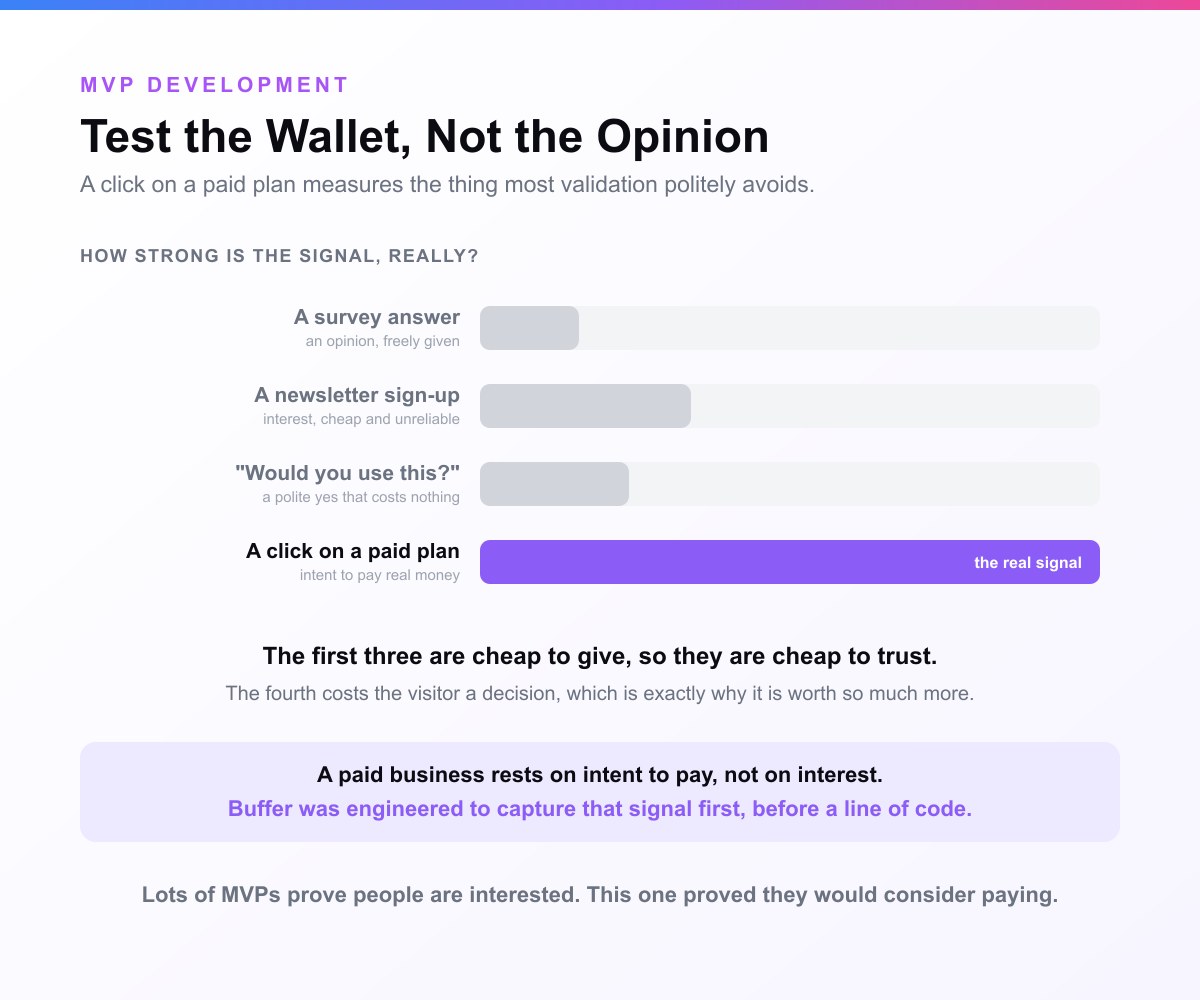
The reason the Buffer story matters is that it tests the thing most validation politely avoids: money. Surveys, sign-ups, and "would you use this?" all measure interest, which is cheap and unreliable. A click on a paid plan measures intent to pay, which is the signal a paid business actually rests on. Buffer's MVP was engineered to capture that signal first, before a line of code.
That is the discipline we bring to a first build at MVP Development. We help founders find the cheapest honest test of the riskiest assumption, often willingness to pay, and, once it is proven, ship a funding-ready MVP in 3 to 4 weeks, by senior engineers, on a fixed quote you approve before we start, with full code ownership.
See more famous first versions in our MVP examples roundup, or read the Airbnb, Dropbox, Uber, and Zappos case studies for more ways the same discipline plays out.
Buffer proved demand with two pages before building anything. See how other giants started in our MVP examples roundup, or, if your landing-page test has already said yes, Tell us the promise your landing page would make and we will help you test the wallet before the build.
Related guides
- Landing page MVP: the approach Buffer used
- Fake door MVP: the fake-pricing-plan technique
- The Zappos MVP: testing willingness to pay with real purchases
- MVP validation: proving demand before you build
Frequently asked questions
What was Buffer's MVP?
Buffer's MVP, in 2010, was a pair of web pages, no product. Founder Joel Gascoigne first put up a landing page explaining the idea (a tool to schedule posts to Twitter) with a button to sign up for more information, which tested interest. Then he added a "Plans and Pricing" page; when a visitor clicked a paid plan, they reached a message saying Buffer was not ready yet and could leave their email. That click on a paid plan tested willingness to pay, before any product existed. The positive response told Gascoigne not just that people wanted Buffer, but that they would pay for it, so he built it, reaching paying customers within about seven weeks.
Why is the Buffer MVP a landing-page MVP?
Because the entire MVP was built from landing pages, not a product. A landing-page MVP presents a product as if it exists and measures whether people act, usually by signing up. Buffer went a level deeper by adding a pricing page, turning it into a willingness-to-pay test: the paid plans were a fake door that captured payment intent rather than processing a real transaction. This let Gascoigne validate the single hardest question for a paid product, will people pay?, using only a couple of pages, which is exactly what a good landing-page MVP is for.
What can founders learn from the Buffer MVP?
The key lesson is to test willingness to pay, not just interest, and to do it before building. Run it as a two-step ladder: first a landing page to see if people are interested enough to act, then a pricing page where selecting a paid plan (a fake door) captures intent to pay. Interest is cheap and unreliable; a click on a paid plan is a far stronger signal that you have a business, not just an idea people like. Buffer proves you can answer "will anyone pay?" for the cost of two web pages, long before you write a line of product code.
Sources & references
- Buffer: Idea to Paying Customers in 7 Weeks: Buffer's own account of the MVP
- Joel Gascoigne: Validate Your Idea with a Landing Page MVP: the founder's write-up
- Eric Ries, The Lean Startup: validated learning and willingness-to-pay tests
- Y Combinator Library: early-stage validation strategy
The Buffer founding story is widely documented; details here reflect the commonly reported account.


