


TL;DR
The Airbnb MVP was three air mattresses on a living-room floor: in 2007, two founders who could not make rent hosted three paying guests during a design conference. That scrappy test of whether strangers would pay to stay in someone's home became one of startup history's most-cited MVPs and the seed of a company now worth tens of billions.
In the autumn of 2007, two design-school graduates in San Francisco could not make rent. A few weeks later they had three paying guests sleeping on air mattresses in their living room. That weekend, almost by accident, became one of the most-cited MVPs in startup history, and the seed of a company now worth tens of billions of dollars.
This is the story of the Airbnb MVP: what they actually built, why it worked, and the lessons you can steal for your own first version.
Key Takeaways
- In 2007, two design-school graduates in San Francisco could not make rent.
- They put three air mattresses in their living room and hosted three paying guests during a design conference.
- That weekend became one of the most-cited MVPs in startup history.
- The MVP tested one question cheaply: would strangers pay to sleep in someone's home?
- It grew into a company now worth tens of billions of dollars.
At a Glance
| The Airbnb MVP | Detail |
|---|---|
| Year | 2007 |
| MVP type | Concierge / manual demand test |
| What they built | Air mattresses plus a simple site for one conference |
| Result | Three paying guests, then a company worth tens of billions |
| Lesson | Test the riskiest question cheaply: will strangers pay to stay? |
Rent was due
Brian Chesky and Joe Gebbia were roommates, broke, and behind on the rent for their San Francisco apartment. Then they noticed an opportunity hiding in plain sight: a big design conference was coming to the city, and every hotel in town was sold out. Attendees were going to arrive with nowhere affordable to stay.
So they made a wildly unglamorous offer. They had spare floor space and a few air mattresses. Why not rent those out, with breakfast thrown in, to designers who could not get a hotel? They threw together a bare-bones website, called it "AirBed & Breakfast," and waited to see if anyone would actually pay to sleep on a stranger's floor.
The entire business rested on one leap-of-faith assumption: that strangers would pay to stay in someone's home. Everything else was detail.
The MVP: three air mattresses and a one-page site
What Chesky and Gebbia built was about as minimal as a product gets, and that is exactly why it is such a clean example of an MVP.
There was no booking engine. No payments platform. No search, no filters, no ratings, no maps, no host dashboard, no mobile app. There was a simple site that described the offer and a way to get in touch, and there were three air mattresses on a hardwood floor. The "product" was a promise plus a place to sleep.
Crucially, the founders ran the whole thing by hand. They set up the mattresses themselves. They greeted the guests, showed them around the city, and cooked them breakfast. They handled everything personally, learning directly from the only people who mattered: the first real customers. That manual, high-touch approach has a name, it is a concierge MVP, and Airbnb is the textbook case of it.
What they deliberately left out
The instinct of most founders is to build the platform, the scalable, automated, global version of the idea. Chesky and Gebbia built none of that, and the restraint is the lesson.
They did not build the things you would associate with "Airbnb" today because none of those things were needed to answer the one question that mattered. You do not need an algorithm to find out whether three people will pay to sleep on your floor this weekend. You need three people, a floor, and a way to ask. Everything beyond that was a feature waiting for permission, permission that only real demand could grant.
By the numbers
- 3 paying guests on the first run
- ~$80 a night, roughly, per air mattress
- 0 lines of complex booking or payments code in the first version
- 1 leap-of-faith assumption being tested: will strangers pay to stay in a home?
- Tens of billions of dollars: the eventual valuation of the public company that grew from it
Why this is the textbook MVP
Strip away the famous logo and the Airbnb story is a near-perfect demonstration of what an MVP is for.
- It tested the riskiest assumption first. Not "can we build a global marketplace," but "will anyone pay for this at all?" That is the question that, if answered "no," kills everything, so it is the one a smart MVP attacks first. (More on that in MVP validation.)
- It delivered real value, narrowly. This was not a mockup or a prototype. Real guests slept in real beds and paid real money. The MVP was tiny, but it was a working product, which is what separates an MVP from a demo.
- It produced learning, not just revenue. By hosting people themselves, the founders learned what guests valued, what worried them, and what the experience needed, the exact input a build-measure-learn loop runs on.
- It was almost free to run. The cost of being wrong was a weekend and some bedding, not a year and a budget. That asymmetry, cheap to test, expensive to skip, is the whole point of an MVP.
The lessons you can steal
You are not building a home-sharing marketplace, but the moves that made the Airbnb MVP work transfer to almost any first version:
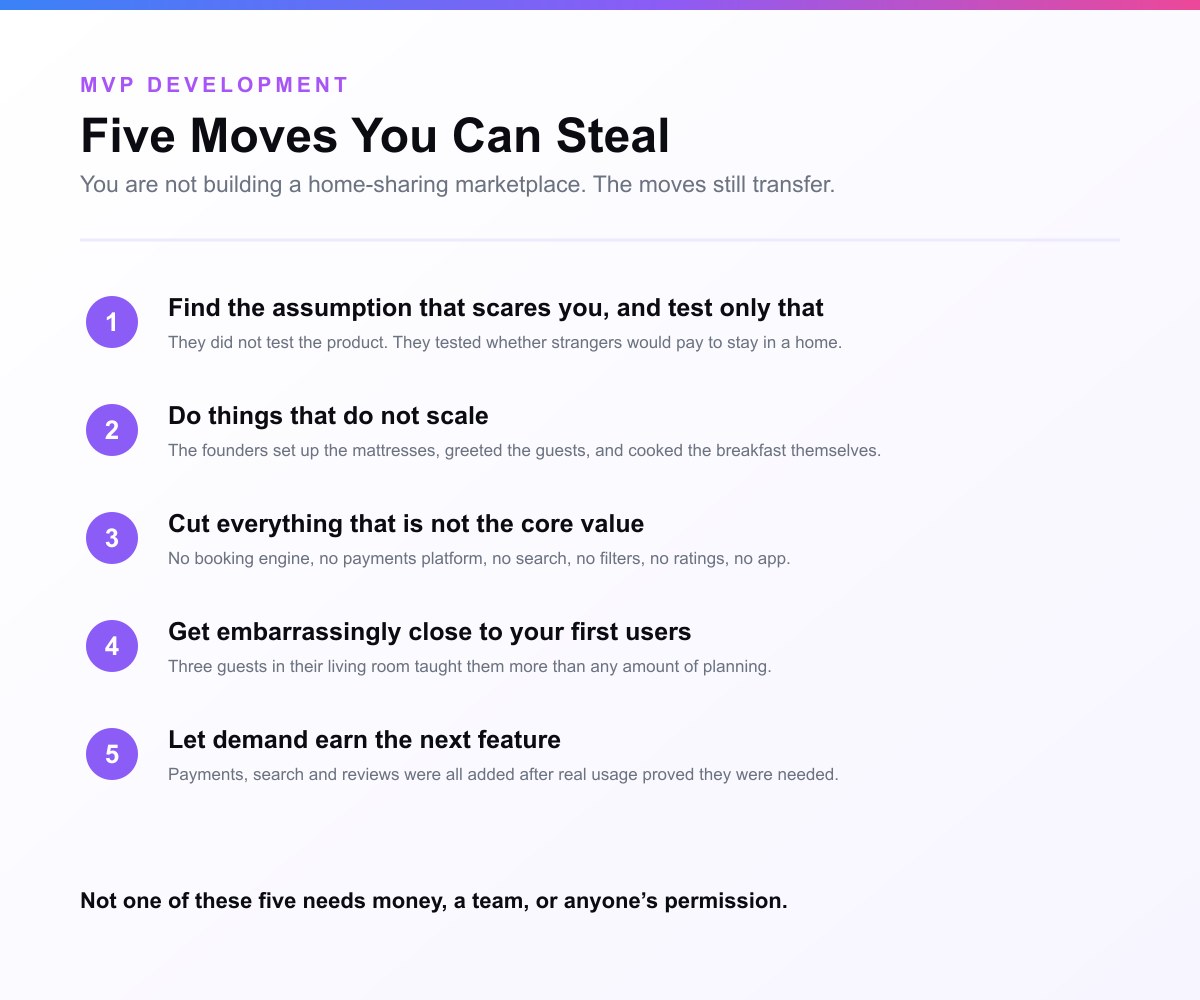
- Find the assumption that scares you, and test only that. Airbnb did not test their product; they tested whether strangers would pay to stay in a home. Name your own version of that question and build the smallest thing that answers it.
- Do things that don't scale. The founders made beds and cooked breakfast by hand. Manual, unscalable effort is not a failure of the MVP, it is often the fastest way to learn before you automate. Build the concierge version first.
- Cut everything that isn't the core value. No booking engine, no filters, no app. Your MVP's job is the one core flow, not a small version of the whole roadmap (see MVP scope).
- Get embarrassingly close to your first users. The founders learned more from three guests in their living room than they could have from any amount of planning. Real behaviour from a few real users beats opinions from a hundred.
- Let demand earn the next feature. Everything Airbnb eventually built, payments, search, reviews, was added after real usage proved it was needed, not before.
From air mattresses to a global brand
The first weekend was not an overnight success, it was a beginning. The idea was nearly written off more than once, and the lean years that followed are part of why the story is so instructive.
To keep the company alive in 2008, the founders pulled off one of startup history's great scrappy-funding hacks: during that year's US presidential election they designed limited-edition cereal boxes, "Obama O's" and "Cap'n McCain's," and sold them, reportedly raising around $30,000 to fund the struggling company. A third co-founder, Nathan Blecharczyk, joined to build the technology the manual MVP had been standing in for. And a turning point came when they were pushed, inside Y Combinator, to go and talk to their early hosts in person in New York, more doing-things-that-don't-scale, which sharpened the product around what real users actually wanted.
From there it compounded: a real platform built on validated demand, expansion city by city, and eventually a public company worth tens of billions. But every bit of that was built on top of a question the air-mattress MVP had already answered: yes, strangers will pay to stay in a home. The rest was execution on a proven idea.
The Airbnb MVP timeline
The journey from air mattress to IPO is worth seeing laid out, because it shows how long the gap between a scrappy MVP and a "real" company can be:
- 2007: Chesky and Gebbia rent air mattresses to design-conference attendees as "AirBed & Breakfast." Three guests pay. The MVP works.
- 2008: They relaunch the site, fund the company by selling novelty election cereal, and Nathan Blecharczyk joins as the technical co-founder.
- 2009: Airbnb goes through Y Combinator, drops the "AirBed & Breakfast" name, and starts building a real platform on the validated demand.
- 2010s: City-by-city expansion, major funding rounds, and growth into a global marketplace.
- 2020: Airbnb goes public, a company worth tens of billions, built on a question first answered by three air mattresses.
The lesson in the timeline: the MVP answered the riskiest question fast, but turning that answer into a giant still took years of execution. The MVP is the start of the story, not the whole of it.
How would you run the Airbnb MVP today?
The tools have changed; the playbook has not. If you had Airbnb's idea now, the modern version of that 2007 weekend would look like this:
- Stand up a one-page site in an afternoon with a no-code tool or a simple landing page, describing the offer and capturing interest, no platform, no app.
- Run the operations by hand. Take bookings over email or DM, arrange payment manually, and personally handle the first few stays. You are the concierge; the software comes later.
- Stay hyper-local and tiny. One city, one weekend, a handful of real guests, exactly enough to answer "will strangers pay?" and nothing more.
- Only build the platform once demand is undeniable. When the manual version is clearly working and you cannot keep up by hand, that is the signal to invest in the real product, on a stack that scales.
The point is that the Airbnb MVP is not a dusty 2007 artifact, it is a repeatable pattern you can run this month, on today's tools, for almost any marketplace or service idea.
One caveat if you are running it in travel specifically: Airbnb had the rare advantage of owning the inventory, because it was their own apartment. Almost every traveltech founder today is reselling somebody else's rooms or seats, which changes the payment, refund and regulatory picture considerably. Our traveltech MVP guide covers what that means for scope.
Apply it to your own MVP
The Airbnb story is reassuring precisely because the MVP was so unimpressive. It was three air mattresses and a one-page site, run by hand by two people who could not make rent. It worked not because it was polished, but because it answered the one question that mattered, cheaply, with real users, before anyone spent a year building the wrong thing.
That is exactly how we think about a first build at MVP Development. We help founders find the riskiest assumption, scope the one core flow that tests it, and ship a funding-ready MVP in 3 to 4 weeks, by senior engineers, on a fixed quote you approve before we start, with full code ownership.
See more famous first versions in our MVP examples roundup, or, when you are ready to build yours, Pitch us your two-sided idea and we will tell you which side to win first.
Related guides
- Traveltech MVP: how to build in Airbnb's category today, when the inventory is not yours
- The Dropbox MVP: the explainer-video case study (a different MVP type, same discipline)
- The Uber MVP: the one-feature, one-city case study
- MVP examples: 15 famous MVPs and what they teach
- Concierge MVP: the do-it-by-hand approach Airbnb used
- MVP validation: testing the assumption that matters most
- What is an MVP?: the definition, in full
Frequently asked questions
What was Airbnb's MVP?
Airbnb's MVP, in 2007, was three air mattresses on the floor of founders Brian Chesky and Joe Gebbia's San Francisco apartment, plus a simple website called "AirBed & Breakfast." With local hotels sold out for a design conference, they offered attendees a place to sleep and breakfast in the morning. There was no booking engine, payments platform, search, or app, just a one-page site and a promise. Three guests paid around $80 a night, which validated the single leap-of-faith assumption behind the whole idea: that strangers would pay to stay in someone's home.
Why is Airbnb considered a concierge MVP?
Because the founders ran the entire experience manually, by hand, rather than building automated software. They personally set up the air mattresses, greeted guests, showed them around the city, and cooked breakfast. A concierge MVP is exactly this: you deliver the service yourself, high-touch and unscalable, so you can learn directly from early users before building the technology to automate it. Airbnb is the most-cited example of the approach, and it let the founders deeply understand what guests valued before investing in a platform.
What can founders learn from the Airbnb MVP?
Several transferable lessons: test your riskiest assumption first (will anyone pay at all?), not the whole product; do things that don't scale (manual effort teaches you fast); cut everything that isn't the core value (Airbnb had no booking engine, filters, or app); get extremely close to your first users; and let real demand, not your roadmap, earn each new feature. The deeper takeaway is that an MVP works when it answers the one question that matters cheaply and with real users, the Airbnb MVP was three air mattresses, and it was enough.
Sources & references
- Eric Ries, The Lean Startup: the MVP and validated-learning principles Airbnb embodies
- Y Combinator Library: "do things that don't scale" and early-startup strategy
- Atlassian, Minimum Viable Product: what an MVP is and is for
The Airbnb founding story is widely documented; details here reflect the commonly reported account.


