


TL;DR
The Instagram MVP was found by deleting, not building: it began as Burbn, a cluttered check-in app, and became Instagram when the founders stripped it down to the one feature people loved, photos. The lesson is that sometimes the MVP is what you remove, not what you add.
Most MVP stories are about what a founder chose to build. The Instagram story is about what its founders chose to delete. Instagram did not begin as Instagram. It began as a cluttered, going-nowhere check-in app called Burbn, and the product the world knows was found by stripping that app down to the one thing people actually loved.
This is the story of the Instagram MVP, and the most under-used way to find your MVP: subtraction.
Key Takeaways
- Instagram began as Burbn, a cluttered, going-nowhere check-in app.
- The product the world knows was found by deleting, not building.
- The founders stripped Burbn down to the one thing people actually loved: photos.
- That single feature, made effortless, became Instagram.
- The lesson: sometimes the MVP is what you remove, not what you add.
At a Glance
| The Instagram MVP | Detail |
|---|---|
| Started as | Burbn, a cluttered check-in app |
| The move | Deleted everything except photos |
| Result | The product people actually loved |
| Lesson | Sometimes the MVP is what you remove, not what you add |
The app that wasn't working
In 2010, Kevin Systrom built Burbn, an HTML5 mobile app inspired by the location check-in craze of the time. It did a lot of things: you could check in to places, make plans, earn points, hang out, and, among many other features, post photos. Mike Krieger joined as co-founder, and they had a working app and some early users.
The trouble was that Burbn was a mess. It was complicated, crowded, and trying to do too much, and it was not catching on. It is the situation countless founders find themselves in: a real, launched product that simply is not working, and no obvious single thing to fix.
The temptation when an app is not working is to add more, more features, more polish, more marketing. Instagram's founders did the opposite. They looked at what was already working, and cut everything else away.
The insight hiding in the data
Rather than guess, Systrom and Krieger looked closely at how people actually used Burbn.
And one behaviour stood out: of all the cluttered app's features, the one people genuinely engaged with was sharing photos.
That single observation reframed the whole company. The product was not failing because it needed more features; it was failing because the one feature people loved was buried under everything else. The MVP was not something they needed to build, it was something they needed to uncover, by removing the noise around it.
The brutal cut
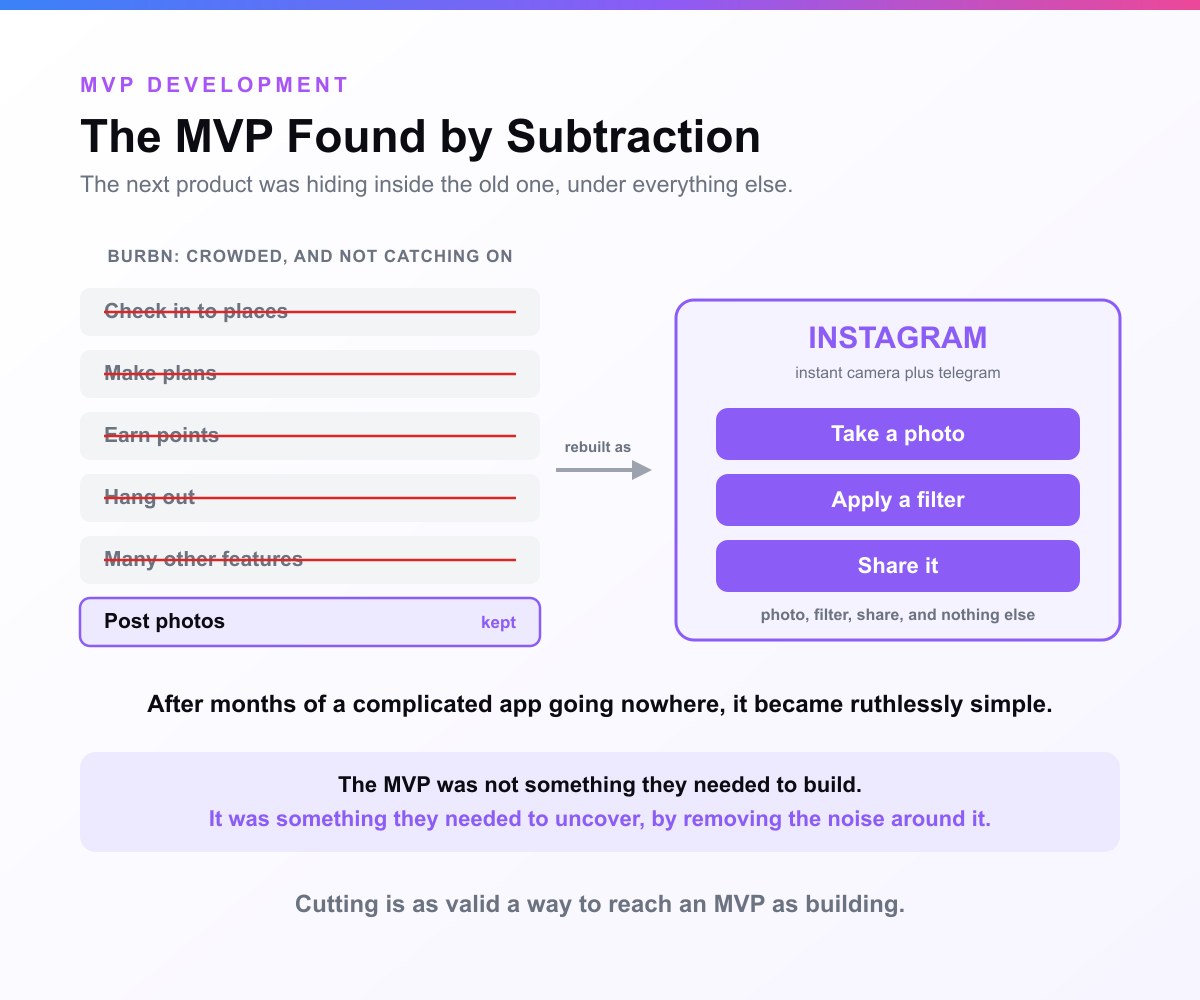
So they made the hard decision that defines the Instagram MVP: they stripped Burbn down to almost nothing. They cut the check-ins, the plans, the points, the clutter, and kept just three things, take a photo, apply a filter, and share it. Then they rebuilt it as a clean, single-purpose app and renamed it Instagram, a blend of "instant camera" and "telegram."
That was the entire MVP: photo, filter, share. After months of a complicated app going nowhere, the product became radically, almost ruthlessly, simple.
Why the filters mattered
One detail made the stripped-down app more than just "photo sharing." Phone cameras in 2010 produced mediocre photos, and the filters transformed them: an ordinary snapshot became something that looked stylish and intentional in a single tap. The filters were not a gimmick; they were the bit of delight that made sharing a photo feel good enough to do again and again.
The MVP was minimal in features but generous in that one experience, exactly where it mattered.
What happened next
The result of the subtraction was explosive. When Instagram launched in October 2010, it reportedly gained around 25,000 users on its first day, and roughly a million within a couple of months, growth Burbn had never come close to. The same founders, the same core technology, but a product cut down to its loved essence, found a market almost instantly.
By the numbers
- 1 app it started as: Burbn, cluttered and stalling
- 3 features the MVP kept: photo, filter, share
- ~25,000 users on launch day, after the cut
- ~13 employees when Facebook acquired it for around $1 billion in 2012
Why this is a textbook pivot-by-subtraction MVP
Instagram is the canonical example of finding an MVP by removing, not adding:
- The MVP was discovered, not invented. The winning product was already inside Burbn as one feature; the founders found it by watching real usage, the heart of a build-measure-learn loop.
- It was a pivot, executed decisively. When the data showed where the love was, they did not cling to the old app, they cut it. Knowing when to pivot or persevere is a founder superpower, and they used it.
- It made "minimum" truly minimal. Three features. The discipline to ship something that focused, after building something complex, is exactly the scope discipline most teams lack.
- It kept quality where it counted. The filters made the one core action delightful. Minimal in scope, polished in the core, the same balance every great MVP strikes.
The lesson you can steal
You may not have a stalling check-in app, but the Instagram move applies whenever a product is not working:
- When something isn't working, look at what already is.
Both paths feel like progress. Only one of them makes the product smaller.
Before adding features or spending on marketing, study how real users behave. The next product is often hiding inside the current one, as a single loved feature.
2. Find your MVP by subtraction. Be willing to delete most of what you built and keep only the part people genuinely value. Cutting is as valid a way to reach an MVP as building.
3. Pivot decisively when the evidence is clear. Do not half-pivot or keep the old app "just in case." Instagram cut hard and committed, which is why it worked.
4. Make the one core action delightful. Instagram kept three features but made the photo-and-filter moment feel great. Minimal scope does not mean a joyless experience.
5. Trust behaviour over attachment. The founders followed what users actually did, not what they had hoped Burbn would become. Real usage is the honest signal.
From a pivot to a billion-dollar app
After the cut, Instagram grew at a pace that startled even its founders, tens of millions of users within two years, on a tiny team. In April 2012, Facebook acquired it for around $1 billion, when Instagram had only about a dozen employees, one of the most striking returns on an MVP in startup history.
None of it came from a grand new idea. It came from the courage to look at a failing product, find the one thing people loved, and delete everything else. The Instagram MVP was not built; it was revealed.
How would you run the Instagram MVP today?
The subtraction play is available to any founder with a product that is not landing:
- Instrument your product and watch real behaviour. Find the one feature or flow people actually use and return to, even if it is not the one you expected.
- Be willing to cut to that core. Strip away everything that is not the loved feature, even if you built it, even if it was your original idea.
- Polish the one thing that remains. Make the core action genuinely delightful, the way Instagram's filters did, so people want to repeat it.
- Relaunch focused, and watch the difference. A product cut to its loved essence often finds traction the cluttered version never could.
The Instagram MVP proves that sometimes your minimum viable product is not something you have to build, it is already inside what you have, waiting for you to remove everything around it.
The MVP you already have
The reason the Instagram story endures is that it speaks to the most common, most painful startup situation: a launched product that is not working. The lazy responses are to add more or to give up. Instagram shows a third path, find the single thing people love, cut everything else, and commit. That is an MVP found by subtraction, and it is one of the most powerful moves a founder can make.
That is the kind of clarity we bring to a first build at MVP Development. We help founders find the one core thing worth shipping, whether by building it or by cutting to it, and deliver a funding-ready MVP in 3 to 4 weeks, by senior engineers, on a fixed quote you approve before we start, with full code ownership.
See more famous first versions in our MVP examples roundup, or read the Airbnb, Dropbox, and Spotify case studies for more ways the same discipline plays out.
Instagram won by cutting a whole app down to a single feature. Browse more first versions in our MVP examples roundup, or, when you know your one feature, Pitch us the one feature your app lives or dies on and we will scope the build around it alone.
Related guides
- Pivot or persevere: the decision Instagram's founders made
- Single-feature MVP: the focus-on-one-thing approach Instagram landed on
- MVP scope: cutting to the one thing that matters
- MVP examples: 15 famous MVPs and what they teach
Frequently asked questions
What was Instagram's MVP?
Instagram's MVP was the result of a pivot. The founders, Kevin Systrom and Mike Krieger, originally built Burbn, a cluttered check-in app with many features that was not gaining traction. Studying how people actually used it, they noticed the one feature people loved was sharing photos. So they stripped the app down to just three things, take a photo, apply a filter, and share it, and relaunched it as Instagram in October 2010. That radically simplified MVP, built from the loved feature inside a failing app, reportedly gained around 25,000 users on its first day and grew explosively from there.
How did Instagram pivot from Burbn?
By subtraction. Burbn was an HTML5 check-in app inspired by Foursquare, with check-ins, plans, points, and photo-sharing all crowded together, and it was not working. Rather than add more features, Systrom and Krieger looked at real usage data and saw that photo-sharing was the only feature people genuinely engaged with. They made the decisive call to cut everything else, keep just photos, filters, and sharing, and rebuild around that single loved feature, renaming the app Instagram. It is a textbook pivot: follow what users actually do, then commit hard to it.
What can founders learn from the Instagram MVP?
The biggest lesson is that an MVP can be found by removing, not just building. When a product is not working, study real behaviour to find the one feature people actually love, then be willing to delete everything else and commit to that core. Pivot decisively rather than half-heartedly, keep the one remaining action genuinely delightful (Instagram's filters made photos look great), and trust what users do over what you hoped they would do. Instagram shows that sometimes your minimum viable product is already inside your current product, waiting for you to cut away everything around it.
Sources & references
- Eric Ries, The Lean Startup: pivots and validated learning
- Y Combinator Library: startup pivots and growth
- Atlassian, Minimum Viable Product: what an MVP is and is for
The Instagram founding story is widely documented; details here reflect the commonly reported account.


