


TL;DR
The Spotify MVP cut everything except one experience: music that played the instant you pressed play. In 2008 its real competitor was free piracy, so instead of trimming features to the smallest product, Spotify made the one core experience, near-zero latency, perfect enough to make people pay.
In 2008, the music industry had a problem with no obvious solution: people had simply stopped paying. Piracy was everywhere, free, instant, and good enough. Selling music meant competing with "free." Most MVP advice is about cutting features until you have the smallest product. Spotify's MVP did something different, and harder: it cut everything except the one experience that had to be perfect, music that played the instant you pressed play.
This is the story of the Spotify MVP, and why sometimes the minimum viable product is not about fewer features, but about one feature done better than anyone thought possible.
Key Takeaways
- In 2008, Spotify's real competitor was free piracy, not other paid services.
- Most MVP advice cuts features; Spotify instead made one experience perfect.
- It cut everything except music that played the instant you pressed play.
- Near-zero latency was the feature that had to beat "free."
- Getting the one core experience right is what made people pay.
At a Glance
| The Spotify MVP | Detail |
|---|---|
| Year | 2008 |
| Real competitor | Free piracy |
| What they perfected | Music that plays the instant you press play |
| What they cut | Almost everything else |
| Lesson | Make the one core experience perfect, not the feature set small |
The real competitor was free
When Daniel Ek and Martin Lorentzon set out to build Spotify in Sweden, the same country that had produced The Pirate Bay, they understood the true competition clearly. It was not iTunes or other paid stores. It was piracy: services where any song was available instantly and for nothing.
That framing shaped everything. To win, a legal music service could not just be available, it had to be better than stealing. And the thing that made piracy so sticky was not the price, it was the immediacy. You wanted a song, you had it. Any legal product that made you wait, buffer, or jump through hoops would lose to the free alternative every time.
The riskiest assumption was not "will people pay for music?" It was "can streaming feel so instant that it beats getting the file for free?" Everything depended on speed.
The MVP: one experience, obsessed over
So the Spotify MVP was built around a single, almost monomaniacal goal: make a track start playing the instant you click it, fast enough that it felt like the music was already on your machine.
On the internet speeds of 2008, that was genuinely hard. The team obsessed over latency, the tiny delay between pressing play and hearing sound, and engineered relentlessly to drive it down to near-imperceptible, using clever techniques like peer-to-peer delivery and smart caching to make streaming feel local.
The difference between a one-second delay and a near-instant one was, in their view, the difference between beating piracy and losing to it.
Everything else was kept minimal. The first version was an invite-only desktop application, no open signup, no mobile apps, no social features at scale, no vast catalogue of extras. Just a clean player and, behind it, the one thing that had to be magic: instant, seamless playback.
Why invite-only
The closed, invite-only beta was not just for hype, though the scarcity did create buzz. It was a control mechanism. Streaming music legally meant licensing deals with rights holders, and a careful, gated rollout let Spotify manage those obligations, control server load, and keep the experience tightly polished for a small group before opening the floodgates. The invite-only MVP let them prove the core experience was magical before scaling the hard commercial and technical machinery around it.
By the numbers
- 1 make-or-break experience: instant, lag-free playback
- Near-zero perceived latency, the metric the whole MVP was judged on
- Invite-only desktop beta, scale controlled on purpose
- Free (ad-supported) at the core, because the competitor was free
- Hundreds of millions of users the platform would eventually reach
Why this is a textbook "nail the core experience" MVP
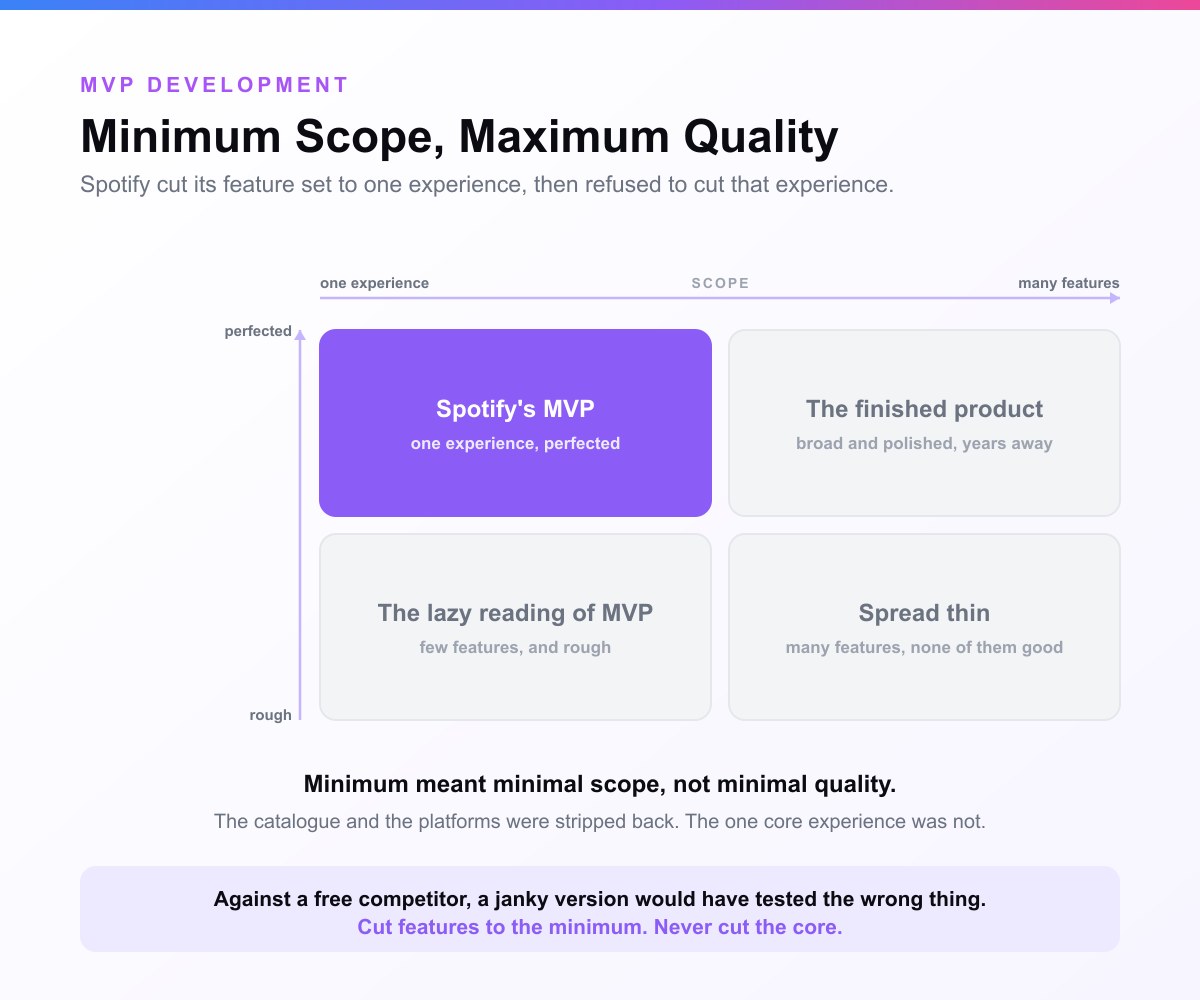
Spotify flips a common misunderstanding of what "minimum" means:
- It identified the one experience that had to be perfect. Against a free competitor, immediacy was everything. The MVP poured all its effort into that single thing rather than spreading thin across features.
- "Minimum" meant minimal scope, not minimal quality. The catalogue, the platforms, and the extras were stripped back, but the core playback experience was polished to an extreme. A janky version would have produced a false negative, because the whole bet was on feel.
- It used a gated beta to validate before scaling. Invite-only let them perfect the experience and manage licensing and infrastructure before opening up, exactly when scale would have been most dangerous.
- It tested the riskiest assumption directly. Not "will people use a music app?" but "is streaming instant enough to beat free?" The MVP was engineered to answer precisely that.
The lesson you can steal
You may not be fighting piracy, but Spotify's MVP teaches a lesson most "build the smallest thing" advice misses:
- When you compete with a free or entrenched alternative, win on experience. Being merely available is not enough; your MVP has to be visibly better at the one thing that matters most.
- Find the single make-or-break experience, and over-invest in it. Strip everything else to the minimum, then make that one thing genuinely excellent. Minimal scope, maximal polish on the core.
- Do not confuse "minimum viable" with "low quality." If your bet is on how the product feels, a rough version tests the wrong thing. Cut features, never the core experience.
- Use a gated beta to perfect before you scale. An invite-only launch lets you nail the experience and manage the hard parts (here, licensing and infrastructure) with a small, controlled audience first.
- Frame the MVP against the real competitor. Spotify's was piracy, not other apps. Knowing what you are actually up against tells you which one thing your MVP must beat.
From a Swedish beta to a global platform
Once the instant-playback experience proved it could genuinely beat free, Spotify earned the right to scale. It opened up beyond the invite-only beta, expanded its catalogue and licensing, added mobile apps, launched in new countries, and eventually reached the United States in 2011. From there it grew into the dominant music-streaming platform, hundreds of millions of users, a public company, and the service that helped pull the music industry back from the brink of piracy.
But all of it rested on a beta that did one thing brilliantly: it made pressing play feel instant. The minimum viable product was not a stripped-down music app; it was a single, perfected experience that proved legal streaming could win.
How would you run the Spotify MVP today?
The "nail one experience" play applies to any product fighting an entrenched or free alternative:
- Name the one experience that has to be better than the alternative, speed, simplicity, quality, whatever your real competitor wins on.
- Strip your MVP to that core, and over-invest in making it excellent. Cut breadth ruthlessly; spend your effort on depth in the one thing that matters.
- Consider a gated, invite-only beta to perfect the experience and manage the hard parts before you open up.
- Judge the MVP on that one experience, not on feature count. If the core feels magical to a small group, you have validated the thing that matters.
The Spotify MVP proves that "minimum viable" sometimes means doing one thing better than anyone expected, not doing many things barely.
Make the core feel like magic
The reason the Spotify story is instructive is that it corrects a lazy reading of "MVP." Minimal does not mean mediocre. When your whole idea rests on how the product feels, against a free competitor, the MVP's job is to make that one feeling, instant playback, undeniable. Everything else can wait; the core cannot.
That is how we think about a first build at MVP Development. We help founders find the single experience their product lives or dies on, and ship a funding-ready MVP in 3 to 4 weeks that nails it, by senior engineers, on a fixed quote you approve before we start, with full code ownership.
See more famous first versions in our MVP examples roundup, or read the Uber and Dropbox case studies for two more ways the same discipline plays out.
Spotify spent its MVP effort on the one thing that had to feel instant. More origin stories are in our MVP examples roundup; when you know your product's magic moment, Tell us the one experience your product must nail and we will scope minimum surface at maximum quality.
Related guides
- Single-feature MVP: the focus-on-one-thing approach Spotify used
- MVP examples: 15 famous MVPs and what they teach
- The Dropbox MVP: another product where the core experience was the whole bet
- MVP UX design: designing an MVP experience that actually wins
Frequently asked questions
What was Spotify's MVP?
Spotify's MVP, around 2008, was an invite-only desktop application built around a single obsession: making music play the instant you pressed play. Founders Daniel Ek and Martin Lorentzon knew their real competition was piracy, free and instant, so a legal service had to beat it on immediacy. The whole MVP poured its effort into driving streaming latency down to near-imperceptible, using techniques like peer-to-peer delivery and caching, while keeping everything else minimal (no open signup, no mobile apps, a controlled catalogue). The gated beta let them perfect that core experience and manage licensing before scaling.
Why did Spotify launch invite-only?
The invite-only beta served several purposes beyond hype. It let Spotify control server load and polish the experience for a small group before opening up; it helped manage the complex music-licensing deals that legal streaming required, by keeping the rollout gradual; and the scarcity created genuine buzz. Most importantly, it let the team validate that the core experience, instant, seamless playback, was truly magical before scaling the hard commercial and technical machinery around it. Gating the launch reduced risk exactly when scaling would have been most dangerous.
What can founders learn from the Spotify MVP?
The key lesson is that "minimum viable" does not mean "low quality." When your product competes with a free or entrenched alternative, your MVP has to be visibly better at the one experience that matters most, for Spotify, instant playback that beat piracy. So identify that single make-or-break experience and over-invest in it, while stripping everything else to the minimum. Cut features, never the core experience, and consider a gated, invite-only beta to perfect that experience before scaling. Spotify shows that sometimes the smartest MVP does one thing better than anyone thought possible.
Sources & references
- Eric Ries, The Lean Startup: the MVP and validated-learning principles
- Y Combinator Library: startup strategy and growth
- Atlassian, Minimum Viable Product: what an MVP is and is for
The Spotify founding story is widely documented; details here reflect the commonly reported account.


