


TL;DR
Bubble lets a non-technical founder build a real, full-stack web app MVP, database, business logic, and responsive UI, entirely without writing code. It is the most capable no-code platform for app-like products, which is why it is a go-to for validating a minimum viable product when you have an idea but no engineering team.
The short case: Bubble is not a website builder, it builds applications, with user accounts, a database, workflows, and integrations. That makes it a genuine option for a SaaS-style or marketplace MVP you can launch in weeks and change yourself. This guide covers why Bubble fits an MVP, what it can and cannot do, and when to choose it, as a spoke of our no-code MVP and MVP tech stack guides.
Key Takeaways
- Bubble lets a non-technical founder build a real, full-stack web app MVP (database, logic, responsive UI) entirely without code.
- It is the most capable no-code platform for app-like products.
- It builds applications, not just websites: user accounts, a database, workflows, and integrations.
- That makes it a genuine option for a SaaS-style or marketplace MVP you can launch in weeks and change yourself.
- It is a spoke of the no-code and MVP tech stack guides.
At a Glance
| Aspect | Bubble for an MVP |
|---|---|
| Type | No-code full-stack app builder |
| Code required | None |
| Best for | SaaS-style or marketplace app MVPs |
| Includes | Database, workflows, user accounts, integrations |
| Ceiling | Hits limits at scale; may need custom code later |
Why Bubble fits an MVP
- A full app, no code. Bubble gives you a database, visual workflows (the "if this, then that" logic that runs your app), and a drag-and-drop UI editor, the three things a web app needs, without an engineer.
- Fast to launch. A founder can go from idea to a working, usable product in days or weeks, which is the whole point at the validation stage.
- You can change it yourself. Because there is no code deploy cycle, a non-technical founder can tweak the product in response to user feedback, keeping the build-measure-learn loop tight.
- Real functionality. User auth, payments (Stripe), databases, API integrations, and third-party plugins are all available, so the MVP does real things, not just a mockup.
- Low cost. No engineering salary and modest subscription tiers, so you validate cheaply (see how much an MVP costs).
What Bubble can build (and what it can't)
Great fit: SaaS-style web apps, internal tools, two-sided marketplaces, directories, booking and CRUD apps, anything that is fundamentally "users log in, data goes in and out, logic runs in between." If your idea is a standard web application and your goal is to validate demand, Bubble can almost certainly build it.
Poor fit: native mobile apps (Bubble is web-first, mobile is via responsive web or wrappers, where React Native or Flutter are the real answer), performance-critical or heavily data-intensive products, anything with complex proprietary algorithms at its core, or a product you already know will need to scale to very high traffic fast. Those are jobs for a custom build.
How to build an MVP in Bubble
Building an MVP in Bubble comes down to four things, the same four any web app needs, assembled visually instead of in code:
- Design the data. In Bubble's Data tab you define your data types (the equivalent of database tables), things like User, Listing, Order, Message, and the fields on each. Getting this structure right early is the single most important step; it is the backbone the rest of the app hangs off. Keep it as lean as the one core flow you are validating.
- Build the pages and UI. In the visual editor you drag elements, groups, inputs, repeating groups, buttons, onto responsive pages. Bubble's responsive engine adapts layouts to screen size, so the same build works on desktop and mobile browsers. This is where your product gets its look and feel.
- Wire up the logic with workflows. Bubble's Workflow tab is where the app does things: "when this button is clicked → create a new thing → send an email → navigate to a page." Each workflow is an event plus a sequence of actions. This visual logic replaces the backend code an engineer would otherwise write, and it is powerful enough for sign-up, payments, dashboards, search, and most standard business logic.
- Connect services and publish. Add Stripe for payments, an email service, and any APIs via Bubble's plugins or the API Connector, then push from your development version to live. Bubble hosts the app for you, so there is no server to set up.
A non-technical founder can learn enough Bubble to build a focused MVP in a few weeks; an experienced Bubble developer can ship one far faster. Either way the work is assembling and configuring, not writing and deploying code, which is exactly why the build-measure-learn loop stays so tight.
What a Bubble MVP costs
Bubble's cost has two parts, and both are low at the MVP stage:
- The platform subscription. Bubble has a free tier for building and paid plans (roughly entry-level tens of dollars a month up to a few hundred for heavier usage) that scale with workload and capacity. For a validation-stage MVP with early users, you are usually on a modest plan. The thing to watch is that, unlike a fixed server cost, Bubble's pricing scales with usage, so a high-traffic app can get expensive, one of the signals it is time to consider custom.
- The build itself. If you build it yourself, the cost is your time. If you hire a Bubble developer or agency, a focused MVP typically costs a fraction of an equivalent custom build, which is much of Bubble's appeal. For the full picture across approaches, see how much it costs to build an MVP.
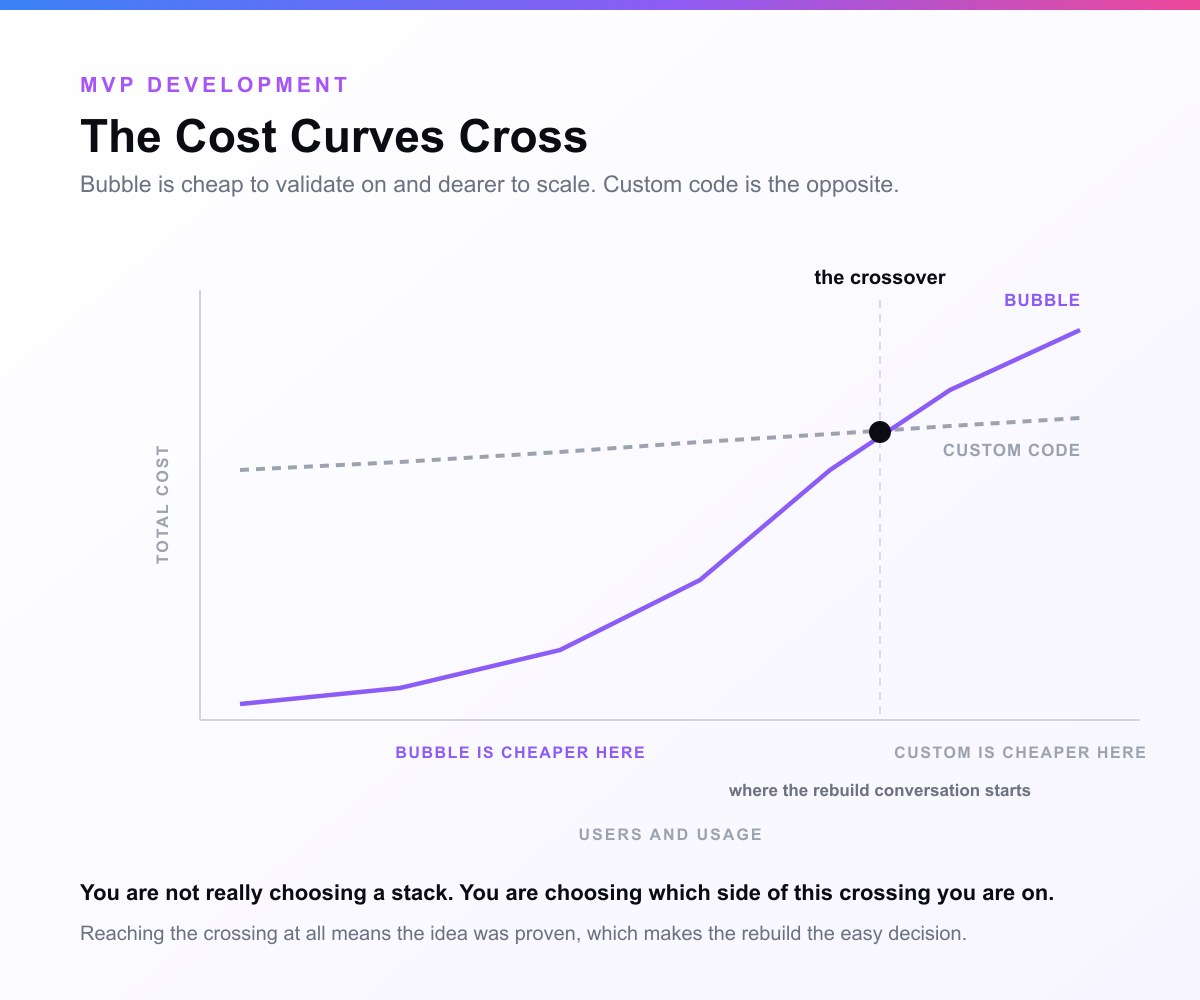
The honest takeaway: Bubble is cheap to validate on and gets more expensive as you scale, the opposite curve to custom code, which is expensive upfront and cheaper per-user at scale. That cost crossover is part of the when-to-rebuild decision.
Real products built on Bubble
Bubble is not just for throwaway prototypes, real companies have launched and grown on it. Founders have publicly described building early, revenue-generating versions of marketplaces, fintech tools, and SaaS products on Bubble, and several raised venture funding on a Bubble-built product before later re-platforming onto custom code as they scaled. The recurring pattern is the one worth copying: validate demand cheaply on Bubble, then invest in a custom build once the idea is proven, by which point the rebuild is a low-risk decision backed by real traction rather than a gamble. That is exactly how a no-code MVP is supposed to earn its rebuild.
Plugins, integrations, and the export limitation
Bubble's plugin marketplace and API Connector cover most of what an MVP needs, Stripe payments, authentication, maps, charts, email and SMS, analytics, and connections to external APIs, so you rarely hit a wall on integrations at the validation stage. The one structural limitation to understand going in: Bubble does not let you export the underlying code. Your app lives on Bubble's platform. That is fine while you are validating, but it means moving off Bubble later is a rebuild on a new stack, not a lift-and-shift of existing code. Plan for that reality rather than being surprised by it, it is the trade-off you accept in exchange for building without engineers.
Common Bubble MVP mistakes
- Over-building before validating. Bubble makes it easy to keep adding features. Resist it, ship the single core flow and learn first (see MVP scope).
- A messy data structure. Rushing the data types early creates pain later. Spend time on the data model up front.
- Treating it as permanent. Bubble is a starting line. Build knowing you may rebuild custom once you have traction, and you will make better decisions.
- Ignoring performance early. Inefficient workflows and bloated pages slow a Bubble app down. Keep it lean.
- Skipping analytics. Wire in tracking from day one so the MVP actually produces the learning you built it for.
Bubble vs custom code for an MVP
Bubble's trade-off is the classic no-code one: **
speed and accessibility now, in exchange for a ceiling later.**
- Choose Bubble when you are non-technical, your logic is standard, and your priority is validating the idea fast and cheaply. For most "does anyone want this?" questions, it is the fastest credible route to a real product.
- Choose custom when your core is genuinely complex or novel, you need full control over performance and data, or you already have strong signal and are building to scale. See the MVP tech stack guide for the full decision.
The honest framing: Bubble is a brilliant starting line, not a finish line. Many successful products validate on Bubble, then rebuild on custom code once they have traction and have outgrown the platform, which is a good problem to have, because by then the idea is proven.
When to move from Bubble to custom
You have likely outgrown Bubble when you hit one of these: performance or page-load limits at scale, logic too complex to maintain visually, costs that climb with usage, or a need for a native mobile app or full engineering control. That is the signal to plan a custom rebuild, on a validated idea, which is far lower-risk than building custom before you knew anyone wanted it. This is the same no-code-to-custom transition every successful no-code MVP eventually faces.
Build your Bubble MVP with us
Bubble is the most capable no-code way to put a real, working web app in front of users without an engineering team, the right call when you are non-technical, your idea is a standard web app, and your goal is to validate demand fast and cheap.
That is exactly the kind of MVP we build at MVP Development. We build MVPs on Bubble when speed and cheap validation are the priority, getting a real, usable product live in weeks, and we build custom when your core is complex or you are ready to scale. The point is to put your idea on the right stack for your stage, not to sell you one approach. Either way you get a funding-ready MVP in 3 to 4 weeks, on a fixed quote you approve before we start.
And when a Bubble MVP succeeds and outgrows the platform, we are the team that rebuilds it custom, by senior engineers, with full code ownership, so your validated idea scales without starting over.
Explore web app MVP development, or see the wider no-code MVP and MVP tech stack guides.
Want your MVP built on Bubble (or custom)? Ask us how far Bubble can carry your product and we will tell you where that ceiling really is.
Related guides
- No-code MVP: the full no-code playbook and tool landscape
- Low-code MVP: visual building plus custom code
- Custom MVP: when to build from scratch instead
- MVP tech stack: choosing the right approach overall
Frequently asked questions
Is Bubble good for building an MVP?
Yes, for the right kind of product. Bubble lets a non-technical founder build a real, full-stack web app, database, business logic, and responsive UI, without writing code, which makes it one of the fastest, cheapest ways to validate a web-app idea. It is best for standard web applications (SaaS-style tools, marketplaces, directories, CRUD apps) where the goal is to test demand. It is a poor fit for native mobile apps, performance-critical products, or anything with a complex proprietary core, those call for custom code. As a validation tool for a standard web app, Bubble is excellent.
Can a Bubble MVP scale?
To a point. Bubble can comfortably handle the traffic of an early-stage product and the iteration of a validation-stage MVP. But it has a ceiling: as usage, data, and logic complexity grow, you can hit performance limits, rising costs, and maintainability issues that visual building struggles with. The common, healthy path is to validate on Bubble, then rebuild on custom code once you have real traction, by which point the idea is proven and the rebuild is a low-risk investment rather than a gamble. So a Bubble MVP scales far enough to validate, and the rebuild is a sign of success.
Bubble or custom code for an MVP?
It depends on your situation. Choose Bubble if you are non-technical, your logic is standard, and your priority is validating fast and cheaply, it is the fastest route to a real product for most web-app ideas. Choose custom code if your core is genuinely complex or novel, you need full control over performance and data, or you already have strong signal and are building to scale. Many founders do both in sequence: validate on Bubble, then rebuild custom once traction justifies it. The MVP tech stack guide walks through the full decision.
Can Bubble build a mobile app?
Bubble is web-first. It builds responsive web apps that work in a mobile browser, and you can wrap a Bubble app to publish it to the app stores, but it is not a true native mobile framework. If your product is fundamentally a native mobile app, push notifications, camera, offline use, smooth native performance, the better choice is React Native or Flutter, which build real iOS and Android apps from one codebase. Use Bubble when your MVP is a web app (or web-first), and a dedicated mobile stack when it is genuinely mobile-native.
Sources & references
- Bubble: the no-code web app platform
- Eric Ries, The Lean Startup: validating fast and cheap
- Atlassian, Minimum Viable Product: scoping the MVP
- Y Combinator Library: startup build and validation advice
The 3 to 4 week figure reflects MVP Development delivery data for tightly scoped custom builds.


