


TL;DR
Ruby on Rails is arguably the framework that invented the modern startup MVP: Twitter, Shopify, GitHub, Airbnb, and Basecamp all launched their first versions on it. It lets a tiny team turn an idea into a deployed product astonishingly fast, and with Rails 8 and Hotwire it is still one of the best tools for building an MVP quickly and cheaply.
Ruby on Rails is, arguably, the framework that invented the modern startup MVP. Twitter, Shopify, GitHub, Airbnb, and Basecamp all launched their first versions on Rails, precisely because it lets a tiny team turn an idea into a working, deployed product astonishingly fast. Two decades later, with Rails 8 and Hotwire, it is still one of the best tools on the planet for building a minimum viable product quickly and cheaply.
This guide covers why Rails suits an MVP, the modern Rails stack, how to build one, what it costs, and, honestly, when not to reach for it.
Key Takeaways
- Ruby on Rails is arguably the framework that invented the modern startup MVP.
- Twitter, Shopify, GitHub, Airbnb, and Basecamp all launched their first versions on Rails.
- It lets a tiny team turn an idea into a working, deployed product astonishingly fast.
- With Rails 8 and Hotwire, it is still one of the best tools for building an MVP quickly and cheaply.
- It is a spoke of the wider MVP tech stack.
At a Glance
| Aspect | Ruby on Rails for an MVP |
|---|---|
| Type | Batteries-included web framework |
| Language | Ruby |
| Best for | Fast full-stack MVPs by a tiny team |
| Proven by | Twitter, Shopify, GitHub, Airbnb, Basecamp |
| Modern tooling | Rails 8, Hotwire |
Why Ruby on Rails is a classic MVP framework
Rails was built on a philosophy that happens to be exactly what an MVP needs: get a working product in front of users fast, without drowning in setup and decisions. A few things make it uniquely MVP-friendly:
- Convention over configuration. Rails makes the boring decisions for you, folder structure, naming, database patterns, so you write feature code, not boilerplate. There is one obvious way to do most things, which means less time bikeshedding and more time shipping.
- Batteries included ("omakase"). Database access, routing, mailers, background jobs, testing, asset handling, and security defaults all come in the box. You are not assembling a framework from twenty libraries before you write a line of business logic.
- Scaffolding and generators. A single command generates a working model, database migration, controller, and views, a functioning CRUD feature in seconds that you then refine. For an MVP, that is a massive head start.
- ActiveRecord. Rails' ORM lets you model your data and query it in clean Ruby, with migrations that version your database. Modelling the domain is usually the heart of an MVP, and Rails makes it fast.
- A mature gem ecosystem. Whatever your MVP needs, authentication, payments, admin panels, file uploads, search, there is a battle-tested gem for it, so you assemble rather than build from scratch.
- Hotwire (Turbo + Stimulus). This is the modern twist: Rails 8 lets you build fast, reactive, app-like interfaces without a separate JavaScript front-end. For an MVP, skipping a whole React frontend and its API layer removes an enormous amount of work.
DHH, Rails' creator, calls Rails 8 "The One Person Framework", the idea that a single capable developer can build and run a real product with it. That is the MVP dream in a sentence.
What you can build fast with Rails
Rails shines for the kind of product most MVPs actually are: a web application backed by a database, where users sign up, create and manage things, and pay. That covers a huge range:
- SaaS products: dashboards, workflows, subscription tools.
- Marketplaces: listings, bookings, two-sided flows (Airbnb started here).
- B2B and internal tools: CRUD-heavy apps with roles and permissions.
- Content and community platforms: anything with users, posts, and interactions.
If your MVP is a data-backed web app, Rails is close to ideal. If it is a real-time game, a mobile-first consumer app, or an ML-heavy product, other tools may fit better (more on that below).
The Rails MVP stack (2026)
A modern, lean Rails MVP stack looks like this:
- Ruby on Rails 8: the framework and application core.
- PostgreSQL: a robust, free, production-grade database (Rails' default).
- Hotwire (Turbo + Stimulus): reactive UI without a separate JS SPA.
- Tailwind CSS: fast, consistent styling.
- Authentication: Rails 8 ships with a built-in auth generator; many teams still use Devise for a fuller feature set.
- Stripe: payments and subscriptions.
- Solid Queue / Sidekiq: background jobs (emails, processing).
- Deployment: Kamal (Rails' own deploy tool, to a cheap VPS), or a platform like Render, Fly.io, or Heroku for zero-ops hosting.
The point of this stack is that almost none of it requires custom infrastructure work. You spend your weeks on the product, not the plumbing.
How to build an MVP with Rails
The rough path from idea to deployed Rails MVP:
- Model the core domain. Identify the few key entities your MVP revolves around (users, plus the two or three things they create or manage) and generate the models and migrations.
- Scaffold the core flow. Use generators to stand up the CRUD for those entities, then refine the controllers and views around the one flow that proves your idea, resisting the urge to build everything.
- Add authentication. Wire up sign-up and login (Rails 8 auth or Devise) so you have real users.
- Make it feel like an app with Hotwire. Use Turbo to get instant, no-reload interactions where they matter, without building a separate frontend.
- Add payments if needed. Drop in Stripe for subscriptions or one-off charges.
- Deploy early. Ship to Render, Fly, Heroku, or a VPS via Kamal in the first few days, and keep deploying, so you are testing on something real, not localhost.
The discipline that matters most is scope: Rails makes it so easy to add features that the temptation is to build a full product. Build the core flow, ship it, and let real usage tell you what comes next.
Cost and timeline
Because Rails removes so much setup and boilerplate, a well-scoped Rails MVP is one of the faster and cheaper builds available. A tightly scoped MVP typically ships in about 3-4 weeks, well within the ranges in our guide to how much it costs to build an MVP and how long it takes. A single strong Rails developer can carry a surprising amount of an MVP alone, which keeps the cost down, exactly the "one person framework" advantage.
Proof: real products built on Rails
Rails' MVP credentials are not theoretical. Some of the most successful products of the last two decades launched on it:
- Twitter: the early versions were Rails.
- Shopify: still runs one of the largest Rails codebases in the world.
- GitHub: built on Rails and still is.
- Airbnb: an early Rails app.
- Basecamp and HEY: from the company that created Rails, dogfooding it in production.
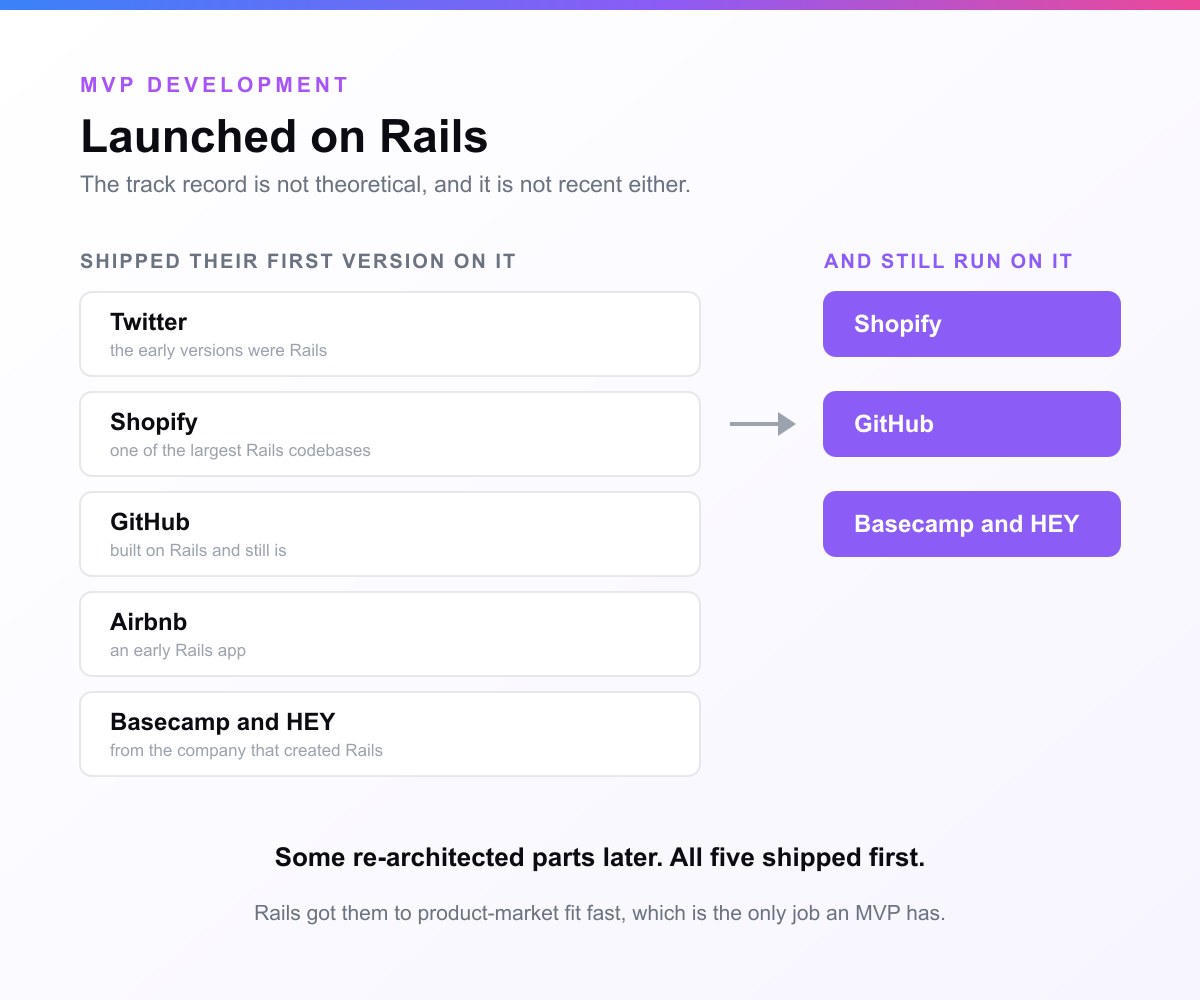
Some later re-architected parts of their systems at massive scale, which is exactly the point: Rails got them to product-market fit fast, and scaling is a good problem to have later. For the MVP stage, that track record is about as strong as it gets.
Rails vs Node/Next.js (and a note on Django)
The most common alternative to Rails for an MVP is a JavaScript stack like Next.js on Node.
- Rails is a batteries-included Ruby monolith, superb for server-rendered, database-heavy CRUD apps built fast by a small team. With Hotwire you get app-like interactivity without a separate frontend.
- Node/Next.js keeps you in one language (JavaScript) across front and back end, and is a natural fit when your MVP is highly interactive, real-time, or you want a React frontend and a shared talent pool.
Choose Rails when you want maximum speed to a working web app and value convention; choose Next/Node when JavaScript everywhere or a rich interactive frontend is the priority. And Rails vs Django (Python) comes down mostly to language and ecosystem: both are mature, batteries-included, MVC-style frameworks that build MVPs fast, so pick Rails if your team leans Ruby and pure web speed, and Django if you lean Python or your product touches data science, ML, or AI. Either way, the right stack depends on your stage, not on fashion.
Limitations: when not to choose Rails
Rails is excellent, not universal. Reach for something else when:
- Your product is ML/AI- or data-first. Python (and Django or FastAPI) sits closer to the data-science and machine-learning ecosystem.
- You need heavy real-time or extreme raw throughput. For certain high-concurrency or low-latency workloads, Node, Go, or Elixir can be a better base.
- It is a mobile-first app. You will still need a native or cross-platform app; Rails would serve as the API backend rather than the whole product (see mobile app MVP).
- Your team has no Ruby experience and a hard deadline. The Ruby hiring pool is smaller than JavaScript's; build in the language your team already knows if time is tight.
None of these are knocks on Rails for its sweet spot, they are just reminders to match the stack to the product.
Build your Rails MVP with us
At MVP Development we build production-grade MVPs on the stack that fits your product and stage, and for a large share of data-backed web apps, that is Ruby on Rails, precisely because it gets a real, owned product live in weeks rather than months. We ship a funding-ready Rails MVP in about 3-4 weeks, on a fixed scope you approve up front, with full code ownership, so you are never locked in. We recommend Rails when it is genuinely the fastest path for your idea, not because it is the only tool we reach for.
Explore our MVP web development service, or if you are weighing stacks, our MVP consulting will help you choose before a line of code is written.
Thinking of building your MVP on Rails? Ask us whether Rails still earns its keep for MVPs and we will answer from experience, not nostalgia.
Related guides
- MVP Tech Stack: how to choose the right stack for your MVP
- Django MVP: the Python counterpart, compared above
- Laravel MVP: the PHP counterpart, strong for SaaS
- Next.js MVP: the JavaScript alternative for interactive apps
- How to Build an MVP: the end-to-end playbook
- MVP Scope: keeping a fast framework from becoming a full build
Frequently asked questions
Is Ruby on Rails good for an MVP?
Yes, Rails is one of the best frameworks for an MVP. Its convention-over-configuration philosophy, batteries-included design, code generators, and the Hotwire toolkit let a small team build and deploy a working, database-backed web app remarkably fast, with little boilerplate or infrastructure work. That is why products like Shopify, GitHub, and Airbnb launched on it. For a data-backed web application, Rails is close to an ideal MVP stack.
How long does it take to build an MVP with Rails?
A tightly scoped Rails MVP typically takes about 3-4 weeks. Rails removes so much setup and repetitive code that a single strong developer can build a surprising amount alone, which shortens the timeline and lowers the cost. The biggest variable is scope: keeping the MVP to its core flow, rather than letting Rails' ease tempt you into a full product, is what keeps it fast.
Is Rails still relevant in 2026?
Very much so. Rails 8, with Hotwire and tools like Kamal, has modernised the framework around exactly what small teams need: building and shipping full web apps fast without a separate JavaScript frontend. Shopify and GitHub still run enormous Rails codebases in production. For MVPs and many production apps, Rails remains a first-rate, actively developed choice.
Rails or Django for an MVP?
Both are mature, batteries-included frameworks that build MVPs quickly, so the choice is mostly language and ecosystem. Pick Rails if your team leans Ruby and you want maximum speed to a web app; pick Django if you lean Python or your product touches data science, machine learning, or AI, where Python's ecosystem is stronger. Neither is "better", the right answer is the one that fits your team and product.
What is the best Rails stack for an MVP?
A lean, modern stack is Rails 8 with PostgreSQL, Hotwire (Turbo and Stimulus) for reactive UI, Tailwind for styling, Rails 8 auth or Devise for accounts, Stripe for payments, Solid Queue or Sidekiq for background jobs, and deployment via Kamal to a VPS or a managed platform like Render, Fly.io, or Heroku. It covers everything a typical MVP needs with almost no custom infrastructure.
Can a Rails MVP scale later?
Yes. Rails scales well enough that Shopify and GitHub run some of the largest codebases on it. Very high-scale products sometimes move specific hot paths to other technologies later, but that is a success-stage decision, not an MVP concern. Building your MVP on Rails does not paint you into a corner; it gets you to product-market fit fast, after which scaling is a good problem to solve.
Sources & references
- Ruby on Rails: official framework documentation
- Eric Ries, The Lean Startup: the validated-learning framework behind the MVP
- Y Combinator Library: founder guidance on building and launching early


