


Note: This guide is general product and engineering advice, not legal, regulatory, or medical advice. Always confirm your specific compliance obligations with a qualified healthcare attorney or compliance professional.
TL;DR
A healthtech MVP is the smallest version of a digital health product that validates demand, but unlike a normal MVP, it cannot cut the regulated core: data privacy, security, and clinical trust are part of what makes it viable in the first place. You still build the minimum, but in healthcare the "minimum" line sits in a different place, because shipping something that mishandles patient data or makes an unsafe clinical claim is not a lean shortcut, it is a liability.
The short version: a healthtech MVP follows the same lean logic as any MVP, scope one core flow, ship it, learn, but it carries three constraints generic MVPs do not: compliance (HIPAA, GDPR, and sometimes FDA), security (you cannot fake or defer real data protection), and trust (clinicians and patients will not adopt a product they do not trust). This guide covers what a healthtech MVP is, why it is different, how to scope and build one without over- or under-building the regulated parts, and how validation works when "does it work" includes "is it safe and compliant."
Key Takeaways
- A healthtech MVP validates demand but cannot cut the regulated core: data privacy, security, and clinical trust.
- In healthcare the "minimum" line sits in a different place, because mishandling patient data or making unsafe claims is a liability.
- Its constraints: compliance (HIPAA, GDPR, sometimes FDA), security you cannot fake or defer, and trust.
- Clinicians and patients will not adopt a product they do not trust.
- The art is scoping without over- or under-building the regulated parts.
At a Glance
| Constraint | Why it cannot be cut |
|---|---|
| Compliance | HIPAA, GDPR, sometimes FDA |
| Security | Real data protection cannot be faked or deferred |
| Clinical trust | Clinicians and patients will not adopt what they distrust |
| The balance | Scope without over- or under-building the regulated parts |
What is a healthtech MVP?
A healthtech MVP (also called a digital health or healthcare MVP) is a minimum viable product built for a healthcare context: telemedicine, patient engagement, clinical workflow tools, remote monitoring, mental health, diagnostics support, provider software, and so on. Like any MVP, it exists to validate a hypothesis with real users as fast and cheaply as responsibly possible, rather than to ship a finished product.
The difference is the operating environment. In a consumer app, the MVP's job is purely to test demand, and you can fake, defer, or cut almost anything that is not the core flow. In healthcare, some of the things you would normally cut, secure data handling, access controls, an audit trail, a lawful basis for processing health data, are not optional polish. They are the price of being allowed to put the product in front of real users at all. So a healthtech MVP is lean and compliant by design, which is a narrower needle to thread than most founders expect.
Why a healthtech MVP is different
Three constraints set healthtech apart from a standard MVP. Understanding them is the whole game.
- Compliance is not a feature you add later. Health data is regulated (HIPAA in the US, GDPR's special-category rules in the EU, and others). The moment your MVP touches identifiable patient information, you inherit obligations. You cannot "add HIPAA in v2," because the handling of data in v1 is exactly what the rules govern.
- You cannot fake the security. A normal MVP fakes the backend, hard-codes data, or skips real auth to ship faster. A healthtech MVP cannot, because a breach of real patient data is a reportable, expensive, trust-destroying event. Security has to be real from the first real user.
- Trust is part of viability. Clinicians stake their judgment and patients stake their health on your product. A buggy, sloppy, or opaque MVP does not just fail to convert, it actively repels the exact users you need. In healthcare, "minimum viable" still has to clear a credibility bar that consumer products do not.
None of this means you build everything up front. It means the line between "core" and "cut later" moves: the regulated, security, and trust foundations are core, and the features are what you keep minimal.
What you can cut, and what you can't
The lean MVP discipline still applies, you just apply it to the right layer. A useful way to split it:
Safe to keep minimal (the features):
- The number of workflows, start with one core clinical or patient job, not ten.
- Integrations, you rarely need to integrate with every EHR on day one.
- Automation and scale, manual back-office processes (a concierge approach) are perfectly valid early.
- Polish, secondary screens, settings, and edge cases can wait.
Not safe to cut (the regulated core):
- Data security, encryption in transit and at rest, real authentication, role-based access, and audit logging.
- A lawful basis and the right agreements, e.g. Business Associate Agreements (BAAs) with any vendor that touches protected health information.
- Privacy by design, collecting only the data you genuinely need, and handling it correctly.
- Honest claims, not marketing your MVP as doing something clinical it has not been validated or cleared to do.
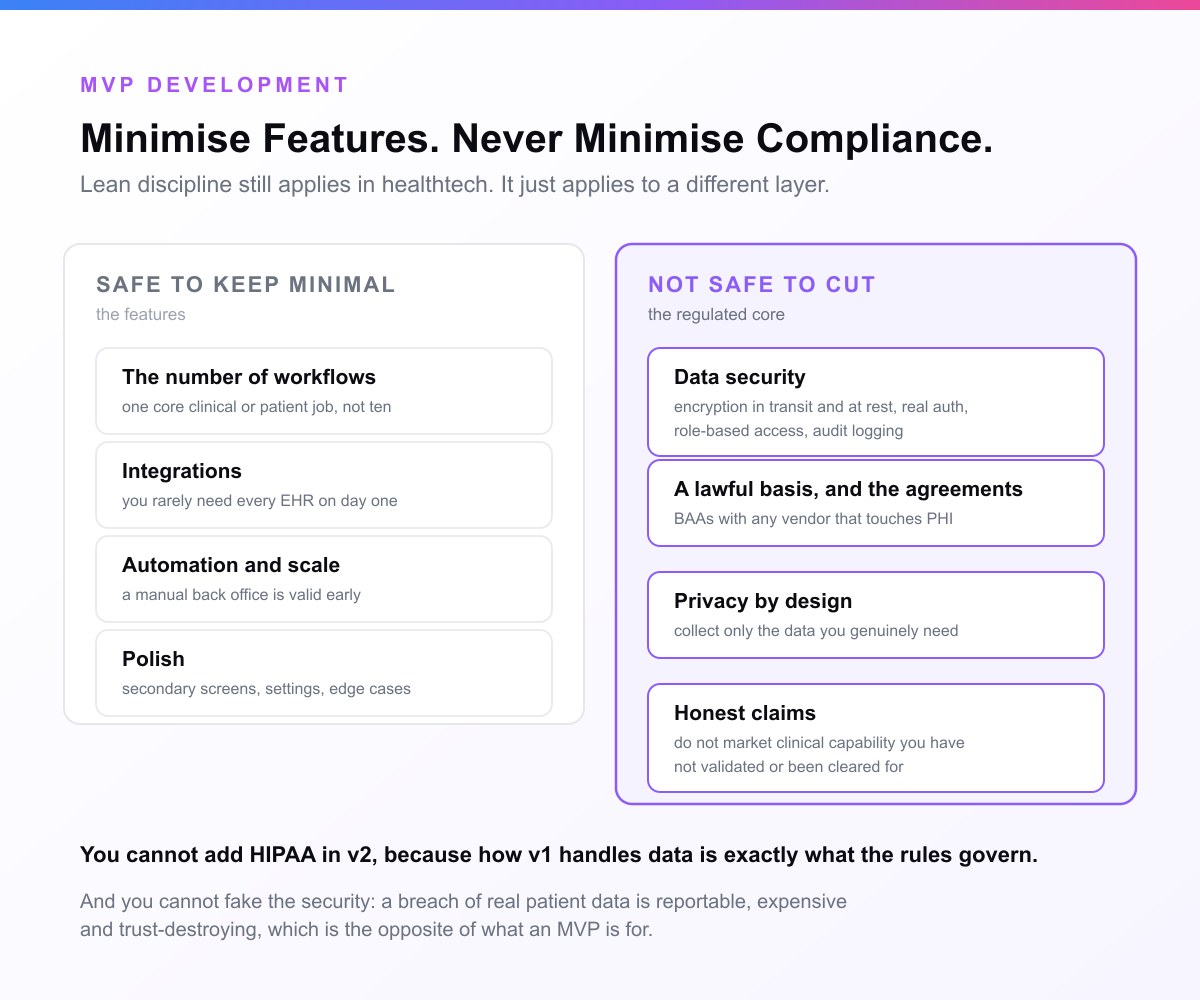
The mantra: minimise features, never minimise compliance or security. That single rule prevents the most expensive healthtech MVP mistakes.
Compliance and regulation at the MVP stage
You do not need to become a regulatory expert to start, but you do need to know which regime applies. The three that come up most:
HIPAA (US). If you handle protected health information (PHI) and work with US healthcare providers, plans, or their vendors, HIPAA likely applies. In practice that means: encrypt PHI, control and log access, sign BAAs with any subprocessor (your cloud provider, analytics, email), and have basic policies in place. Major cloud platforms (AWS, Google Cloud, Azure) offer HIPAA-eligible services and will sign a BAA, which is why most compliant healthtech MVPs are built on them.
GDPR (EU/UK). Health data is "special category" data under GDPR, with stricter requirements. If you have EU users, you need a lawful basis, data-protection measures, and often a DPA with vendors. (Other regulated verticals face the same "compliance is a v1 foundation" rule, an edtech MVP, for example, inherits FERPA and COPPA obligations the same way.)
FDA / Software as a Medical Device (US). This is the one that decides how fast you can move. If your software diagnoses, treats, or drives clinical decisions, it may be regulated as a medical device (SaMD) and face a much longer path. Many healthtech MVPs deliberately scope out of medical-device territory at first, positioning as wellness, workflow, or decision-support (not decision-making), so they can validate the market before taking on a regulatory submission. Whether you can do that is a question for a regulatory professional, but it is one of the most important early scoping decisions you will make.
The practical takeaway: decide early which regulatory box you are in, and scope the MVP to validate the idea within the lightest box you legitimately fit. Getting this wrong in either direction, ignoring rules that apply, or assuming the heaviest rules apply when they do not, is what sinks healthtech timelines.
EHR interoperability: plan for it, don't over-build it
A lot of healthtech lives or dies on whether it fits a provider's existing systems. Standards like HL7 and FHIR and integrations with EHRs (Epic, Cerner/Oracle Health, and others) are how data moves in healthcare. For an MVP, the discipline is the same as everywhere else: do not build every integration up front. Validate the value with one integration, a single export, or even a manual data step first, and invest in deep interoperability only once the demand is proven. But design with interoperability in mind, because a product that can never speak to an EHR has a ceiling in many healthcare markets.
How to scope a healthtech MVP
Scoping starts by naming your riskiest assumption, because that decides what the MVP must prove. In healthtech there are usually three competing risks:
- Market risk, will providers or patients actually adopt and pay for this? (Same as any MVP validation question.)
- Clinical risk, does the intervention actually work / is it safe and effective?
- Regulatory risk, can this even be cleared to operate the way we intend?
A focused scope attacks the riskiest one first while staying compliant on the others. If market risk dominates (common for workflow and engagement tools), build a real, compliant MVP of the one core flow and put it in front of a few design-partner clinics. If clinical risk dominates, the "MVP" may be a small study or pilot, not a broad launch. Naming the risk up front stops you from building a big product to answer a question a small one could.
How to build a healthtech MVP
Once scoped, the build mirrors the standard how to build an MVP process, with compliance threaded through it:
- Choose a compliance-ready stack. Build on a HIPAA-eligible cloud, sign the BAA, and turn on encryption, access controls, and audit logging from the first commit, not as a retrofit. (See the wider MVP tech stack guide.)
- Design the data model around privacy. Collect the minimum PHI you need, separate identifiers where you can, and define who can see what.
- Build the one core flow. Ship the single workflow that tests your hypothesis, to a real, working standard, with the secondary features deliberately left out.
- Keep humans in the loop where it is safer. A concierge or Wizard-of-Oz approach, doing some steps manually behind the scenes, is often the safest, fastest way to validate a healthtech idea before automating.
- Instrument it. Wire in analytics that respect privacy so you can measure adoption and outcomes (see MVP metrics).
A senior team that has done this before can ship a compliant healthtech MVP in weeks, not because they cut corners, but because they know which corners are not theirs to cut.
How to hire MVP developers for a healthcare product
To hire MVP developers for a healthcare product, look for three things before price: a team that has shipped under HIPAA before and can show it (a signed BAA on a previous build, PHI kept to the minimum, audit logging on from day one), a fixed scope agreed in writing so compliance work cannot quietly expand the bill, and a senior engineer you talk to directly rather than an account manager. Then choose the engagement to match your stage: a fixed-price agency for a first working version, a freelancer for a well-defined add-on, a technical co-founder if you need someone to own the product for years.
Three routes, and when each one fits:
| Route | Fits when | Watch for |
|---|---|---|
| Fixed-price agency | You need a compliant first version on a date, with the scope and price fixed before work starts | Ask which cloud they build on, whether they sign the BAA, and who exactly writes the code |
| Freelancer | The product exists and you need one well-defined feature or integration | HIPAA experience is rarer than the profile claims; ask for a build they can name |
| Technical co-founder | The product is the company and you want someone to own it for years, paid in equity | A long search; read how to find a technical co-founder first |
What to have ready before the first call, whichever route: the one core workflow the first version must do, who the users are (patients, clinicians, or both), which data you will actually hold and whether any of it is PHI, and whether the product could fall under FDA software-as-a-medical-device rules (the compliance section above covers the test). A team that asks these questions unprompted is the one to shortlist. On cost: US agencies typically quote $15,000 to $80,000 for an MVP; our healthcare MVP development service is a fixed package, from $350 for a working prototype in 7 days to an investor-ready MVP in 21, HIPAA-eligible stack included.
Validation: market and clinical
In a consumer MVP, validation means one thing: do people want it. In healthtech, "does it work" often has two halves, market validation (do providers/patients adopt and pay) and clinical validation (does it actually help, safely). Early on you usually lead with market and trust signals, design partners, pilot clinics, qualitative feedback from clinicians, while being careful not to claim clinical efficacy you have not demonstrated. As you grow, clinical evidence becomes part of the product and the moat. The key MVP-stage discipline is honesty: validate the demand and the workflow first, prove the clinical outcome rigorously when the stakes and claims require it, and never blur the two.
Common healthtech MVP mistakes
- Treating compliance as a v2 problem. It is a v1 foundation; retrofitting it is far more expensive than building it in.
- Over-building to look "serious." Founders add EHR integrations, dashboards, and admin tools before validating the core. Minimise features, not safety.
- Faking security to move fast. The one shortcut you cannot take. A breach of real PHI ends trust and triggers reporting obligations.
- Over- or under-scoping the regulatory path. Assuming FDA clearance you do not need, or ignoring rules you do, both derail timelines. Get a professional read early.
- Claiming clinical benefit you have not validated. It is a compliance and trust risk. Market the workflow value honestly until the evidence exists.
Build a compliant healthtech MVP with us
A healthtech MVP is the lean MVP playbook applied inside real constraints: validate one core flow with real users, fast, without ever cutting the security, compliance, and trust that make a healthcare product viable in the first place.
That is exactly what we do at MVP Development. We build funding-ready healthtech MVPs on HIPAA-eligible infrastructure, security and compliance designed in from the first commit, scoped to the one core flow that proves your idea, by senior engineers, on a fixed quote you approve before we start, with full code ownership. We help you scope around the right risk, market, clinical, or regulatory, so you validate fast without over-building.
Explore healthtech MVP development, or see how to build an MVP for the full process.
Building a healthtech product? Describe the care moment your product touches and we will scope it with compliance in the room from day one.
Related guides
- Fintech MVP: the other regulated-vertical playbook
- Legal tech MVP: a third regulated vertical, confidentiality and ethical walls instead of clinical trust
- How to build an MVP: the full build process
- MVP validation: testing demand before you build
- MVP scope: defining the one core flow
- SaaS MVP: the broader software-product playbook
Frequently asked questions
What is a healthtech MVP?
A healthtech MVP is the smallest working version of a digital health product, telemedicine, patient engagement, clinical workflow, remote monitoring, and so on, built to validate demand with real users. It follows the same lean logic as any MVP (ship one core flow, learn, iterate), but with a crucial difference: it cannot cut the regulated core. Data security, privacy compliance (like HIPAA), and clinical trust are part of what makes a healthcare product viable at all, so a healthtech MVP keeps its features minimal while keeping its compliance and security real from day one.
Does a healthtech MVP need to be HIPAA compliant?
If it handles protected health information (PHI) and works within the US healthcare system, then yes, HIPAA almost certainly applies, even at the MVP stage. You cannot defer HIPAA to a later version, because the rules govern how you handle data in the version real patients use. In practice that means building on a HIPAA-eligible cloud, signing Business Associate Agreements with vendors that touch PHI, and implementing encryption, access controls, and audit logging from the start. The good news is that modern cloud platforms make compliant infrastructure achievable for a small team. (This is general guidance, not legal advice, confirm your obligations with a compliance professional.)
How is a healthtech MVP different from a normal MVP?
The lean principle is the same, but the line between "build now" and "cut for later" moves. A normal MVP can fake the backend, skip real auth, and defer security to ship faster. A healthtech MVP cannot, because patient data, safety, and clinical trust are non-negotiable. So you minimise features (one workflow, few integrations, manual processes behind the scenes) but never minimise compliance, security, or honesty about clinical claims. There is also a second validation axis, alongside market validation, healthtech often involves clinical validation (does it actually help, safely), which consumer MVPs do not have.
Can a healthtech MVP avoid FDA regulation?
Sometimes, and that decision is one of the most important you will make. If your software diagnoses, treats, or drives clinical decisions, it may be regulated as Software as a Medical Device (SaMD), a longer, heavier path. Many healthtech MVPs deliberately scope to validate the market before entering medical-device territory, by positioning as wellness, workflow, or decision-support rather than decision-making. Whether your specific product can do that legitimately is a question for a regulatory professional, not a guess, but scoping the MVP to fit the lightest regulatory box you genuinely qualify for is often what lets a healthtech startup move at MVP speed at all.
How can I hire MVP developers for a healthcare product?
Shortlist teams that have shipped under HIPAA before and can name the build, insist on a fixed scope and price agreed in writing, and make sure you will talk to the engineer doing the work. Prepare the one core workflow, the user type, and what data you will hold before the first call. Fixed-price packages start at $350 for a working prototype; typical US agency quotes run $15,000 to $80,000.
Sources & references
- HHS, HIPAA: US health-data privacy and security rules
- FDA, Software as a Medical Device (SaMD): when software is regulated as a device
- Eric Ries, The Lean Startup: validating fast and responsibly
- Atlassian, Minimum Viable Product: scoping the MVP
The figures and timelines here reflect MVP Development delivery experience and are general guidance, not legal or regulatory advice.


