


TL;DR
React is the most popular way to build web UIs, but it is a library, not a full framework, so building an MVP with React really means choosing how you use it: a single-page app, a full-stack app with Next.js, or mobile with React Native. Pick the setup that matches your product rather than treating React alone as the whole stack.
React is the most popular way to build user interfaces on the web, so it is a natural choice for an MVP. But there is a catch that trips up a lot of founders: React is a library, not a full framework. It handles your UI, and nothing else, no routing, data-fetching, backend, or build setup out of the box. So "building an MVP with React" really means choosing how you use React: as a simple single-page app, as a full-stack app with Next.js, or as a mobile app with React Native.
This guide is the map. It covers what React actually is, why it is a strong MVP choice, the three ways to build an MVP with it, the stack, and how to pick the right path.
React is a library, not a framework (why that matters)
Frameworks like Rails, Django, and Laravel are "batteries included", they give you routing, a database layer, auth, and structure in one box. React is different: it is just the view layer. It renders components beautifully and manages UI state, but you (or a framework built on top of it) supply everything else.
For an MVP, that has one big implication: you rarely use "just React." You use React through one of three well-trodden paths, and choosing the right one is the real decision. The good news is that all three share the same React skills, so the knowledge transfers.
Key Takeaways
- React is the most popular way to build web user interfaces, a natural choice for an MVP.
- The catch: React is a library, not a full framework; it handles your UI and nothing else.
- It has no routing, data-fetching, backend, or build setup out of the box.
- "Building an MVP with React" really means choosing how you use it: a single-page app, a full-stack app with Next.js, or mobile with React Native.
- Pick the React setup that matches your product rather than treating React alone as the whole stack.
Why React is a strong choice for an MVP
- The biggest talent pool anywhere. React has more developers than any other UI technology, which makes a React MVP faster and cheaper to staff, and easier to hand over. For a startup, that hiring advantage is real money.
- A vast component ecosystem. Ready-made UI kits like shadcn/ui, MUI, and Chakra let you assemble a polished interface fast, instead of designing every element from scratch.
- Reusable components. React's component model means you build your UI once as composable pieces and reuse them, which speeds up iteration as your MVP grows.
- It spans web and mobile. The same React mental model powers web (via Next.js or Vite) and mobile (via React Native), so an MVP can move between platforms without relearning everything.
- Backed by Meta and a huge community. React is not going anywhere, and almost any problem you hit has been solved and documented already.
The three ways to build an MVP with React
This is the heart of the decision. Pick the path that matches what your MVP actually is.
1. A single-page app with React + Vite (the pure-React path)
If your MVP is an interactive, client-side app, a dashboard, an internal tool, a SaaS app behind a login, where search-engine visibility of the app itself does not matter, the fastest route is plain React with Vite. Vite gives you an instant, modern build setup; you add React Router for navigation and pair it with a hosted backend (a BaaS like Supabase or Firebase) so you do not build a server at all. This is the lightest way to get a React MVP live, and the path this guide focuses on, because the other two have their own dedicated guides.
2. A full-stack web app with Next.js
If your MVP is a web app that needs server-side rendering, SEO, a marketing site, or its own backend/API, you want Next.js, the full-stack React framework. It adds the routing, rendering, and backend pieces React leaves out, and is the default choice for most public-facing web MVPs. We cover it in depth in the Next.js MVP guide, so if this is you, start there.
3. A mobile app with React Native
If your MVP is a mobile app (iOS/Android), use React Native, which turns your React skills into a real cross-platform mobile app from one codebase. Full details are in the React Native MVP guide.
Which React path should you choose?
| Your MVP is… | Use | Why |
|---|---|---|
| A logged-in web app, dashboard, or internal tool (no SEO need) | React + Vite (SPA) | Lightest, fastest; pair with a BaaS backend |
| A public web app needing SEO, SSR, or its own backend | Next.js | Full-stack React, routing + rendering + API built in |
| A mobile (iOS/Android) app | React Native | One React codebase for both platforms |
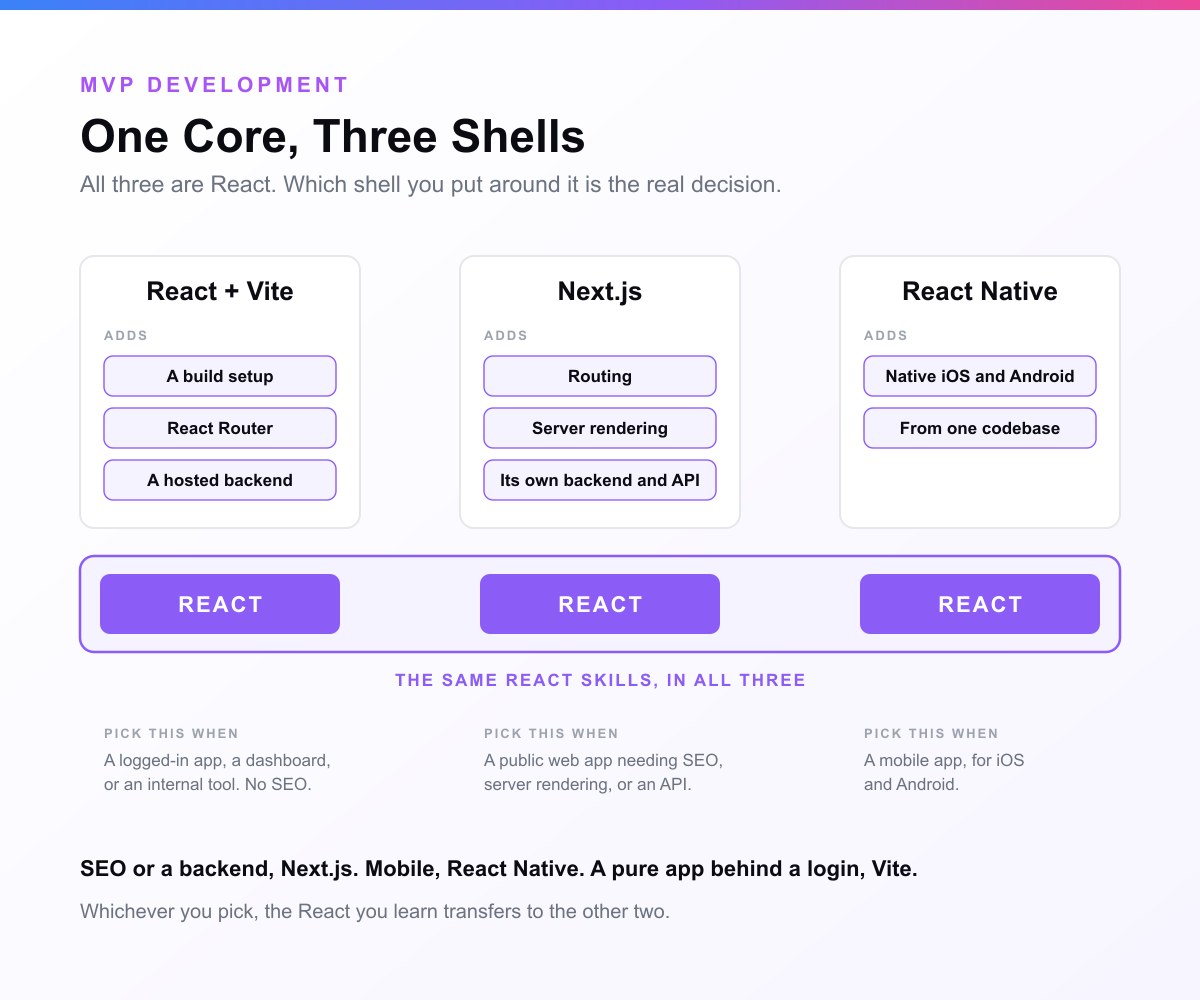
A simple rule: needs SEO or a backend → Next.js; mobile → React Native; a pure interactive app behind a login → React + Vite. Most public web MVPs end up on Next.js; many SaaS tools and dashboards are perfectly served by a Vite SPA plus a BaaS.
The React MVP stack (the Vite SPA path)
For the pure-React path, a lean, modern 2026 stack:
- React 19 + Vite + TypeScript: the UI library, a fast build tool, and type safety.
- Tailwind CSS + shadcn/ui: styling and ready-made, customisable components for a polished UI fast.
- React Router: client-side navigation.
- TanStack Query: data fetching and caching against your backend.
- A BaaS backend: Supabase or Firebase for database, auth, and storage, so you skip building a server.
- Stripe: payments and subscriptions.
- Deployment: Vercel, Netlify, or Cloudflare Pages (static/SPA hosting is cheap and simple).
The theme, as with any good MVP stack, is that you assemble hosted pieces rather than build infrastructure. (If you find yourself wanting server rendering or your own API, that is the signal to switch to Next.js.)
How to build a React (Vite) MVP
- Scaffold with Vite. Spin up a React + TypeScript project in seconds.
- Build the core flow as components. Compose the one user flow that proves your idea from reusable components and a UI kit, resisting the urge to build everything.
- Add a backend without a server. Wire Supabase or Firebase for data, auth, and file storage.
- Handle data with TanStack Query. Fetch, cache, and update server data cleanly.
- Add payments if needed. Integrate Stripe for revenue.
- Deploy early. Push to Vercel, Netlify, or Cloudflare in the first few days and keep shipping.
The discipline that matters most is scope: React's freedom makes it easy to over-build, so ship the core flow and let real usage guide what comes next.
Cost and timeline
A well-scoped React MVP typically ships in about 3-4 weeks, in line with our guides on MVP cost and timeline. React's advantage here is the talent pool: because so many developers know it, a React MVP is usually easier and cheaper to staff than a niche stack, and simpler to hand over or grow later.
Proof: React's track record
React was created and is used by Meta, and it powers the interfaces of some of the most-used products in the world, including Facebook, Instagram, WhatsApp Web, Netflix, and Airbnb, alongside a huge share of modern SaaS apps. It is consistently the most-used web UI library in developer surveys. For an MVP, that ubiquity means mature tooling, endless documentation, and the largest hiring pool of any front-end technology, all of which reduce risk and cost.
React vs Vue vs Angular for an MVP
React is not the only UI option, but for an MVP it usually wins on ecosystem and talent:
- React: the largest ecosystem and talent pool, the most UI component libraries, and paths to both web (Next.js/Vite) and mobile (React Native). Usually the safest, cheapest-to-staff MVP choice.
- Vue: elegant and approachable, with a smaller but loyal community; a fine choice if your team already knows it.
- Angular: a full, opinionated framework (unlike React's library approach), heavier and more enterprise-oriented; rarely the fastest path for a lean MVP, but strong when your team knows it or the app is complex.
For most founders the deciding factor is hiring and ecosystem, and that points to React. As always, match the stack to your team and product.
Limitations: what React does not give you
- It is only the UI layer. You must add routing, data-fetching, and a backend yourself, which is exactly why Next.js exists. If you find yourself rebuilding framework features, switch to Next.js.
- No SEO out of the box (SPA). A plain React/Vite SPA renders on the client, so it is poor for content that needs to rank. For SEO, use Next.js.
- Decision overhead. React's flexibility means many choices (router, data layer, structure); a starter stack (like the one above) removes most of that.
- Not a backend. React never handles your data or business logic on a server, you pair it with a BaaS or an API.
None of these are flaws so much as reminders that React is a piece of the stack, choose the right path around it.
Build your React MVP with us
At MVP Development we build production-grade MVPs in React across all three paths, a Vite SPA for interactive apps, Next.js for full-stack web products, and React Native for mobile, choosing the one that fits your product rather than a default. We ship a funding-ready MVP in about 3-4 weeks, on a fixed scope you approve up front, with full code ownership, and React's talent pool keeps it cost-effective to build and to grow afterwards.
Explore our MVP web development service, or if you are weighing stacks and paths, our MVP consulting will help you choose first.
Thinking of building your MVP in React? Tell us what you are building and we will say plainly whether React is the right tool for it.js, or React Native, for it.
Related guides
- Next.js MVP: the full-stack React path (SSR, SEO, backend)
- React Native MVP: the mobile React path
- MVP Tech Stack: how to choose the right stack for your MVP
- Supabase MVP: the backend to pair with a React SPA
Frequently asked questions
Can you build an MVP with React?
Yes, React is one of the most popular ways to build an MVP. The key thing to understand is that React is a UI library, not a full framework, so you build an MVP with React through one of three paths: a single-page app (React + Vite) for interactive apps behind a login, Next.js for full-stack web apps that need SEO or a backend, or React Native for mobile apps. All three use the same React skills.
Is React or Next.js better for an MVP?
They are not really rivals, Next.js is a full-stack framework built on React. Use plain React (with Vite) when your MVP is a client-side app or dashboard that does not need server rendering or SEO, and pair it with a hosted backend. Use Next.js when your MVP is a public web app that needs SEO, server-side rendering, or its own backend and API, which is most public-facing products. If in doubt for a web MVP, Next.js is the safer default.
What is the best React stack for an MVP?
For a pure-React (Vite) MVP: React 19 with Vite and TypeScript, Tailwind CSS and shadcn/ui for a fast, polished interface, React Router for navigation, TanStack Query for data, a BaaS like Supabase or Firebase for the backend (database, auth, storage), Stripe for payments, and deployment on Vercel, Netlify, or Cloudflare. It lets you ship a complete app without building a server. For full-stack needs, use Next.js instead.
Do I need a backend for a React MVP?
React itself is only the UI layer, so yes, you need something to store data and handle logic. The fastest MVP approach is to pair React with a backend-as-a-service like Supabase or Firebase, which give you a database, authentication, and storage without building or running a server. If you need your own custom backend and API, Next.js (which can serve both) is often the cleaner choice.
React or Vue for an MVP?
Both are excellent, but React usually wins for an MVP on ecosystem and hiring: it has the largest talent pool, the most ready-made component libraries, and paths to both web and mobile. Vue is elegant and a great choice if your team already knows it, but its community is smaller. For most founders optimising for speed and easy staffing, React is the safer bet, though the best choice is whichever your team is fastest in.
Is a React SPA good for SEO?
Not by default. A plain React single-page app renders in the browser, so content-heavy pages that need to rank in search are better served by server-side rendering, which is exactly what Next.js provides. If SEO matters for your MVP (a public marketing site or content that must be found), use Next.js; if your MVP is an app behind a login where SEO is irrelevant, a React/Vite SPA is perfectly fine.
Sources & references
- React: official library documentation
- Eric Ries, The Lean Startup: the validated-learning framework behind the MVP
- Y Combinator Library: founder guidance on building and launching early


